
School entry ages and birthday cut-offs vary across Australia. The first year may be called Kindergarten, Prep, Reception, Transition or Pre-primary. The age a child can start may differ from the age when attendance becomes compulsory.
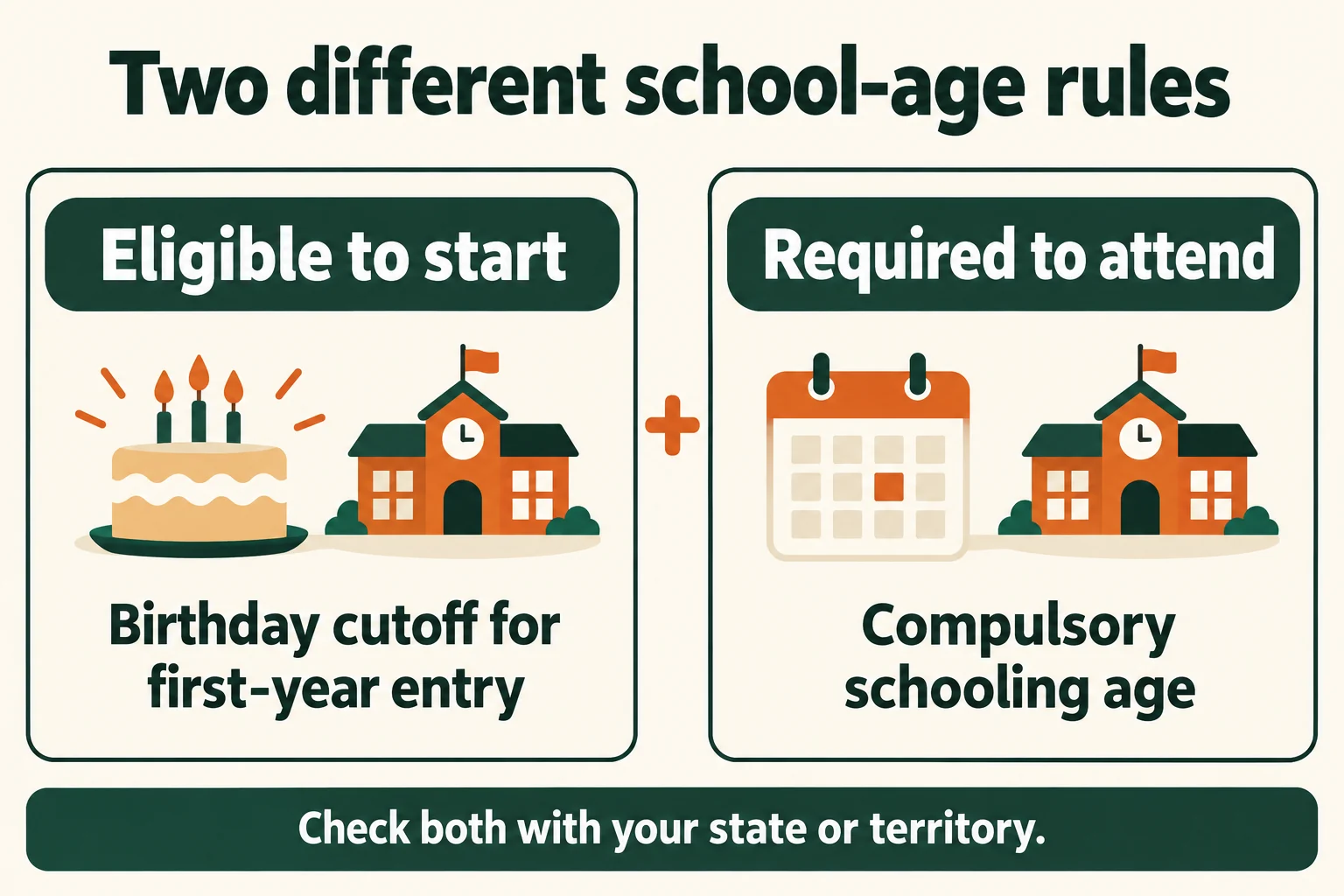
When planning a move, check the destination state or territory’s rules. The table separates entry eligibility from compulsory attendance.
School entry ages by state and territory
| State or territory | Starting year and age rule | Compulsory schooling |
|---|---|---|
| Australian Capital Territory | The Kindergarten entry cut-off is not specified here. | Compulsory education starts at age 6 and continues until the child completes Year 12 or turns 17, whichever comes first. |
| New South Wales | A child can start Kindergarten if they turn 5 on or before 31 July in that year. | A child must be in compulsory schooling by their sixth birthday. |
| Northern Territory | A child aged 5 by 30 June can start Transition. | Compulsory school age applies when a child turns 6 on or before 30 June. |
| Queensland | A child can start Prep if they turn 5 by 30 June in that year. | Prep is required before Year 1. |
| South Australia | In government primary schools, a child who turns 5 before 1 May can start Reception in Term 1. A child who turns 5 from 1 May to 31 October can start in Term 3. A child who turns 5 after 31 October starts the following year. | A child must be enrolled at school by age 6. |
| Tasmania | A child who is 4 on or before 1 January can attend Kindergarten that year. A child who is 5 on or before 1 January must attend Prep that year. | The Prep attendance requirement applies to children who meet the age rule. |
| Victoria | A child who is 5 by 30 April can enrol in and attend a government school. | Schooling is compulsory from age 6 until age 17, subject to specific exceptions. |
| Western Australia | A child who will be 5 by 30 June starts Pre-primary. Kindergarten is an earlier, separate year for children who are 4 by 30 June. | Pre-primary is the first compulsory year. |
The rules above are drawn from the relevant state and territory education departments. Some details apply specifically to government schools: South Australia’s Reception intake schedule is for government primary schools, and the Victorian entry rule shown is for government schools.
Moving interstate with a child
A child’s year level does not automatically transfer under the same name or age rule. For example, Kindergarten is an earlier year in Western Australia, while in New South Wales it is the first year of primary school. Before moving, ask the destination school or education department how it will place your child, based on the child’s age and previous enrolment history.
Take school records that show the child’s current year level and attendance. Tasmania has a specific process for eligible interstate pupils, and South Australia’s enrolment policy addresses interstate transfers. Neither policy guarantees that an interstate transfer will place a child in the equivalent year level. Check enrolment dates and availability as well as age eligibility, particularly if the move coincides with a mid-year intake.