
Canberra is Australia’s capital city, and it sits inside the Australian Capital Territory (ACT), a small self-governing territory surrounded by New South Wales. The ACT Government handles the things a state government handles elsewhere in Australia: tenancy law, public schools, driver licences, public buses and property rates. That is why moving to Canberra means dealing with ACT agencies such as Access Canberra (the one-stop shopfront for licences and registrations) and the ACT Revenue Office rather than with a state department.
Canberra is a young city with well-paid jobs, many of them in government. It has four seasons, cold winters and a tight rental market. Rents are high, but the ACT gives tenants stronger protections than most of the country. The sections below give current rents, tenancy rules, public transport fares, the licence and school steps that follow a move, property charges and the weather month by month.
What Canberra and the ACT are like
At the 2021 Census the ACT had about 454,500 residents. The median age was 35, compared with 38 across Australia, and the biggest age groups were 20 to 24 (10.3%), 25 to 29 (10.1%) and 30 to 34 (8.6%). Students, public servants and early-career professionals make up a large share of the population. The inner-city area known simply as City is younger again, with a median age of 27 among its 4,835 residents.
When you read statistics labelled "Canberra", check the geography. The Census uses the name for a federal electoral division, which covers only part of the city. The ACT total is the figure that describes the whole urban area.
Canberra is organised into districts, each with its own town centre, and rental listings are grouped by them. South Canberra, North Canberra, Woden Valley and Molonglo are close to the centre and the parliamentary precinct. Belconnen, Gungahlin and Tuggeranong are larger outer districts. The district you choose affects your rent more than anything else. It also affects your commute and, because school places depend on your home address, which local public school your children attend.
Most households own at least one car. Canberra is spread out, with wide roads and plenty of parking at suburban shopping centres. That makes driving the usual choice for many residents. The bus network and a MyWay+ ticket, however, suit commuting into the centre.
What renting costs
Rents in the ACT are among the highest in the country, and vacancies are scarce. Domain’s report for the March 2026 quarter, published on Allhomes, put the median house rent at a record $700 a week and the median unit rent at a record $580 a week. Both figures were unchanged from December 2025. House rents were up 1.4% on a year earlier and unit rents were up 3.6%. City-wide vacancy fell to 0.8%, down from 1.5% in December and the lowest since June 2022.
Prices vary a lot by district. The same report gives these medians for the March 2026 quarter:
| District | Median house rent (a week) | Median unit rent (a week) |
|---|---|---|
| South Canberra | $875 | $620 |
| North Canberra | $750 | $610 |
| Molonglo | $730 | n/a |
| Woden Valley | $730 | n/a |
| Tuggeranong | $660 | $520 |
South Canberra is the most expensive region for both houses and units, and it was the only district where rents fell over both the quarter and the year (down 1.7%). Tuggeranong is the cheapest for both dwelling types, and it is the best place to start if you want space for the lowest weekly rent. The trade-off is distance from the centre. Unit rents rose fastest over the year in Gungahlin (6.8%), followed by Belconnen (5.8%), so the outer-district units that were once reliably cheap are catching up.
Suburb-level spreads are wide. In Cotality’s full-year 2025 review, reported by Region Canberra, the highest suburb median for houses was $980 a week in Campbell, while the lowest house median was $582. For units, Garran was highest at $727 and Lyons lowest at $496. The same review found that rent for all dwellings rose 3% to $683 a week over 2025 and that rental listings were 17% below the five-year average. Annual rent growth in Canberra was slower than in Sydney, Brisbane, Perth, Hobart and Darwin. Canberra’s rents are high because they began at a high level.
For a newcomer, competition for each listing is high. Apply the same day you inspect a property, and prepare your documents (identification, proof of income and references) before you arrive. If you are moving from overseas, consider booking short-term accommodation for the first few weeks so you can inspect properties in person rather than commit from abroad.
ACT tenancy rules
The Residential Tenancies Act 1997 (ACT) sets the rules for every residential lease in the territory, and its standard terms apply to every agreement. Landlords and agents cannot contract out of them. According to this guide to the Act, the ACT Civil and Administrative Tribunal (ACAT) handles tenancy disputes, and Access Canberra runs the Office of Rental Bonds, which holds bond money for the length of the tenancy.
Bonds
A bond (the deposit you pay at the start of a lease and normally get back at the end) is capped at four weeks’ rent. A landlord may take only one bond per agreement, so separate pet, cleaning or damage bonds are not allowed. There is no exception for high-rent properties.
Rent increases
A landlord can raise the rent no more than once every 12 months. For a first increase, the 12 months run from the start of the tenancy, and for later increases they run from the day the previous increase took effect. The landlord must give at least eight weeks’ written notice, and the notice has to state the new amount and explain your right to ask ACAT to review the increase.
The increase is also capped. Landlord Wise’s rent increase guide explains that the limit is tied to the change in the Canberra rents Consumer Price Index (CPI) since the last increase, as another rent guide also explains. A landlord can exceed the cap only with your written agreement or ACAT’s prior approval.
If you think a proposed increase is unreasonable, you can apply to ACAT at least two weeks before it takes effect, and no increase takes effect while the review is pending. If you decide not to accept an increase, you can give three weeks’ notice and leave. Landlords are also banned from soliciting bids above the advertised rent, so an agent cannot invite you to offer more than the listed price. The landlord may still accept a higher offer that you make without being asked, and that offer can win the property.
Ending a tenancy
The ACT was the first Australian jurisdiction to abolish no-grounds eviction, which it did on 1 April 2023. A landlord who wants you out must now cite a specific ground, supply written evidence and give the right notice. Recording Law’s summary of ACT tenant rights lists the notice periods:
- 8 weeks if the landlord or a relative is moving in
- 8 weeks if the property is being sold
- 12 weeks for reconstruction or major works
- 26 weeks for a change to non-residential use
A fixed-term lease that the landlord has not validly ended continues automatically as a periodic lease (a rolling lease with no end date). So reaching the end of your fixed term does not force you to move. The 2024 reforms to the Act also let tenants end a lease early in cases of family violence, as this overview of the changes notes.
Getting around Canberra
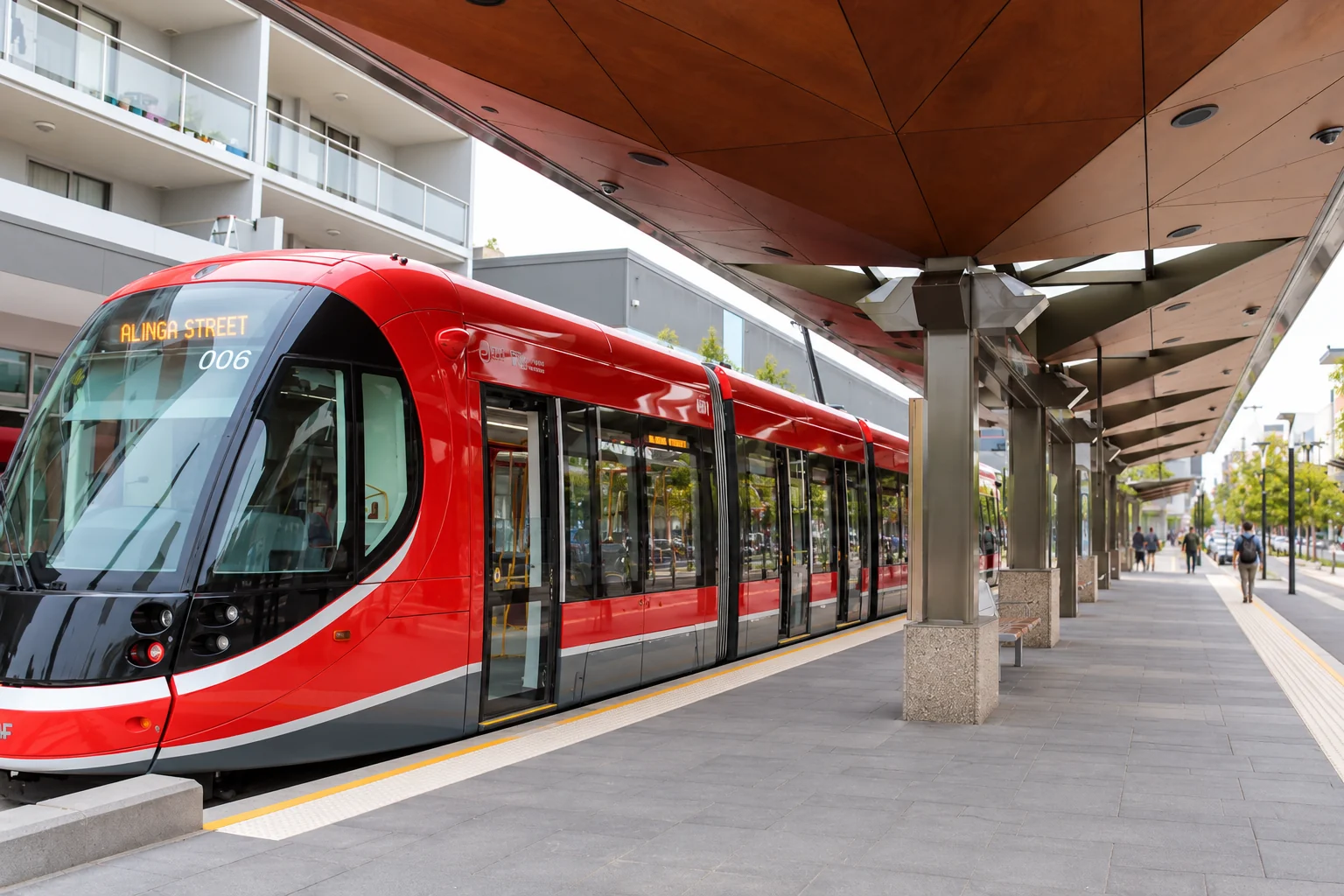
Public transport in Canberra uses MyWay+, the ACT’s ticketing system. You can pay with a MyWay+ card or by tapping a credit or debit card or a phone wallet such as Apple Pay on the reader, with no account needed, as Canberra Digest’s visitor guide explains. Concession holders must register a MyWay+ account and link a bank card.
Fares
Fares are set by a legal determination that took effect on 10 January 2026. The fares determination sets these amounts for MyWay+ travel:
| Fare | Standard adult | Concession | School student | Tertiary student |
|---|---|---|---|---|
| Peak single trip | $3.41 | $1.71 | $1.71 | $1.71 |
| Off-peak single trip | $2.70 | $0.95 | $1.71 | $1.71 |
| Weekday daily cap | $10.16 | $5.08 | $5.08 | $5.08 |
| Weekend and public holiday cap | $6.22 | $2.30 | $2.30 | $2.30 |
A single trip includes any transfers made within 90 minutes of first tapping on, and you pay for the whole journey once. The daily cap means you never pay more than $10.16 on a weekday, and the caps run from 2.00am to 1.59am the following day. Under the determination, off-peak applies on weekdays from 9.00am to 4.30pm and after 6.30pm, and all day on weekends and public holidays. The Transport Canberra fares page gives a 6.30pm evening cutoff, so tap on a little before 6.30pm only if you are willing to risk the higher fare. Remember to tap off as well as on, because forgetting costs a $1.88 default fare for adults.

Setting up auto top-up by direct debit takes 5% off individual trip fares, though the discount does not apply to daily caps. Paper tickets also exist, at $5.29 for a standard single trip and $10.16 for a daily ticket, but they cost more per journey than tapping on with a card. For help, Transport Canberra is on 13 17 10 during business hours.
Concessions and free travel
Concession fares apply to holders of a Pensioner Concession Card, a Health Care Card, a Department of Veterans’ Affairs Gold Card, a Seniors Card from any Australian state or territory, and an ACT Services Access Card. Tertiary students qualify with a valid photo student ID showing full-time enrolment at an Australian higher education institution, or a MyWay+ Tertiary Student Concession Card. ACT residents aged 70 or over travel free with an ACTION Gold Card or MyWay+ card, and so do children below compulsory school age travelling with a responsible adult.
Driving
Anyone arriving from another state with a learner, provisional or full licence must visit an Access Canberra Service Centre and get an ACT licence within three months of moving. The next section covers what to bring.
Licences and school enrolment after you arrive
Driver licences
According to Access Canberra’s interstate licence page, full licence holders need proof of identity and residency plus their current interstate licence. If the licence cannot be produced, or has been expired for more than one month, you need a licence history from the issuing state or territory, and you must present it at a Service Centre within seven calendar days of its issue. There is no fee for a full interstate licence when the ACT licence carries the same expiry date as the old one. New Zealand licence holders pay a fee.
Provisional drivers may receive recognition for time spent as an interstate learner, and must pass a practical driving assessment with an ACT Government Licence Examiner. Applicants under 25 receive a P1 licence and those 25 or older receive a P2 licence, both posted to them. A temporary licence is issued at the Access Canberra Service Centre and covers the wait until the physical card arrives, which can take up to 21 business days. Until the ACT licence is issued, interstate learners and provisional drivers follow the rules of their home jurisdiction.
Overseas licence holders face their own time limit, translation requirement (a licence not in English needs an official English translation) and eligible-country list. These are set on Access Canberra’s overseas licence pages, so confirm them before you arrive, because commercial conversion sites quote different time limits.
Enrolling children in public schools
Every ACT child is guaranteed a place at a public school in their Priority Enrolment Area (PEA), the catchment determined by your home address, from kindergarten through to year 12. You can apply for a different school, but a place there is not guaranteed. If none is offered, you receive an offer from a school in your area. The Education Directorate’s enrolment page sets the age rules: a child must be 4 on or before 30 April of the starting year for preschool and 5 on or before that date for kindergarten. Schooling is compulsory from age 6 until the end of year 12 or age 17, whichever comes first.
Apply through the online enrolment form, which takes about 30 to 45 minutes and is easier on a desktop than a phone. Only one active application can exist at a time, and a new form replaces the previous one. You need an email address, a current ACT or ACT-region home address and an emergency contact, ideally someone in the region who does not live with the child. Key dates change each year, so check the current intake dates before planning a move around the school year.
A school or the Directorate will ask for proof of residence in the form of documents totalling 100 points. A current rates notice, a lease through a registered real estate agent of more than six months, or one electricity or gas bill is worth 50 points each, although only one utility bill counts at that level. A short agent lease or a private lease is worth 20 points. Smaller documents are worth 10 points each. These include an ACT driver licence, an electoral roll letter, a bank or mobile statement no more than 12 weeks old, an insurance letter and your latest tax assessment notice. In practice, a six-month-plus agent lease plus a utility bill or two covers a renting family quickly.
Children of temporary visa holders follow a different route. Some visa subclasses, including 400, 590, 771, 884, 942 and 988, bar enrolling a dependant, so check your visa conditions first. The temporary resident page sets an administration fee of $265, and lists annual tuition of $4,200 for preschool, $11,100 for primary and $14,500 for years 7 to 10. Humanitarian visa holders pay no tuition fees.
Rates, levies and land tax
Homeowners in the ACT pay rates, which are made up of a fixed charge and a valuation charge based on the average unimproved value (AUV) of the land. The Revenue Office calculates AUV as the average of a property’s unimproved land value over five years. Renters do not pay rates directly, though landlords factor them into rents.
All rateable properties also pay the Police, Fire and Emergency Services Levy, which funds those services. From 1 July 2026, residential and rural properties pay a fixed $458 a year. Commercial properties pay marginal rates based on AUV. Pensioners eligible for a rates rebate receive a rebate on the levy capped at $133.
Land tax applies to residential property that is not the owner’s principal place of residence, such as rented or vacant property, according to the Revenue Office’s homeowner page. Online calculators estimate a fixed charge of $1,693 a year for 2025-26, plus marginal rates on AUV and a surcharge for foreign owners. Those are estimates rather than official figures, so confirm the current year’s rates with the Revenue Office before you budget for an investment property.
Canberra weather by season
Canberra sits inland, well above sea level, and its winters are much colder than in Sydney or Melbourne. The Bureau of Meteorology’s Canberra Airport statistics show how wide the swing is.

| Month | Mean max (°C) | Mean min (°C) | Mean rainfall (mm) |
|---|---|---|---|
| Jan | 30.0 | 14.2 | 54.4 |
| Feb | 28.1 | 13.4 | 63.5 |
| Mar | 25.3 | 11.3 | 63.6 |
| Apr | 21.0 | 6.7 | 40.5 |
| May | 16.6 | 2.7 | 33.8 |
| Jun | 13.3 | 1.0 | 46.2 |
| Jul | 12.9 | 0.1 | 32.6 |
| Aug | 14.5 | 1.2 | 47.1 |
| Sep | 18.1 | 3.2 | 48.4 |
| Oct | 21.4 | 6.3 | 52.1 |
| Nov | 24.9 | 9.8 | 73.6 |
| Dec | 27.4 | 11.9 | 75.2 |
Summer (December to February) brings warm days averaging 28 to 30°C and mild nights of 12 to 14°C. January is the warmest month. Heatwaves go well beyond the average: the ACT’s highest recorded temperature was 44.0°C at Canberra Airport on 4 January 2020.
Autumn (March to May) cools steadily, with daytime maximums falling from about 25°C to 17°C and overnight lows dropping from 11°C to under 3°C. By May, frosts begin.
Winter (June to August) is cold. Days sit around 13 to 15°C, and the overnight lows of 0 to 1°C mean regular frosts and icy mornings. July is the coldest month, with a mean minimum of 0.1°C, and the ACT’s lowest recorded temperature is -14.6°C at Gudgenby in 1971. A good heating system matters more in Canberra than in coastal cities, so ask about heating type and insulation when inspecting a rental, and expect higher energy bills in winter.
Spring (September to November) warms from about 18°C to 25°C, with lows climbing from 3°C to 10°C. Late frosts can still occur early in the season.
Rainfall is spread fairly evenly through the year, with an annual mean of 636.7 mm. July is the driest month at 32.6 mm and December is the wettest at 75.2 mm. The median annual rainfall is 568.6 mm, below the mean. That gap means a few very wet years lift the average. Recent months have been warm: the Bureau’s September 2026 summary recorded a mean daily maximum of 19.7°C at the airport, 1.6°C above the long-term average, though a single month does not set a seasonal norm.
Key Takeaways
- Budget for high rent and fast competition: Median rents reached $700 a week for houses and $580 for units in the March 2026 quarter, with vacancy at 0.8%. Tuggeranong is the cheapest district and South Canberra the dearest.
- Use the ACT’s tenant protections: Rent can rise only once every 12 months with eight weeks’ written notice, increases are capped, bonds stop at four weeks’ rent, and no-grounds eviction was abolished on 1 April 2023.
- Transfer your licence within three months: Interstate licence holders must visit an Access Canberra Service Centre, and overseas licence holders should check the current time limit and translation rules before arriving.
- Tap on with a bank card or MyWay+ and let the caps work: An adult peak single trip costs $3.41, and you never pay more than $10.16 on a weekday.
- Collect proof of residence early for school enrolment: You need 100 points of documents, and an agent lease of more than six months plus a utility bill covers most of it. Your home address sets your local school.
- Pack for cold winters: Overnight lows average about 0°C in July, so check heating and insulation when you inspect a rental.