Hamilton Island is a resort island in the Whitsundays, off the central Queensland coast. It is the most developed of the Whitsunday Islands. You can fly direct to Hamilton Island Airport (HTI) or take a ferry from the mainland ports at Airlie Beach or Shute Harbour. The island is car-free, so you get around by golf buggy, free shuttle bus or on foot.
Four decisions shape a trip: how you arrive, whether to stay overnight, how you get around, and when you go. May to October, the dry season, suits most visitors. The stinger season, from November to May, affects swimming. Each decision comes with its own rules and figures.
Flying to Hamilton Island
The official Getting Here and Around page describes HTI as the gateway to the Whitsundays and lists direct flights from Sydney, Melbourne and Brisbane. 35 weekly flights operate from the major capital cities, flown by Virgin Australia, Qantas and East Air. Fares vary by season and booking date, so check them with the airlines directly.
Flying direct is the simplest route because the airport is on the island. Complimentary airport or marina transfers to your accommodation are included in most packages, and staff meet arrivals outside the baggage collection area.
A cheaper alternative is to fly into Proserpine or Mackay and transfer to Airlie Beach for the ferry. Hamilton Island Air also flies direct to the island from Whitsunday Coast Airport (Proserpine) and Whitsunday Airport (Shute Harbour), which saves the ferry leg. Private planes and helicopters can land at HTI.
Taking the ferry
Cruise Whitsundays runs ferry transfers seven days a week between Hamilton Island and both Port of Airlie and Shute Harbour. Timetables, rates and bookings are on the Cruise Whitsundays website. You can also book by phone on +61 7 4846 7000, and tickets are sold online or at the terminal.
The crossing from Airlie Beach takes about 60 minutes. From Shute Harbour it takes 37 minutes, which makes Shute Harbour the quicker option if you have a car or a transfer to get there. Ferries arrive at the Hamilton Island Marina in Marina Village, and more than a dozen services run through the day from the two mainland points. Some services also stop at the airport jetty to connect with flights. Holiday-home guests are directed to embark and disembark at the airport terminal.

Arrive at least 30 minutes before departure to allow for ticketing, parking, luggage check-in and boarding. Long-term parking is available at both the Shute Harbour and Port of Airlie terminals.
Fares as of early 2026 were about A$89 return per adult and about A$63 return for children aged 4 to 14, with services running from about 8:00 am to 5:30 pm. Fares change, so check the current fare sheet on the Cruise Whitsundays site before you book.
Helicopter, seaplane and driving
A helicopter from Airlie Beach takes about 8 minutes and costs roughly A$300 to A$400 per person one way. Seaplanes run between Airlie Beach and the island. Regional charters can be arranged from Mackay, Proserpine and Airlie Beach.
Driving all the way from Brisbane to Airlie Beach or Shute Harbour is about 1,100 km, roughly 12 hours non-stop. Most travellers who start in Brisbane fly instead, since the island itself has a direct service.
Where to stay
Accommodation on the island includes resorts and holiday homes, and most packages include transfers. Hamilton Island offers the widest choice of dining, activities and tours in the Whitsundays. By comparison, Daydream Island is compact and family-friendly, and Long Island is peaceful. Hamilton and Daydream are the two islands most often chosen for pools, gentle snorkelling and easy dining.
Holiday homes suit larger groups, with one catch. A single buggy will not carry a full group of eight, so large parties need to plan for a second buggy or for shuttle buses.
Getting around by buggy, shuttle or foot
Hamilton Island has golf buggies, private vehicles and compliant privately owned e-bikes, but only vehicles approved by Hamilton Island Enterprises are permitted. The number of vehicles is controlled to keep the island tranquil, and motorcycles, mopeds and motorised scooters are not permitted. The Vehicle Ownership Guidelines (March 2021) govern vehicle ownership by property owners and businesses, so they do not apply to visitors.
Visitors whose accommodation does not include a buggy can hire one, subject to availability. A standard buggy is a four-seater with a canopy and headlights. Hire is by the hour, half day, full day or week, and it requires a current driver’s licence. Third-party hire operators commonly set a minimum driver age of 21, so confirm the age with the operator before booking. A credit card is needed for the security deposit.
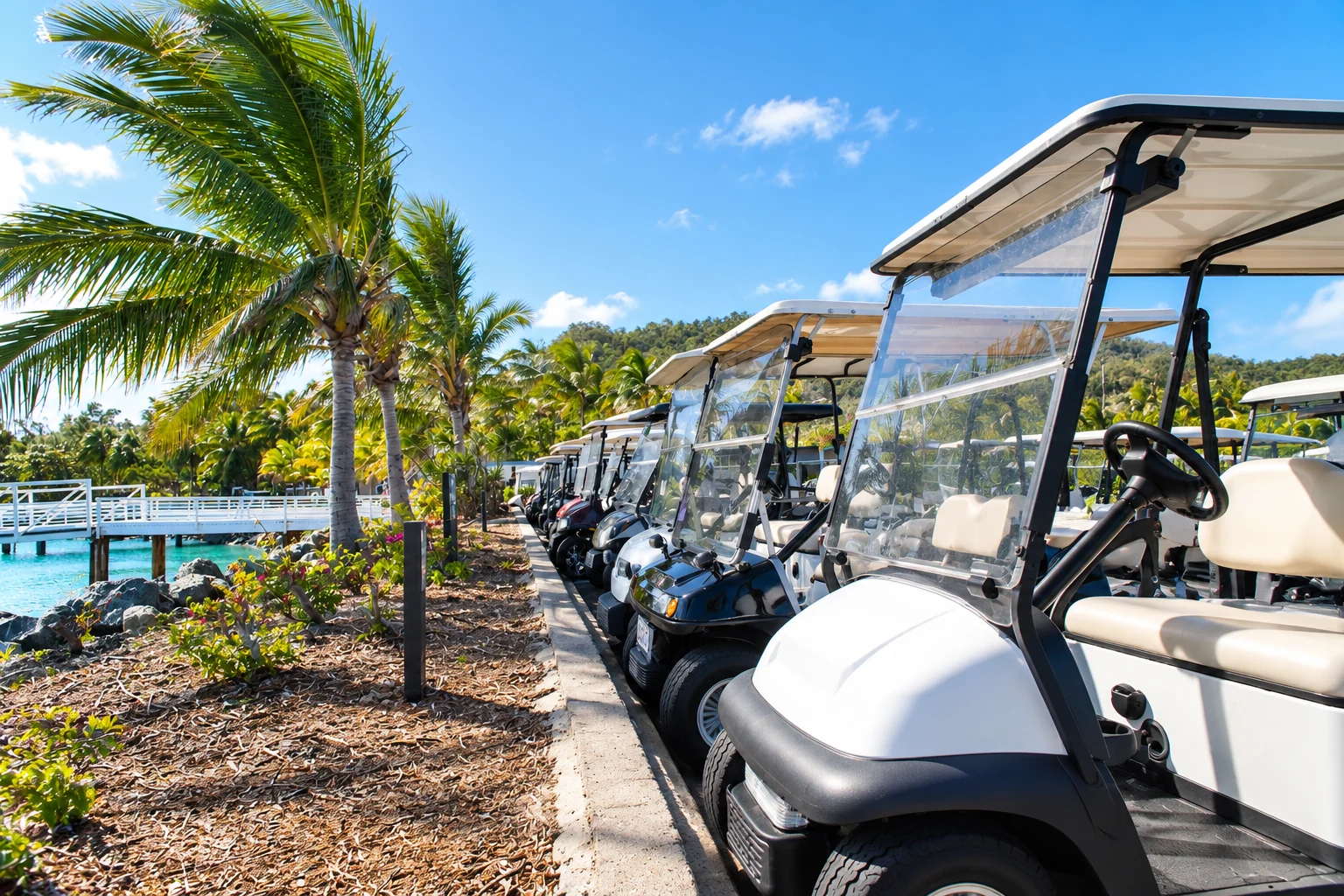
Buggy drivers follow Queensland road rules and the Department of Transport and Main Roads conditions of use:
- Vehicles cannot be driven between 1.00 am and 4.00 am.
- All passengers must wear seatbelts, and it is illegal to hold a phone while driving.
- Children under six months need a rearward-facing infant restraint in the front seat.
- Children aged six months to under four need an approved forward-facing restraint.
- Children may not sit on another passenger’s lap.
- The maximum buggy speed is 20 km/h, and passengers must stay seated.
Walking is also allowed on bushwalk trails, footpaths and roads, and a free shuttle bus operates around the island. Resort buses run continuously around the main attractions and are free for island guests.
Beaches on Hamilton Island
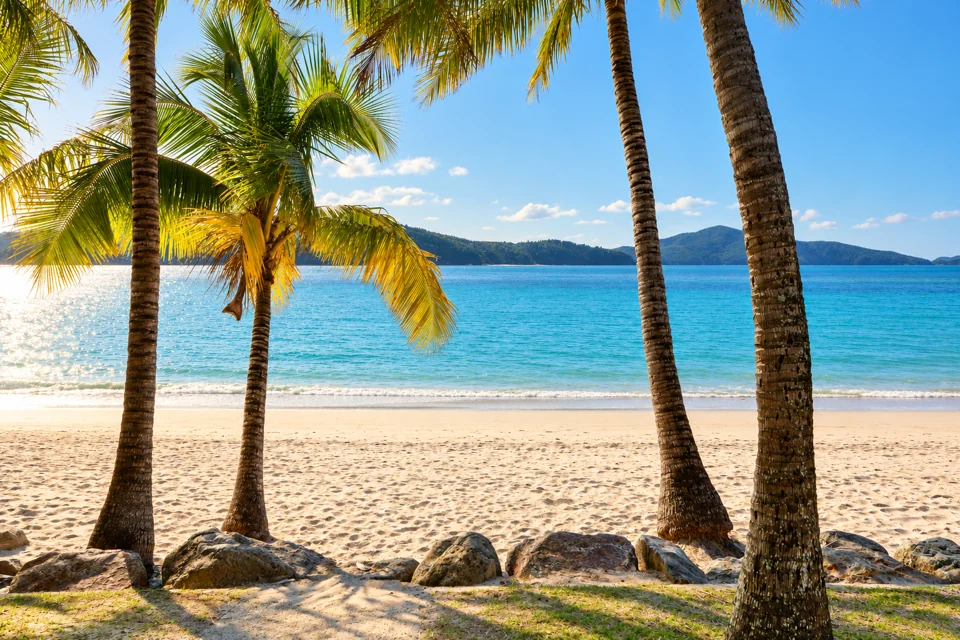
Catseye Beach is the main beach and suits swimming, kayaking and paddleboarding. Swim out past the reef at low tide to see turtles. Beach surfing is poor, but wind and kite surfing are good.
Hideaway Bay is a short stroll from the Scenic Trail entrance and is rated Grade 3 (Moderate) on the official bushwalk listing. Coral Cove is reached by following the Scenic Trail to Saddle Junction and then taking the Coral Cove Walking Trail. Escape Beach is also reached on foot and is covered in the next section.
Whitehaven Beach is about seven km of white silica sand, with Hill Inlet at the northern end. It is boat-only, with no public road or bridge, so you reach it on a tour or charter from Hamilton Island. Whitehaven is a short boat ride away.
Marine stingers are present from November to May, and stinger suits are recommended. Lifeguards patrol seasonally. Never swim alone at secluded beaches.
Walking trails on Hamilton Island
The island has over 20 km of scenic walks and private beaches. About 70% of the island is untouched native bushland.
The Scenic Trail runs from the Scenic Trail Entrance to Saddle Junction. This is the main junction for the Passage Peak, South East Head, Escape Beach, Middle Head and Coral Cove trails, so most longer walks start by reaching it.
The South East Head Trail is Grade 3 (Moderate). It passes through dense bush and exposed rock, with grass trees and views of the Lindeman group, and ends at a giant chair. Walkers can add Passage Peak or Escape Beach before returning to Saddle Junction. Passage Peak is the highest point on the island’s hiking list. The "Icons" route links a 3 m chair at South East Head, a giant swing at Coral Cove and a giant hammock at Escape Beach.

Trail conditions call for preparation:
- All trails need a reasonable to high level of fitness because of the hilly terrain and heat.
- Carry 1 to 2 litres of water per person per hour, and wear a hat, sunscreen and sturdy shoes, since most trails are rocky.
- Trails are open from sunrise to sunset and have no toilets, so take all rubbish away.
- Parts of the trails have no mobile coverage, so walkers alone should tell someone before starting.
- Check the weather before setting out.
Dogs are not permitted in the Natural Reserve areas or on the walking trails, and fires are prohibited anywhere on the island. Guided walks with a resident tour leader run seasonally, and the Hamilton Island App lists the dates.
Wildlife on land and sea
Hamilton Island’s wildlife includes wallabies, goannas, sea eagles, kites, ospreys, sulphur-crested cockatoos and kookaburras. Humpback whales are occasionally seen offshore. Lace monitors are also present, so lock away all food.
For koalas, kangaroos and a giant saltwater crocodile, visit the Hamilton Island Wildlife Park, which offers guided tours, VIP encounters and a Wildlife Café. Wild saltwater crocodile sightings in the Whitsundays are extremely rare, so the park is the place to see one. The Wildlife Trail explains native wildlife and conservation efforts.
Anyone planning to fly a drone should read the official No Drone Zone page first.
Things to do beyond the beach
Free and low-cost options are bushwalking, the shuttle bus, beach time and wildlife watching on the trails. Paid activities include snorkelling and diving, sea kayaking and water sports, game fishing, Great Barrier Reef tours, glass-bottom boat tours and a scenic helicopter flight over Heart Reef. There is also a Koala Gallery breakfast, and golf at Hamilton Island Golf Club on Dent Island. Prices vary by operator, so check them when booking.
Day trip or overnight
A day trip from the mainland needs about 6 to 8 hours including ferry transfers, which leaves 4 to 5 hours on the island. That is enough for a stop at One Tree Hill, the marina, a swim at Catseye Beach and one short walk, but it does not leave room for the longer trails and a Whitehaven tour together. Day visitors need no camping permit, and commercial day tours do not use national park camping permits.
An overnight stay suits visitors who want both the trails and a boat trip, since the ferry crossing each way takes a large share of a single day. Staying on the island also gives access to the early hours when trails are coolest, since they are open from sunrise.
Camping permits on nearby islands
Hamilton Island itself is a resort, so camping applies only to the national park islands nearby. Camping is available at 25 locations across the Whitsunday islands, and each stay needs a permit with a tag bearing your booking number displayed at the campsite. Camper numbers are limited, so book and buy permits in advance. Penalties apply for camping without a valid permit. Book the boat transfer to the campsite with the operator before booking the permit. Permits are booked at qld.gov.au/Camping.
Fees as of March 2024 were A$7.25 per person per night or A$29 per family per night. Check the booking site for current fees before you pay. Campsite rules include:
- Use gas or fuel stoves only, with no open fires.
- At least 5 litres of fresh water per person per day.
- Most campsites have toilets but no showers.
- Caravans, camper trailers, generators, barbecues, campfires and dogs are not permitted.
- Whitehaven Beach has tent-only camping.
- Do not swim in Cid Harbour because of dangerous sharks.
Marine park zoning also applies. Some activities such as fishing or collecting are not allowed in some zones, and penalties apply.
Best time to visit Hamilton Island
The dry season runs from May to October. Rainfall in the driest months, August to October, averages about 25 to 27 mm a month, based on Bureau of Meteorology long-term averages for Hamilton Island Airport. The wet season runs from November to April, with January averaging about 298 mm and February about 289 mm.
Mean maximum temperatures climb from 21.6°C in July to 29.9°C in January and December, and mean minimums run from 18°C in July to 24.9°C in January. Dry-season maximums are 24.3°C in May, 22.3°C in June, 21.6°C in July, 22.9°C in August, 25.3°C in September and 27.4°C in October. Walking suits the cooler dry months best, given the heat and the 1 to 2 litres of water per hour the trails demand.
Beach conditions follow a slightly different pattern. August to November has the most sunshine and least rain, and sunbathing suits October to April. Swimming suits November to May, when the sea is above 25°C, but that period overlaps with stinger season, so pack a stinger suit. Sailing is best from June to October.
September and October balance the dry weather, warming temperatures and sunshine, with stingers not yet in season at the start of the window. For current conditions, use the Bureau of Meteorology Whitsundays forecast or the official Hamilton Island weather page.
Planning summary
- Choose the arrival route first: Fly direct to HTI for the simplest trip, or take the Cruise Whitsundays ferry from Shute Harbour (about 37 minutes) or Port of Airlie (about 60 minutes).
- Plan around a car-free island: Only approved vehicles are permitted, so use a buggy, the free shuttle or your feet. Buggy hire needs a current licence and a credit card for the deposit, and operators commonly set a minimum age of 21.
- Prepare for the trails: They run sunrise to sunset, have no toilets, and need 1 to 2 litres of water per person per hour. Dogs are not permitted.
- Stay overnight to do more: A day trip gives 4 to 5 hours on the island, which fits one walk and a beach swim but not much more.
- Time the visit for August to October: These are the driest months, while swimming is best from November to May with a stinger suit. Camping on national park islands needs a permit booked in advance.