
Anbangbang Billabong is a permanent waterhole in Kakadu National Park, Northern Territory. The 2.5 km loop around it takes about one hour. Parks Australia describes it as a short circular walk with Burrungkuy (Nourlangie) rising behind the water. A billabong is a pool left behind when a river changes course or recedes, and in Kakadu these pools hold birdlife and crocodiles.
A Kakadu park pass covers entry, and the walk has no separate fee. Water levels decide when the track is open, so check the access report before you drive out. Dawn and late afternoon are the best times to see birds and wallabies. Do not linger at the water’s edge, because crocodiles live in the park’s billabongs.
Walking the billabong loop
The loop starts from the same carpark as the Burrungkuy (Nourlangie) rock art site. Parks Australia lists it as a 2.5 km loop of about an hour, and Kakadu Tourism calls it an easy track that circles the billabong with sandstone escarpment cliffs reflected in the water. Water lilies flower in season. Picnic tables sit beside the water, which makes the walk a reasonable lunch stop between rock art visits.

Part of the walk is wheelchair accessible, including the path to the picnic table area. If you need to plan around the accessible section, ask at the Bowali Visitor Centre for its length.
The track is well defined and fairly level, with little climbing. A separate 3.9 km, 1.5-hour circuit starts from the Nawurlandja parking area and has 42 m of total ascent. Because it is a different route from the official loop, check which carpark a map or app is sending you to. Dogs are not permitted on the walk.
Kakadu Tourism recommends binoculars, a camera or a sketchbook. Binoculars matter most, because the birds spend much of their time out on the water.
Birds and wallabies
Kakadu Tourism lists the birds you can expect at the billabong: magpie geese, green pygmy geese, egrets, comb-crested jacanas, cormorants, corellas and red-tailed black cockatoos. Jacanas walk across floating lily pads, so scan the water lilies too. Wallabies leave the surrounding woodland to graze near the billabong in the early morning and the evening, so those are the hours to walk if you want to see them.


Anbangbang is also described as a bird-watching hotspot in the late dry and early wet seasons. Across Kakadu, shrinking water in the late dry season concentrates wildlife, so the same effect applies here. If birds are the main reason for your visit, aim for those months and an early start. Remember that those same conditions also concentrate crocodiles.
Water levels and walk access
In the dry season Parks Australia says the trail "may open in stages depending on water levels", and it directs visitors to the Kakadu access report for daily updates. Part of the loop can therefore be closed while another part is open, so check the report on the day you travel rather than relying on a guidebook.
Kakadu’s seasons follow the pass pricing calendar. The dry season runs from 15 May to 31 October, and the tropical summer, or wet season, runs from 1 November to 14 May. The earlier part of the dry season is when you are most likely to find the track still opening up. By the late dry season the water has dropped, and the birdlife has concentrated around what remains.
Wet-season roads
The park itself never officially closes in the wet season, but flooding shuts many roads and sites. According to Kakadu Tourism, the Arnhem and Kakadu highways stay open, along with the roads to Nourlangie, Ubirr and Cooinda. It adds that they "may occasionally close after big storms". Because the walk starts from the Nourlangie carpark, the Nourlangie road is the one that matters for this trip.
Roads that close in the wet season include the Jim Jim and Twin Falls roads, Old Jim Jim Road, and the roads to Gunlom, Maguk and Sandy Billabong. Many minor unsealed roads also close. Those that stay open are 4WD only, and some bush campgrounds shut.
Never drive into floodwater. Road closures are common, and flooding can be deep and extensive, even for experienced drivers. At a flooded crossing, read the signs, check the depth markers and flow speed, and wait for the water to recede. Crocodiles may also be present at flooded crossings.
If you hire a 4WD in the wet season, ask about floodwater levels on all roads at the Bowali Visitor Centre before heading out.
Vehicles and fuel
The Nourlangie area is reached by sealed road, and you do not need a 4WD to see the best of Kakadu. A 4WD is needed for Jim Jim Falls, which requires a high-clearance vehicle. Jim Jim and Twin Falls usually open around July, and the final 11 km of the Jim Jim road is 4WD only. If you add those places to your trip, remember that food, water, fuel and Wi-Fi are at Cooinda Lodge, about 45 minutes from that area.
Cars with 2WD and 4WD can be hired in Darwin, often with daily distance limits, while campervan hire often has none. Check the limit before you book, because the distances in Kakadu add up quickly.
Crocodile safety around billabongs
Parks Australia says Kakadu has around 10,000 crocodiles, about 10% of the Northern Territory’s total. Estuarine (saltwater) crocodiles are aggressive. They live in floodplains, billabongs, rivers and coastal waters. Freshwater crocodiles are shy but can turn aggressive if disturbed. Anbangbang is crocodile country, even though the track is easy and the setting looks calm.
Four rules cover the walk:
- Obey every crocodile warning sign.
- Do not enter the water.
- Stay back from the water’s edge.
- Never feed, harass or interact with a crocodile.
Stay on the formed path and take photos from a distance. Do not crouch at the bank to look at lilies or fill a bottle.
Swimming rules in the park are set by the individual swimming areas. Kakadu’s safety guidance names the Jabiru swimming pool as the only public swimming place it recommends. Some visitors swim at their own risk in selected plunge pools and gorges, including Gubara, Maguk, Jim Jim Falls and Gunlom. Park staff survey those areas for estuarine crocodiles before they open each dry season. Traps stay in place all dry season, and crocodiles can still move in at any time, so read the signs at each pool. A billabong such as Anbangbang is never a swimming place.
Safer ways to see crocodiles
Parks Australia notes that the dry season is the best time to see crocodiles, because shrinking water bodies concentrate them. It suggests three safer options: a commercial cruise on the East Alligator River or Yellow Water (Ngurrungurrudjba) Billabong, the Cahills Crossing viewing platform, or the Yellow Water boardwalk. Visitors should also stay clear of the water at Cahill’s Crossing.
For emergencies, remote areas have emergency call devices that are for emergency calls only. The Bowali Visitor Centre gives road access information on 08 8938 1120, and the Jabiru medical centre provides first aid on 08 8979 2018.
Kakadu park pass costs
Entry to Kakadu needs a park pass, and it is valid for 7 days. It covers entry to the park, ranger-guided activities and information. The pass covers Kakadu only. A Northern Territory Parks Visitor Pass, including the annual version, covers NT Government parks only so it does not replace a Kakadu pass.
Parks Australia announced on 25 June 2026 that passes for visits from 1 July to 31 October 2026 are sold at the wet-season rate. The official pass page lists the rates:
| Pass (7 days) | Rate for visits 1 July to 31 October 2026 | Standard dry-season rate |
|---|---|---|
| Adult (16+) | $25 | $40 |
| Child | $12.50 | $20 |
| Family (2 adults and 2+ children) | $65 | $100 |
| Concession | $19 | $30 |
The lower rates are the standard tropical summer prices from 1 November to 14 May. The standard rates apply from 15 May to 31 October, except in the 2026 period above. Confirm the current rate on the Parks Australia pass page before you buy.
Northern Territory residents enter free with proof of residency, and children aged 0 to 4 are free. The park pass flyer lists concession eligibility for Seniors Card holders (60+), aged pensioners, returned service veterans, disability pensioners and their carers. You can buy a pass online through the Parks Australia booking site. Passes are also sold at Tourism Top End in Darwin or at the Bowali Visitor Centre.
Bowali Visitor Centre
The Bowali Visitor Centre in Jabiru is the place to check road conditions, pick up maps and see exhibits and interactive displays. It is on the Kakadu Highway, a couple of kilometres south of the Arnhem and Kakadu Highway intersection (address: Kakadu Highway, Jabiru NT 0886). Entry is free.
According to Kakadu Tourism, it opens daily except Christmas Day and New Year’s Day. The listed hours are 10 am to 4 pm in the wet season (November to March) and 9 am to 5 pm in the dry season (April to October). Hours and facilities can change in the wet season, so phone ahead on 08 8938 1120 if you are relying on it for flood information.
Where to stay near Anbangbang
Jabiru is the main hub, with accommodation, shops, fuel and an airport. Kakadu Tourism’s accommodation page lists Cooinda Lodge and Yellow Water Campground. Cooinda is a different part of the park from Anbangbang, so plan your driving days with that in mind. Many tours, hotels and campsites are booked a year in advance, so reserve early if you are visiting in the dry season.
Combining Anbangbang with nearby walks
The billabong loop pairs well with other stops from the same carpark area. The Burrungkuy (Nourlangie) main gallery and shelter walk is a 1.5 km return track, graded easy, with a recommended time of 2 hours. It passes the Anbangbang gallery and the Kunwarddewardde lookout. Kakadu Tourism suggests Nawurlandja Lookout as the next stop after the billabong. It is graded moderate with some gradual elevation gain, and Parks Australia’s lookout page has its length.
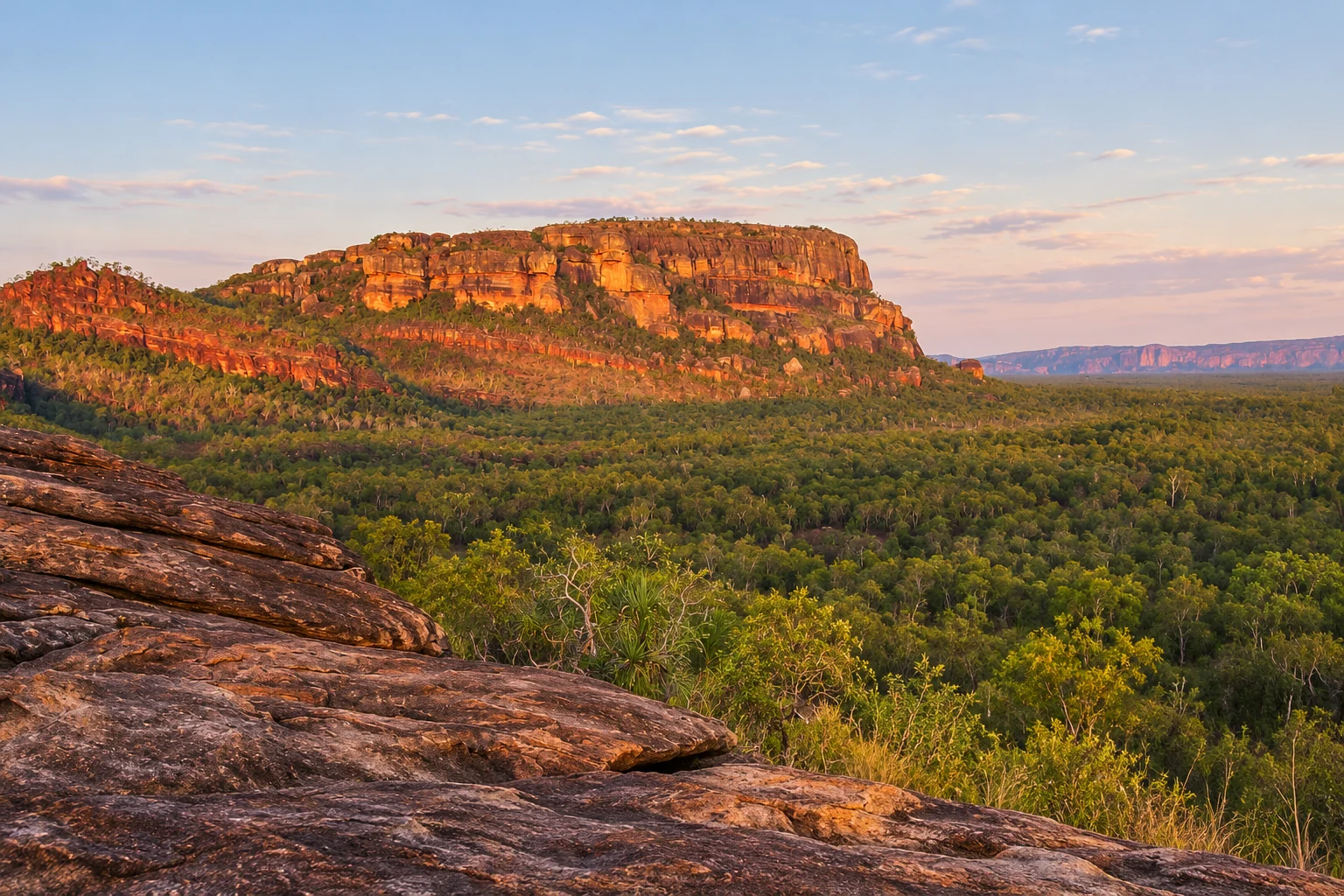
Much of Kakadu is Aboriginal land, and the rock art here is part of living culture. Follow the signs at the rock art sites and stay on the marked paths. A Parks guidebook PDF on Anbangbang gives background on the area.