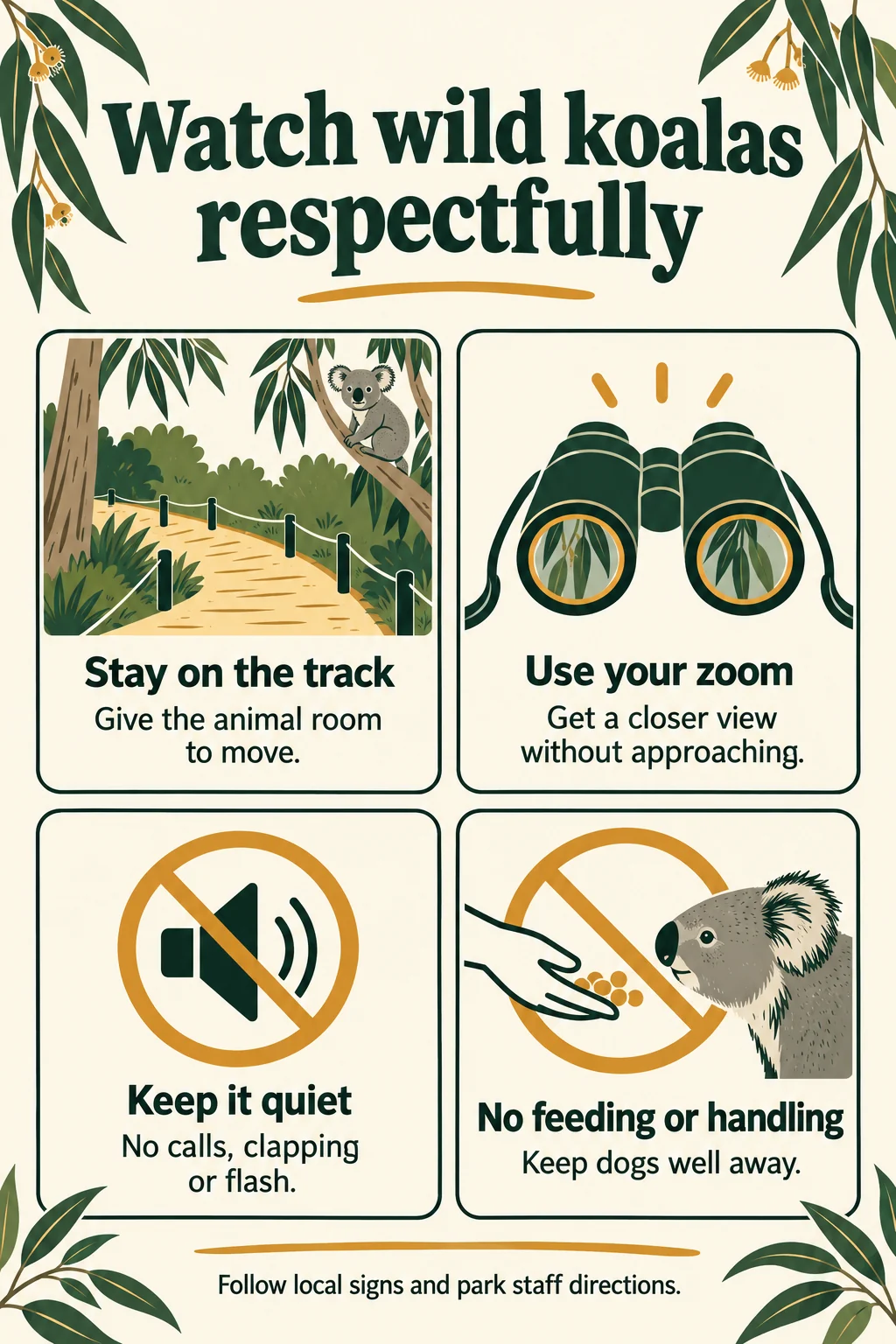
Watch koalas from a path or boardwalk without approaching or disturbing them. The Koala Clancy Foundation recommends staying at least 10 metres from wild koalas; this is practical advice, not a verified Australia-wide legal minimum.
Whether you are in wild habitat or a wildlife park, do not touch or feed koalas. Do not handle or cuddle them. Follow signs, barriers and staff directions at wildlife parks.
Keep your distance from koalas
Stay on the marked track and give a koala space to move freely. The Koala Clancy Foundation advises viewers not to approach, surround the animal, block its route or touch the tree it is in. If the koala changes its behaviour, such as becoming alert or moving away, step back and leave it undisturbed.
Binoculars or a camera with zoom let you see more without getting closer. Do not leave a track to improve your view, even if the koala appears to be asleep.
Keep noise low and turn off flash
Speak quietly and move slowly. Do not call, whistle, clap, play koala sounds or knock on a tree to attract attention. Noise and movement can prompt a koala to move away; research cited by the Koala Clancy Foundation also links visitor noise with increased vigilance in captive koalas, though that finding does not establish the same response in every wild animal.
As a precaution, turn your camera flash off. Flash rules vary by site, so follow the current signs and staff instructions at a reserve or wildlife park.
When to watch for koalas
Koalas feed at night and may rest in trees while you visit. NSW Government guidance says koalas are more active around dawn, dusk and at night, though these activity patterns cannot guarantee a sighting. Watch from safe public areas rather than walking or driving in unsafe conditions to find one.
In New South Wales, the state government describes koalas as more mobile during the breeding season, which it identifies as August to February. That seasonal guidance applies to NSW; it is not a single viewing season for all of Australia.
Do not feed or handle koalas
Never feed or chase a koala. Do not catch or handle one. Keep dogs well away, and do not try to draw an animal down from a tree. These actions can disturb the koala and put both people and wildlife at risk. Tourism Australia and South Australia’s National Parks and Wildlife Service also advise visitors to stay on tracks and avoid feeding wildlife. They recommend viewing koalas from a safe distance.
At wildlife parks, stay behind barriers and keep hands out of enclosures. Do not tap on glass or fences. Follow each park’s posted rules and staff directions. Some wildlife displays operate under specific state licensing conditions, but those conditions do not make touching or cuddling an appropriate visitor activity.
If a koala appears injured or distressed, contact park staff or a local wildlife rescue service. Do not approach or attempt to handle it; NSW Government guidance warns that koalas can injure people and that incorrect handling can harm the animal.
Explained visually