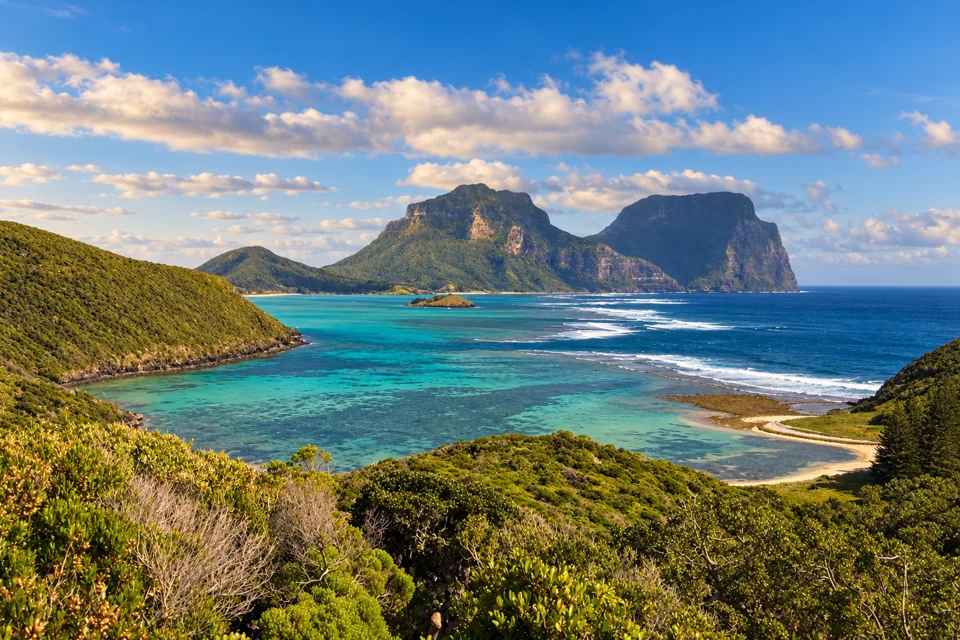
Lord Howe Island is a small World Heritage-listed island in the Tasman Sea, about 600 km east of Port Macquarie in New South Wales. It is about 11 km long and 3 km wide at its widest. The Lord Howe Island Board (LHIB), the island’s local authority, limits vehicles, visitor numbers and access to protected areas.
Most visitors fly in from Sydney, Port Macquarie, Newcastle or the Gold Coast. The only sea route is a cargo ship from Port Macquarie. Accommodation, flights and baggage allowances all limit a trip, so book a bed first, then flights, and pack light.
Flights to Lord Howe
Flights land at Lord Howe Island Airport (LDH), which the LHIB operates. The runway is short, so Dash 8 turboprop aircraft are the type used. Qantas and QantasLink fly from Sydney, and flights from Sydney take about two hours (flight listing). Frequency varies through the year, so check the current Qantas timetable for the days your dates fall on, and read the official getting there page for the overview.
Eastern Air Services flies direct from Port Macquarie, Newcastle and the Gold Coast. One-way flight times are:
- Port Macquarie to Lord Howe: 1h 30m
- Lord Howe to Port Macquarie: 1h 45m
- Newcastle or Gold Coast to Lord Howe, and back: 1h 50m
Eastern says it meets the Regular Public Transport standard, which it describes as the highest approval issued by the Civil Aviation Safety Authority. It also says every accommodation property on the island meets arriving flights and provides free transport for arriving and departing guests. Pick a departure airport on Eastern’s booking form to see which dates are flying.
Fares and baggage limits
Eastern lists these one-way fares, before taxes and fees:
| Route | Fare from (AUD) |
|---|---|
| Port Macquarie to Lord Howe | $670 |
| Lord Howe to Port Macquarie | $695 |
| Newcastle or Gold Coast to Lord Howe | $800 |
| Lord Howe to Newcastle or Gold Coast | $800 |
Fares move with demand, so confirm the price on the booking form. Travellers arriving by air also pay LHIB levies. The LHIB’s FY2024/25 fee information, as summarised here, lists an environment levy of $25.34 per sector per passenger and a QantasLink passenger levy of $38.02 per sector. Ask your airline or accommodation what applies to your travel dates.
Baggage is the other tight constraint. Qantas allows one checked bag of 14 kg on Lord Howe flights. Bags heavier than 14 kg, up to 23 kg, may not travel on the same flight because of aircraft weight limits, so treat 14 kg as the real limit. Qantas lists a 7 kg carry-on allowance on its Port Macquarie route and offers extra allowance for pre-purchase online. A resident frequent flyer reports that a second bag often arrives the day after you do. Put medication, swimwear and walking shoes in your carry-on or first bag. Eastern’s allowance for Port Macquarie to Lord Howe is 14 kg per passenger.
Island Trader cargo ship
The Island Trader, operated by Birdon, runs a regular shipping service between Port Macquarie and Lord Howe Island. It is a freight service, so contact Birdon directly about cargo bookings on 0417 892 642 or islandtrader@birdon.com.au. The crossing takes about two days each way, and bookings are essential.
The published schedule covers voyages B192 to B221, from 15 January 2026 to 21 March 2027 (page updated 17 August 2026). Most voyages leave Port Macquarie on a Thursday, reach Lord Howe on the Saturday and return on the Sunday or Monday. The next scheduled voyages are:
- B212: leaves Thursday 5 November, arrives Sunday 8 November, returns Monday 9 November
- B213: leaves Friday 27 November, arrives Sunday 29 November, returns Monday 30 November
- B214: leaves Thursday 10 December, arrives Saturday 12 December, returns Monday 14 December
The schedule can change, especially around public holidays, so check the live schedule page before you book.
Day trip or overnight stay
An overnight stay of several nights is the sensible plan. Flights run to limited timetables, and the cargo ship takes two days each way. Mt Gower alone takes a full day, and the best snorkelling and seabird viewing happen in the morning and late afternoon. Accommodation hosts also arrange the airport transfers, so a bed is part of the transport arrangement. Treat a booked place to stay as the starting point of the trip, then fit the flights around it.
Where to stay under the 400-visitor cap
Visitor numbers are limited to 400 at any one time. The cap is set by the number of beds, and the island has had it for more than 40 years. The LHIB issues the bed licences, which is how the cap is enforced. With so few beds, rooms and flight seats sell out together. Travellers should have a confirmed place to stay before booking flights, and Coral CoE says the peak season from September through April sells out well in advance.
Accommodation runs from self-catering apartments and cottages to small lodge-style guesthouses, and there is no large resort. Most properties include a bicycle. Self-catering suits longer stays, and a guesthouse suits travellers who want meals arranged for them. Lodges are the usual choice for a short trip.
Getting around the island
Most people walk or cycle, and car use is limited. The island speed limit is 25 km/h for vehicles, bicycles and e-bikes, and the LHIB guide lists walking and pushbikes as the most common forms of transport. You can hire a bike on the island or freight your own through Eastern Air or Birdon.
Helmet rules are enforced: riders must wear an approved helmet that is securely fitted and fastened. Police enforce the rule, and on-the-spot fines can run to hundreds of dollars. Negligent or dangerous riding carries penalties for pushbikes and e-bikes alike, and riding under the influence can lead to a fine or imprisonment. Bicycles are not permitted on any permanent park preserve walking track or on the Little Island track, so lock the bike at the trailhead.
Vehicles for private use need LHIB approval under its Vehicle Importation, Transfer and Use Policy. Eligibility requires two continuous years of residence in an approved dwelling on a Perpetual Lease, so visitors cannot bring a car, and most seasonal staff do not qualify either.
Golf buggies need conditional registration to use public roads, and the Transport for NSW vehicle sheet sets out the rules. The driver needs a Car (Class C) licence. Required equipment includes roll-over protection, headrests on all seats, an approved acoustic vehicle alert system, a speed-showing instrument cluster and unique keys. A flashing amber beacon must run while the buggy moves on a road, and use is restricted to designated areas and routes. Conditional registration is not available where a vehicle that complies with Australian Design Rules can do the same job.
Walks and Mt Gower
Most walking is on the permanent park preserve, which covers 75% of the island (about 1,300 hectares). The LHIB manages it, rather than NSW National Parks. Clean your shoes at the boot scrub bays on entry and exit, and stay on marked tracks. Offshore islands are off limits except Blackburn Island (Rabbit Island), where visitors must stay on the trail. Access to Mt Eliza is restricted during the bird nesting season, 1 September to 1 March.

Mt Gower (875 m) is the island’s highest point, and Mt Lidgbird reaches 777 m. Mt Gower and Roach Island both require a licensed tour guide. Auswalk rates the Mt Gower walk challenging to strenuous, with rope-assisted climbs, considerable exposure and an eight-hour return, and advises finishing before dusk. The Mount Gower Trek from Lord Howe Environmental Tours leaves at 7am and runs for most of the day. The tour costs $200 and is limited to 15 hikers. The operator calls it a serious hike needing a high level of fitness, and describes mist forest at the summit with trees, ferns, mosses and orchids. If you are unsure of your fitness, the operator recommends trying the Goat House Cave walk on Mt Lidgbird first.
Other walks are shorter:
- Kims Lookout circuit: This walk is about 4 km. It climbs Malabar Hill for views toward Mounts Gower and Lidgbird, then follows the cliff top to Kims Lookout.
- Transit Hill and Blinky Beach: This walk is about 1.7 km and starts near the Administration Centre.
- Memorial Track: This track drops from Kims Lookout to Old Settlement Beach.
- Mt Eliza: This walk can be combined with a canoe paddle from North Beach, outside the nesting restriction.
Most island walks are easy to moderate, with day walks up to 12 km.
Beaches and snorkelling
A sandy, semi-enclosed coral reef lagoon runs along the island’s 10 km west coast, and its sheltered water makes it the base for most swimming and snorkelling. North Bay has excellent snorkelling with turtles and stingrays, and is also good for seabird spotting. Glass-bottom boat and snorkel tours run best in the morning, especially from October to April, when the water is calm and clear.
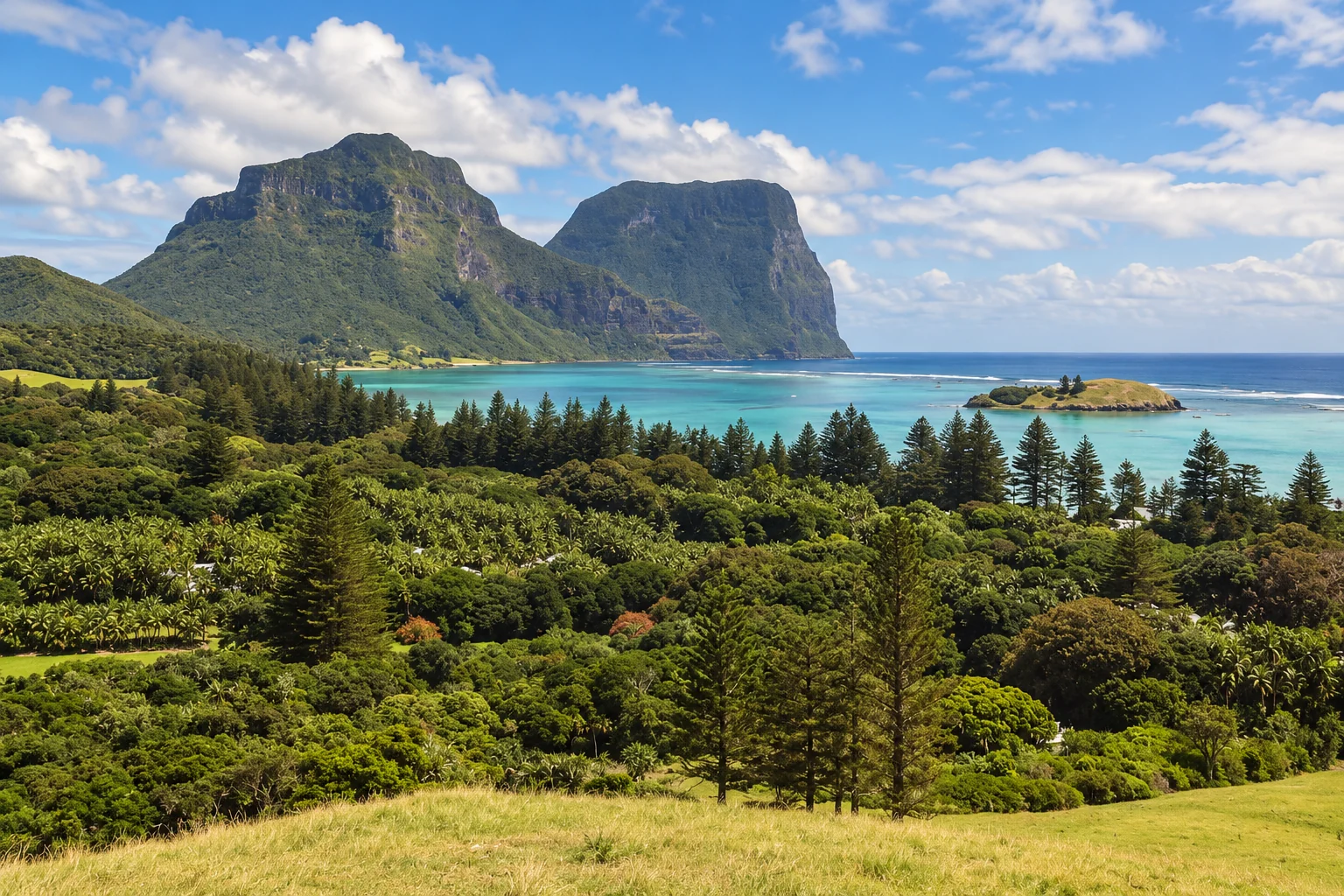
The Lord Howe Island Marine Park surrounds the island and includes the world’s southernmost coral reef. Personal motorised watercraft (jet skis) are prohibited in the marine park.
Wildlife and seabird seasons
Seabirds drive the island’s wildlife calendar, and The seabird calendar runs month by month:
- January: the best time for breeding seabirds, with sooty terns, brown noddies and masked boobies likely to have chicks.
- February: colonies are busiest, red-tailed tropicbird chicks hatch and corals spawn.
- March: summer breeding closes and providence petrels begin breeding around Mt Gower.
- April: migrating shorebirds such as bar-tailed godwit and Pacific golden plover pass through.
- May: many seabirds leave, while providence petrels and little shearwaters incubate.
- June: one of the quieter months.
- July: providence petrel chicks hatch on the mountain summits.
- August: little shearwater chicks hatch on Roach Island.
- September: muttonbirds and terns return, and golden whistlers are easy to spot.
Providence petrels breed through winter on Mt Gower and Mt Lidgbird. Lord Howe Environmental Tours describes walkers sharing the Mt Gower summit with them from March to September. In winter, late afternoon at Little Island may show birds returning to their burrows beneath the mountains.
Best time to visit
The official tourism site answers "Anytime" and describes a mild climate all year. Sea breezes stop summer getting too hot, and the warm surrounding seas keep winter pleasant. Its figures (last updated 11 September 2025) are:
| Month | Water (°C) | Max air (°C) | Min air (°C) | Rainfall (mm) |
|---|---|---|---|---|
| December | 24 | 24.1 | 19.3 | 102.9 |
| January | 25 | 25.4 | 20.7 | 107.6 |
| February | 26 | 25.8 | 21.0 | 102.4 |
| March | 26 | 25.0 | 20.1 | 127.7 |
| April | 23.5 | 23.4 | 18.2 | 141.9 |
| May | 22 | 21.6 | 16.4 | 147.6 |
| June | 20.5 | 19.9 | n/a | n/a |
Rainfall climbs from December to a peak of 147.6 mm in May. Summer maximums sit around 25°C, and winter averages about 19°C.
Winter is the quieter season. Some guesthouses and lodges close for renovation, some tour operators stop trading for vessel maintenance, and some restaurants close or reduce hours, so ask your accommodation what is open before you book. Walkers and seabird watchers favour September to May. The walking and birdwatching window can extend to June, with winter colder but often sunny. Choose summer for warm water, calm snorkelling and the busiest seabird colonies, and winter for petrels and fewer visitors.
Arriving by private boat
Every visiting vessel needs LHIB approval to use a mooring, under clause 90 of the Lord Howe Island Regulation 2014. Approval cannot be transferred, and the Board may cancel it at any time. Email arrivals@lhib.nsw.gov.au at least six weeks before departure for commercial vessels, or two weeks for non-commercial vessels. The LHIB vessel application lists these FY2024/25 fees:
- $55.00 non-refundable administration fee
- $60.00 per night
- $50.68 environmental levy per person per visit (not payable for a one-night transit stay)
- $105.00 biosecurity inspection (a late or incomplete biosecurity application costs $400.00)
- $400.00 commercial vessel inspection
- $184 per hour for inspections over two hours
Cancelling more than 28 days before arrival refunds all fees except the administration fee. Cancelling within 28 days is non-refundable with no changes, although weather cancellations may allow a transfer to other dates. Call 02 6563 2066 for mooring and biosecurity enquiries.
Quick planning points
- Book a bed first: Visitor numbers are capped at 400 at any one time, so lock in accommodation before you book flights.
- Pack under 14 kg: Qantas allows one 14 kg checked bag, and heavier bags may not travel on the same flight.
- Fly or book the cargo ship early: Flights leave from Sydney, Port Macquarie, Newcastle and the Gold Coast. The Island Trader takes about two days each way and needs a direct booking with Birdon.
- Walk or cycle: The speed limit is 25 km/h. Helmets are mandatory. Bikes are banned from park preserve tracks.
- Book a licensed guide for Mt Gower: The full-day trek costs $200 and is limited to 15 hikers.
- Match the season to your interest: Choose summer for calm snorkelling and busy seabird colonies, or winter for providence petrels, accepting that some businesses close.