Katherine is a town of about 10,000 people in the Northern Territory, roughly 320 km south of Darwin on the Stuart Highway. Travellers use it as a base for Nitmiluk National Park, whose gorge is about 30 km east of town, and for the free Katherine Hot Springs just south of the centre. The town sits at the junction of the Stuart and Victoria Highways, so most people driving between Darwin, Alice Springs and Western Australia pass through.

Three decisions shape a visit: when to go (the dry season, May to September), how to see the gorge (cruise, canoe, helicopter or walk) and how long to stay. A typical visit combines a gorge cruise, a swim at the hot springs and, with more time, Leliyn (Edith Falls) on the northern side of the park.
Getting to Katherine
The drive from Darwin is about 320 km, and the road is sealed throughout. It takes around three hours without stops. Many drivers split it by stopping at Litchfield National Park, about 106 km from Darwin, then continuing the remaining 255 km to Katherine.
Katherine has an airport, but most visitors arrive by car. Without a car, a full-day tour from Darwin to Nitmiluk Gorge and Edith Falls is listed from A$345 as a base price with AAT Kings.

When to Visit
NT Parks says May to September are the most comfortable months to visit and walk. This is also when the river is calm, and when the hot springs are open to swimmers.
The wet season runs from October to April. Katherine’s annual rainfall is 1,112.5 mm, and temperatures across the NT can exceed 40°C from October to April. The town’s mean maximum over the year is 34.2°C and its mean minimum is 20.2°C, according to climate figures for Katherine. Check the Bureau of Meteorology warnings for heatwaves and read the NT Government heat guidance before any walk.
The Katherine River floods in the wet season, the park access road may be cut for short periods at peak flooding, and the park can close unexpectedly because of bushfires, flooding or maintenance. NT Parks links a "check if the park is open" page from the Nitmiluk park page, and that is the one place to check before you drive out.

Nitmiluk National Park
Nitmiluk covers about 292,800 hectares and is located on the lands of the Jawoyn people, who live and work there and continue to share their culture with visitors. The Parks and Wildlife Commission of the NT and the Jawoyn traditional owners govern the park together. It was established on 19 October 1977 as Katherine Gorge National Park, and it recorded 309,800 visitors in 2022.
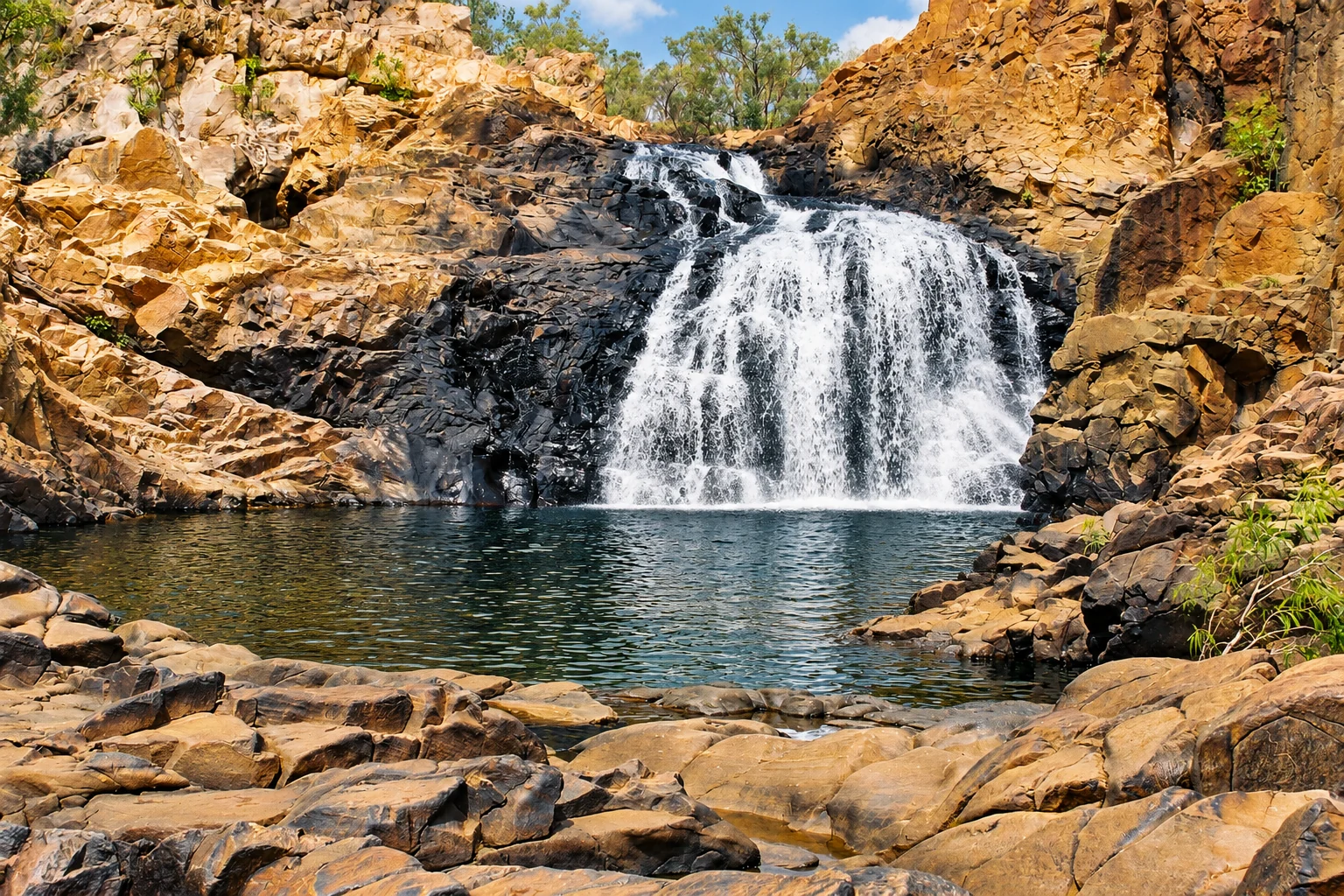
The park has two visitor sections, 90 km apart. The gorge entrance is about 30 km east of Katherine on sealed Gorge Road. Leliyn (Edith Falls) is reached from a turnoff 40 km north of Katherine on the Stuart Highway, followed by a further 20 km along Edith Falls Road. Both sections are on sealed roads, so a 4WD is not needed.
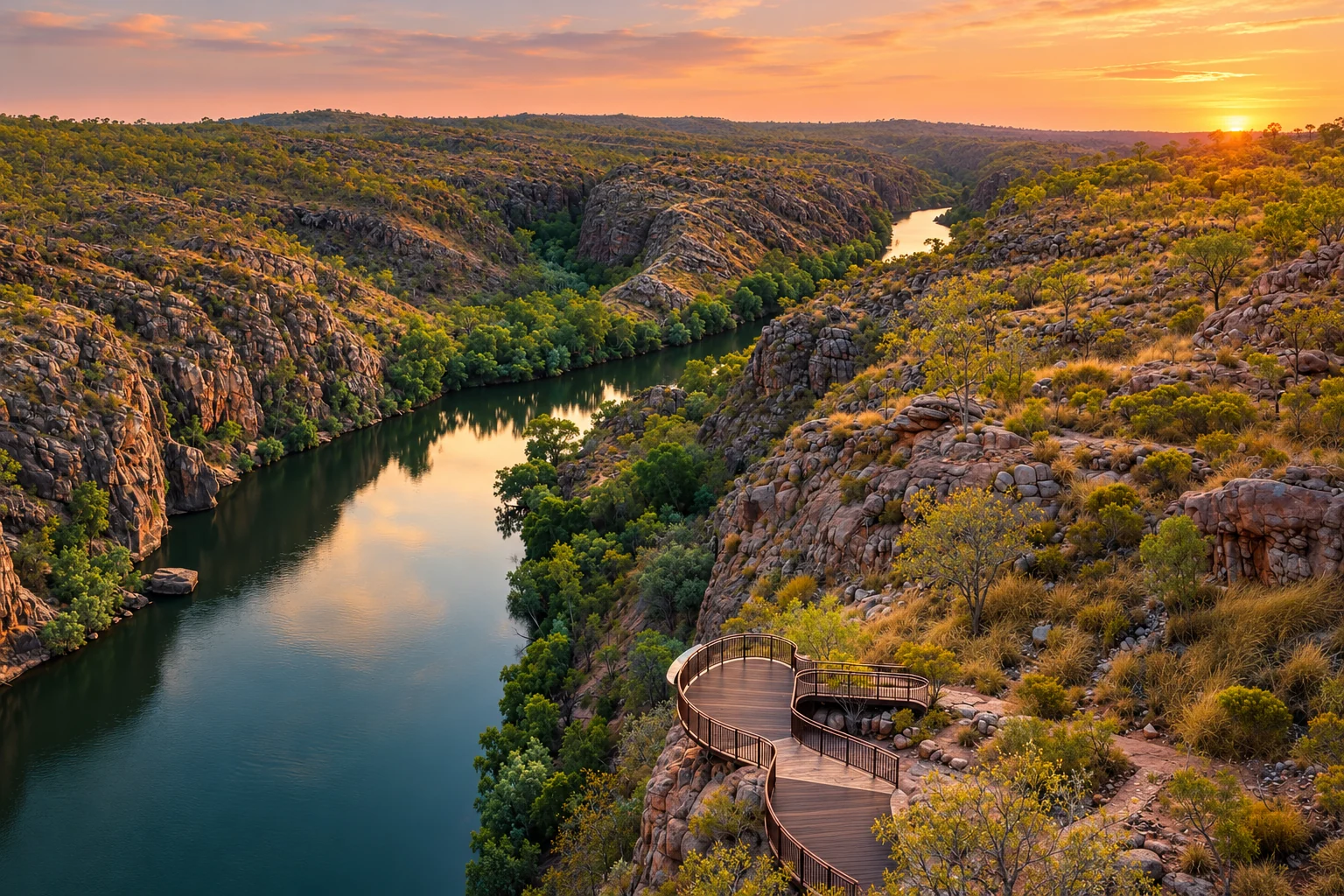
The Katherine River has carved 13 gorges through the sandstone, and visitors explore them on foot, by canoe, by boat or by helicopter. Leliyn is a quieter spot built around a natural pool fringed with paperbark and pandanus, and it suits swimming and short walks.
Park Passes and Fees
The park requires visitors to the NT to have an NT Parks Visitor Pass, which you buy through the NT Parks pass page. The pass has been listed at A$10 per adult per day or A$20 for three days, covering both sections. Confirm the current price on the official page.
If you book a tour through a reseller, check whether the pass is included. AAT Kings says the pass is required for each guest on its tour and is included in the tour price for departures from 1 April 2027.
Gorge Cruises and Tours
Boat cruises are the standard way to see the gorge. The 2-hour cruise passes through two to three gorges, and the operator also runs a half-day safari that reaches the third gorge. Booking offices are in the Gorge Tourist Precinct, and you can also book at the Katherine town visitor centre. Arrive 15 minutes before departure.
The 2-hour NitNit Dreaming Two Gorge Boat Tour is listed from A$139 per adult through an operator-supplied listing. The operator’s sunset dinner cruise is listed from $198. Prices change, so check the operator’s own site before you go.
The Katherine Gorge experience called KG20 is listed from A$314, and a half-day Dalabon Aboriginal cultural experience from A$189, both on the operator’s listing. The Dalabon experience is the better choice if you want a First Nations perspective rather than scenery alone.
Helicopters, Canoes and Walks
Helicopter flights carry up to three passengers with a minimum of two people. NT Parks says a 12-minute flight reaches the sixth gorge and a 25-minute flight covers the whole gorge system. Listed adult prices start at A$189 for the Nitmiluk Scenic Express over three gorges and A$426 for a sunrise flight. A sunset flight with a landing is from A$485. A Katherine Gorge and Edith Falls tour with a remote landing is from A$839. All four are on the operator’s listing.
Canoes are hired by the hour, for a half day, full day or overnight. A half-day hire has been listed at about A$119 to A$129, and an overnight double canoe at up to A$249. To bring your own canoe, register at the Nitmiluk Centre first and pay a fee. Experienced paddlers can camp at the fourth, sixth and ninth gorges if they book through Nitmiluk Tours in advance.
The walk to the first gorge is about 600 m each way, and wheelchair access reaches the top of the first gorge only. The park has numerous other walking tracks, with the Jatbula Trail as the long-distance option.
Swimming, Fishing and Park Rules
Saltwater crocodiles can enter the gorge at high water, and swimming is prohibited in the wet season. They are removed when the dry season begins, and other pools reopen once rangers finish their post-wet-season surveys. Gorge 1 stays closed to swimming and private canoes. NT Parks says to swim only where recommended and to obey warning signs.
Fishing for barramundi is by lure only, and bait fishing is not permitted. Fishing is not permitted in the second gorge for cultural reasons, according to the park fact sheet. Full boat, canoe and fishing rules are on the NT Parks canoes, boats and fishing page.
General park rules apply to everyone. Keep to designated roads and tracks. Do not touch Aboriginal art sites or feed animals. Carry out all rubbish. Open fires are allowed only in the Nitmiluk Tours campground. Drones need a permit obtained before arrival under the NT drone rules.
Where to Stay in the Park
The park has two campgrounds, one at the Gorge and one at Leliyn. The Gorge offers powered and unpowered tent and caravan sites, accommodation, a caravan park, barbecues, drinking water, toilets, a ranger station, food and disabled access. Leliyn has unpowered sites only, with showers, toilets, a gas barbecue, coffee, food, a phone and a ranger station.
Camping fees are paid on site, and overnight accommodation and canoe bookings go through the operator. Online campground fees have been listed at A$10 to A$15 per night. Camp only in designated areas, because bush camping elsewhere is generally not allowed and overnight parking is limited to designated campgrounds unless you hold a specific permit (park camping rules). Pets are not permitted.
Walking the Jatbula Trail
The Jatbula Trail runs about 60 km from Nitmiluk to Leliyn over five days and four nights. NT Parks opens bookings in November for the following year. Campsites are limited to 15 people per night. The route follows a path used by generations of Jawoyn people between the gorge and Leliyn, and it is named after Peter Jatbula, who helped secure land rights for his people.
Walkers need a ferry booking to start and must attend a mandatory safety briefing. Each designated camp is for one night only. Heat on the plateau is the main medical risk, phone coverage is poor and bail-out options are limited, according to the trail guide. Walking fees are $25 per person per night, capped at $125 for six or more days, and camping fees are additional. The NT Parks page lists a camping fee of $3.30 per person per night.
Katherine Hot Springs
The hot springs are on Riverbank Drive, Katherine South, about 2 km south of the town centre. Katherine Town Council manages the site, and entry is free, with no charge for the pools, boardwalk, picnic area or car park. The water sits at 25°C to 30°C. A raised boardwalk leads to a viewing platform at the spring source, and the main pool has a wheelchair ramp and stainless steel handrails. There is also a shaded picnic area, a playground and toilets. The Pop Rocket Cafe operates in the dry season and charges for food and drink.
The springs open 7am to 7pm daily in the dry season. They close to swimmers from about October to April, when the river rises and crocodile risk increases. Exact dates vary with rainfall, so check the Katherine Town Council website or the Katherine Visitor Information Centre, especially in May or September. High river levels, electrical storms or maintenance also cause closures.
Crowds peak in the mid-morning, especially from June to August, so an early visit is quieter. The top pool, near the spring source, is the warmest and deepest and is reached by a steep staircase. The other pools involve stepping over rocks and tree roots, so wear footwear until you reach the water’s edge.
Swimming is at your own risk, with no lifeguard on duty, and children must be supervised at all times. Do not use soap, shampoo or detergent in the water. Carry out your rubbish, keep dogs on a leash and out of the pools, and do not camp at the springs.
History of Katherine
The Jawoyn, Dagoman and Wardaman peoples lived in the region for thousands of years before Europeans arrived, and rivers and gorges held spiritual significance for them. "Nitmiluk" is the Jawoyn name for Katherine Gorge, pronounced "Nit-me-look" and meaning "Cicada Place". A journal article on Nitmiluk traces the name to the Dreaming figure Nabilil, who camped at the gorge entrance and heard the cicada’s song. The same article says Nitmiluk is central to Jawoyn tradition and law, and that colonial naming practices overwrote many such place names.
On 4 July 1862, explorer John McDouall Stuart crossed the river about 90 km upstream from the present town. His diary says he named it Katherine after the second daughter of pastoralist James Chambers. The Katherine Telegraph Station was established on 22 August 1872 as part of the Overland Telegraph Line, and a small permanent population grew up on the west side of the river.
Town growth began from 1926, following the opening of the railway line. After the Second World War, tourism helped the town expand. The railway reached Darwin on 13 September 2003, completing a continuous track from Adelaide to Darwin. Today the main industries are beef cattle, mining, horticulture and tourism, and RAAF Base Tindal, about 17 km south on the Stuart Highway, is a significant local employer. The 2021 census recorded 9,643 people in the town.
Katherine as a Top End Stopover
Katherine is called the "Crossroads of the North" because the Stuart Highway meets the Victoria Highway there, and the town is the gateway to Kakadu, Nitmiluk and Gregory National Parks. Tourism NT describes it as where the outback meets the tropics: it gets Top End monsoons but has a drier climate similar to the Red Centre.
Travellers heading south reach the south-west junction of Central Arnhem Road 51 km south of town. Those continuing to Western Australia turn west onto the Victoria Highway.
For a short stop, allow a full day for the gorge cruise and an afternoon or morning for the hot springs. A longer stay adds Leliyn, a canoe trip or a helicopter flight, and suits anyone planning the Jatbula Trail or a night at one of the park campgrounds. Planning around the dry season avoids the heat, flooding and swimming closures.