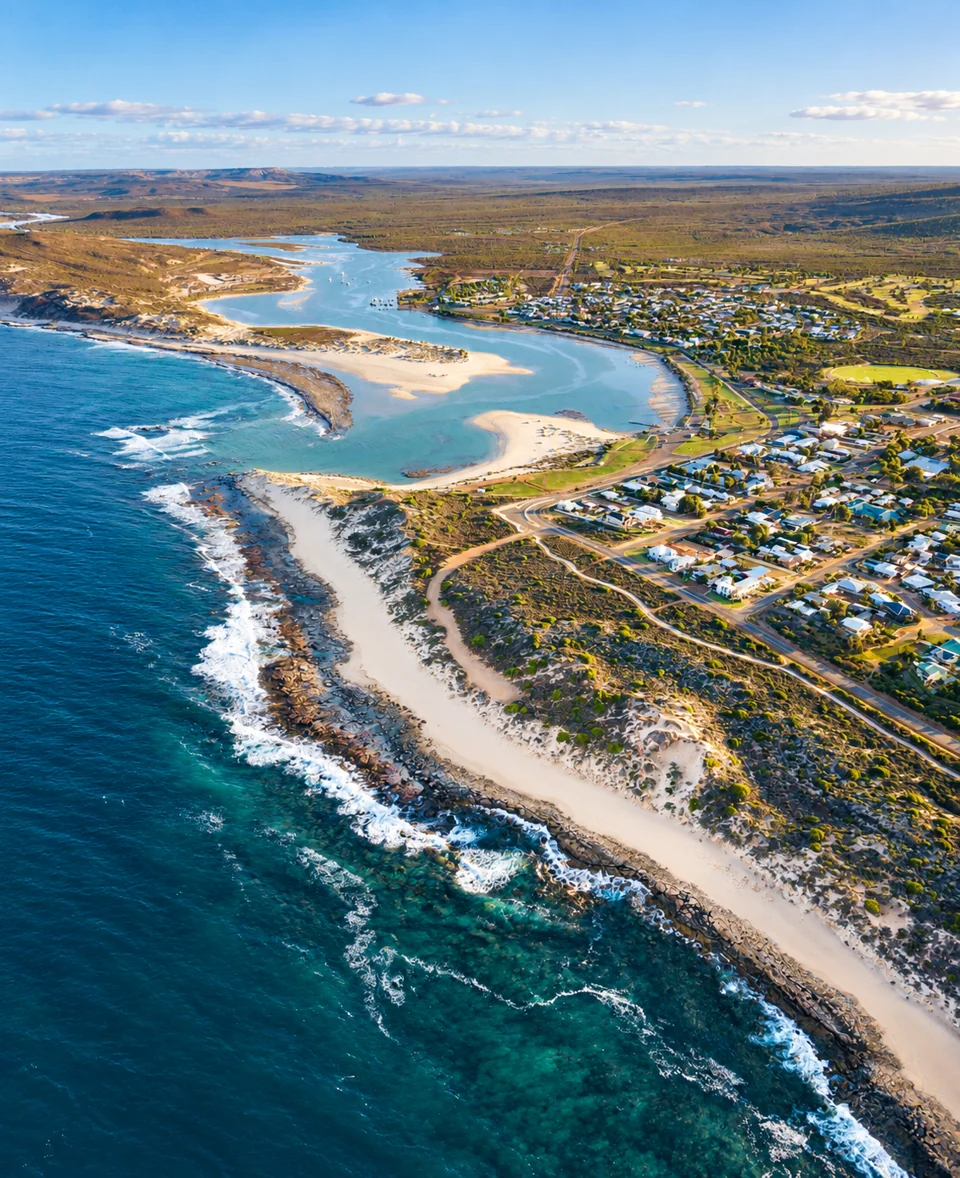
Kalbarri is a coastal town on Western Australia’s Coral Coast, about 575 to 590 km north of Perth, and it is the base for Kalbarri National Park. The park has two landscapes: sea cliffs along the coast, which are free to visit, and the Murchison River gorges inland, which need a park pass and are the hottest and most exposed part of the trip.

Season, heat and water shape most planning decisions. The cooler months suit hiking, and July to October brings wildflowers and whales. Carry all your own water, and check the heat rules for the gorges before you go.
Getting to Kalbarri
Driving from Perth
The Kalbarri Visitor Centre describes an easy six to seven-hour drive. Route 1 follows Brand Highway and then the North West Coastal Highway at Geraldton, and is stated as 590 km from the Perth CBD. Route 2 takes the scenic Indian Ocean Drive, which joins Brand Highway just south of Dongara and then continues on the North West Coastal Highway at Geraldton, at 575 km. Most people break the trip at Geraldton.
From Geraldton
Both routes into Kalbarri leave from Northampton. The coastal route takes Port Gregory–Kalbarri Road past Port Gregory, Lucky Bay and Wagoe Beach, and takes about 1 hour for 100 km. The inland route runs via the Ajana–Kalbarri road, passes the turn-off to the national park, and takes 1 hour 10 minutes for 110 km. The coastal route also passes Hutt Lagoon, so it suits a leisurely trip with stops.
Coach, air and electric vehicles
Transwa and Integrity coaches both serve Kalbarri, and the Visitor Centre lists their timetables and fares. Meedac is a booking agent for Transwa services on 0476 814 195. Transwa’s Kalbarri–Perth service runs on Tuesday, Thursday and Saturday, costs roughly $90 to $120. The Geraldton–Kalbarri leg costs roughly $20 to $26. Confirm current times with Transwa before you book.
There are no direct flights from Perth to Kalbarri. Qantas flies Perth to Geraldton daily, and a hire car is available at Geraldton airport for the drive north. Electric vehicle chargers are at the Allen Centre (Visitor Centre) car park in Kalbarri and at the Northampton RSL Hall car park.
When to Visit
The park’s official advice is to hike from May to October, and it warns that summer temperatures can be extreme. From November to March, inland temperatures can exceed 40°C inside the gorges, so early morning is the only workable time. The Loop trail can reach 50°C in summer.
April to October is the best period, with day temperatures of about 20 to 28°C and low rainfall. April and October are the shoulder months. July to October combines wildflowers with humpback whales along the cliffs. Visit in the cooler months if you plan to walk the Loop, and treat November to March as a season for the coast, the river and short early walks.
Park Entry and Passes
Coastal sites have free entry. A park pass is required for the inland gorge area, which includes Nature’s Window, the Skywalk, the Loop trail, Z-Bend, Ross Graham and Hawk’s Head.
The Explore Parks WA fee table lists $17.00 per standard vehicle (12 or fewer occupants) and $10.00 per concession vehicle. Large vehicles with more than 12 occupants pay $8.00 per person, or $3.50 for concession holders, and a motorcycle pays $10.00. Check the park page for current fees before you travel.
You can buy a pass at the Visitor Centre, at WA Parks & Wildlife headquarters or at the entry fee station. A ticket machine at the main park entrance operates 24 hours a day. Holiday and annual passes are also sold through the DBCA shop.
The Coastal Cliffs
Wind and wave erosion have cut cliffs that plunge about 100 m to the ocean. No pass is needed, and the lookouts are a good option on days when the gorges close for heat.
Red Bluff is about five minutes’ drive south of town. Ocean swells strike the cliffs here, and sunset is the best time to visit. Tourism WA describes the lookout as overlooking the 200 km Zuytdorp Cliffs.
Natural Bridge sits on the coast, outside the inland gorge pass, so entry is generally free.

Hutt Lagoon lies on the drive between Port Gregory and Kalbarri. Its water ranges from bubblegum pink to lilac and sometimes red. Tourism WA advises visiting before sunset. Midday, between about 1:00 and 3:00 pm when the sun is high, brings out the strongest colour, while the evening light is softer. Choose the time by which look you want.
Whale watching runs from June to November according to Tourism WA, with July to October the prime humpback period along the cliffs.
The Murchison River Gorge
The park surrounds the lower Murchison River, which has cut an 80 km gorge through red and white banded sandstone. The park covers over 183,000 hectares. The bands formed on tidal flats millions of years ago, and the ripple surfaces around Nature’s Window record waves that moved across those flats. The park page acknowledges the Nanda people, and the Visitor Centre acknowledges the Nhanda people as Traditional Custodians of the area.
Kalbarri Skywalk
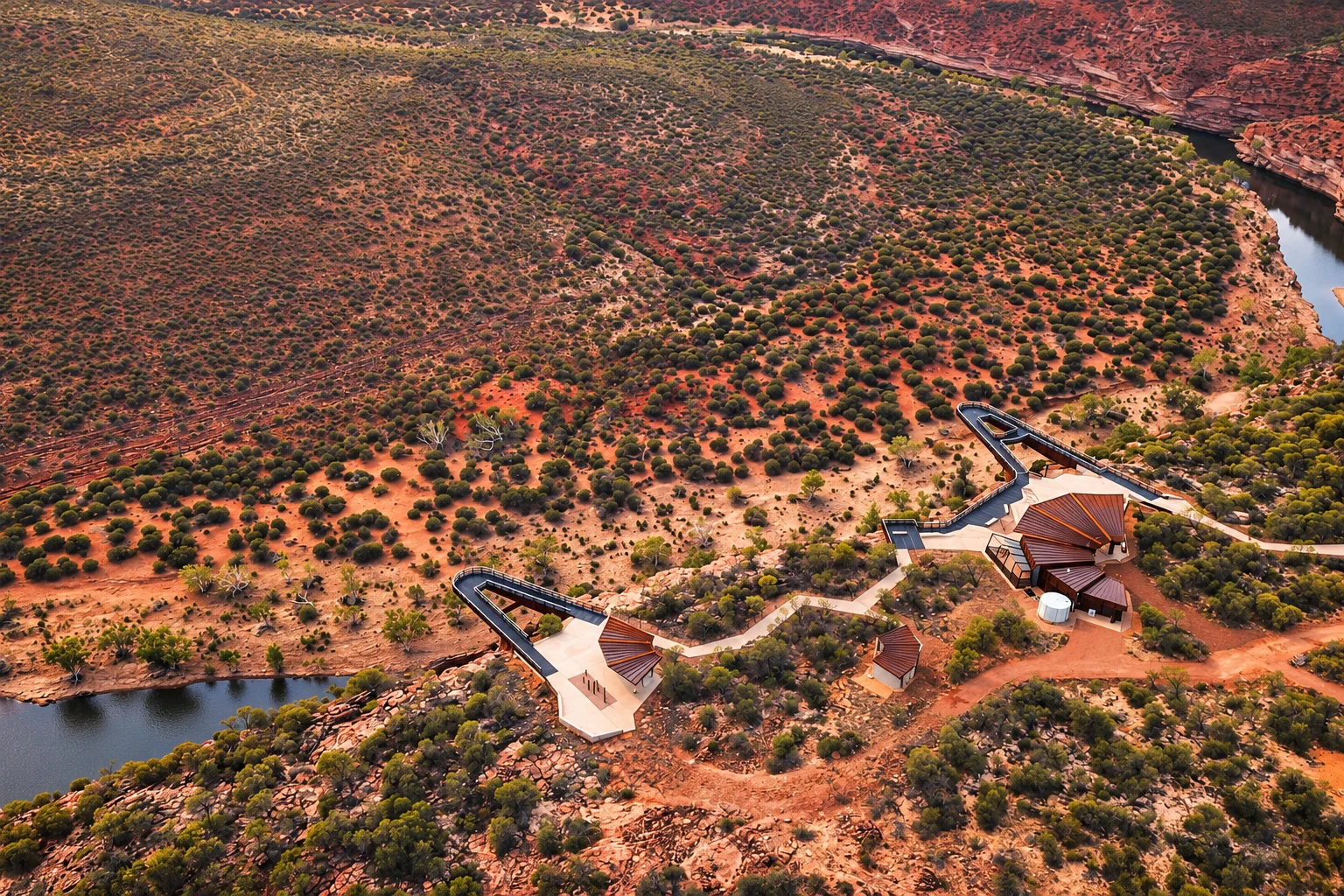
The Skywalk has two cantilevered platforms that extend beyond the edge of a 100 m drop. It is 37 km from the township on sealed road, about half an hour’s drive, and the paths to the platforms are flat and level. The site has toilets, a kiosk and designated parking bays. Shelters and undercover seating are also provided. The Skywalk Cafe’s hours are seasonal, so check before relying on it. The platform has no shade, so visit before noon or in the late afternoon.
Nature’s Window
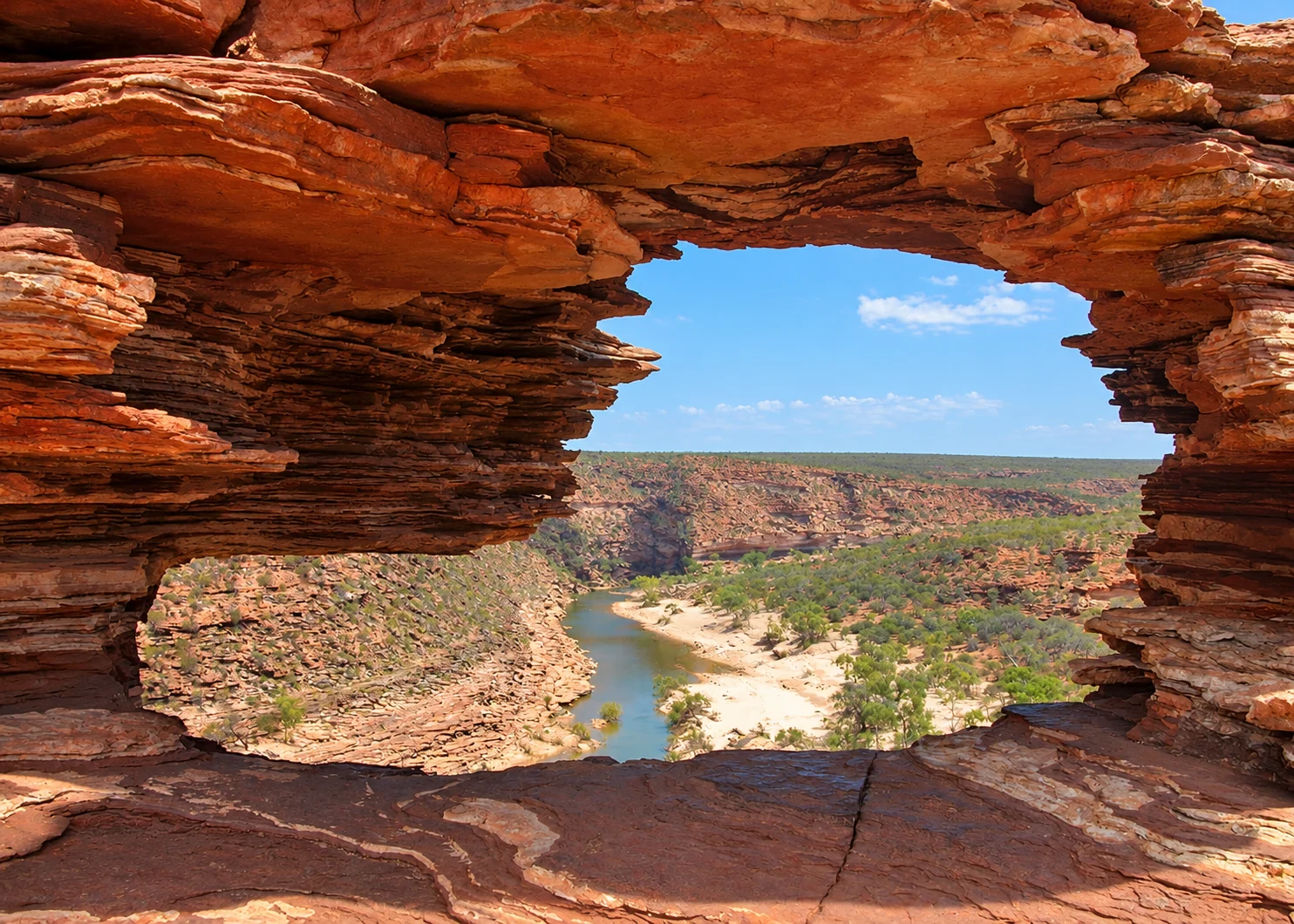
Explore Parks rates Nature’s Window as a moderate, one-kilometre return walk of 30 to 45 minutes, Class 3. It starts with stairs from the parking-area lookout, follows a sealed path with gorge views and finishes with a rocky section. Stay back from edges and do not climb on the fragile rock in or above the window. It is the park’s busiest site, so arrive early. Supervise children at all times, because the trail has stairs, uneven surfaces and exposed sections.
The Loop
The Loop is a 9 km, Class 4 circuit over rocky and sandy terrain, and the park allows 3 to 5 hours. It has no drinking water and limited shade. After the rocks past Nature’s Window the trail follows the clifftop, has some climbing, and carries distance markers every 500 m. It is closed after 7am from November to March inclusive, so in those months you must start before 7am.
Z-Bend and other walks
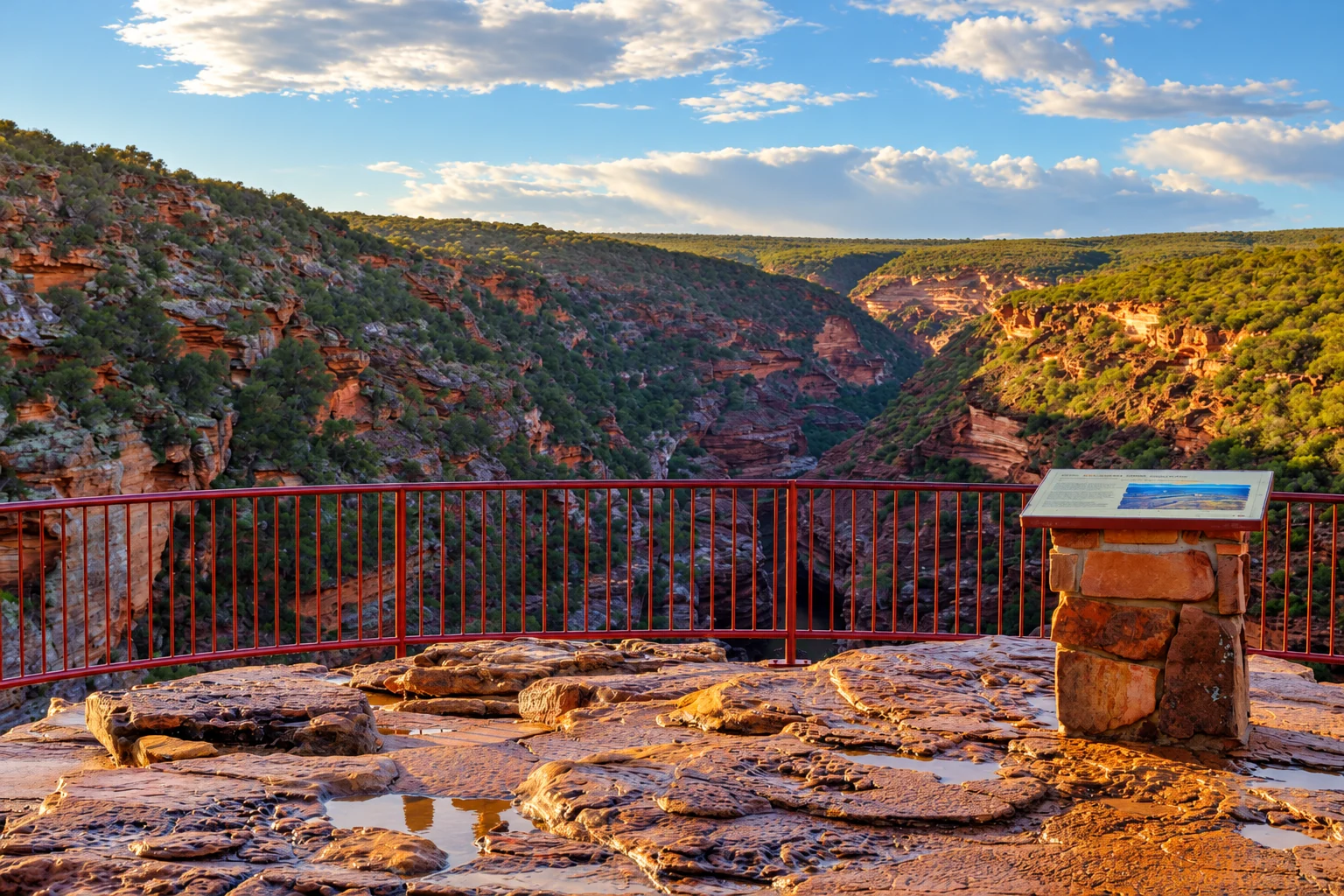
Z-Bend Lookout is about 600 m each way from the car park, roughly 1.2 km return and Class 3, with views about 150 m down to the river. The Z-Bend River trail is longer, at about 2.6 km return and 2 hours. Four Ways is a hard walk of 2 to 4 hours, and the Skywalk area walk is easy at 45 to 90 minutes.
| Walk | Distance | Time | Grade |
|---|---|---|---|
| Nature’s Window | 1 km return | 30 to 45 minutes | Class 3 |
| Z-Bend Lookout | about 1.2 km return | short | Class 3 |
| Z-Bend River trail | about 2.6 km return | about 2 hours | harder |
| The Loop | 9 km | 3 to 5 hours | Class 4 |
| Four Ways | not stated | 2 to 4 hours | hard |
Inland park roads are paved, so a 4WD is not needed. Caravans and camper trailers cannot enter the inland section, so leave them in town, and ask the park office on 08 9937 1140 if your set-up is unusual.
Wildflower Season
Tourism WA recommends July to October for wildflowers, with over 1,100 varieties, from grevilleas to feather flowers. The park page describes spring as the wildflower season, with displays it calls exceptional. Late August and September are described as the main display. Timing shifts with rainfall, and the bloom moves from north to south along the Coral Coast between June and October. If flowers are the reason for the trip, ask the Visitor Centre which areas are blooming before you choose your days.
Where to Stay
In town
Tasman Holiday Parks Kalbarri is at 92 Grey St, opposite the Murchison River, with some water’s-edge and shaded sites. Check-in is at 2pm and check-out at 10am. Each site takes one car and a maximum of six people. Sites and cabins have a five-night minimum in school holidays. Dogs are not allowed in cabins and are permitted on campsites only outside school holidays. Accommodation includes powered sites for motorhomes and caravans, a two-bedroom cabin sleeping five and two-bedroom villas sleeping four and six.
Kalbarri Anchorage Holiday Village is at 168 Grey St and has a pool, barbecue, bathrooms, a camp kitchen and wifi. Pets are welcome on camping sites. For a one-night stay, contact the park directly, and have your caravan’s total length, including the drawbar, ready when you book. See the park’s website.
Murchison House Station
The station is on the river, about 11 km north of town, and its Homestead Campground is small and open all year, with unpowered sites only. The campground has separate male and female ablutions, a basic camp kitchen and a free gas barbecue. Campers who are not self-contained walk to the Shearers Quarters for hot showers and flushing toilets.
The 4 km access road is gravel, maintained by Northampton Shire, and can become corrugated. The campground is AWD accessible. Bookings are essential, and the 2025 fees are:
- One vehicle with two people: $45.00 per night
- Child aged 6 to 16: $5.00
- School holidays and long weekends: $45.00 per night minimum
Generators are not permitted between 5pm and 9am, drones are strictly prohibited, and motorbikes, quad bikes and ATVs are not allowed. Friendly dogs are welcome but must stay in the vehicle until arrival and must not chase livestock. Keep children close, because the sites sit on the river edge. Call 08 9937 1998 (office open weekdays 9am to 6pm, weekends 2pm to 6pm). Cancellations within 24 hours of departure are not refunded. Bush camping for self-sufficient 4WD vehicles runs from April to October.
Camping near and in the park
Camping outside a designated area in the national park needs authorised approval, which takes time, and applicants must register interest six weeks in advance. Ask for forms and guidelines at 08 9937 1140 or kalbarriadmin@dbca.wa.gov.au.

On the coast, Lucky Bay Campground provides no drinking water, but the park is reachable by road; 4WD is needed only for the beach route. Dogs must be on a lead, and a nightly fee per vehicle is paid to the camp host. It cannot be booked and sites are first come, first served.
Heat, Water and Safety
Water. The park has no drinking water. The park page advises about 1 litre per hour per person while hiking, and the Loop page advises 3 to 4 litres per person per day.
Heat and clothing. Hike early, and wear a hat, loose clothing and sturdy footwear with sunscreen.
Closures. The gorge area may close in extreme heat (40+ degrees) or unsafe weather, sometimes without notice. Check alerts.dbca.wa.gov.au before you drive in.
Hiking safely. Walk with a companion, tell someone your route, and consider carrying a personal locator beacon, which the park suggests for rescue. The cliffs are about 100 m high, so stay back from edges at Nature’s Window and Z-Bend.
Pets and baiting. Pets are not permitted in the park. 1080 baits are laid on an ongoing basis in and around the park. 1080 is poisonous to humans and kills domestic cats and dogs.
Wildlife. H5 bird flu has been detected in WA. Call the hotline on 1800 675 888 to report sick or dead birds, marine mammals or other wildlife.
Water activities. The park page links to safety guidance for swimming, surfing, fishing, paddling, snorkelling, diving and abseiling.
Contacts and Closure Alerts
- Kalbarri Visitor Centre: +61 (0)8 9937 1104. Open Monday to Friday 9am to 5pm and Saturday 9am to 1pm, closed Sunday. Hours may vary on public holidays.
- Park office: 08 9937 1140.
- Geraldton Parks and Wildlife Office: (08) 9964 0901.
- Live closures and alerts: alerts.dbca.wa.gov.au.