
Freycinet National Park sits on a granite peninsula on Tasmania’s east coast, run by the Tasmania Parks and Wildlife Service (PWS). Its best-known sight is Wineglass Bay, a curved white beach below pink granite peaks called The Hazards. On a first trip, make a few decisions early: buy a parks pass, get a car, book a campsite or room ahead, and start early enough to beat the crowds at the walking tracks car park.
Everything in the park is reached from Coles Bay, a small township at the peninsula’s base, which is about 2.5 to 3 hours’ drive from Hobart and about 2 to 2.5 hours from Launceston. The main walk takes between one and three and a half hours depending on how far you go, so most first-time visitors can fit the highlights into two days. Camping rules changed on 3 November 2026, and pass prices were updated on 1 July 2026, so those details are worth checking against the PWS pages before you pay.
Paying for park entry
Every vehicle entering a Tasmanian national park, including Freycinet, needs a valid parks pass. The PWS passes page confirms this applies to Wineglass Bay and the walking tracks, and that children under 5 are free. The pass covers entry only. Some activities, such as guided cave tours, multi-day walks, shuttle buses and campground stays, cost extra.
For a short trip, two passes matter most. According to Campwatch’s 2026 comparison, rates from 1 July 2026 are $49.15 for a Daily Pass (valid up to 24 hours, per vehicle with up to eight people) and $98.35 for a Holiday Pass (valid up to two months, all Tasmanian national parks). If you plan to visit other parks such as Mount Field or Cradle Mountain, note that the Daily Pass excludes Cradle Mountain. The Holiday Pass is the better value once you add a second or third park to the itinerary. A single-park annual pass costs $53.50 and an all-parks annual pass costs $104.75, which suits residents or travellers who will return.
Concession prices apply to some passes if you hold a current Australian Government-issued Seniors Card, Pensioner Concession Card, Health Care Card or DVA card. Since 1 December 2025, the Seniors concession matches the other concession cards at 20 percent off. Existing Seniors passes stay valid until they expire. The discount requires an Australian-issued card, so interstate and overseas visitors cannot use their home concession cards.
Passes can be bought online through the PWS pass site (passes.parks.tas.gov.au), at national park visitor centres, at Service Tasmania centres and on the Spirit of Tasmania ferry, according to the PWS page and Wikivoyage’s park entry. The Freycinet Visitor Centre, inside the main entrance, also sells passes, and it is the logical stop for water and track information on arrival. It opens daily from 9am to 4pm. Buying online before you leave Hobart or Launceston saves a step on arrival day.
Older reviews and articles quote lower figures, such as a $45 entry fee. Those predate the current rates, so treat anything quoted from earlier years as out of date.
Getting to Coles Bay
Freycinet is a drive-in destination. From the Tasman Highway (A3), turn onto Coles Bay Road (C302) about 12 km south of Bicheno. According to the PWS Wineglass Bay page, the main entrance and Freycinet Visitor Centre are reached through Coles Bay township, about 28 km from the highway on sealed road. The walking tracks car park is another 10 minutes or so past Coles Bay, at the end of the road.
From Hobart, allow about 2.5 to 3 hours. From Launceston, allow about 2 to 2.5 hours. The YTravelBlog route notes give roughly 195 km from Hobart. Add time for stops, since the east coast road passes through towns such as Orford and Swansea, and the drive suits a coffee or lunch break.
All roads to the park are sealed, so a 4WD is not needed. The one gravel road in the area leads to Friendly Beaches, about 9 km after you leave the highway. The PWS advises avoiding night driving in reserves where possible, because wildlife is active on the road at dusk and dawn. Tasmania.com lists an advisory speed of 60 km/h on roads to and from the park after dark.
Buses and car hire
Public transport is limited. An area profile for Coles Bay says there is no rail and services are infrequent, and recommends a private vehicle. The Wineglass Bay travel page says to book a connecting service to Coles Bay with Calows Coaches, which runs from Launceston. There is no direct Hobart bus to Coles Bay, and connections are made through Bicheno, according to Rome2rio.
Tassielink is described as a seasonal coach between Bicheno and Hobart in one account, while Tripoto lists a daily service at about $30 one way. Confirm the current timetable with the operator before you plan around a bus, and book a return that leaves enough time for an early walk.
Most visitors hire a car in Hobart, Launceston or Devonport. Inside the park there is no regular shuttle, so you will either drive between the Visitor Centre, Cape Tourville and the walking tracks car park, or walk the shared track described below. The Wineglass Bay Cruise, a boat tour that departs from Coles Bay, offers another view of the bay but does not replace a shuttle.
Wineglass Bay: the lookout and the beach
The Wineglass Bay walks start from the walking tracks car park, and they split into two distinct trips. Mixing up their distances is the most common planning error, because different websites quote different numbers.
The lookout
The official Wineglass Bay Lookout page gives the lookout walk as 2.6 km return, taking 1 to 1.5 hours, rated Grade 3 on the PWS grading system. The climb is about 1.3 km each way, steep and uphill, with seats along the way for resting. Platforms sit near the saddle between two peaks, giving the classic view of the bay’s curve. Whales or dolphins are sometimes visible from the lookout. Several other websites say 3 km, but the PWS figure of 2.6 km is the one to plan with.
The track is part of the "60 Great Short Walks" collection. The PWS says it is not suitable for people with health issues or restricted mobility. Children need supervision around the hazardous cliffs, and walkers should stay within the barriers. Toilets are at the car park.
The beach
If you continue to the sand, the walk becomes about 6 km return and takes 2.5 to 3.5 hours, also Grade 3. PWS describes the route as the lookout track to the saddle, then roughly 1,000 stairs down to the beach. Every one of those stairs has to be climbed again on the way out. A further 20-minute walk along the sand to the south end gives views back toward The Hazards.
The PWS advises returning by the same track, which it calls the shortest and easiest route, and tells less-fit walkers to allow extra time and rest often. The track has no facilities until the beach, which has a composting toilet but no bins and no drinking water, so carry out all rubbish and bring water and food for the whole walk. If you want to swim, remember that Freycinet’s beaches are unpatrolled.
Midday is the busiest time on the track in high season, according to Thorough Travel’s park guide, which recommends going early morning or late afternoon. An early start also helps with parking. Summer visitors in particular should aim to reach the car park soon after it becomes light enough to walk.
Which one to choose
For a first visit, the lookout is enough if you have limited time, mobility concerns or poor weather. It delivers the main view in about an hour. Choose the beach if you are reasonably fit, have half a day, and want to stand on the sand and swim or paddle on a warm day. Plan for changing weather either way: the lookout page advises choosing a walk to match conditions, and Tasmanian weather can shift quickly even in summer. Layers, a waterproof jacket and sun protection are sensible whatever the forecast looks like in Coles Bay.

Other walks and lookouts
The rest of the park suits shorter outings, gentler days and overnight trips. These work well as a second-day plan, as a wet-weather option, or as a fallback when the walking tracks car park is full.

Cape Tourville
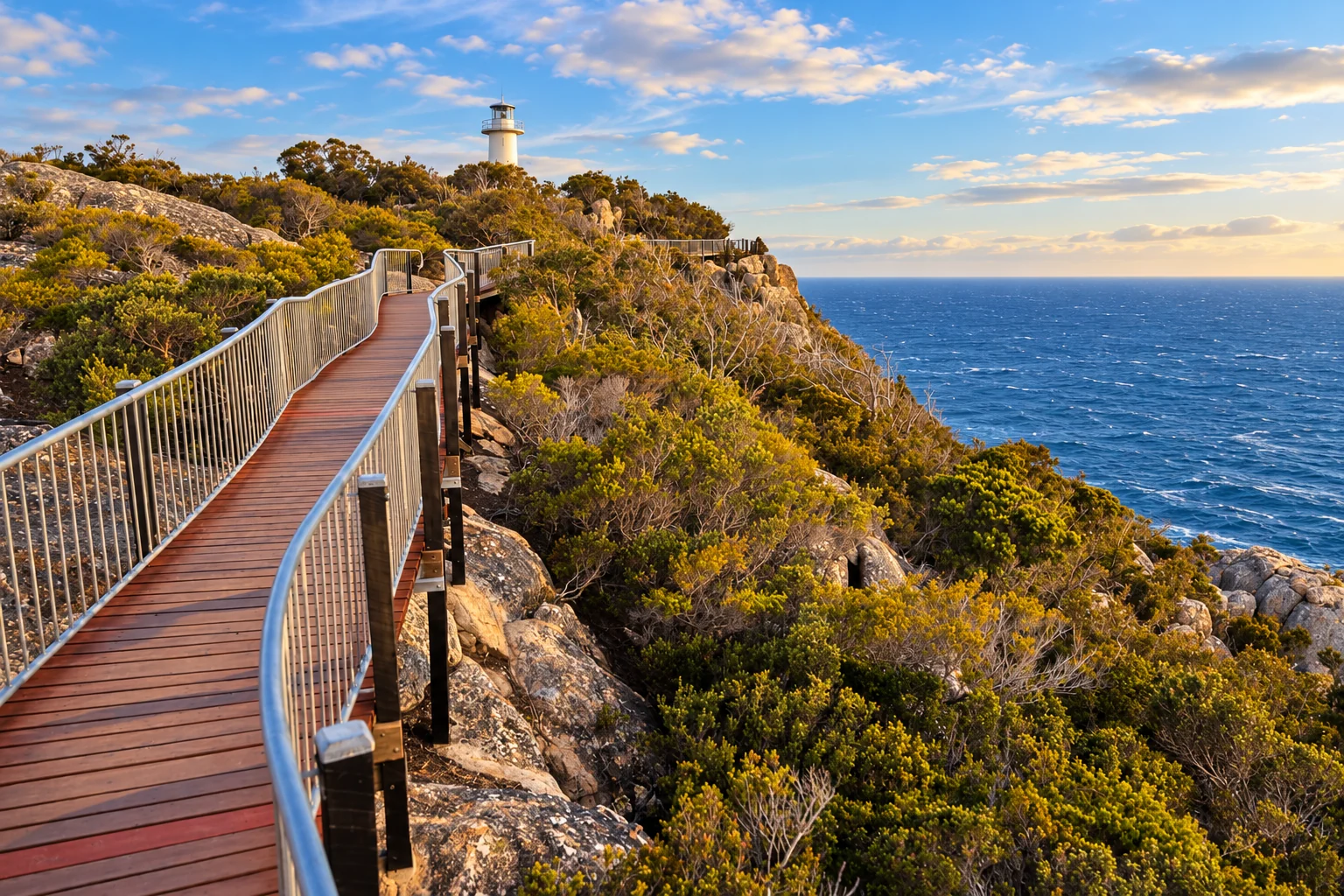
Cape Tourville is the easiest viewpoint. Hike and Explore rates it Grade 1 over about 600 m, and Explora describes a 10-minute boardwalk loop with clifftop views, which suits anyone who wants a view without a climb. Explora also lists May to November as the whale-watching season at the cape. A visit here and a stop at the Visitor Centre make a reasonable arrival-day plan.
Freycinet Walk and Cycle Track
The Freycinet Walk and Cycle Track connects Ranger Creek with the start of the Wineglass Bay and Freycinet Peninsula tracks. It is 4 km one way, takes about an hour, and is rated Grade 2, described by the PWS as suitable for most ages. The surface is hardened or compacted, with gentle hills and occasional steps. Official times along it:
- Ranger Creek to Honeymoon Bay: 2 km one way, about 30 minutes.
- Ranger Creek to the walking tracks car park: 4 km one way, about 1 to 1.25 hours.
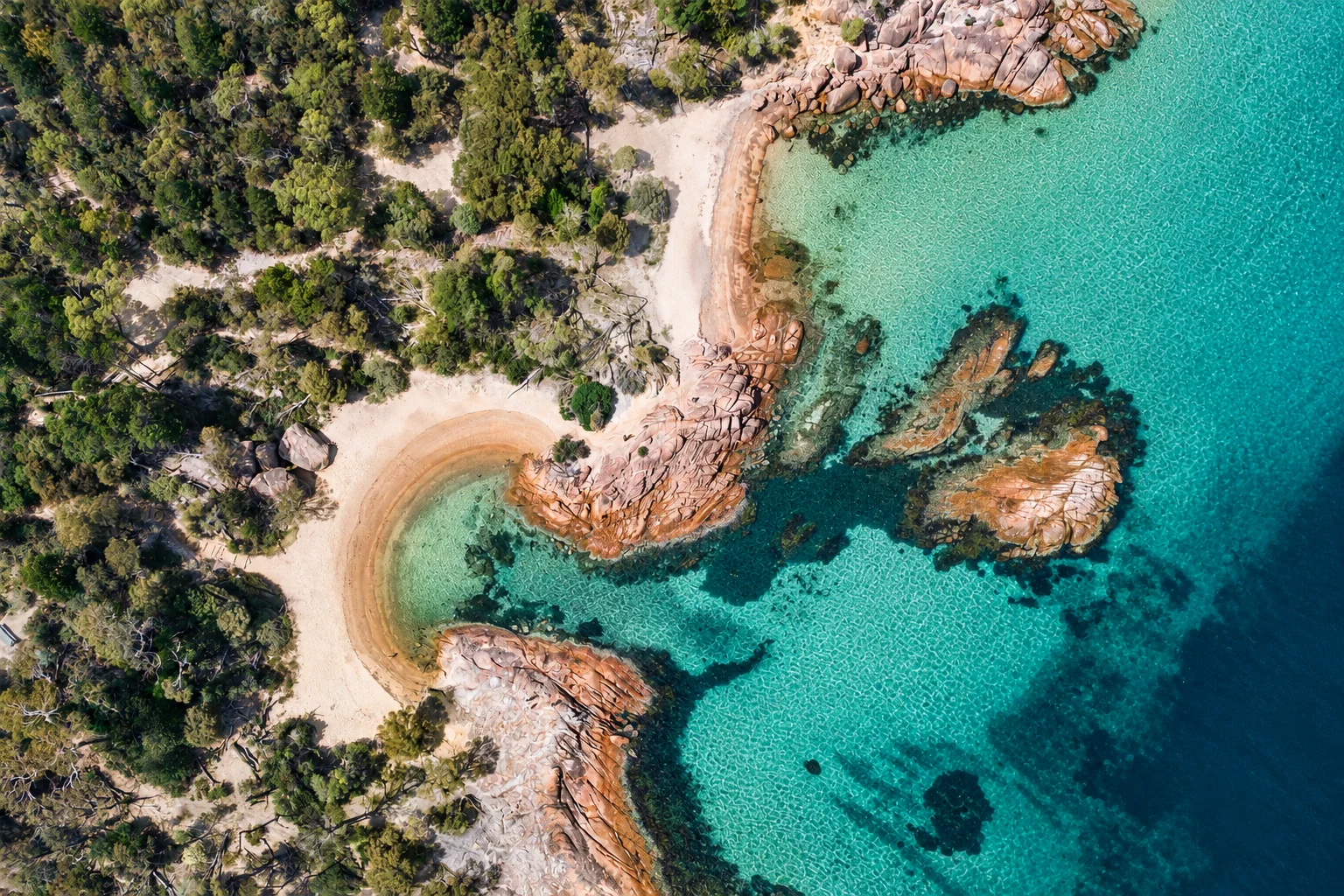
This is the only walking track in the park where bikes are permitted. It is a shared, low-speed, two-way track, and cyclists give way to walkers. Both walkers and cyclists must stop and give way to vehicles at road crossings, and children should dismount before crossing. Watch for loose gravel, bridges, boardwalks and tight corners. Campers at Richardsons Beach or Ranger Creek can walk the track to the Wineglass Bay start without moving the car, and skip the car park crowds. A bike rack sits before the Wineglass Bay walk begins.
Friendly Beaches
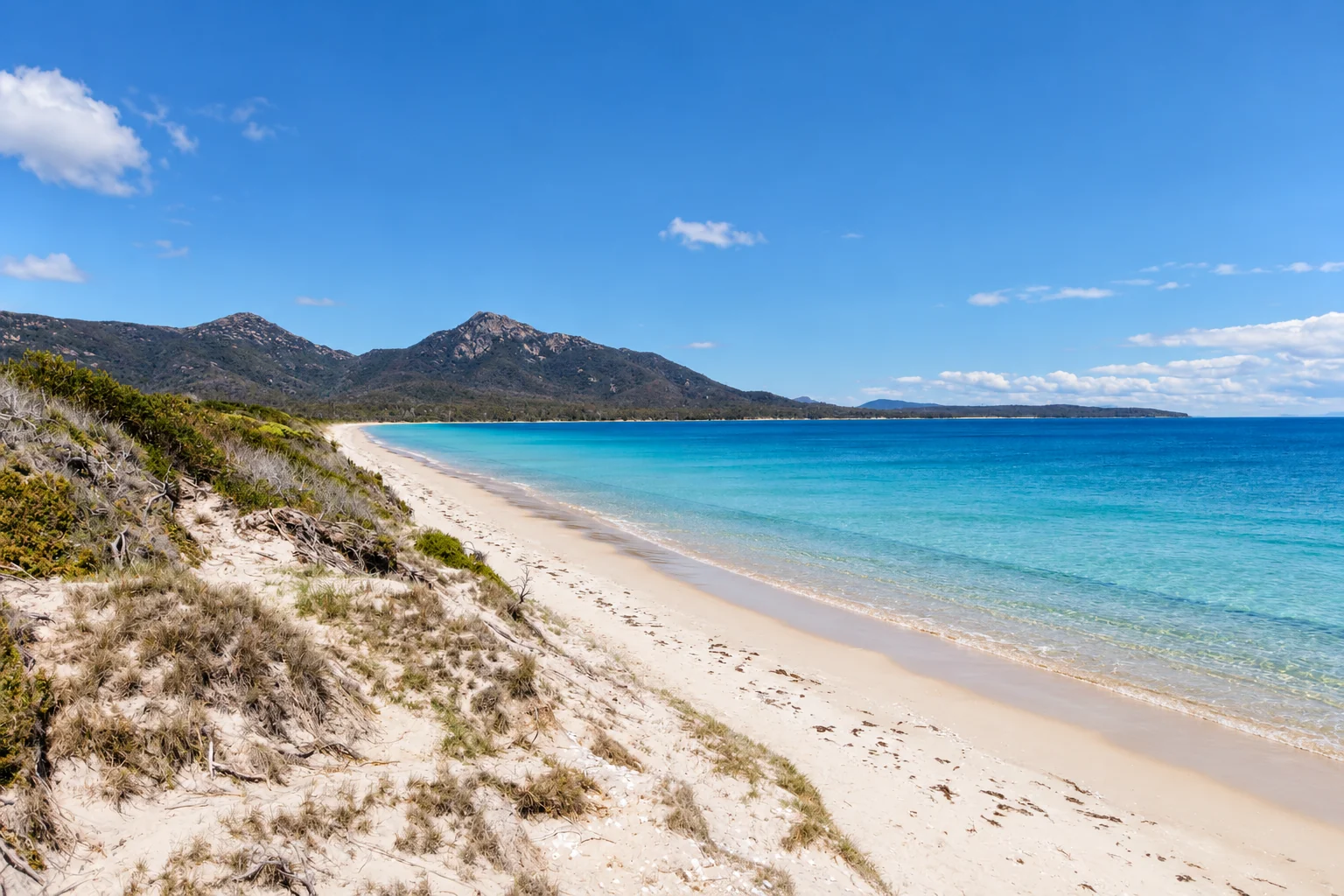
At the northern end of the peninsula, Friendly Beaches offers long white sand and quiet walking, rated Grade 2, with options from 5 minutes to 5 hours and from 100 m to 5 km. The beaches are unpatrolled and swimming is not recommended. Supervise children closely. This is the best spot to try when the main car park is full, and it is also the free-camping area covered below.
Freycinet Peninsula Circuit
Experienced walkers can take on the Freycinet Peninsula Circuit, a 27 km, Grade 3 loop over two to three days that starts at the Wineglass Bay car park. PWS advises walking anticlockwise, down the western side, to reduce the spread of Phytophthora, a root-rot disease that damages native vegetation. Water is scarce, creeks are unreliable, and walkers should boil water before drinking and top up at Cooks Beach. The climb between Cooks Beach and the Wineglass Bay campsite totals about 500 m. The PWS suggests winter as a good season, since creek water tends to be more reliable and the east coast is milder. The Wineglass Bay campsite has no water tanks.
Where to stay
Freycinet has a handful of in-park camping areas, one free camping area, a lodge inside the park boundary, and further accommodation in Coles Bay. Bookings have become more important since the PWS changed its camping system.
Main campgrounds
Since 3 November 2026, PWS’s Parks Online Booking System requires advance booking and payment at 10 fee-charging campground areas, including Freycinet, according to Tasvanlife’s coverage of the change. The Freycinet campgrounds named are Richardsons Beach, Ranger Creek and Honeymoon Bay. Fees are charged per site per night for up to six people, and vary by site type (standard, premium unpowered or powered), so check current rates on the booking system.
Campervans can use only powered sites 1 to 18. A parks pass is required in addition to the campsite booking, and the system covers campgrounds only. Some older listings, such as Camping Tasmania’s directory, describe a ballot for summer and Easter. Those listings predate the new system, so book through PWS and expect summer dates to go first.
According to the Wineglass Bay accommodation page, Richardsons Beach has potable water, toilets and cold showers. It sits next to the Visitor Centre and has accessible toilets as well as accessible powered and unpowered sites. Thorough Travel reports electric barbecues, picnic tables and toilets at Honeymoon Bay and Ranger Creek.
Free camping and walk-in sites
The Friendly Beaches camping area at Isaacs Point charges no camping fee and takes no bookings. Sites for tents, caravans and campervans are first-in, first-served for up to 14 nights. A parks pass is still needed to enter, and facilities amount to pit toilets with no fresh water. Bring all the water you need. The turn-off is about 19 km before Coles Bay township, so you will be a longer drive from the walking tracks than campers at Richardsons Beach.

Cooks Beach is a walk-in campground about 12 km from the Freycinet Ranger Station, and the Wineglass Bay campsite is for walkers on the Peninsula Circuit.
Freycinet Lodge
For a room instead of a tent, Freycinet Lodge is a four-star property on Coles Bay Road inside the park, with 60 rooms in cabin-style accommodation. Room types include Premier Cabin, One Room Cabin and Family Cabin, with balconies, air conditioning and kettles. Check-in is from 2pm and check-out by 10am. The lodge does not take pets and has no capacity for extra beds. It is about a 20-minute walk to Coles Bay township. The Bay Restaurant serves a buffet breakfast daily, 7:30 to 10:00, per Luxury Escapes, and Richardson’s Bistro is closed during winter.
Rates vary widely by date and booking site. The lodge’s own page advertises season deals from $241, and Hotels Combined showed a typical price around $294 per night in late September 2026. KAYAK lists AUD 328.67 for a Standard room and up to AUD 569.61 for a Premier room. Guest reviews are generally positive but mixed on room size and décor, so check recent photos before you commit.
The lodge’s own operator, Freycinet Adventures, runs sea kayaking and e-bike tours. Other Coles Bay hotels start lower, with the cheapest at $228 in the same Hotels Combined search.
When to visit
Freycinet is open all year. The best season depends on whether you want swimming weather or quiet tracks.
Summer, from December to February, is the busiest season. Temperatures run roughly 15 to 22 °C, which suits beach days, but the walking tracks car park fills early during school holidays and at Easter, according to Hike and Explore. If you arrive after mid-morning in peak season, Cape Tourville and Friendly Beaches are sensible fallbacks. Campsites also sell out first for these dates under the new booking system.
Autumn, from March to May, gets strong recommendations for mild, dry, clear weather and fewer people. That claim appears in the Freycinet Resort autumn guide, which is operator-commissioned, and in independent guides such as Tasmania Trails. Spring, from September to November, brings mild temperatures, wildflowers and active wildlife. For a first visit that includes the Wineglass Bay beach walk, autumn or spring gives the best balance of comfortable walking conditions and room to move.
Winter, from June to August, is the quietest period. It is too cold for swimming, but the walking is good and the viewpoints are peaceful. Check that restaurants and campsites are open, since the lodge’s bistro closes for the season. Freycinet also has a drier, sunnier microclimate than other parts of Tasmania, particularly the west coast, according to Tasmania Trails.
Whale watching favours the cooler months. Sources agree on roughly May to November, with humpback and southern right whales migrating along the east coast. The lookout and Cape Tourville are the most convenient vantage points. Whale sightings are a bonus, so do not plan around them.
How long to stay
Opinions vary on time. Roz and Loz suggests most visitors come for a half day, while Absolutely Lucy recommends at least two to three days. For a first trip, two nights is a realistic middle path. Arrive the first afternoon, collect your pass and water at the Visitor Centre, and walk the Cape Tourville boardwalk. Do the Wineglass Bay walk early on day two, then use any remaining time for the Walk and Cycle Track or Friendly Beaches.
Rules, safety and supplies
Freycinet has several rules that catch first-time visitors out, particularly around fire, pets and water.
Fire. Freycinet is a Fuel Stove Only Area. According to PWS, fires are prohibited, and gas and fuel stoves are allowed except on Total Fire Ban days, when no naked flames are allowed in the open, stoves included. Check the fire danger rating before you cook outdoors in summer.
Drones are not permitted in Tasmanian national parks or reserves. Pets are not allowed in the park either, according to Tasmania.com and OnlyTasmania, which also lists the Wineglass Bay walk as off limits to pets, firearms and bicycles. Anyone travelling with a dog needs a different plan for the days at Freycinet.
Water and rubbish. Drinking water is scarce. Refill at the Visitor Centre’s filtered, chilled water station, or at the taps at Honeymoon Bay and the walking tracks car park. Carry out all rubbish, because there are no bins at Wineglass Bay beach.
Wildlife and insects. Possums investigate unattended bags and food, so store food safely and keep gear within reach. Mosquito-borne Ross River virus is present in the area, so use repellent. Wildlife is most active at dusk and dawn, so drive slowly then. Pademelons are common but rarely seen by day, while Tasmanian devils are harder to find as numbers decline.
On the tracks. Freycinet walks often run over steep granite and loose gravel, and PWS recommends sturdy footwear. Cliffs are hazardous and beaches unpatrolled. Tell someone your plans and avoid walking alone. Turn back if conditions worsen or the group tires.
Key Takeaways
- Buy a parks pass before entering: The current Daily Pass is $49.15 per vehicle and the Holiday Pass is $98.35, with the Holiday Pass better value if you visit several Tasmanian parks.
- Match the Wineglass Bay walk to your day: The lookout is 2.6 km return (1 to 1.5 hours), while the beach is about 6 km return (2.5 to 3.5 hours) with roughly 1,000 stairs to climb back up. Start early to beat the midday crowds and find space in the car park.
- Book campgrounds in advance: Since 3 November 2026, Richardsons Beach, Ranger Creek and Honeymoon Bay need online booking. Per-night fees vary by site type and are charged on top of the parks pass. Friendly Beaches remains free and first-come, but has no fresh water.
- Hire a car: Public transport to Coles Bay is limited, and every road to the park is sealed. Hobart is about 2.5 to 3 hours away and Launceston about 2 to 2.5 hours.
- Carry water and follow the park rules: Refill at the Visitor Centre or the Honeymoon Bay and car park taps, and leave drones and pets at home. Only gas or fuel stoves are allowed for cooking, and none on Total Fire Ban days.