
Australia is large, and the major cities are far apart. Sydney and Melbourne are about 865 km apart by road, and most other pairs of capital cities are further. For a first-time visitor building an itinerary that links several cities, a domestic flight (a flight between two Australian airports) is often the only practical option for the longer legs. Trains and coaches cover some corridors, but they take most of a day or a night.
Compare door-to-door time: the time from leaving your accommodation in one city to arriving at your accommodation in the next. Airborne time is only one part of that. On Sydney to Melbourne, a flight is about 1 hour 25 minutes in the air but roughly 3.5 to 4.5 hours door to door, compared with about 11 hours by train and longer still by coach. That gap of six to seven hours or more makes flying the sensible choice on long legs. On shorter legs, or where the train ride is part of the appeal, the advantage shrinks.
Fares, baggage rules, airport transfers and connection times all affect the outcome. The sections below work through each of them using the Sydney to Melbourne corridor as the main example, then add notes on Sydney and Brisbane airports, which many first-time visitors pass through.
Comparing door-to-door time and cost
The Sydney to Melbourne route shows the trade-offs clearly because it has three options: flight, train and coach. The figures below come from several 2026 comparison pages. They differ slightly from page to page, so treat them as ranges.
| Mode | Journey time | Typical one-way fare (AUD) |
|---|---|---|
| Train (NSW TrainLink XPT) | About 11 hours | About $78 to $110 economy; wider range of $110 to $250 |
| Coach | Longer than the train, including rest stops | From about $60 (Firefly) or about $135 (Greyhound); $50 to $100 range |
| Flight | About 1 hour 25 minutes airborne; about 3.5 to 4.5 hours door to door | About $79 to $220 for the flight alone |
The time figures come from Melbourne Tourism’s 2026 comparison and Viamo’s route page. The door-to-door estimate comes from Melbourne Info, which puts it at 3.5 to 4.5 hours, and Aus-Bus, which says about four hours. The XPT is a long-distance diesel train run by NSW TrainLink. It travels between Sydney Central and Southern Cross Station in Melbourne, and Melbourne Info describes one daytime and one overnight service, so check the current timetable at booking.
What the fares leave out
The advertised air fare is only part of the cost. Aus-Bus gives a flight-only range of about $79 to $220. A typical saver fare, plus a checked bag and airport transfers at both ends, comes to about $185. With those extras, the air fare can sit close to the train fare. Melbourne Info says advance air fares can undercut the train, and that the train carries no airport transfer cost and arrives in the city centre. Viamo says coaches are generally the lowest guaranteed fare, while budget airline fares, Jetstar in particular, can fall very low when booked well ahead.
A fair comparison adds these items to each option:
- the fare itself
- the checked bag, if your fare excludes one
- the transfer from your accommodation to the airport or station
- the transfer from the arrival point to your next accommodation
The train and coach both end in central Melbourne. Southern Cross Station includes the coach terminal, and Sydney’s coaches (Greyhound and Firefly) use the Central Station coach terminal.
Cheaper airports and their costs
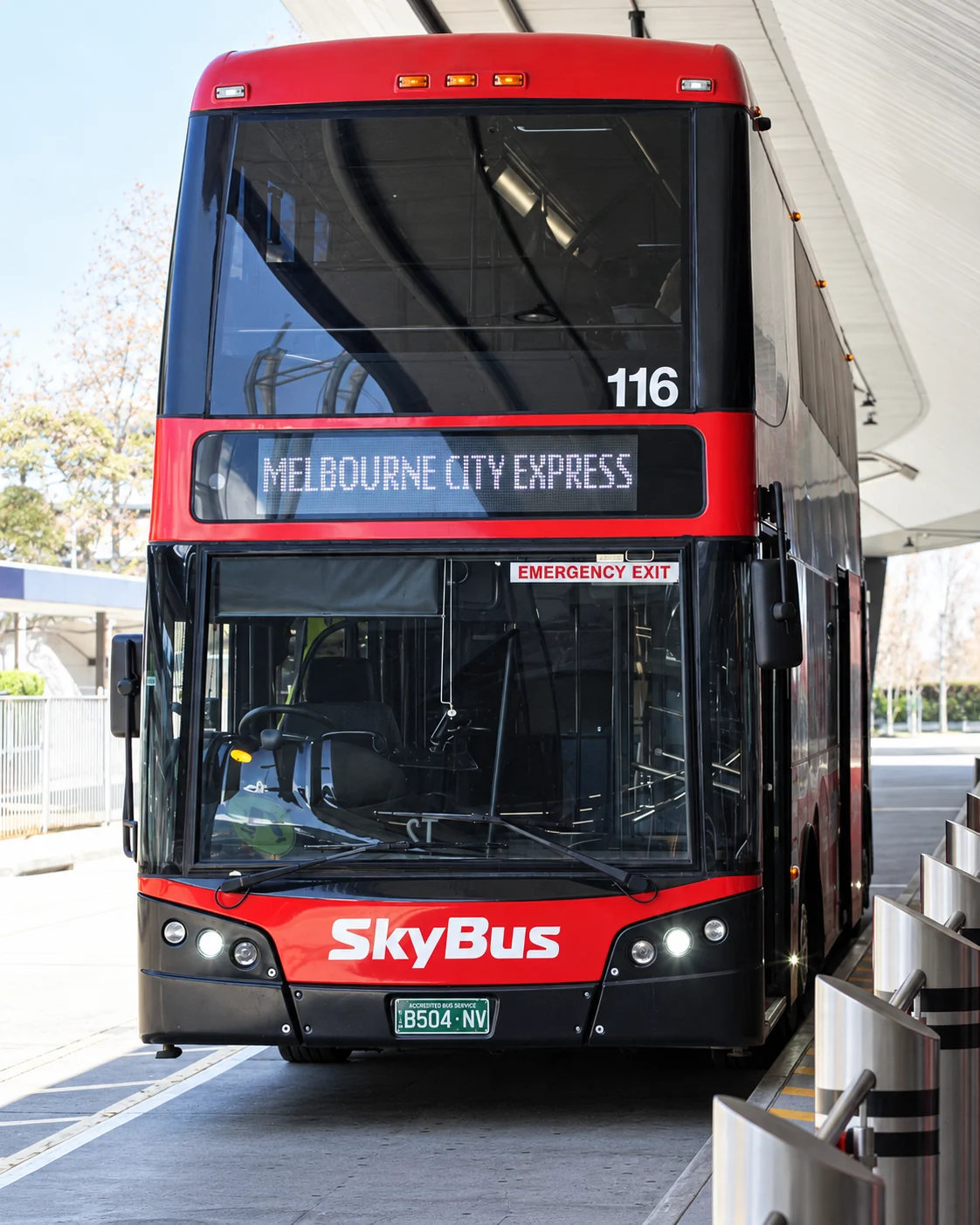
Some routes offer a second airport with lower fares. Melbourne Tourism notes that Avalon (AVV), which sits outside Melbourne, can offer cheaper Jetstar fares, but the SkyBus transfer adds time and reduces flexibility. A saving of a few dollars on the fare can be lost to a longer ride at the other end, so price the whole journey before you choose.
Combining modes
You can mix modes on one itinerary. Melbourne Tourism prices a train in one direction and a flight in the other at $200 to $300 per person. A combination like this suits travellers who want to see the countryside once without committing to the full 11 hours both ways.
When a flight saves meaningful time
A flight saves the most time on long legs, where the ground trip takes a full day or more. Sydney to Melbourne is the clearest example: flying is about six to seven hours faster door to door than the train, and faster still than the coach. The same logic applies to other long pairs, such as Brisbane to Melbourne or Sydney to Cairns, where the train or coach takes a day or longer. A flight on those legs gives you back one or more days of your trip.
Tight itineraries
Flying also makes sense when a missed day would cost you something you have already paid for. If you have a booked tour, a reef trip or a night of accommodation at the destination, a morning flight guarantees you most of the day on arrival. A coach that arrives late at night leaves you without the day you needed.
Short legs and scenic routes
On shorter intercity trips the gap narrows. The airport process adds the same fixed time regardless of flight length. You travel to the airport, check in and pass security, then collect your bags and travel from the destination airport into the city. After those fixed costs, a short hop saves little compared with a direct train or coach into the city centre. Rail and coach routes can also be the experience itself, and a daytime train through the countryside is a legitimate reason to accept a longer journey.
Overnight services
The overnight XPT from Sydney to Melbourne turns the travel time into sleeping time, which reduces its real cost. Fewer hours are lost if you board in the evening and arrive the next morning. Seats on an overnight train are less comfortable than a hotel bed, so judge this against how well you sleep sitting up.
A decision rule
If the ground journey takes more than about eight hours and your budget allows, fly. If it takes under about four or five hours and the train or coach connects city centres directly, compare the full door-to-door costs before assuming a flight is faster. That rule is a judgment based on the Sydney to Melbourne numbers, not an official threshold, but it matches the pattern in the data: once the air leg is only a small fraction of the total, ground transport catches up.
Delays can also reverse the gain. The reliability figures later in this guide show that on busy routes, a flight can run well past its scheduled time.
Planning airport transfers
Getting to and from the airport takes real time and money, and the two airports many first-time visitors use, Sydney and Brisbane, are laid out differently. Melbourne’s airport transfer details are not covered here, so check the airport’s website and your airline before you travel.
Sydney Airport (SYD)
Sydney has three terminals that are not connected airside, so a passenger who changes terminals has to leave the secure area and come back through security. Qantas uses Terminal 3 for domestic flights. Terminals 2 and 3 are adjacent and a short walk apart, so a domestic-to-domestic connection on Qantas avoids a terminal transfer. If you connect between airlines that use different terminals, expect a transfer of about one hour in total, according to Simple Flying. That covers getting off the plane, travelling between terminals and clearing security again.
Two transfer options link the terminals. The free terminal bus runs every 15 minutes from 05:30 to 22:30 and takes about 10 minutes. The Airport Link train is another option. Simple Flying says it charges a station access fee at both airport stations and quotes $8.50 for the Airport Link, so confirm the current fee before you plan the trip. Skyscanner lists the train at 13 minutes to Central from the domestic and international terminals. That puts Sydney’s airport rail trip well inside the time you would spend in a taxi stuck in peak traffic.
Domestic arrivals in Sydney do not go through passport control, according to Skyscanner. A traveller flying in from overseas, though, clears immigration at the first Australian port of entry, so a connection that starts with an international flight is a different case, covered below.
Brisbane Airport (BNE)
Brisbane’s Domestic and International terminals are about 4 km apart in separate buildings. A free bus links them in about 10 minutes, according to Helloroam. If you arrive from overseas and continue on a domestic flight, you collect your bags and clear customs before the domestic leg. Qantas and Virgin Australia passengers can drop bags at the Domestic Transfer Desk.
The Airtrain runs to the city. It takes about 22 minutes from the Domestic Terminal to Brisbane City (Central), according to the Wikipedia entry on the line, which listed an adult fare of $19.80 one way and $37.60 return as of December 2022. That fare is dated, so check the current price and the online discount before you budget.
Practical steps
Look up the transfer at each end of every flight and count it as part of the journey. When the airport is on a rail line and your accommodation is near a station, take the airport train instead of a taxi. For early flights, check the first train time before you book, because a flight that leaves before the first service forces a taxi or rideshare. If you have an early departure, pick accommodation near the airport train line for the night before.
Checking baggage and check-in rules
Baggage rules decide whether a cheap fare stays cheap. Allowances differ by airline, by fare and by route, and a multi-city trip on several airlines means a different set of rules on each leg. Check the exact allowance for each ticket when you book and again before you pack.
Qantas
Qantas publishes its domestic checked allowance, updated October 2026:
- Economy: one piece up to 23 kg
- Premium Economy: two pieces up to 23 kg each
- Business: two pieces, each with a higher weight limit than Economy
Qantas also sets a weight limit for each domestic checked piece and a maximum combined size, so check the allowances page before you pack. Dash 8 services (smaller propeller aircraft used on some regional routes) and Lord Howe, Christmas and Cocos (Keeling) Islands have different allowances. Power banks must go in your carry-on, not in checked baggage. If part of your journey runs on a partner airline, the allowance may differ, so check the booking under Manage Booking.
On carry-on, Qantas’s allowances page lists two pieces for Economy, each within set size and weight limits. A dash 8 aircraft allows one piece. Some guides quote higher limits per item or in total for Qantas, so if you carry a heavy bag, plan around the stricter figure.
Virgin Australia and Jetstar
Virgin Australia changed its carry-on rules from 2 February 2026. Economy passengers now get one standard bag up to 8 kg plus a personal item, with no single item over 8 kg. The previous 7 kg total, which could be split across two bags, no longer applies. Business and Economy X fares allow a higher total weight split across two smaller bags, with no item over 8 kg. Virgin’s checked allowances depend on the fare. One guide says the most basic fare carries no checked allowance, so read the fare conditions before you pay.
Jetstar’s Starter fare allows one main carry-on bag up to 56 x 36 x 23 cm plus one small item, sharing a 7 kg total. Carrysizer says this applies to travel before 2 February 2027. A paid upgrade allows a higher carry-on weight depending on route and fare availability, according to Luggage Direct.
Extra bags cost less online
Qantas increased the price of additional baggage on domestic and international flights from 9 June 2026. The allowances page does not list the new amounts, so check the purchase page for the current price. Buying extra bags online for Qantas-coded flights ahead of time avoids the airport fee for bags over the allowance. Yahoo Lifestyle gives about $60 for extra carry-on at domestic check-in and about $85 at the boarding gate, and about $15 per domestic flight for a Virgin Economy X upgrade, though it does not date those figures.
Packing for a multi-city trip
Pack to the strictest allowance on your itinerary. If one leg is on a Jetstar Starter fare with 7 kg of carry-on and no checked bag, you either pay for a bag on that leg or pack light for the whole trip. Keep power banks, medication, valuables and one change of clothes in your carry-on. A checked bag that arrives a day late is less disruptive if your carry-on holds the essentials.
Allowing for connection buffers
A connection is a change from one flight to another, usually at an airport that is neither your starting point nor your destination. Many multi-city trips involve a connection, particularly when a visitor from overseas continues to a second city on a separate flight. The time you allow depends on the airport, the airline and whether both flights are on one ticket.
Official and database minimums
The minimum connection time (MCT) is the shortest gap an airline or booking system accepts between two flights. Qantas set domestic-to-domestic connections at Sydney, Melbourne, Perth, Brisbane and Adelaide at 40 minutes, up from 30 minutes, for new bookings from 18 August 2022, according to its notice to travel agents. The notice says the change gives customers and their bags enough time to make their flights.
Industry database figures, verified by Travelvient in June 2026, are lower, and they are minimums that assume nothing goes wrong:
- Sydney: 30 minutes domestic to domestic and 60 minutes domestic to international. Any connection involving an international arrival is 90 minutes.
- Brisbane: 30 minutes domestic to domestic, 90 minutes domestic to international and 90 minutes international to domestic.
- Melbourne: 75 minutes domestic to domestic and 150 minutes off an international arrival.
Helloroam says Sydney, Melbourne and Brisbane airports publish no minimum connection time of their own and tell passengers to check with their airline.
Add time beyond the minimum
A floor assumes a smooth day. Add buffer for each factor that applies to you:
- Terminal changes. A Sydney connection between airlines in different terminals takes about an hour, according to Simple Flying. Brisbane’s two terminals sit 4 km apart.
- Checked bags. On a single ticket, the airline transfers your bags. On separate tickets you collect and re-check them yourself.
- Children or reduced mobility. Everything takes longer. Families on the Australian Frequent Flyer forum suggest allowing at least 90 minutes to two hours.
- International arrivals. You clear immigration, collect bags and clear customs before the domestic leg, so use the 90-minute or longer figures above as a starting point.
Separate tickets
Two flights bought on one booking are protected: if the first arrives late, the airline rebooks you. Two flights bought separately carry no such protection. The forum advice for separate tickets or international legs is two to three hours. That is opinion rather than official guidance, but it is sensible given the risk: a missed second flight on a separate ticket usually means buying a new fare.
The simplest way to avoid the risk is to book your whole multi-city route on one ticket where the airline offers it, or to leave an overnight gap before any flight you cannot afford to miss, such as a tour departure or an international flight home.
Planning for delays, cancellations and refunds
Buffers matter because Australian domestic flights run late often enough to plan around. The Australian Competition and Consumer Commission (ACCC), the federal competition regulator, publishes a domestic airline monitoring report using on-time data from the Bureau of Infrastructure and Transport Research Economics (BITRE). It counts a flight as on time if it arrives within 15 minutes of schedule, and as cancelled if it is cancelled or rescheduled less than seven days before departure.
What the October 2025 figures show
In October 2025, industry on-time arrivals were 74.1%, against a long-term average of 80.6%. The ACCC attributed the drop mainly to adverse weather, including cross winds in Sydney. By airline, on-time arrivals were:
- Qantas: 75.2%
- Jetstar: 73.1%
- Virgin Australia: 72.1%
- Rex: 69.6%
The industry cancellation rate was 2.1%, slightly below the long-term average of 2.2%. Qantas and Rex had 2.6%, Jetstar 1.9% and Virgin Australia 1.4%. Cancellations concentrated on some routes: Canberra to Sydney at 6.9%, Canberra to Melbourne at 4.5%, Melbourne to Sydney at 3.9%, Brisbane to Melbourne at 3.4% and Brisbane to Sydney at 3.0%. Rex now flies regional and remote routes only, after withdrawing from major-city routes in July 2024, so it matters mainly for country destinations.
A single month is a snapshot. July 2025 was worse after east-coast storms, including a "bomb cyclone" in Sydney, when Virgin Australia’s on-time rate fell to 66.8%, the lowest of the monitored airlines that month. The data show that bad weather on the east coast brings clusters of delays and cancellations, and the busiest routes between Sydney, Melbourne, Brisbane and Canberra are the most exposed.
Why a cancellation hurts more at busy times
The ACCC notes that when load factors (the share of seats that are filled) are high, passengers can wait longer to be rebooked after a cancellation. Industry load factor was 84.4% in October 2025. During peak periods, such as school holidays and the AFL and NRL Grand Finals, later flights have fewer empty seats. The ACCC, citing Airservices Australia, said airlines operated 2,799 domestic flights on 18 September 2025, the busiest day for regular public transport since 2019.
For a visitor, the practical response is to avoid scheduling a domestic flight on the day of a fixed commitment. Fly the day before a tour start, and avoid the last flight of the day if you must reach a destination by a certain time. A morning flight that is cancelled leaves you the rest of the day to be rebooked.
Your rights if a flight is cancelled
The federal government’s Aviation White Paper introduced a Charter of Rights for airline customers. The ABC reported in August 2024 that it would entitle customers to refunds for disrupted, cancelled or unreasonably delayed flights and that the scheme was expected to operate by 2026. Airlines will also have to explain delays and cancellations in regular reports to government. Executive Traveller reported in April 2026 that the rules promise cash refunds for major delays but stop short of European-style fixed compensation. Expect a refund or rebooking, with no cash payment on top, and check the airline’s current policy when you book.
Travel insurance fills the gap for costs the airline does not cover, such as a prepaid hotel night in the city you could not reach. Check that your policy covers domestic flight disruption before you rely on it.
Key Takeaways
- Compare door-to-door time and total cost: Add airport travel, check-in, security, bag collection and transfers at both ends. On Sydney to Melbourne, that still leaves a flight about six to seven hours ahead of the train.
- Fly the long legs and consider ground transport on short ones: When rail or coach takes a full day, a flight gives you that day back. On shorter legs, a train or coach into the city centre closes most of the gap.
- Check baggage rules for each ticket: Qantas Economy includes one 23 kg checked bag, while Virgin Australia and Jetstar allowances depend on the fare and carry-on limits changed in 2026. Pack to the strictest limit on your route.
- Leave more time than the minimum connection: Qantas sets 40 minutes for domestic connections at major airports, but allow longer for terminal changes, international arrivals, children, and especially separate tickets.
- Plan for delays on busy routes: Only about three in four flights arrived on time in October 2025, and Sydney, Melbourne, Brisbane and Canberra routes had the highest cancellation rates. Avoid flying on the day of a fixed commitment.