
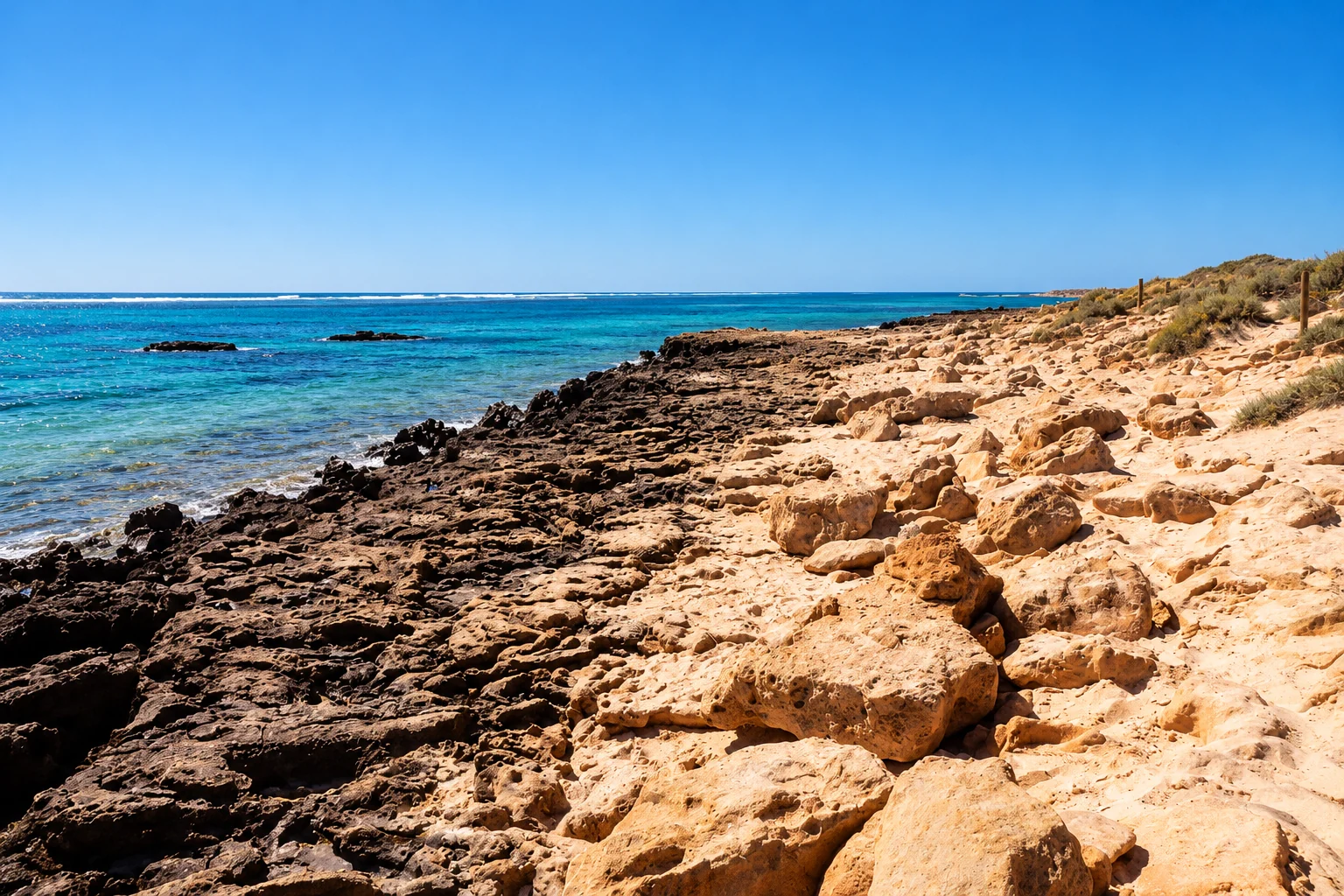
Turquoise Bay is a white sand beach on the Ningaloo coast of Western Australia, inside Cape Range National Park about 60 km from Exmouth. It is known for clear water, coral close to shore and a drift snorkel, where a gentle current carries you along a stretch of reef. The beach is part of the Ningaloo Coast World Heritage Area, inscribed on 24 June 2011, which covers 604,500 hectares.
There is no ticket for the beach itself. You pay the Cape Range National Park entry fee at the park boundary or in advance, drive your own vehicle, and bring food and water from Exmouth, as nothing is sold at the beach. Your main decisions are the time of year, the tide and whether your swimming ability suits the currents, which are strong at times. Rangers do not patrol the beach regularly.
Snorkel areas and the sanctuary rule
The official visitor guide calls Turquoise Bay "just as the name suggests a beautiful white sandy beach with turquoise blue water" and describes it as the ideal location for swimming, snorkelling or relaxing on the sand. It sits about 9 km south of Milyering Discovery Centre, the park’s northern information point. Coral and marine life are close to the shore, so the bay is one of the most visited spots in the park.

The beach has two snorkelling areas. The Bay Snorkel Area is the sheltered section in front of the Bay Loop car park, and the Drift Snorkel Area is reached from the Drift Loop car park. A walk along the sand connects the two car parks. The official map also marks Sandy Point as a danger zone.
The bay lies in a sanctuary zone, so the rule is "look but don’t take". Penalties apply for extractive activity, and collecting shells from Ningaloo Marine Park is not permitted. In 2022, TripAdvisor’s Travellers’ Choice awards ranked the beach No. 1 in the South Pacific and No. 3 in the world, according to the same regional tourism page.
Entry fees and passes
Turquoise Bay has no separate fee. You pay standard Cape Range National Park entry, and as at October 2026 the park page lists these rates:
| Category | Fee |
|---|---|
| Standard vehicle (12 or fewer occupants) | $17 per vehicle |
| Concession vehicle | $10 per vehicle |
| Large vehicle (more than 12 occupants) | $8 per person ($3.50 concession) |
| Motorcycle | $10 (no concession) |
Fees are paid at park entry stations, at Milyering Discovery Centre, or at the Parks and Wildlife office in Exmouth. Current fees are listed on parkstay.dbca.wa.gov.au. Shothole Canyon and Charles Knife Canyon do not charge park entry fees.
If you plan to visit several Western Australian parks, a pass can work out cheaper than paying at each gate. The Parks and Wildlife fees and passes guide (dated October 2023) lists the Holiday Pass at $30 for 5 days, $50 for 14 days and $70 for four weeks, each giving unlimited entry to all parks. The Annual All Parks Pass costs $130, or $80 for concession holders. Local residents and ratepayers can buy the Annual Local Park Pass for $30. Passes are sold online, at Parks and Wildlife offices and at selected tourist outlets and visitor centres. They must be displayed in the vehicle window, and online passes must be printed first.
Camping fees are charged per person per night on top of entry fees. Entry fees apply on the day of arrival, and campers can leave and re-enter during their stay without paying again. Ningaloo Marine Park has no visitor fees, and Milyering Discovery Centre is free to enter.
Bookings and tours
Turquoise Bay needs no booking. A few nearby activities do.
Camping. Online booking is essential and is made at parkstay.dbca.wa.gov.au. Bookings open year-round, up to six months ahead. Camping is permitted only at designated sites between Boat Harbour and Ned’s Campsite. Check-in is at 11 am and check-out at 10 am. Tulki campground is about 2 km south of Turquoise Bay, according to Wikivoyage.
Whale shark tours. Operators in Exmouth run these, and the park does not take bookings for them. Ningaloo Whaleshark Swim lists its prices by season on its pricing page, last modified 12 October 2026:
| Season | Adult | Senior | Child (6 to 16) |
|---|---|---|---|
| Peak (WA April and July school holidays) | $690 | $670 | $650 |
| Main (27 March to 31 August, excluding April and July school holidays) | $660 | $640 | $620 |
| Shoulder (15 to 26 March and 1 September to 15 October) | $630 | $615 | $600 |
The school-holiday exclusion dates are 10 to 25 April and 3 to 25 July. Observers who stay on the boat pay $290 when accompanying a swimmer and $350 when not, and a child observer under 6 pays $50. A family of two adults and two children costs $2,260. The price covers pick-up and drop-off from select accommodation, a full-day boat trip from about 7:00 am to 4:30 pm, in-water support, multiple snorkels on Ningaloo Reef, food and briefings. Bookings are online or on 0497 005 692.
Three Islands Whale Shark Dive advertises tours from AUD 620 that include a spotter plane, free photos, a buffet lunch and a no-sighting guarantee. It takes bookings on its booking page and on 1800 138 501. Prices change by season, so confirm the figure when you book.
Turtle tours. Parks and Wildlife runs evening turtle eco-education tours from December to March. Book through the Ningaloo Visitor Centre on (08) 9949 3070.
Opening times
Milyering Discovery Centre is open Monday to Sunday, 9:00 am to 3:45 pm, and closed on Christmas Day, as listed on the Milyering page. Wikivoyage reports that the gift shop is open until 3:30 pm daily and that hired snorkel gear must be returned before closing. The Ningaloo Visitor Centre in Exmouth town is a separate facility with its own hours.

The beach has no gate or opening hours. It is open 24 hours a day, year-round, though the park’s guidance is to avoid driving at night because of kangaroos. Roads can deteriorate or close after rain, so check alerts.dbca.wa.gov.au before you leave Exmouth. The Emergency WA site, emergency.wa.gov.au, covers wider hazards such as cyclones.
Getting to Turquoise Bay
You need your own vehicle. The beach is roughly 60 km from Exmouth, about 45 to 50 minutes by car. Somewhere After the Detour (published June 2026, updated July 2026) describes the road as sealed all the way to Yardie Creek and fine for a 2WD. A campervan hire operator says the same for Turquoise Bay, the other beaches and the gorges.
From Exmouth, head north on Murat Road, turn left onto Yardie Creek Road, follow the Cape Range National Park signs and take the Turquoise Bay turnoff on the right. The speed limit in the park is 80 km/h. Wildlife is active after sunset, so kangaroos are a hazard for anyone driving at dusk.
To reach Exmouth, Qantas flies from Perth in about 90 minutes, according to Coral Coast. Driving from Perth takes about 14 hours, per Perth Is OK. Flying in means hiring a car in Exmouth, as there is no public transport to the beach.
The park’s access roads are mostly 2WD, but conditions deteriorate quickly after rain and access can be restricted. Vehicles are not allowed on the beaches, except at designated boat-launch and kayak access points. Dogs are not permitted in the park.
Parking and facilities
The beach has two car parks. Bay Loop serves the sheltered bay, and Drift Loop serves the drift snorkel. A travel guide reports that parking is free, since the fee is for park entry.
There is no shop, café or food outlet at Turquoise Bay, so bring water, food, sun protection and snorkelling gear from Exmouth. Milyering, 9 km north, has a public telephone and Telstra mobile reception. Milyering Discovery Centre can be reached on (08) 9949 2808 or milyering@dbca.wa.gov.au, and the Parks and Wildlife Exmouth office on (08) 9947 8000. Download the free Emergency+ app before the trip. Without mobile coverage it cannot connect a call to 000, but it gives you your GPS location to pass on.
Swimming and snorkelling safety
The park authority’s guidance on the bay is direct. Dangerous currents occur at Turquoise Bay. They form when water builds up in the lagoon behind the reef, and large waves and a high tide increase the flow out through gaps in the reef. Strong currents can also occur on the beach immediately west and south of the bay. The official guide advises inexperienced swimmers not to swim or snorkel in strong currents, especially alone, and to join a licensed tour operator instead. Everyone should read the signs at the beach entry points and assess conditions from the beach. If you are unsure, stay well inside the bay, where strong currents are less likely. The guide’s rule is "If in doubt, don’t go out."
The drift snorkel is the feature that attracts most visitors, and it suits confident swimmers. Coral Coast says moderate to strong currents form because of a break in the reef, and that weak or inexperienced swimmers should not attempt it. A local travel guide notes that the reef extends more than 1 km offshore, the ocean can be rough with strong undercurrents, and the drift suits moderate to high fitness. Travel guides place the strongest currents at the southern point of the sandbar and the northern end of the drift loop. It recommends that less experienced swimmers stay in the Bay Loop area, where conditions are calmer, and head for shore if the current strengthens. Follow the signs on arrival, and ask the rangers at Milyering about the day’s conditions and tide before you set off.
The park’s behaviour rules apply in the water. Never snorkel alone, snorkel within your ability, and stand on sand and never on coral. Touching coral damages it.
Best time to visit
The cooler months are the most comfortable. Summer temperatures often exceed 45°C, and winter ranges from the low 20s to the low 30s °C. The park page advises that walks should only be attempted between April and September, and the guide recommends carrying at least 4 litres of water per person on any walk. Tropical cyclones occasionally occur between November and April. Travel guides note that November to March brings fewer tourists, but temperatures can exceed 40°C. The dry season from April to October brings warm, sunny weather and minimal rain, according to a travel guide.
The wildlife calendar also shapes the season:
- Whale sharks are in the area from early March to late August, according to the tour operators, and operators say they usually show up off Exmouth at the beginning of March.
- Humpback whales migrate north from June and return to rest in the Exmouth Gulf until early November.
- Turtle mating runs from September to December and nesting from October to March. Hatchlings emerge about 60 days after laying.
Tide matters more than season for snorkelling. Snorkel guides recommend a tide of 1.2 m or higher, because at low tide you risk scraping on the coral. Check a tide table for Exmouth before you leave and plan the snorkel around it.
Within the day, early morning, from about 7:00 to 9:00 am, is the quietest time, and the water is clearer. Weekdays are quieter than weekends. In hot months, plan to snorkel early, rest in the shade at midday and leave before the worst of the afternoon heat.
How much time to allow
Allow two to three hours at the beach if you want to snorkel and rest, as A snorkelling guide suggests. Add the 45 to 50 minute drive each way from Exmouth. A half day covers Turquoise Bay and a stop at Milyering Discovery Centre, which has self-guided displays, audiovisuals and brochures on the World Heritage Area. A full day lets you add a gorge walk or Yardie Creek. If you plan to snorkel early and also walk, the heat sets the order of the day: snorkel in the morning and keep walks for the cooler months.
Nearby snorkel spots, walks and wildlife
Other snorkelling. At Lakeside, walk 500 m south along the beach from the car park to the sanctuary markers and snorkel between the beach and the in-water buoys. Oyster Stacks is for high tide only, with a minimum tide of 1.2 m, and its entry is sharp and rocky. Coral Bay, further south, has snorkel tours run by operators and a Parks and Wildlife information hut.
Walks. The park’s walks are graded from Class 1 (suitable for reduced mobility) to Class 4 (moderate to high fitness).
| Walk | Class | Distance and time | Location |
|---|---|---|---|
| Mangrove Bay Bird Hide Walk | 1 | 100 m return, about 10 minutes | 8 km north of Milyering |
| Mandu Mandu Walk | 4 | 3 km return, about 2 hours | 14 km south of Milyering |
| Yardie Nature Walk | 1 | 1.2 km return, 40 minutes | 39 km south of Milyering |
| Yardie Gorge Trail | 4 | 750 m return, 1 hour | Yardie Creek |
| Shothole Canyon Walk | 4 | 100 m return, 15 minutes | Turnoff 17 km south of Exmouth |
| Badjirrajirra Walk | 4 | 6 km return, 3 hours | Charles Knife Road turnoff 22 km south of Exmouth |
The final 12 km of the Shothole Canyon road is four-wheel-drive only.
Wildlife. Black-flanked rock wallabies are visible at the Mandu Mandu and Yardie Creek gorges, and the park has more than 160 bird species. Whale shark tours are the most reliable way to see the animals themselves.
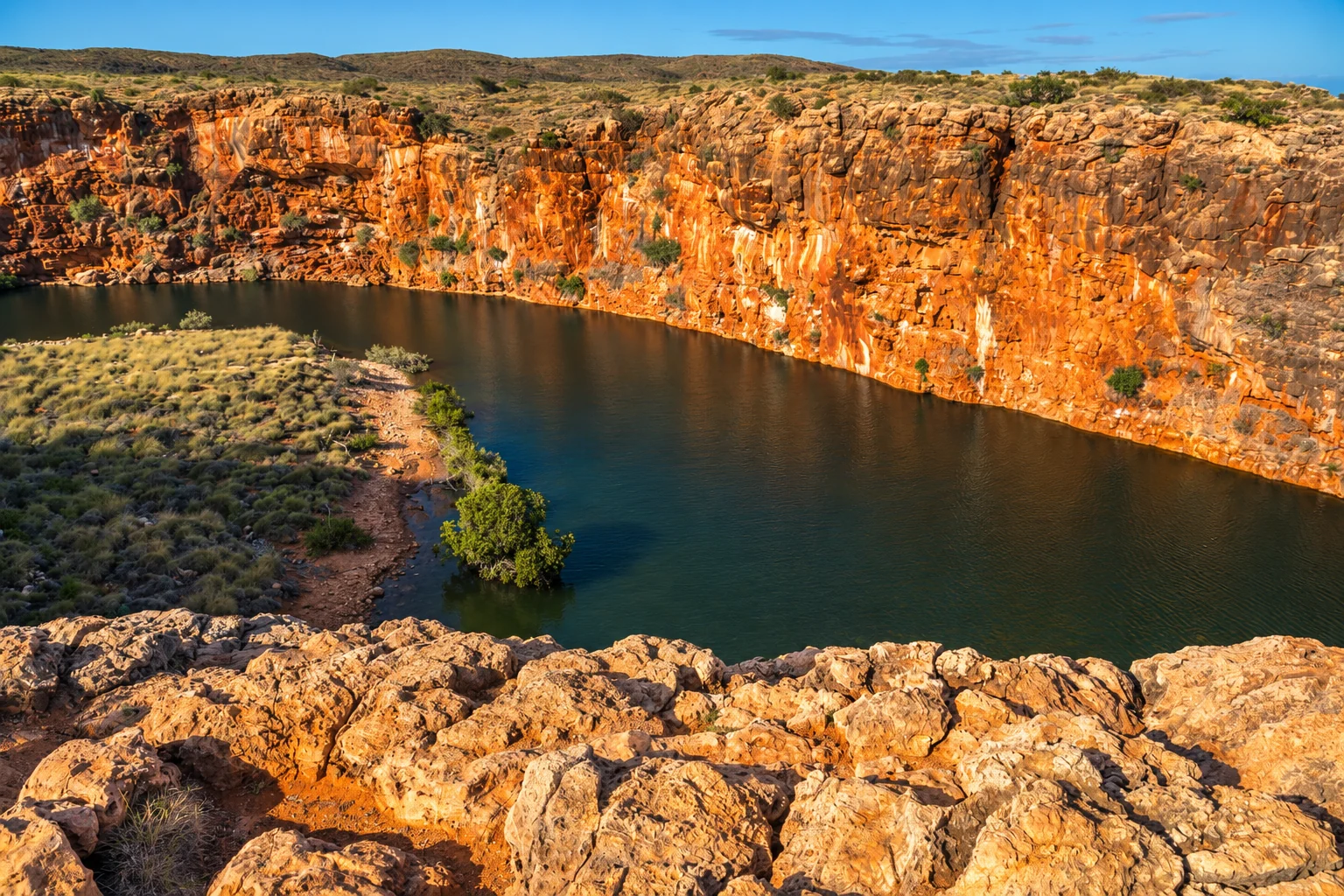
Yardie Creek and the turtle centre. The sealed road ends at Yardie Creek Gorge. Crossing the creek to continue south needs a 4WD, and the creek can become impassable because of tides and weather, so check with Milyering Discovery Centre. A travel listing says kayaking, paddleboarding, swimming and hiking are allowed at Yardie Creek, and powered boats are not allowed. The Jurabi Turtle Centre is on Yardie Creek Road, about 20 minutes north of Exmouth, and has free displays about marine turtles all year.
Where to stay
There is no accommodation at Turquoise Bay. Inside the park, camping at designated sites needs a booking through ParkStay (see above). Yardie Homestead Caravan Park is the closest caravan and RV park, with powered sites and cabins. Most visitors base themselves in Exmouth, where tour pick-ups, supplies and fuel are available.
What to remember before you go
- Pay park entry, not a beach ticket: Turquoise Bay costs $17 per standard vehicle ($10 concession) as the Cape Range National Park entry fee. A Holiday Pass starting at $30 suits visits to several parks.
- Match the swim to your ability: Currents at the bay are dangerous at times, and rangers do not patrol the beach. Inexperienced swimmers should stay in the sheltered bay or use a licensed tour operator.
- Snorkel at a tide of 1.2 m or higher, early in the day: Mornings from about 7:00 to 9:00 am are quietest, and a higher tide protects you from scraping on coral.
- Visit in the cooler months: Summer temperatures often exceed 45°C, and the park page advises walking only from April to September. Whale sharks are in the area from early March to late August.
- Bring everything from Exmouth: The beach is about 60 km away on a sealed road and there is no shop on site. You need your own vehicle. Check alerts.dbca.wa.gov.au before you set off.