
Rottnest Island is a car-free island off the Western Australian coast, reached by ferry from Fremantle or Perth. The crossing takes about 30 minutes from Fremantle and about 90 minutes from Perth. Most visitors come for the quokkas (small marsupials about the size of a domestic cat), the bike loop and the beaches. Every visitor pays an island admission fee, which ferry operators collect at booking and include in the fare.
Ferry timetables, bike hire and the island’s swimming and wildlife rules shape most of a day there. Check current prices and timetables on the official sites before you travel.
Ferries from Perth and Fremantle
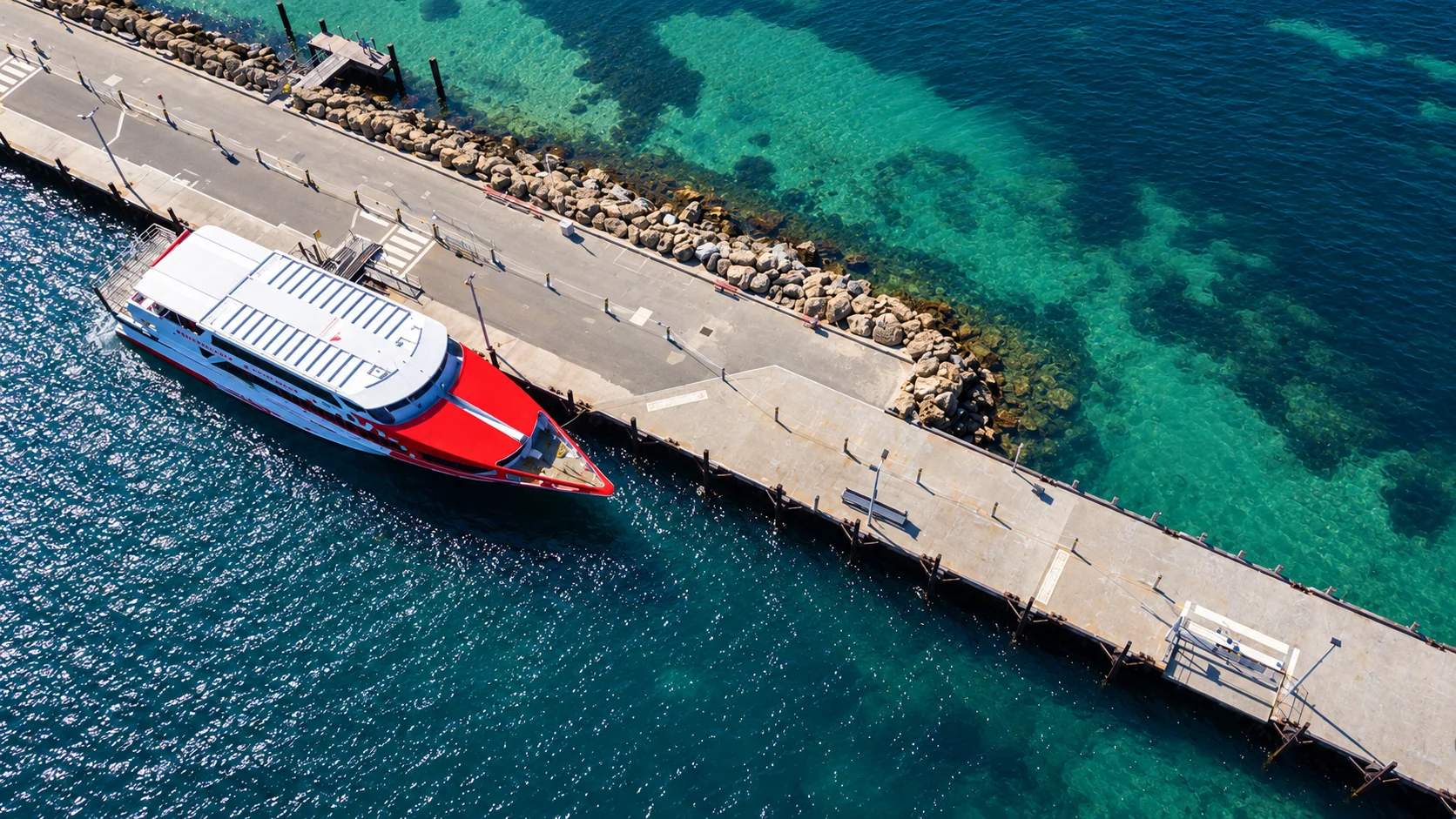
SeaLink ferries leave from two places: O’Connor Landing at Victoria Quay in Fremantle, and Barrack Street Jetty in Perth. The Fremantle sailing takes about 30 minutes. The Barrack Street sailing takes about 90 minutes, so it suits visitors staying in the CBD who prefer to skip the trip to Fremantle, while the shorter crossing leaves more of the day on the island.
The timetable changes by season and day of the week. For 12 October to 1 November 2026, the Monday to Thursday timetable lists a Barrack Street Jetty departure at 8:30am, a return from Rottnest at 8:00am, and Fremantle departures including 7:00am, 9:00am and 9:45am. The Friday to Sunday block lists Rottnest departures at 8:00am, 9:00am, 10:00am, 10:30am, 12:00pm and 2:30pm, plus a 4:30pm sailing listed as returning to the Perth CBD only. SeaLink states that the timetable is subject to change without notice, so confirm the sailing times for your travel date on the SeaLink timetable before you plan the day around a return time.
SeaLink’s site currently carries a notice about limited parking and road closures near the Fremantle terminal. Check the ferry status page before you travel, and consider public transport or a drop-off. Book through SeaLink’s online booking page.
Ferry fares and the admission fee
SeaLink’s same-day return fares from Fremantle B-Shed are valid from 1 July 2026 to 31 March 2027. The totals below combine the ferry fare and the island admission fee, which is paid at booking.
| Category | SeaLink fare | Admission | Total |
|---|---|---|---|
| Adult | $68.50 | $21.50 | $90.00 |
| Concession / Student | $62.50 | $21.50 | $84.00 |
| Youth (13 to 16) | $62.50 | $11.00 | $73.50 |
| Child (4 to 12) | $36.00 | $11.00 | $47.00 |
| Infant (0 to 3) | Free | Free | Free |
| Family (2 adults, 2 children) | $173.00 | $57.00 | $230.00 |
These come from SeaLink’s fares page, which adds that fares may vary with dynamic pricing based on passenger demand and time of travel. Treat the table as a guide and confirm the price when you book.
The admission fee is a government charge. SeaLink collects it on behalf of the Rottnest Island Authority (RIA), the body that manages the island, and it pays for conservation and the upkeep of facilities. The RIA fees and charges page lists the fee for 1 July 2026 to 30 June 2027. A single-day visit costs $21.50 for an adult, $11 for a child aged 4 to 16 and $57 for a family of two adults and two children. An extended stay, where you return on a different day, costs $28.50 for an adult, $14.50 for a child and $75 for a family. Children under four pay nothing.
The Rottnest Island Regulations 1988 exempt a few groups. Regulation 5 covers children under four, Authority members and permanent residents. It also covers crew of a domestic commercial vessel or commercial aircraft, and anyone who has already paid and has not returned to the mainland since. The Authority may also reduce, waive or refund fees.
Visitors arriving by private boat or plane pay separately. Vessels entering the marine reserve must pay for all passengers, and the RIA’s annual vessel sticker for 1 September 2026 to 31 August 2027 ran from $370.50 for boats from 3.75 m to under 8 m up to $1,066 for vessels of 20 m and over, with a 50% discount on annual fees bought after 1 April each year. Private aircraft pay $65 per landing or $589 for an annual aerodrome permit that includes admission fees. The fees page has the current schedule.

Getting around the island
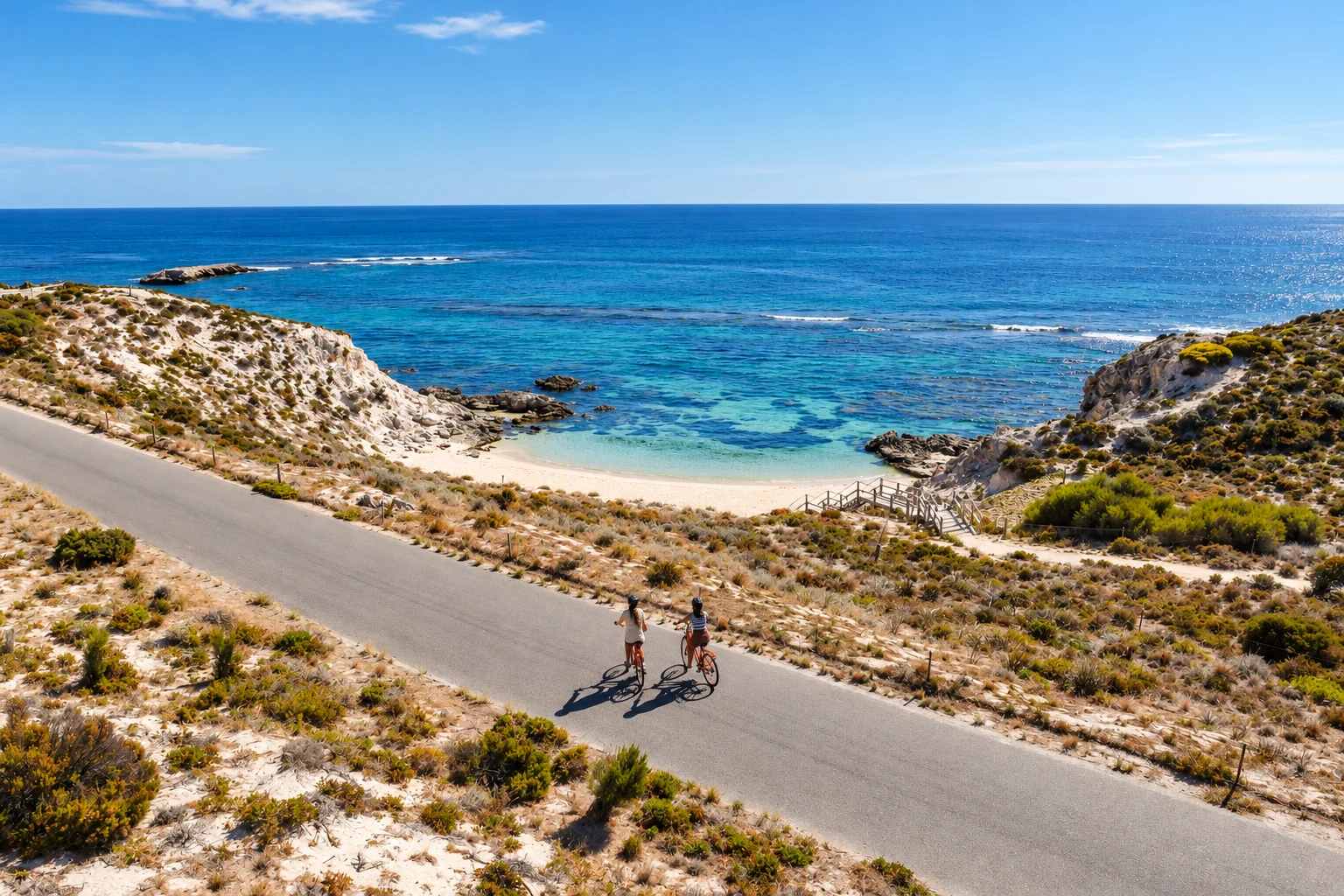
Rottnest has no private cars, and the bicycle is the main way to see it. SeaLink offers adult bike hire at $35 per day, with a helmet and lock included and an island call-out service if something goes wrong. Add the bike under "Add Optional Extras" at checkout and collect it when you step off the ferry. The bikes have 7 gears, a water bottle holder and a luggage carrier, and you hand them back to the crew on the return ferry. Only adult-size bikes are offered, and riders under 18 must be accompanied by a parent or guardian aged 18 or over. Breakdown cover through Pedal & Flipper handles flat tyres, chain problems and gear problems.
You can bring your own bike for an additional fee: $20 per day for a pedal bike and $25 per day for an e-bike. Remove e-bike batteries before travel. Tandems and oversized bikes are not carried.
An e-bike hired on the island costs more. A Pedal & Flipper price list valid from 1 July 2026 gives $35 for an adult bike with a $50 deposit, $21 for an extra day and $20 for same-day hire after 1pm. It lists e-bikes for riders 18 and over at $83 per day with a $200 deposit, a junior bike at $22 and an electric scooter at $79. Confirm these at the hire counter.
Visitors who prefer a package can book the Australian Pinnacle Tours bike and ferry tour from Hillarys, valid 1 April 2026 to 31 March 2027. It costs $124 for an adult, $115 for a concession, $110 for a youth (13 to 16) and $72 for a child (4 to 12). The ride covers about 25 km and finishes from 4:00pm.
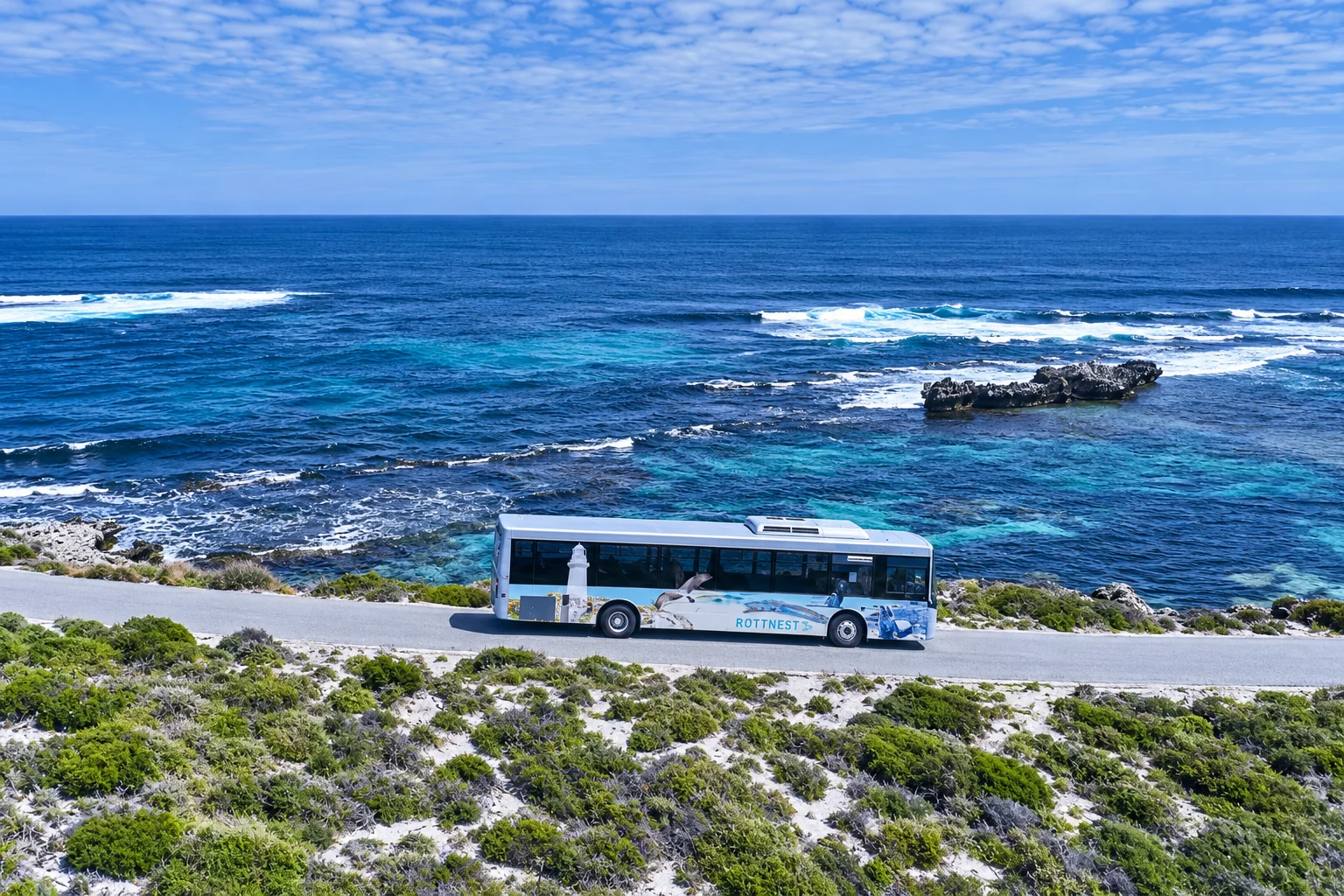
Visitors who do not want to cycle, have small children or find the bikes booked out can use the Island Explorer bus, which serves stops including Geordie Bay and Little Parakeet Bay.
The RIA’s travel tips require every visitor riding a bicycle to wear a helmet. Electric bicycles and e-rideables are permitted, subject to the Road Traffic Code 2000. In coastal areas, stay on designated tracks to limit dune erosion.
Cycling routes and timing
The mini loop is 4 km and takes about 30 minutes. The full loop is 22 km and takes 3 to 5 hours, which is why the choice of loop decides how much beach time you get.
A northern route starts at Thomson Bay Settlement and follows the road to The Basin, Longreach Bay and Parakeet Bay. It then goes around Lake Baghdad and Pink Lake and returns to the settlement via Lake Herschel. A separate one-day route takes in the lighthouse and the bays on the east and south coasts.
An e-bike is the better choice if you want the full loop out to the West End, or if you are not a strong cyclist. A practical plan for a single day is to ride part of the loop, stop for two or three swims and leave the far end for another visit.
Beaches and swimming
Rottnest has 63 beaches and 20 bays, so the choice comes down to what you want to do in the water.
Calm water for families
The Basin is a short walk or ride from Thomson Bay. Protected tidal pools form a natural swimming area, and rocks and dunes shelter it on three sides. It has shaded areas, toilets and small benches. Surf lifesavers patrol it on weekends from November to January.
Little Salmon Bay is small and sheltered, with a snorkel trail that has underwater information panels. It gets crowded at peak times, and snorkel rentals can sell out on busy days. Bring reef-safe sunscreen.
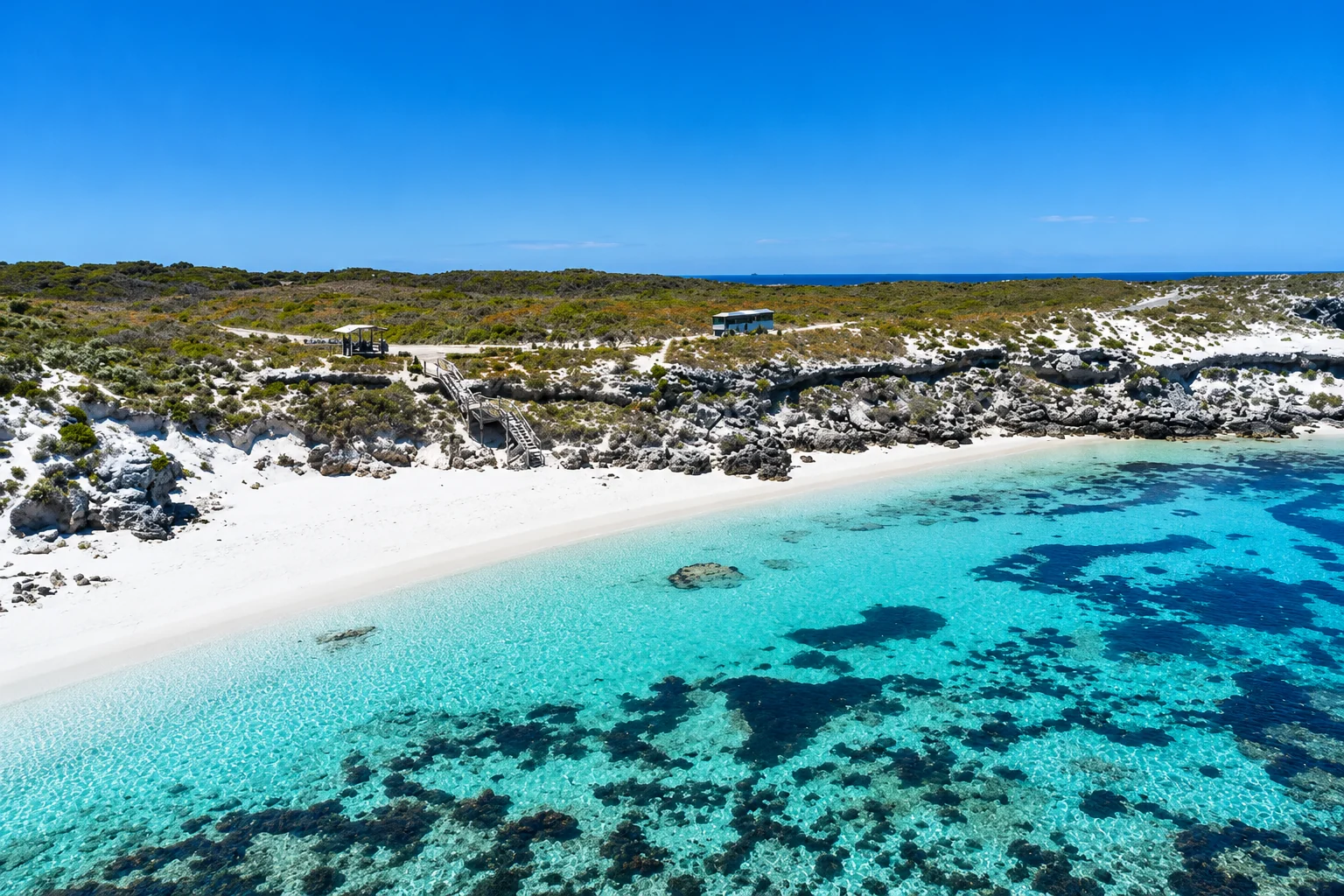
Parakeet Bay is a protected cove about a five-minute bike ride from Geordie Bay, with a sandy bottom and stingrays in the shallows. Little Parakeet Bay is on the bus route, close to the settlement and protected by the reef.
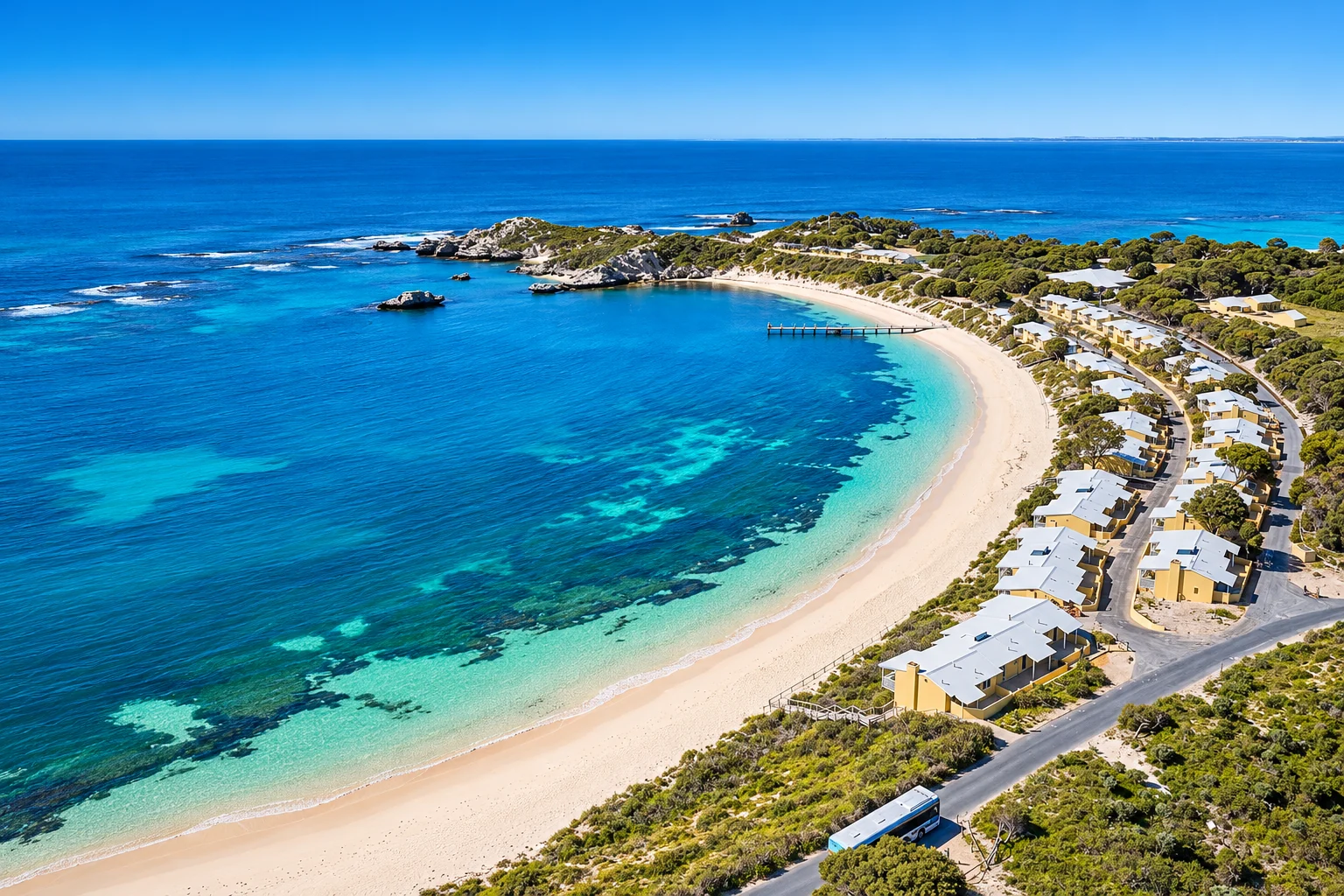
Geordie Bay is a large beach with holiday units and Geordie’s Café, and it is also on the bus route. Mary Cove has an underwater reef around it, which makes the water calmer.
Snorkelling and diving
Parker Point has a snorkel trail suited to experienced snorkellers, in water 3 to 5 metres deep, reached by swimming out from shore. It lies in a marine sanctuary zone where fishing is prohibited. Little Armstrong Bay is a marine sanctuary with coral reefs and is a highlight for snorkelling alongside The Basin.
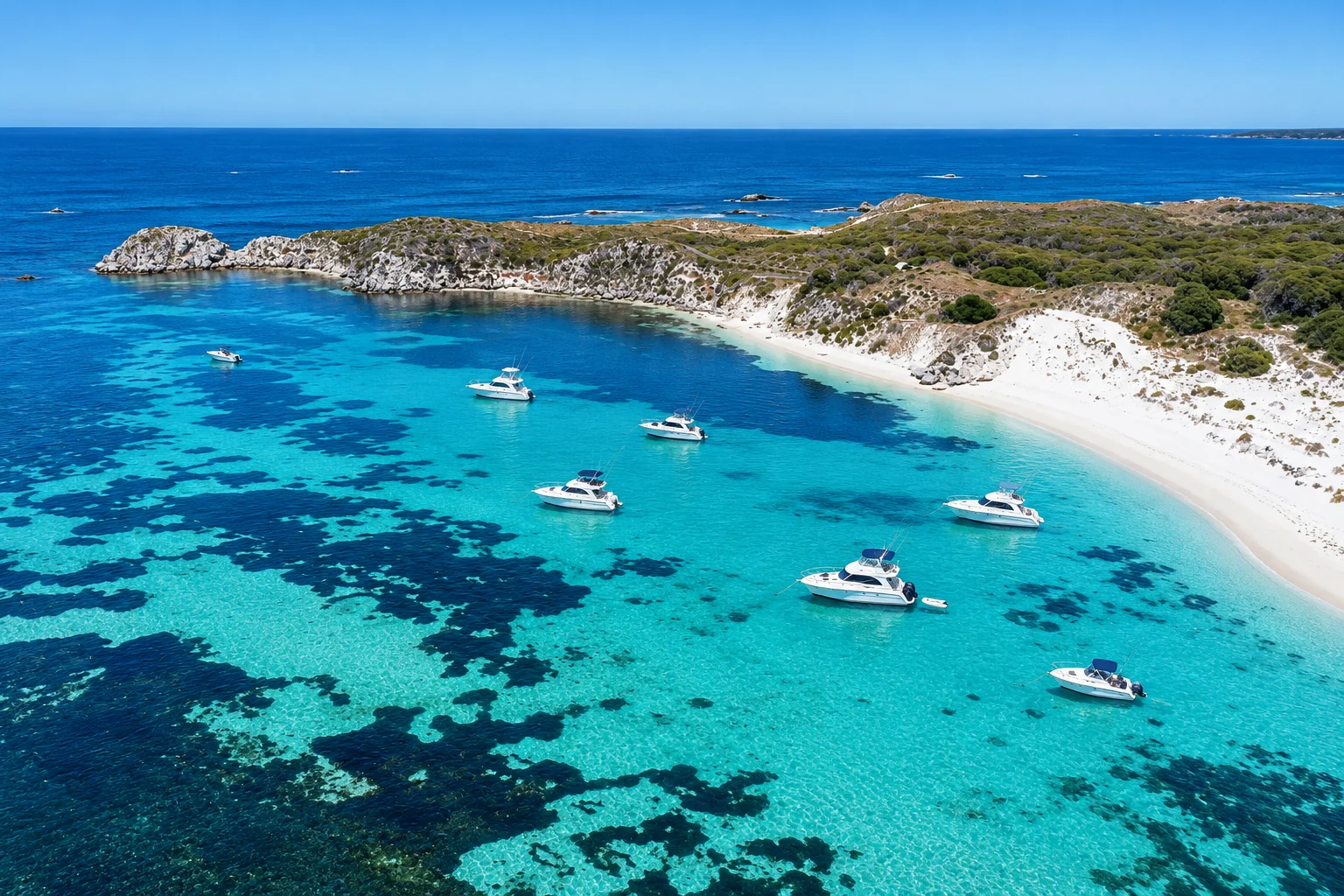
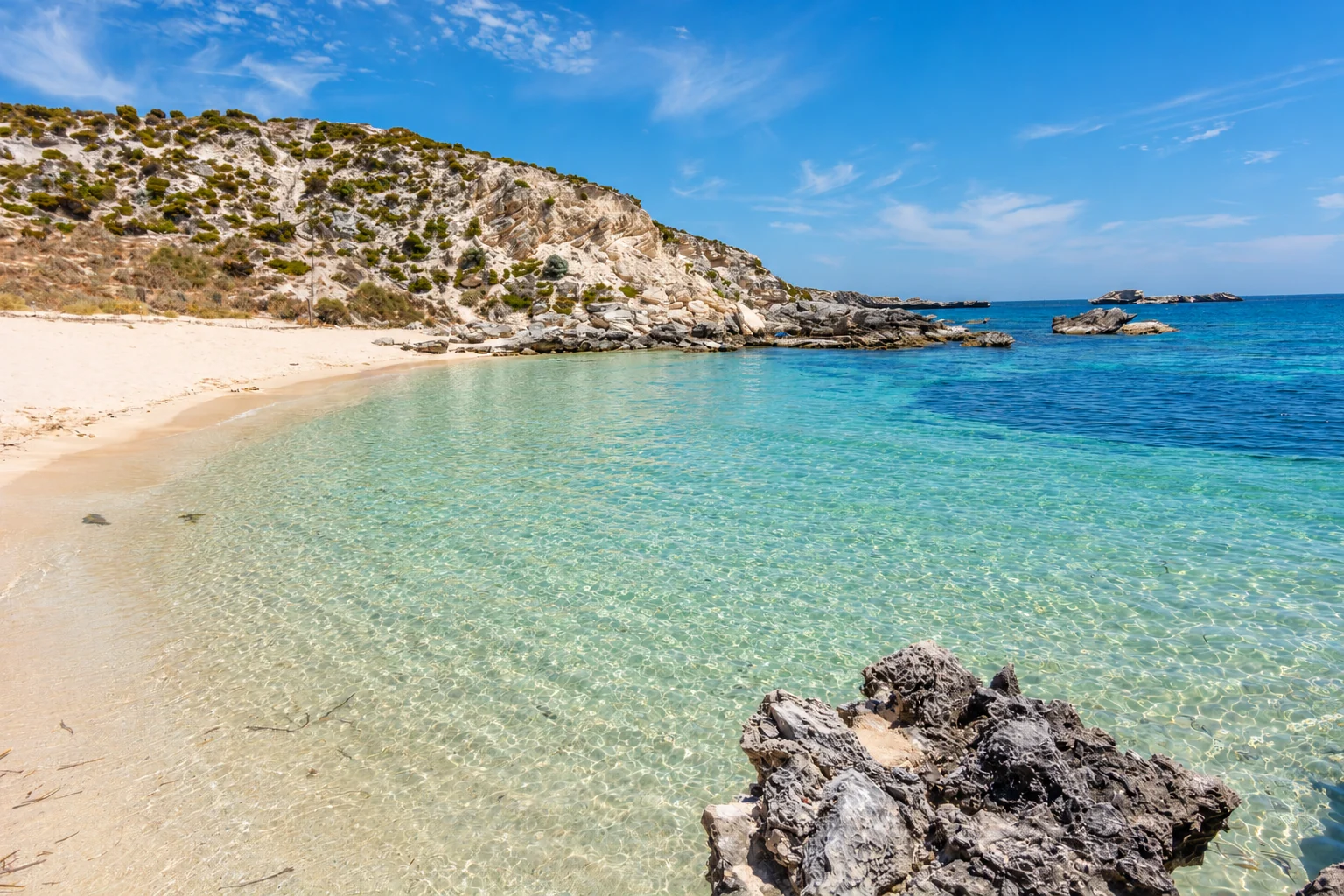
Henrietta Rocks, on the southeastern corner, is good for snorkelling and diving, and the wreck of the barge The Shark lies just offshore. Lady Edeline Beach is about 100 metres long, on the neck of land between the main island and the West End, with rocky lagoons for snorkelling.
Quieter beaches and hazards
Ricey Beach is on the far side from Thomson Bay, sheltered by the offshore reef, quieter and popular for fishing. Pinky Beach has sheltered sand and views of Bathurst Lighthouse, about 1 km (5 minutes) from a stop, and it suits swimming, snorkelling and seabobbing.
Longreach Bay is sheltered from the prevailing Indian Ocean winds, but the seabed drops off sharply a short way out. Inexperienced swimmers should stay close to shore.
Official swimming rules
The RIA’s swimming rules say to swim under supervision or with a friend and to obey the signs. If conditions are uncertain, do not swim, because they change regularly. Do not swim straight after a meal or under the influence of alcohol or drugs, and do not run and dive into the water. If you get into trouble, signal for help, float with a rip current or undertow, and wait for assistance.
Swimming is prohibited between the main ferry jetty and the Fuel Jetty at all times. It is not permitted from the ‘T’ Jetty or from the end of the main ferry jetty, and swimming near moorings, jetties or designated anchorage areas is not recommended.
Seeing quokkas respectfully
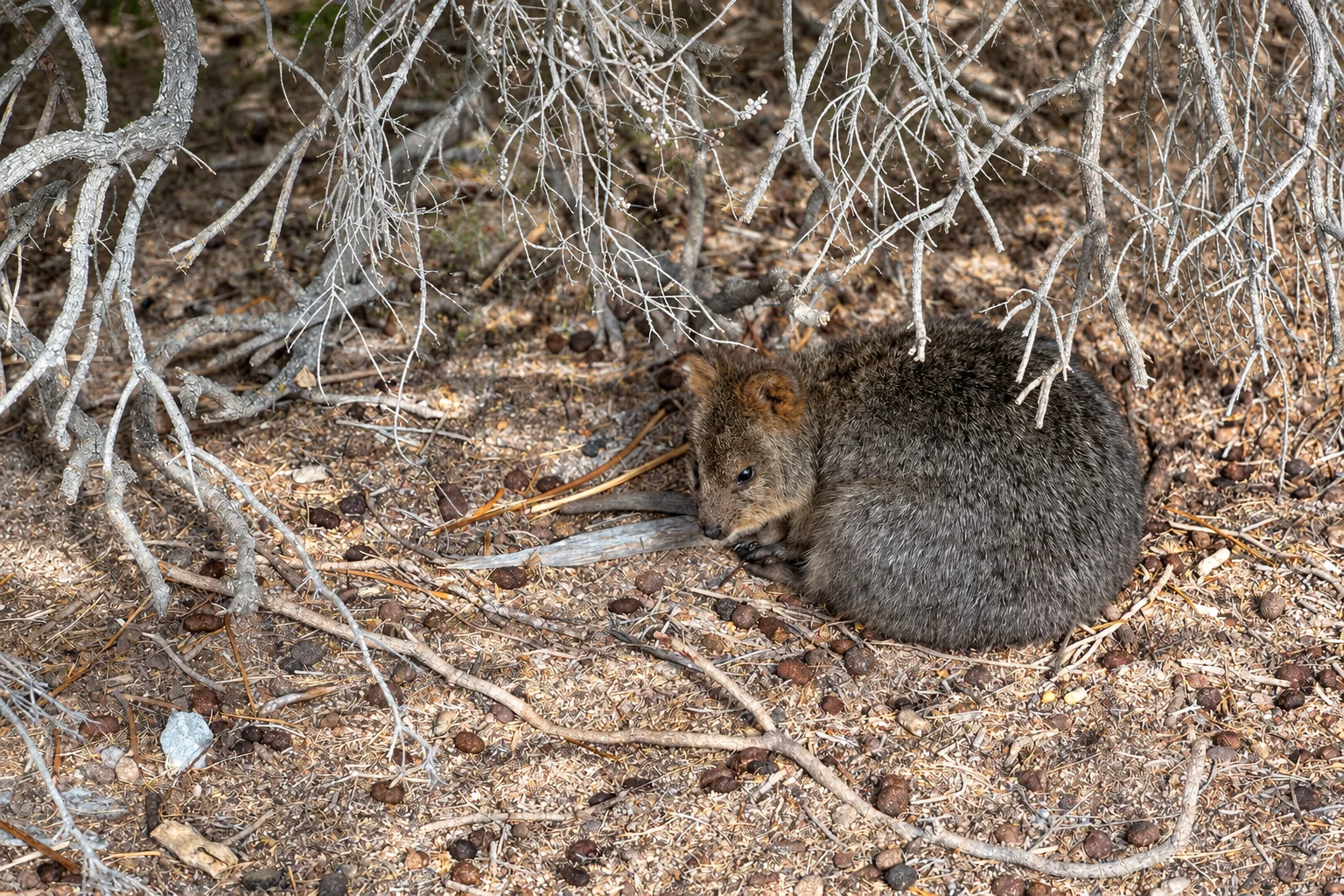
About 10,000 quokkas live on Rottnest, compared with an estimated 4,000 on the mainland. They are listed as vulnerable, and their main threats are feral cats, foxes and habitat loss. The best times to spot them are early morning and evening. Named hotspots include Garden Lake, which you reach via Digby Drive. Others are the trail near Wadjemup Lighthouse and the trail to The Basin, which runs between the golf course and sports oval.
Quokkas also gather around the settlement at Thomson Bay, hoping for food such as bakery sausage rolls. Feeding is prohibited there, so keep your food covered and out of reach, and eat away from the animals.
For a good encounter, stay quiet and still, give the quokka plenty of space and let it come to you. Getting low helps, because quokkas are more likely to approach at their own level. A selfie stick gives a closer angle without disturbing the animal. Use burst mode, avoid flash and shoot in shade or at dawn or dusk.
The RIA rules, as reported in 2024, ask visitors to observe from a respectful distance and let the animals go about their natural movements. Do not touch them, because touching can make them sick and spread disease. It can also cause mothers to abandon young that carry an unfamiliar scent. Do not feed them, including leaves, because human food makes them sick and feeding leaves disrupts natural foraging. That report quotes the RIA saying feeding can attract a $150 fine, and that rangers patrol regularly throughout each day.
Anyone who deliberately interferes with wildlife, including by feeding or touching it, can be fined on the spot under the Rottnest Island Regulations 1988, according to the RIA’s practical tips. Prosecution under the Wildlife Conservation Act 1950 carries fines up to $10,000. Animal cruelty can bring fines up to $50,000 and five years’ imprisonment under the Animal Welfare Act 2002.
Marine and safety rules
Avoid walking on any reef. Five marine sanctuary zones, set up under the Authority’s Marine Conservation Action Plan, prohibit fishing and collecting. Spearfishing is prohibited within specified boundaries of the Rottnest Island Marine Reserve, and fishing licences apply for restricted species. Swimming with long-nosed fur seals at Cathedral Rocks is not permitted, and a purpose-built viewing platform is provided instead.
Divers must fly or tow the international ‘A’ flag, and boats should keep at least 50 metres from it. A 5-knot speed limit applies in most bays, and there are no designated water-ski areas in the marine reserve. Liquid waste, including from marine sanitation devices, cannot be discharged within the reserve.
On land, the RIA names several hazards:
- Blue bottle jellyfish: They may be in the water or wash ashore. Their stings are painful but not life-threatening, so do not touch them.
- Snakes: Venomous snakes live on the island. The dugite is timid but may bite if harassed, and anyone bitten needs immediate medical help.
- Cliffs and caves: Unstable rock slopes, cliffs, overhangs, limestone cliff edges and caves can collapse, so stay clear.
- Dunes and fire: Sandboards and similar devices are prohibited because dune blowout is an ever-present threat. Lighting fires and campfires are banned.
Camping is permitted only in designated settlement campsites, booked through Stay Rottnest Campground. Unaccompanied minors cannot stay overnight.
Facilities and what to carry
Carry at least two litres of water per person, or three in hot weather. Refill points are at Thomson Bay, Army Jetty, Kingstown Barracks, The Basin, Vlamingh Lookout and Geordie Bay. Barbecues are at Thomson and Geordie Bays, and free Wi-Fi ("RottnestWiFi") covers the main settlement. Laundry is at Geordie Bay, Kingstown Barracks and behind Pedal & Flipper Hire, with varying coin and card payment rules.
For medical needs, call 000 in a life-threatening emergency. Injuries go to the Nursing Post in Thomson Bay, and AEDs (defibrillators) are on the island and at the Nursing Post. There is no pharmacy, but the General Stores sell non-prescription medicines. Rangers can be reached on (+61 8) 9372 9788 or VHF Channel 16 ("Rottnest Rangers"). Fuel (unleaded, premium and diesel) is at the Fuel Jetty, self-service 24 hours, which matters mainly to boaters.
Planning a day trip
A Fremantle departure gives the most time on the island because the crossing takes 30 minutes. A Perth departure suits a CBD base but adds a long sailing each way. Book the ferry and bike online beforehand, since bikes can sell out and the ferry is the only way across.
On arrival, collect your bike from the ferry crew, fill your water bottle and put on your helmet. For a relaxed day, ride the mini loop, then head to The Basin for the tidal pools. Add Little Salmon Bay for the snorkel trail if you have energy. For a full day with an e-bike or strong legs, start the 22 km loop early and allow 3 to 5 hours of riding on top of your beach stops.
Save quokka-spotting for late afternoon, when the animals are more active. Garden Lake, the trail near Wadjemup Lighthouse and the Basin trail are the places to try, and a short wait at a quiet spot does better than chasing them around the settlement.
Check the return sailing for your day before you commit to a plan, because the timetable differs between Monday to Thursday and Friday to Sunday. Return bikes to the crew on the return ferry.