Renting a campervan in Australia means paying a rental company a daily rate for a van that sleeps and cooks for you. You usually pick it up from a city depot or airport. Four decisions set the final cost. You choose a brand and vehicle tier, and you choose a season to travel. You also decide whether to return the van to a different location and how much damage excess to cover. The excess is the maximum you pay if the van is damaged. At pickup, the operator holds a security bond of roughly $3,000 to $7,500 on your card to secure it.
Brands fall into three groups. Maui is the premium option, and Britz and Apollo sit in the mid-range. The budget group includes JUCY, Wicked Campers, Spaceships, Mighty and others. Your age and licence determine which brands you can book.
Choosing between campervan brands
Maui is the premium option. Its fleet is mostly Mercedes-Benz based, with some larger models on Iveco, and Campercompare describes the vans as typically under two years old. Every Australian Maui model has a built-in toilet, shower and vanity, so it is fully self-contained.
Britz and Apollo sit in the middle. Britz vans run one to three years old, and its 4WD campers (two and four berth, for unsealed roads) are the strongest off-road range among the big brands. Apollo vans are two to five years old, and its range runs from 2-berth vans to 6-berth motorhomes plus 4WD. Apollo operates 10 depots in Australia. On both brands, only models with four or more berths carry a toilet and shower. Britz usually costs a little more than Apollo, according to a brand comparison.
Apollo, founded in Brisbane in 1985, merged with Tourism Holdings Limited (THL) in 2022, and THL also owns Britz, Maui and Mighty, so these brands share an owner. Apollo keeps its own pricing and standards, although fleet management is shared. Campercompare estimates that Apollo and Britz account for about 60% of bookings across Australia and New Zealand.
The budget end covers several styles of van:
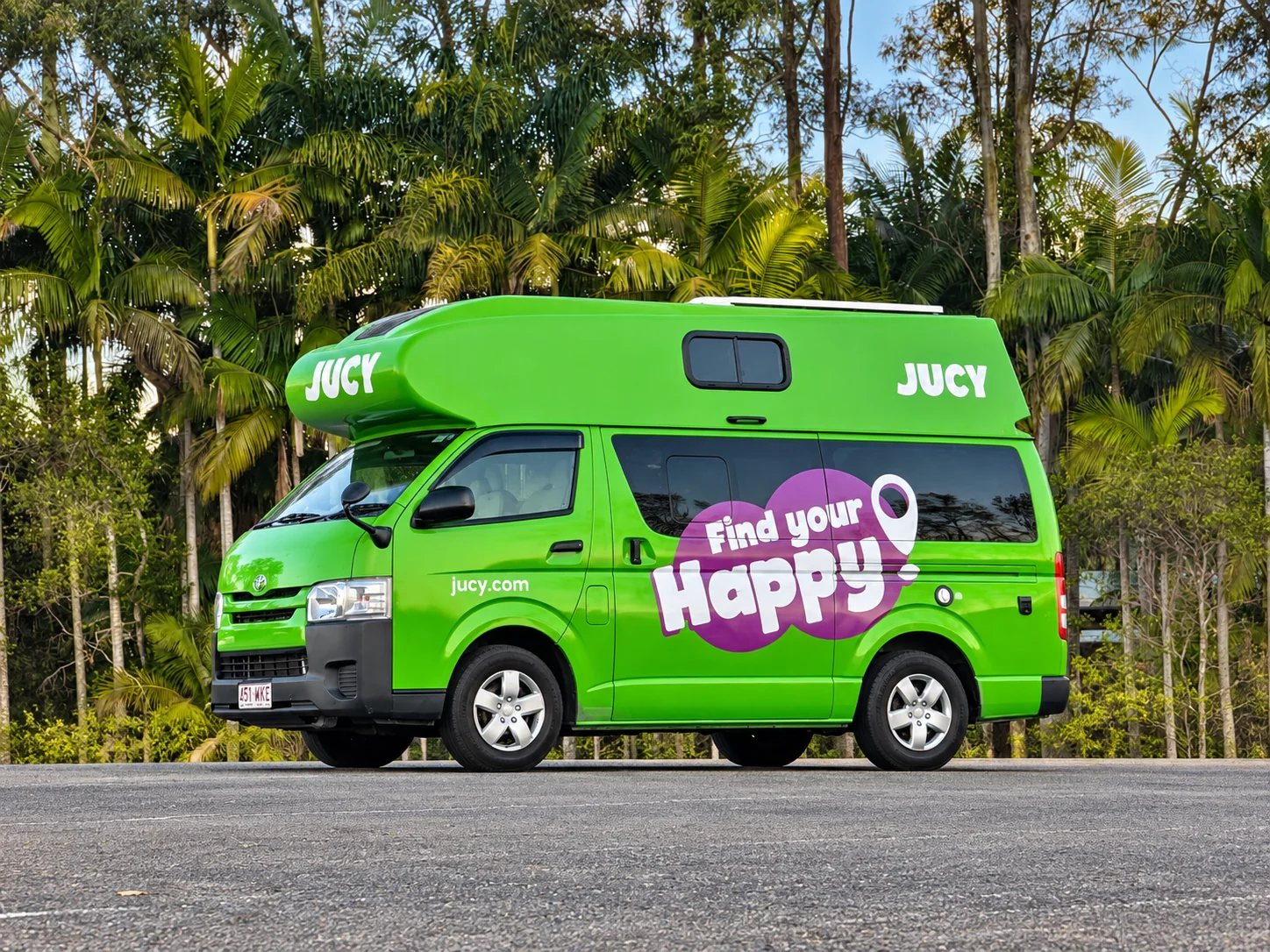
- JUCY runs bright vans in two lines: Chill’d (the cheaper, retro tier) and Star RV (the premium motorhome line). The cheaper vans have no onboard bathroom. JUCY’s homepage lists airport locations in Adelaide, Brisbane, Cairns, Melbourne, Perth and Sydney.
- Mighty, MightyLITE, Cheapa Campa and Hippie Camper form the value end of THL. MightyLITE is the cheapest entry point, with vans six years old or more.
- Spaceships rents compact Toyota Estima sleepervans from eight depots: Sydney, Melbourne, Brisbane, Airlie Beach, Cairns, Hobart, Adelaide and Perth.
- Travellers Autobarn has operated since 1993 and rents budget vans.
- Wicked Campers offers campervans (including the Johnny Feelgood, Budget Mini Camper and Mystery Machine range) and 4WDs (Desert Sands, D5 Adventure Camper and Grip). Its homepage lists 11 pickup depots: Sydney, Brisbane, Cairns, Melbourne, Alice Springs, Darwin, Adelaide, Broome, Exmouth, Perth and Hobart. The Alice Springs, Broome and Exmouth depots make it useful for outback and west coast routes.
- Overlander specialises in 4WD campers, with interstate agencies in Cairns, Darwin, Perth, the Gold Coast and Brisbane, and locations also listed for Sydney and Broome.
Camplify takes a different model: a peer-to-peer marketplace that lists more than 21,000 owner-supplied vehicles across Australia. Its bookings include damage cover and 24/7 roadside assistance, according to a brand comparison. Vehicle quality varies by owner, so read the damage cover terms before booking.
In practice: choose Maui for a premium self-contained motorhome, Britz or Apollo for a mid-range trip (Britz if you want 4WD), JUCY, Mighty or Spaceships for lower prices if you accept a basic vehicle, and Camplify for an owner-supplied van. Broker sites such as Motorhome Republic list Apollo, Britz, Maui, JUCY, Mighty, Spaceships and Travellers Autobarn side by side, which makes price comparison quicker.
Daily campervan rates by season
Rates move with the season, the vehicle size and the pickup location. JUCY publishes indicative starting rates per day (insurance and optional extras are not included) in its 2026 pricing guide:
| Vehicle | Shoulder (March to April, July to October) | Peak (November to February) |
|---|---|---|
| Chill’d Cloudbreak, 2-berth | from $50 | from $75 |
| JUCY Crib Plus, 4-berth | from $60 | from $85 |
| Chill’d Malibu, 2-berth self-contained | from $85 | from $110 |
| JUCY Condo, 4-berth self-contained | n/a | from $95 |
The same guide lists the Chill’d Cloudbreak from $35 a day in low season.
Across the wider market, Campercompare’s 2026 price guide gives these per-day ranges:
| Category | Low season | Shoulder | Peak |
|---|---|---|---|
| Budget 2-berth | $50–80 | $70–120 | $100–160 |
| Standard 2–3 berth | $80–130 | $120–180 | $160–250 |
| Large motorhome 4–6 berth | $130–220 | $180–300 | $250–400 |
| Premium or luxury 2–4 berth | $180–300 | $250–400 | $350–600 |
| 4WD camper 2–5 berth | $100–180 | $150–250 | $200–350 |
By brand, Camptoo’s 2026 guide gives per-day examples of $150–300 for Britz, $180–250 for Apollo, $240–400+ for Maui and $250–450 for StarRV (Apollo’s premium line). A larger vehicle costs more in every season, and December to January and school holidays push every category toward the top of its range.
Bonds and extra costs
The bond is the largest cash outlay. Operators usually hold between $3,000 and $7,500 on your card at pickup, which matches standard-cover excess of $2,500 to $7,500. The hold is released after the van is returned undamaged, so make sure your card limit can absorb it on top of your trip spending.
Camp tables and chairs cost $5–10 a day or $30–80 per trip, and after-hours pickup or drop-off costs $50–150, according to Campercompare. Location surcharges run $20–100, according to Ratpack Travel. Pick-up fees and preparation fees are other charges to look for in the fine print.
Running costs matter as much as the rental rate. Ozroadtrips estimates fuel consumption by vehicle type, with diesel near A$2.87/L nationally in late September 2026. Campsites cost A$0–25 a day on a tight budget and A$40–70 a day at typical levels. Park passes and attractions add A$5–15 a day on a tight budget and A$15–30 typically. For a budget couple, the same guide puts the whole trip at roughly A$165–300 a day, or A$1,150–2,100 a week, covering hire, fuel, campsites and food.
Self-contained vehicles, which carry their own toilet and shower, cost two to three times more to hire. Camptoo says they can save $30–50 a night on campsite fees, so a long trip through areas with free or low-cost camping can narrow the gap.
How one-way hire works
One-way hire means collecting a van in one city and returning it in another. Most operators charge a one-way fee that rises with distance. A few waive it inside their own network.
Overlander states "No One-Way Fees" between its own agencies. Its one-way page shows an example route running Sydney, Brisbane, Gold Coast, Cairns, Darwin, Perth and Broome, and asks you to request a quote for your specific route. JUCY offers one-way hire between most branches, and a small relocation fee may apply, according to its site.
Where fees apply, Campercompare’s 2026 figures put them at $200 to $800+, depending on distance:
- Sydney to Brisbane (either direction): $200–$400, although some operators waive the fee on this popular route.
- Melbourne to Sydney: $200–$400.
- Adelaide to Melbourne: $150–$350.
- Cairns to Sydney: $400–$800.
- Darwin to Adelaide or Melbourne: $500–$1,000.
- Perth to anywhere on the east coast: $600–$1,200.
Other estimates sit in the same band. Ratpack Travel quotes $150 to $1,000 depending on distance and company. Motorvana lists extras of AUD 185 for Melbourne to Sydney and for a Sydney campervan to Brisbane, and AUD 285 for a Melbourne motorhome to Darwin and for a Perth RV to Sydney, with some one-way discounts applying. On a long-term hire from Sydney to Perth, Campercompare says fees can add $300–$800, and some operators waive them for long hires. Camplify owners set their own one-way charges, and some charge per kilometre, sometimes with a cap.
Minimum hire length is the other catch. A comparison listing on Aussie Campervans lists minimum hire periods on routes such as Sydney to Brisbane and Sydney to Melbourne, and notes that relocation fees and minimum hire durations depend on route and supplier. Motorvana also says one-way motorhome and campervan rentals carry minimum durations. Ask the operator for the one-way fee and minimum length for your exact route before you build a multi-city itinerary.
Relocation deals
Transfercar lists relocations from $1 a day with no one-way fee and no booking fee. These are trips where a rental company needs a van moved, so you take whatever routes are offered and your dates are set by the company. The east coast corridor is the most consistent route, and outback and west coast routes appear less often. Fuel contributions and the bond vary by deal.
Campervan insurance and excess
Every campervan rental includes a standard policy that covers damage to third-party property and vehicles. The renter is liable for damage to the hired van up to an excess, also called the liability or bond, according to DriveNow. DriveNow gives the standard excess as about $500 to $7,500 for standard campervans and up to $8,000 for 4WD campers, included in the daily rate and charged as the maximum if you buy no reduction. Campercompare says the included cover often carries an excess of $5,000 or more. Operators’ published terms set the figure that applies to your booking.
Reducing the excess
Excess reduction is an optional daily charge that lowers or removes your liability. Indicative prices:
| Option | Daily cost | Excess afterwards |
|---|---|---|
| Reduced excess | $25–45 | $500–2,000 |
| Zero excess (full cover) | $40–65 | $0 |
| Third-party excess cover | $8–15 | $0 (bond still paid at pickup) |
The first two rows come from Campercompare’s 2026 guide. Travelwheels describes an Orange tier at $25 a day (excess $1,000) and a Green tier at $35 a day (excess $0). Operator reductions typically fall in the $30–50 range.
Many companies cap excess-reduction charges at 40 or 50 days, so the remaining days of a long hire cost nothing extra. Discovery Campervans, for example, caps its Stress Free Plus premium at 50 days on hires of 51 days or more. Inclusive packages from some suppliers also lower the bond, add tyre and windscreen cover, extend overhead and underbody cover and sometimes include table and chairs, but contents vary by supplier.
The THL brands price this differently. Insurers report that Britz, Mighty and Maui offer a one-off AU$350 liability reduction per hire. It brings accident liability to $0 and adds overhead and underbody damage, unlimited tyre and windscreen cover, and towing and recovery on 4WD roads where Britz has given permission.
Third-party excess cover
An independent policy is cheaper than the operator’s version. RentalCover says rental companies charge $60–100 a day for their own excess cover, against $6–10 a day for its product. The trade-off is cash flow. The rental company still takes the full bond at pickup, because it needs to secure its exposure. You pay any damage excess to the supplier first, then claim it back, and some policies exclude campervans or set value limits.
What stays excluded
Standard liability does not cover small dents and scratches, tyres, windscreens, underbody or overhead damage, according to Discovery Campervans. Overhead damage, such as a roof, air-conditioning unit or awning hit by a low bridge or branch, is a typical exclusion even with full cover. Many standard policies and mid-tier reduction packages also exclude single-vehicle rollover, which matters in remote areas.
Where you drive affects cover as well. 2WD vehicles are generally limited to sealed roads. Cover does not apply on unsuitable roads, in restricted areas, or after negligence, misuse or breach of the agreement. A reduction you have bought is void if you break the contract terms, and a 1Cover page lists driving under the influence of alcohol or illegal drugs and not holding the required licence as unpaid claims. After any accident, collect accurate third-party details, whatever cover you hold and regardless of fault.
Cover you already hold
Travel insurance generally covers illness, accidents and trip cancellation, but not damage to motor vehicles or campervan hire. Credit-card rental cover often excludes campervans and motorhomes, or vehicles above a value or weight threshold. It usually requires the whole rental to be charged to the card, and claims are reimbursements. Check your card’s terms before relying on it. If you are an overseas renter, exchange-rate movements can change the amount refunded to your card.
When to book and where to travel
JUCY advises booking three to six months ahead for peak season (November to February) and two to three months ahead for shoulder and low seasons, according to its pricing guide. Season depends on your route. The quietest months in the south are May to August, and the tropical north runs the opposite way. A Melbourne to Hobart trip and a Cairns to Darwin trip therefore have different cheap months.
Britz hires typically include unlimited kilometres, basic kitchen kit, linen and bedding, and a camp table and chairs, but some promotional rates cap kilometres and long-term hire can charge extra per day for unlimited kilometres on some categories. JUCY rates have included unlimited kilometres, kitchen equipment, bedding and linen, and 24-hour roadside assistance, so confirm against its current terms. Promotions appear regularly, such as a limited-time 25% off banner on the Wicked Campers homepage, and each carries its own dates and conditions.
Match the depot network to your route. Wicked Campers collects at Alice Springs, Broome and Exmouth, and Overlander at Cairns, Darwin and Perth, which suits outback and west coast legs. Spaceships covers Airlie Beach and Hobart. Apollo’s 10 depots and JUCY’s six airport locations suit trips between the main east coast cities. For long drives, Tourism Australia says the Australian government recommends a break every two hours, and Discovery Campervans advises against driving at dawn and dusk because of kangaroos.
Driver age and licence rules
Tourism Australia says drivers generally must be over 21 to hire a campervan or motorhome, though some companies set the minimum at 18. No special permit is needed. Minimums by operator, from Campercompare’s licensing guide:
| Operator | Minimum age | Licence | Young-driver fee |
|---|---|---|---|
| Apollo, Britz, Maui | 21 | Full, held 2+ years | n/a |
| Let’s Go | 21 | Full, held 1+ year | n/a |
| JUCY | 18 | Full | n/a |
| Spaceships | 18 | Full | n/a |
| Hippie Camper | 18 | Full | n/a |
| Travellers Autobarn | 18 | P2 or full | $15 a day under 21 |
| Cheapa Campa | 18 | n/a | $25 a day under 25 |
| Camperman | 18 | P2 or full | None (maximum age 85) |
Apollo confirms that most of its campervans and motorhomes need drivers who are at least 21 with a full licence, while the Mighty Highball/Double Down, Cheapa Hitop/Endeavour and Hippie Hitop/Endeavour models require drivers to be 18 or older with a full licence. DriveNow accepts drivers from 18 but requires 21 or older for AWD and 4WD vehicles, and Camplify owners sometimes set the minimum at 25.
Provisional and learner licences
Learners are generally not accepted. Provisional drivers have a few options. Camperman takes P2 drivers from 18 with no surcharge. Travellers Autobarn takes P2 drivers from 18 for smaller vehicles, with a young-driver fee possibly applying. JUCY generally does not accept P2 holders. Camplify does not accept P1 or P2 drivers, because it requires a full, unrestricted licence. VroomVroomVroom rejects learner permits and often restricts P1 and P2 drivers, and says some operators want the licence held for at least 12 months. A full Australian car licence (Class C in most states) generally covers standard campervans up to 4.5 tonnes GVM (gross vehicle mass, the maximum loaded weight).
Overseas licences and the IDP
An International Driving Permit (IDP) is a booklet that translates a foreign licence. You need one if your licence is not in English, uses non-Roman characters, or lacks details such as a photo, licence class or expiry date, according to Travellers Autobarn. If your licence is not in English, you need an IDP or an official or accredited English translation, plus the original licence. An IDP is not accepted without the original licence.
Carry the physical card, because photos and digital copies are not sufficient. The name on the licence must match the booking name. Only drivers named on the rental agreement may drive, and each additional driver must be authorised, hold a valid licence and sign the agreement. How long an overseas licence stays valid after you arrive depends on the state or territory, so before a longer trip, check with the road authority in the state or territory where you land.