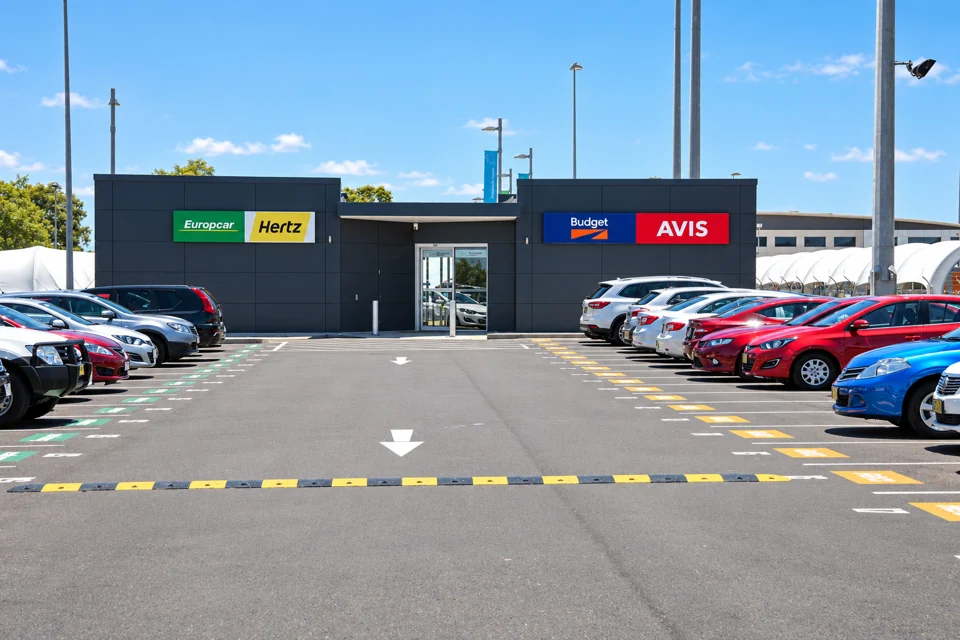
Newcastle Airport (airport code NTL) sits at Williamtown, about 15 km north of Newcastle city centre. Sixt gives the terminal address as Terminal Building, Williamtown NSW 2318. The airport is the usual gateway to the Hunter region, Port Stephens and the Central Coast, and Sydney is roughly two hours south by car along the Pacific Motorway, so a hire car (what Americans call a rental car) is the practical way to get around.

Most of the big national brands operate at the airport: Sixt, Budget, Avis, Europcar, Hertz, Redspot and Alamo. Others, including Thrifty, Enterprise and East Coast Rentals, appear in airport listings with different pickup arrangements. Town depots in Newcastle itself are often cheaper but need a shuttle or taxi to reach.
Before you book, check four things: where the counter and the cars are, whether you meet the age and licence rules, how much you pay if the car is damaged (the "excess"), and which roads the contract allows you to drive on. The excess is the amount you pay out of your own pocket before the rental company’s damage cover applies, and it is the biggest hidden cost in most hire agreements.
Who hires cars at the airport and where you collect
Sixt has its desk in the terminal, about 100 m east of arrivals, and signs lead you to the car rental area. According to Sixt’s branch page, the counter opens 07:00 to 17:00 every day including bank holidays, and the return car park has 15 bays. Bus routes 130, 131, 136, 138 and 145 stop at the terminal if you want to leave the airport without a car at all.
The other operators work in a similar way, though the details differ by brand:
| Operator | Pickup arrangement at NTL |
|---|---|
| Sixt | Terminal desk east of arrivals, cars in the shared rental car park |
| Budget | Counter in the arrivals terminal opposite baggage claim, cars a short walk away |
| Avis | Terminal counter, pickup at the rental car park |
| Redspot | Rental offices beside baggage reclaim |
| Alamo | Desk in the terminal, short walk to the cars |
| Europcar and Hertz | Listed at the airport by comparison sites |
| Thrifty | Listed at the airport, with a shuttle bus described instead of a terminal counter |
| East Coast Rentals | Listed at NTL, with a shuttle for some companies |
Budget puts its counter in the arrivals terminal opposite baggage claim. If nobody is at the desk, leave the arrivals hall, turn left and head to the rental office. The rental car park is off Kindler Way, and returns use the same spot as pickup. Budget also has a drop box at its arrivals desk for after-hours returns. Avis runs a terminal counter as well, and Redspot directs travellers to baggage reclaim, where the rental offices sit side by side. Alamo describes an in-terminal desk with a short walk to the cars.
The desk and the vehicles are in different places. After you sign the paperwork, you walk out to the car park outside the terminal, which VroomVroomVroom describes for airport pickups generally. Several brands share the same lot, so a short walk is normal.
Thrifty is the brand where listings disagree. QEEQ describes a shuttle bus rather than a terminal counter, so confirm the pickup method in your booking confirmation. Uber Rent lists East Coast Rentals at NTL, and it also notes a shuttle for some companies.
Counter hours vary by brand. Sixt closes at 17:00, while Europcar’s airport hours, as VroomVroomVroom shows them, run to 21:30 on weekdays and Sundays and earlier on Saturdays. If your flight lands in the evening, check the closing time of your chosen brand before you book. If the counter will be shut, ask the branch about out-of-hours pickup and return options.
Peer-to-peer hire is another route. Turo’s Newcastle pickup is near the airport, outside the terminal, and you deal with a private owner instead of a rental company.
Town depots and off-airport pickup
Newcastle’s city depots cluster along Clyde Street in Hamilton North and on Maitland Road. Off-airport firms usually provide a free shuttle from the terminal, and Road Genius puts the wait at about 15 to 20 minutes. It estimates a taxi to the city depots at around 30 minutes. Kayak says Budget and Europcar offer shuttle or pick-up services from the airport to their off-airport locations.
VroomVroomVroom’s city listing shows Avis Newcastle Downtown and Budget both at 50 Clyde Street, open 08:00 to 17:00 Monday to Friday and 08:00 to 12:00 on weekends. Discover Cars lists Thrifty at 11B/50 Clyde Street, Hamilton North. Kayak NZ places a Hertz branch in the Clyde Street area near the Number 12 bus stop, and a Keddy by Europcar branch on Denison Street off the Pacific Highway near the Tudor Street bus stop. Airport Rentals adds Europcar at 5 Throsby Street, Avis at 33 Maitland Road, Hertz at 213 to 217 Maitland Road, and Thrifty at 272 Pacific Highway, Charlestown.
Several details favour a town depot. Road Genius notes that terminal rentals carry airport fees and can have queues when many flights land together. In the price snapshots later in this article, city rates start lower than airport rates for comparable cars. The weekend hours at the Clyde Street branches are short, though, with a midday closing on Saturday and Sunday, so a late Sunday arrival is awkward.
Town pickup suits a traveller who will spend the first night in Newcastle and does not need the car straight away. You can take a taxi or the shuttle into town, settle in, and collect the car the next morning at the depot. It suits a traveller who is heading straight to Port Stephens or the Hunter Valley much less, because that person gains little from a detour into the city and pays the taxi fare for it.
Some Newcastle operators also allow you to pick up and drop off at separate locations, which Kayak NZ mentions in its Newcastle listing. That makes a town depot useful for a trip that starts at the airport and ends in the city, but fees apply on some routes, and the one-way section below covers them.
Road rules matter for first-timers on arrival day. Australians drive on the left. Kayak’s Newcastle guidance points out that roundabouts are common, that you must give way to vehicles already in them, that pedestrians have priority at designated crossings, and that Newcastle gets congested at peak times. Allow extra time on your first drive from the airport if you are not used to left-hand traffic.
Age, licence and overseas visitors
The minimum hire age is 21 at every airport operator in the listings, and drivers under 25 face extra rules. Sixt sets a minimum of 21 with a valid licence, requires 25 for luxury or large-vehicle categories in many cases, and may charge under-25s extra fees. Avis also has a minimum of 21, with restrictions and possible fees for drivers under 25. Redspot sets no maximum age and charges drivers under 25 a daily surcharge.
Alamo publishes figures. Drivers aged 21 to 24 pay AUD 23.50 per day (excluding GST), and if any driver holds a probationary licence, a Probationary Licence Fee of AUD 28.00 per day (excluding GST) applies. Drivers in the 21 to 24 band are limited to mini, economy, compact, compact SUV, compact commercial van, intermediate, intermediate pickup and standard classes. Over a week, that surcharge adds up before tax, so include it when you compare prices.
Turo sets its own rules. Its Newcastle listing has a minimum age of 21, charges a Young Driver Surcharge of $15 per day for drivers under 25, requires age 25 or older for Deluxe cars and 30 or older for Super Deluxe, and excludes P-platers entirely.
For licences, most operators ask for a full licence held for at least 12 months. Avis spells it out: a full, current and valid licence held for at least 12 consecutive months, with learner, provisional and restricted licences not accepted. Avis also says digital licences are accepted only in the issuing state, so interstate travel requires a physical licence. Sixt asks for a licence held for at least one year, depending on car category. Redspot says P-platers need a Provisional P2 licence, and it asks for the full-licence period at collection. Redspot also says on its FAQ page that stays over three months need a local licence.
Overseas visitors have extra rules from two directions: the state’s driving law and the hire company’s own conditions. The NSW Government says tourists and temporary visitors can drive in NSW on an overseas licence for up to six months, provided the licence is current, they have not been disqualified or suspended, and they carry it. If the licence is not in English, you must also carry an English translation or an International Driving Permit (IDP), which is issued by the motoring association or embassy of the country that issued your licence. Sixt applies the same logic at the counter: an IDP or certified English translation is needed if the licence is not in English or has no photo. Avis asks for an IDP or official translation if the licence is not in the Roman alphabet.
The NSW rules say whether you may drive on the road. They do not say what a particular counter will accept, so confirm the paperwork with your chosen branch. Arrange the IDP or translation in your home country before you fly, since the issuing body must be the one in the country that gave you the licence.
Payment, excess and what voids your cover
Credit cards are the standard payment method. Sixt requires a credit card in the renter’s name with enough available credit, does not accept cash, and says some sites accept debit cards but you should confirm with the branch. Hertz’s Australian driving guide, published in 2018, describes a bond deposit covering fuel and extras on all rentals, with major credit cards and Visa debit accepted. Rules may have changed since, so treat it as a guide to how the deposit works rather than current policy. Redspot asks extra drivers to show a full valid licence at any branch, to provide a credit card, and to pay a daily surcharge.
The deposit and the excess are separate. The excess is the amount you pay if the car is damaged, and basic damage cover in your rental rate always carries one. The Hertz guide says standard rates include damage cover subject to excess, and its Accident Excess Reduction, MAX and SuperCover options reduce it further. MAX brings the damage excess to $0, though the guide gives no dollar figure for the standard excess. An Airport Rentals guide written about ten years ago puts the uninsured first portion at AUD 3,500 to 5,000 and says some operators add an extra excess for single-vehicle accidents or accidents on unsealed public roads, which can lift liability to AUD 5,000 to 8,000. That figure is dated, so check the amount in your own agreement before you sign.
National Cover explains that CDW (collision damage waiver) and LDW (loss damage waiver) are not insurance. They cap your liability at the excess stated in the agreement. The company you rent from sells these waivers, and you can reduce the excess at the counter, but a separate excess policy bought from a third-party insurer is often cheaper. National Cover’s excess policies typically reimburse up to about AUD 5,000 to 10,000, but they pay only after you have paid the excess to the rental company and submitted the loss report and receipts. CarInsuRent excludes people under 21 or over 84, damage that results from breaching the rental agreement, and fines, with a maximum of US$4,500 per loss.
Your cover depends on following the rental agreement. Finder warns that excess cover applies only if you follow the rental agreement, and claims can be denied for off-road driving, unauthorised drivers, or alcohol or drugs. Hertz says an unregistered driver is not covered for damage, so every additional driver must be listed on the agreement and show a valid licence and IDP where needed. National Cover adds that driving on gravel or dirt when the agreement prohibits it can void both CDW and LDW and leave you liable for the full repair.
Unsealed roads, remote routes and one-way hires
Operators set different rules on where you can drive, and those rules can change your itinerary. Alamo’s Newcastle terms allow driving only within Australia and only on properly formed sealed, metalled or gravel roads. Beaches, streams, rivers, flood waters, fire trails and snow are all prohibited, as is entering or leaving the Northern Territory, Western Australia or Tasmania. These restrictions rule out driving on the sand at Stockton or Port Stephens and taking the car on a ferry to Tasmania. Keep your day trips on formal roads.
Bargain Car Rentals’ national terms show the wording you will meet elsewhere. They do not list a Newcastle site, so use them as an example only. They ban driving on roads where snow has fallen or is likely to fall, and allow unsealed roads only if they are graded, well maintained and unlikely to make the vehicle unsafe. Freely and Finder both say unsealed or off-road driving generally falls outside excess cover.
Hertz’s guide is more permissive on this point. It says vehicles may be driven on unsealed roads to reach accommodation, national parks or roads under repair, but on some routes only a 4WD is allowed. It recommends a 4WD or AWD for off-the-beaten-track driving and says one is required on some roads, so check the vehicle against your itinerary. For remote travel, the guide says fuel stations can be hundreds of kilometres apart, fuel costs more outside towns, and you should carry water. It also advises checking for road and weather closures from fire or flood, and planning around an average of 80 km/h on bitumen. Most trips from Newcastle stay on well-served roads, but the same advice applies if you stretch the trip north or west.
One-way hires, where you pick up in one place and drop off in another, are available. Hertz’s guide says one-way fees may apply on certain routes, and you should check the standard terms. Discover Cars advises confirming drop-off instructions with the supplier at pickup. If you plan to drive from Newcastle to Sydney and fly out, price the one-way fee when comparing, because it can outweigh the saving from a cheaper daily rate.
What drives the price
Vehicle class is the biggest factor. Kayak NZ says small cars are around 41% cheaper than other types on average, though it gives no date or method for that figure. Transmission also matters. Kayak notes that automatics are available at most Newcastle companies but may carry an extra charge because manuals are more common. Location adds a further layer, since terminal rentals carry airport fees. Young-driver fees, additional drivers, tolls, fuel options and one-way drop-offs all lift the total.
The price snapshots below are advertised or sampled rates from comparison sites, not published tariffs, and they will differ on your dates.
- Airport, Discover Cars: Redspot MG3 economy automatic AUD 46.39 per day; Thrifty (Clyde Street branch) AUD 60.62; Avis Mazda 3 AUD 60.69; Redspot AUD 61.86.
- Airport, CarHire sample for 10 to 17 September: Europcar MG3 from AUD 66 per day; Redspot MG3 from AUD 72; Thrifty Suzuki Swift from AUD 74; Budget from AUD 75; Avis from AUD 80; Hertz from AUD 81. Full-size SUVs reach up to AUD 383 per day.
- City, VroomVroomVroom "cheapest this week": East Coast AUD 39 per day; Europcar AUD 54; Thrifty AUD 62; Budget AUD 67; Hertz AUD 67; Avis AUD 72.
The pattern is consistent. Economy cars at the airport cost more per day than the cheapest city depots in these samples, which can start near AUD 39, and SUVs cost far more than hatchbacks. Skyscanner lists Turo from AUD 26 per day, which is the lowest advertised figure, though peer-to-peer hire comes with its own insurance and pickup arrangements.
On timing, Skyscanner suggests booking about two weeks ahead for Newcastle, though it gives no basis for the claim. Kayak advises reserving online in advance to secure a specific car and access special rates. Several Discover Cars and Skyscanner listings show free cancellation and unlimited mileage, but terms vary by offer, so read them for the rate you choose. Membership discounts can also help. Sixt offers Auto Club members up to 20% off the daily rate and NRMA members up to 20% when booking directly.
Booking steps for a first trip
The cheapest daily rate is rarely the cheapest total. Work through these decisions in order:
- Match the pickup point to your arrival. Airport desks save time, while town depots save money but need a shuttle or taxi and have short weekend hours.
- Check the counter hours against your flight time, and give your flight details at booking so the car is held if you are delayed. Hertz’s guide recommends this for airport pickups.
- Confirm you meet the age and licence rules, and add any young-driver or probationary fee to the quote.
- Bring a credit card in the driver’s name with enough available credit, since Sixt accepts no cash.
- Compare the operator’s excess with the price of an excess reduction or a third-party policy, and read the exclusions.
- Check the contract against your route, especially for unsealed roads, beaches, and interstate trips.
- Choose a toll option and a fuel option before collection. Sixt manages tolls through Linkt, while Hertz’s guide describes a daily Toll Day Pass or paying later at the actual toll cost plus a per-rental processing fee. Hertz also offers a prepaid tank with no refund for unused fuel, and a refuelling charge if you return the car less than full.
Compare the all-in figure, with age surcharges, extra drivers, automatic fees, one-way fees and excess cover included, before you click confirm.
Key Takeaways
- Choose the pickup point first: Counters for Sixt, Budget, Avis, Redspot and Alamo are in or beside the terminal, while town depots on Clyde Street and Maitland Road need a shuttle or taxi.
- Check age and licence before comparing prices: The minimum age is 21, under-25 fees apply, and most operators want a full licence held for at least 12 months.
- Carry the right overseas paperwork: NSW lets visitors drive on an overseas licence for up to six months, and a licence not in English needs a translation or an IDP.
- Price the excess, not just the daily rate: The excess is what you pay if the car is damaged, and third-party excess policies pay out only after you cover it first and follow the rental agreement.
- Match the contract to your route: Unsealed roads, beaches, fire trails and interstate trips are restricted or prohibited by some operators, and breaching the terms can void your cover.