
Melbourne’s public transport network is run by the Victorian Government. It covers trains, trams and buses across the city. Visitors with children get three useful facts early. Children under 5 travel free without a card. Since 1 January 2026, children and teenagers aged 5 to 17 also travel free, but they need a Youth myki, a $5 reusable card that carries their free-travel status. Adults pay a single metropolitan fare, which is currently discounted by half until 1 January 2027.
Prams are easy on trains, workable on low-floor trams and buses, and hard on older high-floor trams. The rest of the planning comes down to three things: which cards to buy before you arrive, which routes to choose for step-free travel, and where to check live information on the day.
Which children travel free
Melbourne Metro lists that children under 5 travel free at all times and need no card. Older Public Transport Victoria wording describes the same group as 4 and under, so a child on their fifth birthday moves into the Youth myki group.
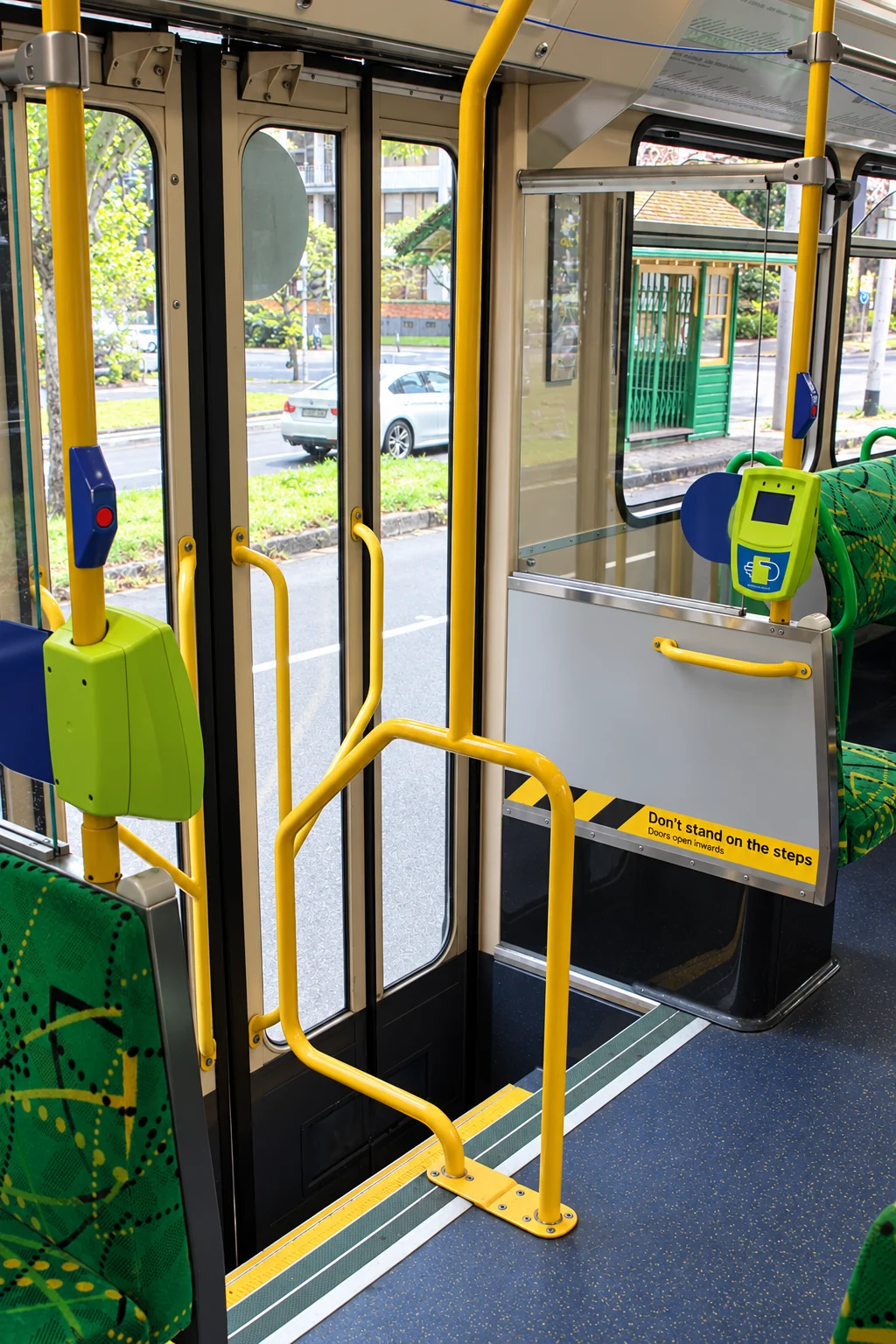
From 1 January 2026, the Victorian Government made public transport free for everyone under 18 on trams, trains, buses and coaches. Youth Central confirms that children aged 5 to 17 travel free with a Youth myki. The child must tap the card on and off each time they travel, and in areas without myki readers they must show it.
Getting a Youth myki as a visitor
The Youth myki costs $5, according to the Transport Victoria campaign page and Visit Victoria. Visit Victoria lists online purchase and staffed stations as the places to get one. The card works like any other myki for tapping on at stations and boarding buses and trams. It stays valid until the child turns 18. A Premier’s announcement states that all under-18s are eligible wherever they live, so interstate and overseas children can have one. The same announcement says the Youth myki card number can be used for free travel on booked V/Line regional services.
For a family of two adults and a 7-year-old and a 3-year-old, that means two adult fares, one $5 Youth myki for the 7-year-old, and nothing for the toddler. If you have several school-age children, each needs their own card, because the card is what makes the trip free.
Older teenagers
Free travel stops at 18. Youth Central says that 18-year-olds travelling on a child ticket must carry proof-of-age ID. Anyone 18 or over pays an adult fare. Concession fares apply only to people with an eligible concession card.
Children travelling without an adult
Official guidance for children travelling alone depends on the child’s readiness rather than a set age. Victorian Government guidance on travelling to school says a child needs to know what is around them and what is safe, how to look after belongings, how to ask for help, and how to use a mobile phone if they carry one. It recommends doing a test run or two with the child, and it says the child must want to travel this way. Visitors can apply the same checklist on a quiet daytime trip before letting an older child go a few stops alone.
Fares for the adults in your group
Children may travel free, but the adults still need a valid ticket on every trip. Since 2023, the whole metropolitan network, which used to be split into Zones 1 and 2, has been a single fare zone. The same fare applies whether you ride two stops or travel to the outer suburbs.
Current fare figures
All myki fares are half price from 1 June 2026 to 1 January 2027, and the discount applies automatically when you touch on. The figures below come from Melbourne Metro’s fares page, and OZ Local Updates lists the same discounted amounts.
| Fare | Normal price | During the discount |
|---|---|---|
| 2-hour fare (trains, trams and buses) | $5.70 | $2.85 |
| Daily cap | $11.40 | $5.70 |
| Weekend and public holiday daily cap | $8.00 | $4.00 |
A 2-hour fare lets you change between trains, trams and buses within that window. The daily cap is the most a myki charges in one day. Once you reach it, the rest of the day costs nothing extra. Standard prices return after 1 January 2027. Check the official metropolitan fares table for the dates of your trip. Concession card holders pay half the full fare with a Concession myki.
Choosing a card or contactless payment
A standard myki costs $6 and is sold at stations, the PTV Hub and shops displaying the myki sign. Melbourne Metro adds that Android users can put a myki into Google Pay. The operator lists many places to buy and top up. These include myki machines at all Metro stations, some accessible tram stops and bus interchanges, 7-Eleven stores, about 800 retailers around Melbourne, the PTV Hub at Southern Cross Station and the Transport Victoria website. You can also top up through the Transport Victoria app. Online top-ups take about 45 minutes to process, and phone top-ups need at least 24 hours, so use a machine or the app if you need credit straight away.
Since July 2026, adults can also tap on and off with a contactless bank card or phone wallet on all trains, trams and buses. It always charges the full fare, so it gives no concession or youth benefit. It suits a short visit when you do not want to buy a card. Each adult needs their own card or phone.
Touch on and touch off
On trains, you touch on at the myki reader when you enter a station and touch off when you leave. Metro Trains explains that myki calculates the lowest fare automatically. If you forget to touch off at the end, you may be charged more, so make touching off a habit from the start. Trams and buses follow their own tap rules. Children with Youth mykis should tap on every trip, including trams and buses.
Prams on trains, trams and buses
Trains, trams and buses differ a lot in how easy they are with a pram, so your choice of route matters. A VicRoads fact sheet on using public transport is written for people who use mobility devices, but the same spaces and ramps are used by prams.
Trains
All metropolitan trains have allocated spaces for wheelchairs, mobility aids and prams. Every metropolitan station can be reached by ramp or lift except Heyington, which has stairs. Ramp steepness and length vary from station to station, and wet weather affects access, so if you are pushing a heavy double pram uphill, allow extra time.
At the platform, look for the wheelchair symbol, which marks the boarding point close to the front of the train. At larger stations where trains run in both directions, go to the end of the platform for your direction and wait near the white platform marker, or ask station staff. The driver provides a ramp, although some stations have a raised platform section near the front that may allow boarding without one. Telling the driver your destination station, or showing it written down, lets them help you off at the right stop.
Trams
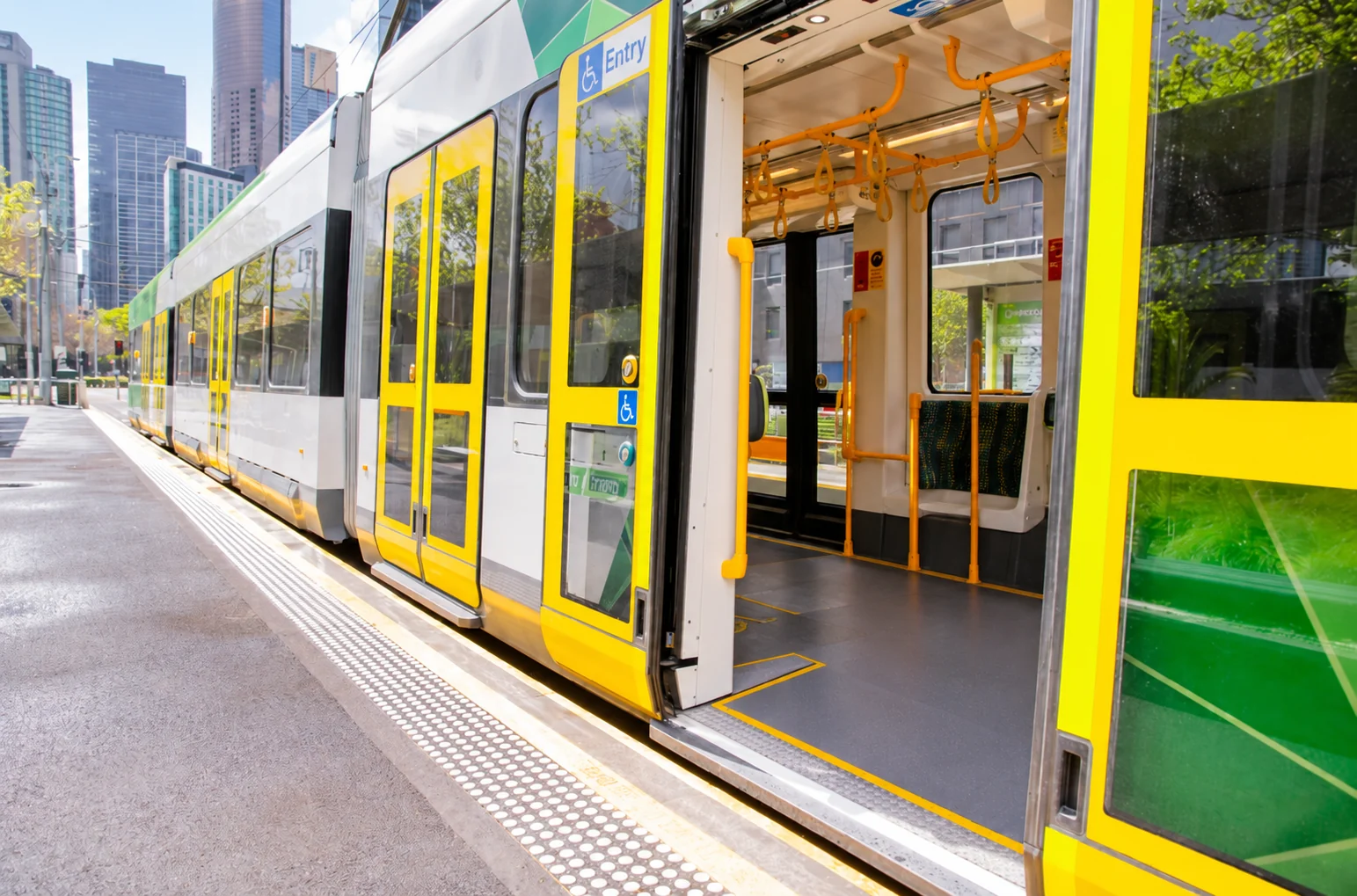
Tram access is less consistent. Not all routes or stops are accessible, and not all trams are low-floor. Low-floor trams have allocated spaces marked with a wheelchair symbol on the floor, while high-floor trams have steps that make a pram impractical. A wheelchair symbol on digital stop displays shows when the next tram is low-floor, and tramTRACKER and the Yarra Trams route guides show which routes and stops are accessible.
Two details matter for families. Tram drivers may not be able to leave their cabin, so do not count on help with loading. There can also be a small gap between the stop and the tram floor. Pick a stop with a raised platform where you can, and board with the pram’s front wheels first and your hand firmly on the handle.
Buses
Low-floor buses have allocated spaces for wheelchairs, mobility aids and prams, positioned in the middle of the bus and marked with a wheelchair symbol. The driver lowers the bus and can use a ramp. You must board and get off at the front door. Flip-down seats in the allocated space are folded up by the driver if empty, and if other passengers are sitting in the space, they must move.
Safety on platforms and at stops
Transport Victoria’s page on travelling with children and prams is the official starting point for pram tips. The advice covers holding the pram at all times, keeping the child strapped in, applying the brake and standing behind the line on platforms and tram stops. A toddler walking beside the pram should hold your hand near the platform edge.
Allocated spaces are limited
The allocated spaces on trains, trams and buses are shared with wheelchair users. The VicRoads fact sheet notes that off-peak travel may be easier because designated spaces are limited and may be occupied. Weekday mid-morning and early afternoon are the quieter periods to aim for with a big pram. PTV also runs Try before you ride events, which let people practise boarding while vehicles are stationary.
The Free Tram Zone
Trams inside a central area of Melbourne cost nothing, which suits tired legs and short hops between attractions. The zone covers the CBD and Docklands. Travel Victoria also lists Queen Victoria Market, and Melbourne Info adds the MCG gates on routes 48, 70 and 75.
Trips that stay entirely inside the zone are free and do not need a touch on. Trips that start or end outside the zone need a myki as normal. Travel Victoria says that touching off is not necessary within the zone, but touching on or off is still required when a journey leaves it. Melbourne Info adds that you have until the tram crosses the boundary to tap on.
Several family favourites sit outside the zone and need a fare. The Shrine, Royal Botanic Gardens, Melbourne Zoo, Arts Centre and St Kilda are all outside the free area, and the MCG is listed with the same outside-the-zone group on the site’s list of fare-paying places. A tap made inside the zone is charged a 2-hour fare, and reimbursement requires a tap-off inside the zone. To avoid a mix-up, Brighton Savoy’s visitor guide advises paying from the start of any journey that leaves the zone.
A child under 18 with a Youth myki should still tap on for trips that leave the zone, so the family does not arrive at a boundary with one card unused. Zone edges can change, so check the current map on the official network pages before you rely on a particular stop.
Planning the day with children
Journey planning starts with the Transport Victoria Journey Planner. It plans trips between any two Victorian locations on all public transport modes, for the date and time you choose. It shows step-by-step directions, fare estimates and planned disruptions. Enter the time you expect to leave rather than the current time, especially for a long day, because weekend disruptions are common.
Timetables, alerts and the app
Metro publishes full train timetables, and Metro Notify sends personalised updates by line, station and special event. The Public Transport Victoria app covers journey planning, mobile myki, instant fare payment and real-time alerts including disruptions. You can save favourite routes and stops and receive an alert when something changes. Saving your accommodation stop and the main attraction you plan to visit gives you a quick return route when the children are tired.
Phone support
The public transport enquiries line is 1800 800 007. Metro’s page says it operates from 6am to midnight daily, with all-night service on Friday and Saturday. It is also the number to call about planned disruptions before you travel. More detail is on the public transport enquiries page.
Preparing children for stations and crowds
Metro offers a visual story PDF to help prepare children for a new environment. It also has interactive virtual station tours for Box Hill, Flagstaff, Flinders Street, Footscray, Melbourne Central, North Melbourne, Parliament and Richmond. Flinders Street and Melbourne Central are the stations many visitors use first, so a short virtual walk-through shows children (and parents) where the platforms, stairs and exits are before they arrive. This is especially helpful for children who find noise or crowds unsettling.
Help at major stations
Travellers Aid operates at Flinders Street, Southern Cross and Seymour stations. According to the VicRoads fact sheet, services include accessible bathrooms, mobility equipment hire, charging and a companion service, and some require booking. Council "Mobility Maps" mark lifts, ramps, toilets and charging points for individual suburbs, which is useful when you plan a walk from a station to a park or museum with a pram.
Where to find current route and access information
Fares, tram routes, station works and disruption notices change. The sources that stay accurate are those run by the network operators and Transport Victoria.
| Need | Where to look |
|---|---|
| Plan a door-to-door trip | Transport Victoria Journey Planner |
| Train timetables | Metro timetables |
| Service updates | Metro Notify and the PTV app |
| Station accessibility | Metro station accessibility features |
| Accessibility resources | Transport Victoria accessibility page |
| Current fares | Metropolitan fares table |
| Phone enquiries | 1800 800 007 (6am to midnight daily; all-night Friday and Saturday) |
Transport Victoria manages the network, and its fares and myki pages are the reference for current prices. Metro Trains runs the train services, so its site is the best source for timetables and station details. Confirm fare amounts in this guide, including the half-price discount that ends on 1 January 2027, on the official fares table for your travel dates.
Before each day out, check Metro Notify or the PTV app for disruptions that morning, look at the accessible-stop details for any tram route you plan to use, and confirm where lifts are at the station you will leave from. If the lift at a station is out of service, the phone line can help you find the nearest alternative.
Key Takeaways
- Buy a $5 Youth myki for each child aged 5 to 17. Free travel for under-18s from 1 January 2026 only works when the child taps the card on every trip, and children under 5 need no card.
- Budget for adult fares only, and check the discount dates. Half-price myki fares run from 1 June 2026 to 1 January 2027, so the 2-hour fare of $5.70 drops to $2.85 until then. After that, it returns to $5.70.
- Choose trains for prams, and check trams before you go. All metropolitan trains have allocated spaces, and every station is reachable by ramp or lift except Heyington, but only low-floor trams have pram spaces.
- Use the Free Tram Zone for short CBD and Docklands hops. Trips entirely inside the zone are free, but trips that start or end outside it, such as to the zoo or the Botanic Gardens, need a myki.
- Check live information the morning you travel. The Journey Planner, Metro Notify, the PTV app and the 1800 800 007 phone line cover disruptions and access changes.