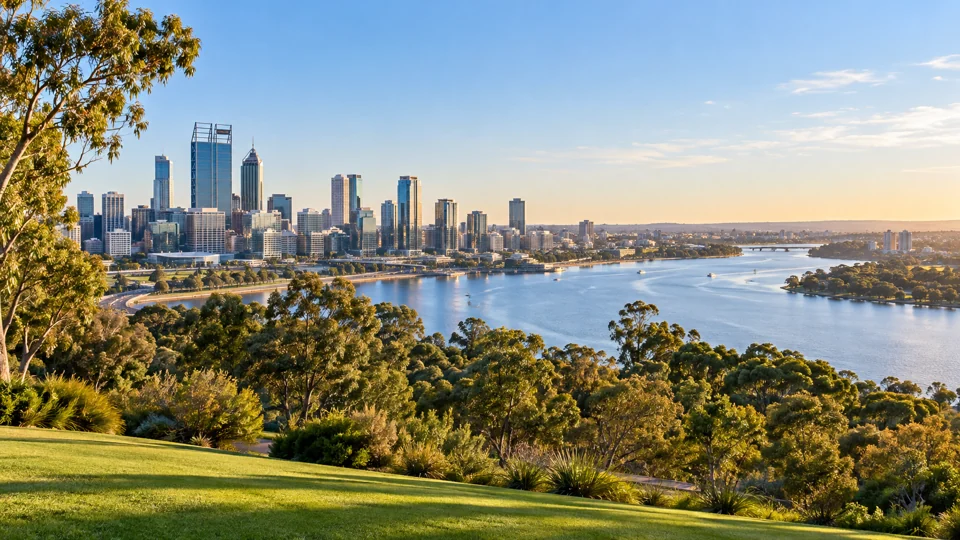
Kings Park is a 400-hectare reserve on Mount Eliza, about 1.5 km from central Perth. It contains the Western Australian Botanic Garden. Entry is free, and the park is open 24 hours a day, every day of the year. The Botanic Gardens and Parks Authority (BGPA), the state body that manages the park, charges only to reserve a shelter or lawn for a group.
Most of the park is native bushland, so a single visit can take in city lookouts, memorials, planted wildflower beds, an elevated glass walkway and bush paths.
Getting to Kings Park
Tourism WA describes the park as about a 15-minute walk from the city centre. Fraser Avenue runs from Kings Park Road in West Perth to the main tourist and restaurant precinct, and the State War Memorial and Botanic Garden entrance are a short walk from there. The park also has entry points at Jacob’s Ladder and Fraser Avenue.
Two free bus options reach the main car park. The Transperth 935 must show "Kings Park" on the front, not "Parliament House", and terminates on Wadjuk Way beside the main car park. The Blue CAT (Route 1) runs to the same terminus. City buses in the free transit zone cost nothing, and the BGPA confirms both services are free. Blue CAT runs every 15 minutes daily, although some early-morning and late-night services do not continue to Kings Park from Elizabeth Quay Bus Station.
The official visitor map lists the other options. The Red CAT stops in West Perth, roughly 1 km from the park. The Green CAT runs Monday to Friday and stops on Kings Park Road just outside the park. The Perth Explorer has a stop at the Wadjuk Carpark.
Parking rules
Parking is free for the length of your park visit and is for Kings Park visitors only. The BGPA fines people who park and leave. The time limit rules in the park FAQ set a 4-hour limit at these locations:
- Wadjuk Carpark
- Poolgarla Carpark
- Jorang Carpark, next to the Next Gen Gym and the Royal Kings Park Tennis Club
- The car parks off Kattidj Close
- Signed sections of May Drive
The limit is enforced from 7 am to 4 pm, Monday to Friday, excluding public holidays, and signs mark the restricted areas. Caravans and other oversized vehicles use the Wardong bus park on May Drive. Other car parks on the map include Botanic Garden, Pines, Kulunga, Kalbarri, Zamia, Bidga, Swan and Forrest. If you plan a full day on a weekday, move your car before the four hours run out or arrive by bus.
Opening hours and entry
The park and Botanic Garden are open around the clock. Facilities keep shorter hours, according to the 2023 visitor map:
- The Visitor Information Centre on Fraser Avenue is open 9:30 am to 4 pm daily.
- The Lotterywest Federation Walkway is open 9 am to 5 pm daily.

Check both before you visit, because hours change. Contact the park on (+61 8) 9480 3600 or enquiries@bgpa.wa.gov.au. The Visitor Information Centre phone is (08) 9480 3634, and a Park Management Officer can be reached for urgent help on 0418 923 973. Call 000 for fire or smoke. Lost property goes through Customer Service on 9480 3600. Luggage storage is not offered, and buggies and mobility scooters are not available for hire.
Lookouts and views
The park’s position on the crest of Mount Eliza gives views of the city skyline and the Swan River (Derbarl Yerrigan). The BGPA management plan also lists the Canning River (Djarlgarro Beelier) and the Darling Range (Katamordo) to the east among the views.
Kaarta Gar-up Lookout sits near Fraser Avenue and is the easiest to reach from the main precinct. Dryandra Lookout, near the Swan Carpark off Forrest Drive, anchors the end of the Law Walk. Trails WA says the Law Walk takes in lookouts with views of the Perth skyline, the Swan and Canning rivers and the Perth Hills. Because the park is open all day, you can see the skyline in daylight or after dark.
Memorials
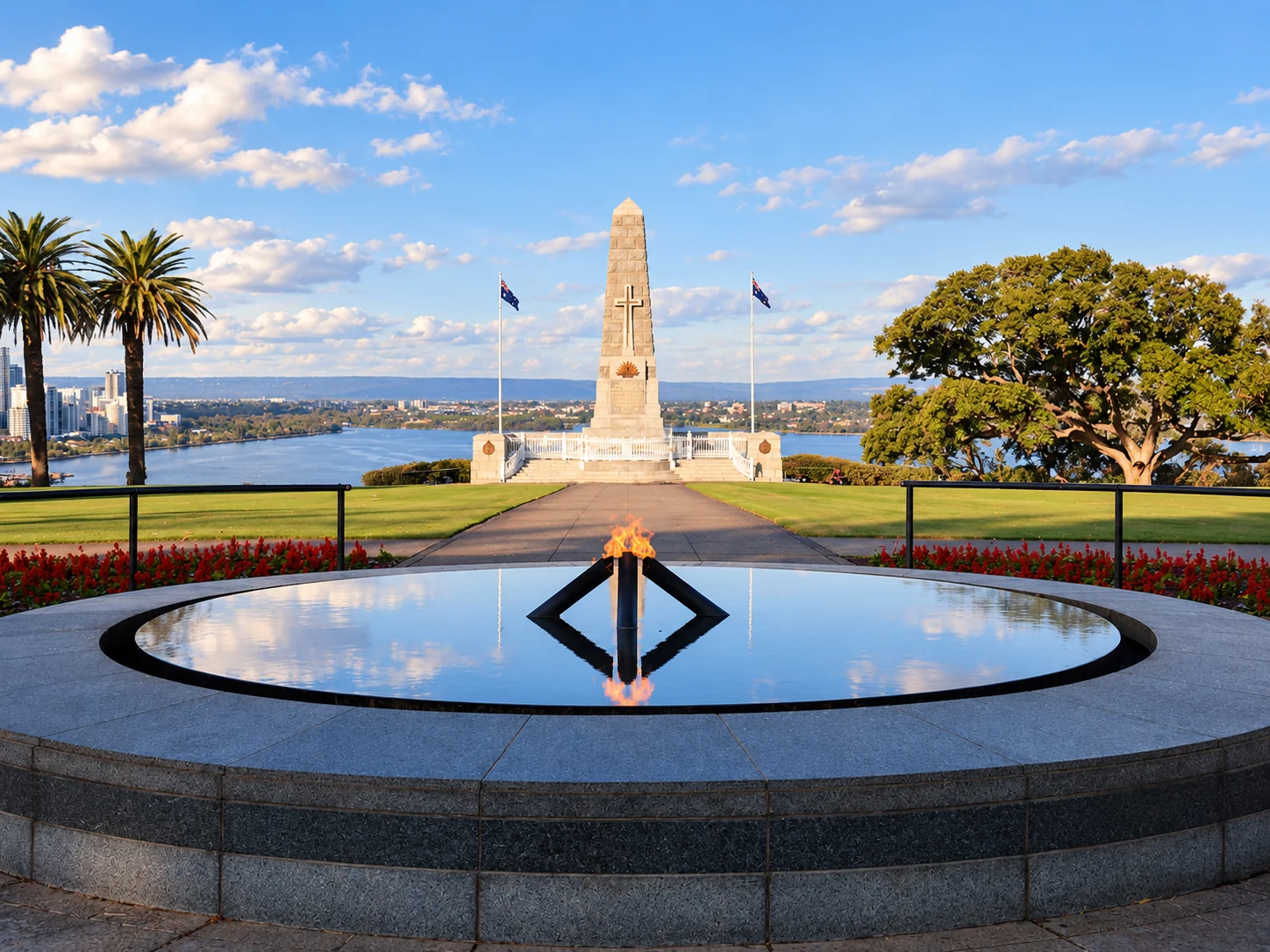
The State War Memorial is the park’s main landmark. It has the Flame of Remembrance and the Pool of Reflection, and is a short walk from Fraser Avenue. The Honour Avenues and the Pioneer Women’s Memorial are also in the park. Other mapped features include the Place of Reflection, Kennedy Fountain, Mt Eliza House, May Circle and Crawley Steps.
The Kokoda Track Memorial Walk is the most physical memorial route. According to the list of paths in Kings Park, it starts at Kennedy Fountain on Mounts Bay Road and climbs 150 steps rising 62 m. Wear shoes with grip and allow rest stops. The BGPA limits new memorials on its lands to protect the existing ones and their settings.
Lotterywest Federation Walkway
This glass-sided walkway runs through the bushland canopy and is the park’s best-known elevated walk. Tourism WA suggests allowing 40 minutes return. The walkway is open 9 am to 5 pm, so it is closed for sunrise and evening visits even though the rest of the park stays open.
The walkway suits wheelchairs and prams, though it is not completely flat. Dogs are not permitted on the raised boardwalk section, so take dogs on a bush path instead.
Law Walk and bush paths
The Law Walk combines manicured gardens with natural bush and includes the Federation Walkway. Trails WA rates it easy: it is flat with a hardened surface, has no steps or steep sections, needs no bushwalking experience and suits unassisted wheelchair users and prams. It is a loop of about 2.5 km that starts at Rotunda Two and follows the escarpment to Dryandra Lookout. Allow about 45 minutes. This is the walk to choose with young children, older relatives or anyone who wants views without climbing.
The management plan maps show many other paths through the bush, including:
- Nature Trail
- Broadwalk Vista
- Goanna Path
- Wren Path
- Boomerang Path
- Serventy Path
- Speargrass Path
- Prionotes Path
- Magpie Path
- Western Path
- Baird Path
- Zamia Path
- Spearwood Path
Keep to the designated bushland paths. Picking wildflowers and lighting fires of any kind need formal authorisation under the Botanic Gardens and Parks Regulations 1999.
Free guided walks
Volunteer guides lead free walks every day from outside Aspects of Kings Park on Fraser Avenue. The morning walk runs 10 am to 11:30 am and the afternoon walk 1 pm to 2:30 pm. Each takes about 1.5 hours at an easy to moderate grade. The BGPA says the walks are not suitable for wheelchairs or prams.

Individual visitors do not need to book. Groups of 10 or more must book through the BGPA Bookings Officer. Wear closed shoes and bring a hat, jacket, sunscreen and water. Toilets are nearby. The BGPA cancels walks when the temperature reaches 37°C or above and may cancel them in extreme weather. Check the BGPA notices page for closures.
The 2026 program adds themed walks:
- Heart of the Park runs on Fridays from July to October.
- Water Views and Bushland runs on Mondays from July to October.
- A Walk on the Quiet Side runs on 2 November.
- Paws and Plants: Walking With Your Dog runs on 15 November on dog-friendly paths.
For a self-guided option, the Biosecurity Trail runs daily and covers the threats facing Western Australian flora.
The Western Australian Botanic Garden
The botanic garden opened in 1965 and holds more than 3,500 species of Western Australian plants, including many rare and threatened species. The collection is displayed in themed beds across 17 hectares and grouped by region and by genus. Genera on display include Verticordia, Boronia, Grevillea, Hakea, kangaroo paws and Eucalyptus. Every plant has a documented origin, and interpretation signs guide visitors through the collection.
The Gija Jumulu boab is listed at 760 years old on the official visitor map, and it is one of the garden’s best-known single plants.

The park does not sell plants and does not accept plants from non-accredited sources. Friends of Kings Park hold plant sales four times a year, and the next is on 8 November 2026.
Wildflowers and the Everlasting Kings Park Festival
The BGPA says flowers appear in every month, but September is the best month for wildflowers. The Everlasting Kings Park Festival, which began as the Perth Wildflower Festival and takes its name from everlasting daisies, runs from Friday 18 September to Sunday 4 October 2026. It has more than 60 spring activities, including garden displays, guided walks, workshops, artist demonstrations, family events and school holiday activities.
Everlasting Ideas offers gardening talks by horticulturists and landscape designers on gardens suited to Western Australian conditions. Everlasting Nature Play Day is a free family event at Rio Tinto Naturescape with wildlife encounters and nature crafts. The finale is "Moortabiny: Becoming Family", a show of drones, light and storytelling on 2, 3 and 4 October 2026.
Festival gardens take about three months to plant, and seed collection and growing can start up to three years ahead. Expect busy paths and car parks during the festival, particularly on weekends. For access, VisitPerth’s 2025 festival listing described accessible toilets, ACROD parking, nearby parking and wheelchair access at Fraser Avenue. Check the festival page for 2026 arrangements.
Outside spring, the park hosts Fraser Avenue Tree Lights and a summer season of outdoor concerts, films and plays.
Playgrounds and family areas
The BGPA maps page describes several family areas, each with a different age focus.
- May Drive Parkland has a playground suited to children over six and a 75 m walkway raised above the ground. Zamia Cafe is on site, and Bovell Kiosk opens at busy times. Summer outdoor cinema evenings are held here.
- Poolgarla Family Area has the Ivey Watson Playground, suited to children under six, and Koorak Cafe.
- Rio Tinto Naturescape Kings Park is a learning and discovery area for children rather than a playground or picnic area. The main entrance is on May Drive. It is closed on Mondays and on high fire-risk days or in hazardous weather, according to the visitor map. Its education programs won the Premier’s Science Award in Science Engagement in 2018.
- Saw Avenue Picnic Area has picnic and barbecue facilities and play areas. The Kulbardi Pavilion, formerly the Variety Pavilion, is a venue for hire.
- Arthur Fairall Playground is due to be demolished in October 2026, so plan an alternative if you are visiting around then.
Dogs are not permitted in children’s playgrounds or in cafés.
Picnics and barbecues
Free electric barbecues are available on a first-come, first-served basis, and venue bookings do not include exclusive use of them. Portable barbecues are not permitted. Group reservations of a shelter or lawn carry a fee, which is the only charge for park use. For eating out, the Fraser Avenue precinct has the Botanical Café, Fraser’s Restaurant and a kiosk, alongside the Aspects of Kings Park Gallery Shop and the Visitor Information Centre.
Rules to know before you go
| Topic | Rule |
|---|---|
| Dogs | On a lead of 2 m or less at all times. Not tied up or left in cars. Not permitted on the raised walkway boardwalk, at events, in children’s playgrounds or in cafés. |
| Barbecues | Portable barbecues are not permitted. Free electric barbecues are provided. |
| Drones | Hobby use is not permitted. Commercial use needs a filming permit from the Bookings Officer. |
| Ashes | Scattering or burial is not permitted. |
| E-scooters | Suspended until further notice. |
| Wildflowers and fires | Picking wildflowers and lighting fires need formal authorisation. |
| Events and commercial activity | Need formal authorisation. |
The BGPA park FAQ is the place to check these rules before you go.
Aboriginal heritage
The Whadjuk Noongar people are the traditional custodians of Kings Park, and the management plan describes the park as highly significant to them. Noongar names for the place include Kaarta Koomba, Kaarta Gar-up, Mooro Kaarta and Kata Moor, and the name Kaarta Koomba is displayed at the main entrance. The plan places the park at the natural heart of Whadjuk Noongar culture, at a key junction of the river and a chain of lakes, linked by songlines and continuing cultural practice. The State Library of Western Australia says the land has been significant to the Whadjuk Noongar for at least 40,000 years.
Kennedy Spring (Goonininup), at the base of the southern face, provided year-round water for Aboriginal inhabitants and early European visitors.
Aboriginal cultural tours run by appointment and start near the Wadjuk Carpark. Destination Perth says the experience with a local Nyoongar guide requires booking, so arrange it ahead rather than turning up. The management plan also commits to a cultural agreement with Whadjuk Noongar leaders, an Aboriginal heritage focal point in a prominent location and continued Noongar naming of park features.
Bushland and conservation
More than two-thirds of the park is remnant banksia and tuart woodland, which is why path discipline matters. The management plan records 327 native plant species, 80 bird species, 20 reptile species and more than 300 fungi species in the bushland. The bushland is a Bush Forever site, and two Threatened Ecological Communities listed under the federal EPBC Act are present: Banksia Woodlands of the Swan Coastal Plain and Tuart Woodlands and Forests of the Swan Coastal Plain.
Restoration work in 2014 to 2019 planted more than 61,000 native plants across about 50 species. The Western Australian Seed Centre is at the Biodiversity Conservation Centre. The park’s history of protection goes back a long way: land was set aside for public purposes in 1831, gazetted as a public park in 1872, and made a Class A Reserve, the highest level of protection for public land under Western Australian law, in 1900.
Accessibility
The Law Walk and Federation Walkway suit wheelchair users and prams, but the guided walks do not, and the Kokoda Track Memorial Walk is stepped and not suited to wheelchairs or prams. An accessibility guide for the park notes that the Transperth 935 runs from St Georges Terrace into the park along Fraser Avenue. The park has no mobility scooters or buggies for hire, so bring your own equipment. The Kokoda Track Memorial Walk is stepped and not suited to wheelchairs or prams.