JUCY is a campervan and motorhome rental company with branches at Australian airports. Its website lists six pickup points (Adelaide, Brisbane, Cairns, Melbourne, Perth and Sydney), ten vehicle models that sleep two, four or six people, and a rental contract that sets out age limits, licence requirements, bonds, card rules and cancellation charges. The contracting company is JUCY Rentals PTY Limited, and the contract is governed by Queensland law.
For a first-time visitor comparing operators, the terms that matter most are the excess (the amount you pay toward damage if something goes wrong), the bond (a refundable amount held on your card), and the rules for dropping a vehicle at a different branch. The contract is the JUCY Australia and New Zealand Car and Camper Terms and Conditions valid from 1 January 2024. That document covers both countries, so clauses written only for New Zealand, such as road user charges on diesel vehicles, do not apply to an Australian hire. Licence rules for visitors are set by state and territory governments. Your rental agreement and booking confirmation override any summary. JUCY may update its terms, and the agreement lists the fees for your booking.
Where JUCY operates
The JUCY Australia homepage lists six locations, and all of them are airports: Adelaide Airport, Brisbane Airport, Cairns Airport, Melbourne Airport, Perth Airport and Sydney Airport. That gives you a pickup point in five state capitals plus the main gateway to Tropical North Queensland. Darwin, Hobart and Canberra are not on the list, so a trip that starts or ends there involves a one-way drop-off at another city or a different operator.
A JUCY blog post about the Splendour in the Grass festival refers to a Gold Coast branch about 30 minutes from the festival site near Byron Bay, and says JUCY also has branches in Brisbane and Sydney. The homepage does not list the Gold Coast among its airport locations. The Gold Coast branch closed effective October 2025, and JUCY directs customers to its nearby Brisbane branch, so if your itinerary depends on collecting from the Gold Coast, use the Brisbane branch instead. If you are choosing between operators, Brisbane is the more reliable starting point for the Gold Coast and Byron Bay region.
Because every listed branch is at an airport, the pickup works well for international arrivals. You collect the vehicle, drive away, and avoid taking a taxi or train into the city first. There is a catch for late flights, though. The terms deal with out-of-hours collection and returns separately, and the rules are detailed in the one-way section below. Under clause 14C, afterhours pickups are available on request, JUCY quotes the fee at booking, and you pay for any airport parking yourself. If your flight lands outside standard hours, request an afterhours pickup when you book, not on arrival.
Branch pages on the JUCY site give the address and opening hours for each location. Check the page for your pickup branch when you book, since terminal arrangements differ between airports.
When you contact JUCY from Australia, the number in the terms is 1800 150 850 (clauses 17B and 23G). That is a free-call number within Australia, so overseas visitors should use a local SIM or an app that can dial 1800 numbers, or use the feedback email in the complaints section.
Campervans and motorhomes
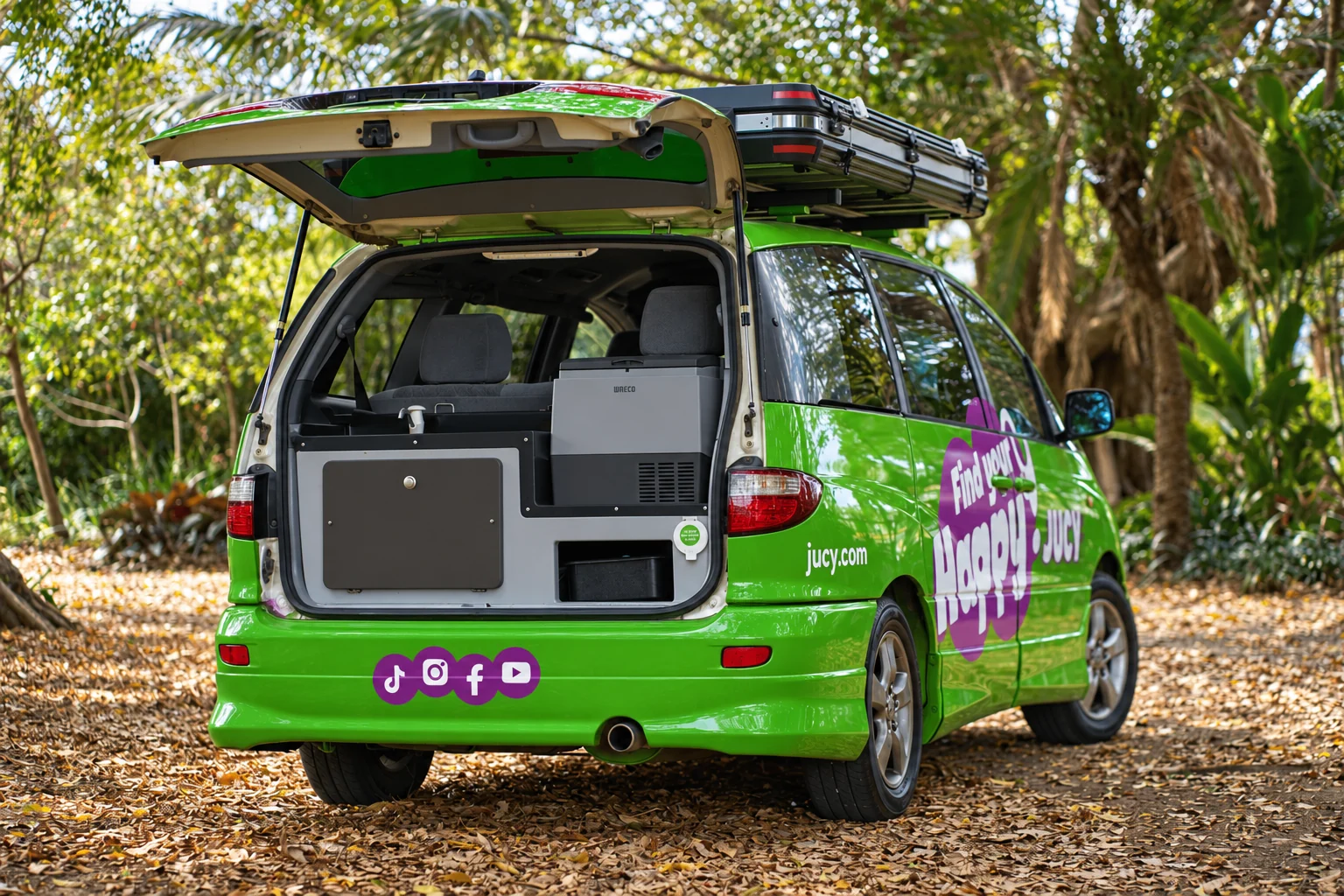
JUCY publishes seven campervans and three motorhomes. The campervans sit under two names. The standard JUCY range has the 2-Berth Coaster, the 4-Berth Crib+ and the 4-Berth Condo. A berth is a sleeping place, so a 2-berth sleeps two adults and a 4-berth sleeps four. The Chill’d range, a second JUCY brand, has the Chill’d 2-Berth Cloudbreak, the Chill’d 2-Berth Malibu, the Chill’d 4-Berth Sunseeker and the Chill’d 6-Berth Big Kahuna.

The motorhomes carry Star RV branding and come in three sizes: Polaris 2-Berth, Polaris 4-Berth and Polaris 6-Berth. A motorhome is a larger, purpose-built vehicle, so these suit families or groups who want more interior room than a converted van offers. All three motorhomes sit on the same vehicle list as the campervans.
The sleeping capacity is the best guide to picking a model. A couple travelling light can use a 2-berth, and the Coaster, Cloudbreak, Malibu and Polaris 2-Berth all sleep two. Four adults, or two adults with two children, fit the Crib+, Condo, Sunseeker or Polaris 4-Berth. The Big Kahuna and the Polaris 6-Berth are the only six-sleepers. Sleeping capacity and seatbelt numbers can differ between vehicles, so check how many seats the vehicle has before you book for a larger group.
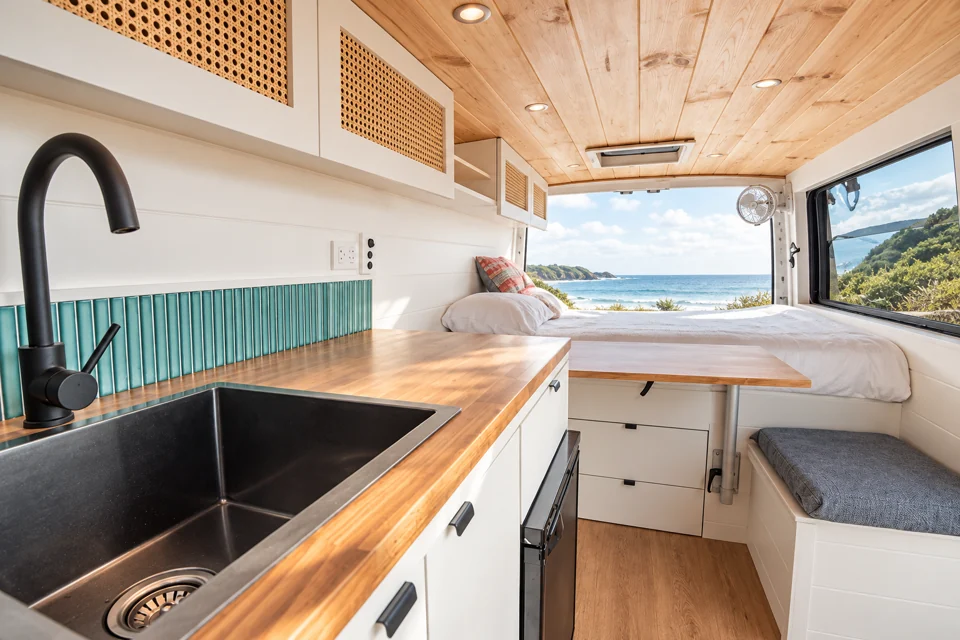
JUCY’s blog says the campervans are equipped with fridges, and that the kitchen includes a gas cooker and a kettle. The same post describes the Condo as fitting up to three large pieces of luggage and four smaller bags, which gives a four-person group a useful benchmark for packing. If you are flying in with large suitcases, that is worth measuring against what your party carries.
The homepage states that all hires include unlimited kilometres. That removes a cost that often catches visitors out on long routes. A Sydney to Cairns drive covers thousands of kilometres, and with unlimited kilometres you pay no per-kilometre charge. You still pay for fuel yourself (clause 7B), unless you took a pre-purchased fuel option. Return the vehicle with a full tank, because the terms charge an AU$30 admin fee plus the fuel cost if JUCY refuels it (clause 18E).
Pets are restricted. A registered guide dog or pet dog in a JUCY campervan costs an additional AU$299 and needs approval first (clause 6D).
Floor plans, dimensions and per-model prices appear on each model page and in the booking flow. Compare those figures for your travel dates, because campervan pricing follows the season.
Age and licence rules
The minimum age to be an authorised driver is 18. Clause 5A also requires a valid licence, shown at collection. An authorised driver is anyone named on the rental agreement who is permitted to drive. If you want a second driver, that person must go to a JUCY branch for approval after collection (clause 5C), so plan for both drivers to be present at pickup or at a branch early in the trip. An unauthorised driver is one of the excess exclusions, which means any damage caused while they drive is not covered by the excess reduction you paid for.
A young driver surcharge appears in the terms for hires of cars: AU$5 per young driver per day for drivers aged 18 to 21 (clause 14A and the additional charges table). The terms state this charge for cars, and it is worth confirming on your booking whether any age-related fee applies to the campervan you choose.
Overseas licences are accepted. JUCY’s terms require that a licence not in English comes with an accredited English translation (clause 5B). The Driving Tips page says that for stays under six months, you may drive with your home licence if it is printed in English and you follow local laws. If the licence is not in English, the page says you need an International Driving Permit (IDP) and/or an official English translation. An IDP is a booklet, issued in your home country, that translates your licence details into several languages. It is only valid alongside your original licence.
The two JUCY documents use slightly different wording, so the safest course for a licence in a non-Latin script is to carry both the IDP and an accredited translation. Government rules point the same way. Austroads, the national road transport body, says visiting drivers can use an overseas licence, carried with an IDP or an English translation if the licence is not in English. Its page also says most states and territories allow visitors to use an overseas licence indefinitely while it remains current. The Northern Territory’s three-month limit no longer appears on the current Austroads page. The NSW Government allows visitors to use an overseas licence for the first three or six months, as long as it is current and the visitor follows NSW road rules. Access Canberra advises visiting drivers to hold an IDP, and lists three acceptable combinations: an overseas licence plus an IDP, an overseas licence in English, or a non-English licence with an official English translation.
Provisional licences have their own rule. The terms accept green P-type licences and New Zealand restricted licences, but the driver must follow every condition of that licence (clause 5B). A breach, such as driving outside permitted hours, can void the excess reduction cover and end the rental agreement. Check your licence conditions before you sign.
Excess, bonds and reduction options
The excess is the maximum you pay toward damage to the vehicle when you are at fault, and a bond is money JUCY holds on your card against that possibility. Clause 9 sets out three options: Risk Taker, Stress Free and Stress Free Plus. Risk Taker means you carry the full excess. Stress Free and Stress Free Plus are excess reduction options that you buy to reduce what you owe after an incident, and JUCY lists the bond for both as AU$0.
The Risk Taker bond depends on the vehicle:
Check your booking for the bond that applies to a Chill’d or Polaris model. A Risk Taker bond of AU$3,000 to AU$5,000 is a large hold on a visitor’s credit limit, so many hirers choose a reduction option. JUCY "strongly recommends" Stress Free Plus. The terms say the hirer’s liability under excess reduction cover goes up to AU$2,000,000 per incident, not per rental (clauses 10B and 10C), so each separate event is assessed on its own.
Risk Taker comes with extra conditions. The bond must be paid by credit card only and is debited immediately. JUCY refunds it if you return the vehicle on time, undamaged, with a clean interior and a full tank (clause 12A). Once a refund is processed, the funds take 5 to 30 business days to reach your card (clause 12C), so a Risk Taker hold can outlast your trip. Risk Taker hirers also pay a AU$125 admin fee per damage claim, regardless of fault or any separate travel insurance (clauses 11L and 17M).
Reduction cover has limits. The terms list exclusions in clause 11, and they apply even if you bought Stress Free Plus. The exclusions include driving while intoxicated, driving an unsafe vehicle, using an unauthorised driver, submerging the vehicle (the terms name creeks, rivers, flooded fords, salt water and beaches), and driving off-road or on unsealed roads. The unsealed-road exclusion has one exception: access roads to recognised commercial campgrounds under 12 km. Driving with a warning light on, lost keys, interior damage and reckless conduct are also excluded. Australian outback and coastal routes often include gravel, so plan routes that stay sealed.
Rollovers get special treatment. A single-vehicle rollover counts as a breach of the terms unless you took Stress Free Plus. Without it, your liability is capped at AU$5,000 unless another exclusion applies (clauses 6I and 11Q). This is the clearest case where the top option does more than the mid-tier one.
Winter travel in the Victorian Alps has its own rule. Vehicles on the Great Alpine Road and entering Mt Hotham Alpine Resort must carry Diamond Pattern snow chains during the declared season (clause 6K).
Deposits, card payment and extra charges
A 20% deposit is due at booking, and again after any amendment, before JUCY issues a confirmation (clause 4E, which the 2022 Australian terms also contain). The remaining fees and the bond are paid in advance (clause 7A). The card must be a credit or debit card in the hirer’s name that JUCY accepts. The accepted card types are Visa, MasterCard, UnionPay International and American Express (clause 7C).
Card use carries several costs. Admin surcharges apply to card payments under Australian and New Zealand law, so check the surcharge shown on your booking confirmation. Your own bank may add fees, and clauses 7D and 7E make bank fees, including currency conversion fees, the hirer’s responsibility. Overseas visitors paying in Australian dollars from a card in another currency should expect the conversion charge. The card holder is jointly and severally liable (clause 7F), which means JUCY can pursue that person for the full amount of any charge. JUCY can process charges to the card up to six months after the hire, so keep the card active and monitor your statement after you return.
If you pay with a debit card, JUCY holds a AU$300 security bond on it (clauses 7G and 12I). This is separate from the Risk Taker bond, which requires a credit card.
The tolls rule matters for first-time visitors, especially in Sydney, Melbourne and Brisbane, where many motorways are tolled. JUCY charges tolls to your nominated card, plus a AU$3.45 service fee per toll notice (clauses 7H and 15D). Fines are handled the same way, with a AU$60 admin fee per infringement on top of the fine (clause 15B). Parking and speeding fines issued during your hire are passed to you, so the admin fee is the cost of JUCY forwarding them.
Several other fees in the 2024 terms apply to specific situations:
- Late return: the daily rate applies until the vehicle comes back, plus JUCY’s actual costs, and an unauthorised extension can attract a late return fee of up to AU$500 (clause 18B).
- Cleaning: up to AU$299 for general cleaning, and up to AU$500 for emptying greywater or the toilet cassette (clauses 6D, 18C and 18D).
- Public holidays: AU$100 per pick-up and per drop-off on public holidays and observed days (clause 14E).
The public holiday fee deserves a look at your dates. A pickup on Boxing Day or Easter Monday and a drop-off on a holiday weekend can add AU$200 to a trip. Public holidays vary between states, so check the calendar for your pickup and drop-off cities.
One-way hires and afterhours returns
JUCY’s homepage says one-way campervan hire, where you pick up in one city and drop off in another, is available between "most of our branches", and that a small relocation fee may apply. The homepage describes "flexible one-way trips and no hidden fees". The terms (additional charges table, item 8) say a fee applies when a vehicle is returned to a different JUCY location, "as listed on Agreement". Your booking confirmation therefore contains the exact figure for your route, and that is the number to compare with other operators. Because "most" of the branches take one-way hires, confirm that your specific pair of airports is offered.
Premium location fees can also appear on the agreement for branch pick-ups (item 6 of the same table). If you return the vehicle to a location that is not listed on your agreement, JUCY can charge a retrieval fee of up to AU$500 (item 3). This means you should not change your drop-off city informally. Ask JUCY to amend the booking first, because amendments are subject to availability and JUCY approval (clause 4D).
Popular first-trip routes work with the six-airport network. Sydney to Brisbane, Brisbane to Cairns, Melbourne to Adelaide and Perth to Adelaide all link two listed airports. A trip down the east coast, with Sydney, Brisbane and Cairns on the list, is the most common pattern for visitors who want a one-way route.
Afterhours returns follow strict rules, set out in clauses 14B to 14D:
- Afterhours returns go to branches, not to airport terminal car parks.
- You remain responsible for the vehicle until JUCY takes possession again during standard hours.
- Afterhours drop-offs need prior approval.
- You must refuel, leave the receipt, remove your belongings and use the key drop box.
- Damage that occurs in that window is not covered by excess reduction.
The last point is a real financial risk. If you drop the vehicle at 5 am for a 7 am flight, you carry the risk of damage or theft overnight even if you bought Stress Free Plus. A standard-hours return, where staff inspect the vehicle with you, avoids this. For an early flight, book the campervan return for the afternoon before and use a hotel for the last night, or arrange approval for an afterhours drop-off knowing what it means for your cover.
Cancellations, changes and roadside help
Cancellation charges under clause 4F follow three tiers, and the 2022 Australian terms use the same ones:
- 22 or more days before pick-up: you receive a full refund of the deposit or amount paid, less any credit card admin fee.
- 1 to 21 days before pick-up: 20% of the booking value is chargeable, and the rest of the hire fees is refunded less card fees.
- Within 24 hours of departure, or no collection at the branch: 100% of the booking value is chargeable.
The 20% charge in the middle tier equals the deposit, so a cancellation anywhere from three weeks out to the day before costs you roughly the deposit you already paid. Cancelling inside 24 hours or failing to collect costs the whole booking. If you amend a date and the new date falls inside a cancellation window, a later cancellation incurs the original fee.
Changes follow a separate set of rules. JUCY must approve amendments, and you must request a change to the return date at least 48 hours before it (clause 4D). JUCY may recalculate the rate when you change the location, category, collection point or dates before collection (clause 4B). A voluntary downgrade to a cheaper vehicle is not refunded (clause 4C), and returning a vehicle early earns no refund (clause 18A). If your schedule is uncertain, book only the days you are sure of and extend on the road if a vehicle is available.
For breakdowns, JUCY registers all vehicles with RACQ, the Queensland motoring organisation, for 24-hour roadside assistance. Mechanical breakdowns fall under JUCY’s own programme. Non-mechanical problems such as running out of fuel, a flat tyre, lost keys or a flat battery are charged by RACQ or the third party, and neither Stress Free nor Stress Free Plus covers them (clause 17D and item 10 of the additional charges table). Check the tyre pressure and fuel gauge before leaving remote areas, because a flat tyre on a long outback road is a charge you pay yourself.
For complaints, the terms give the address feedback@JUCYworld.com, and JUCY aims to resolve complaints within 14 days (clauses 23C and 23D). Clause 23G allows referral to the ACCC, the Australian Competition and Consumer Commission, and the 2022 Australian terms state that rights under the Australian Consumer Law are not excluded.
Key Takeaways
- Confirm your branch first: JUCY’s homepage lists six airport branches in Adelaide, Brisbane, Cairns, Melbourne, Perth and Sydney. A blog post mentions a Gold Coast branch that the homepage does not list, so verify any Gold Coast pickup before booking.
- Choose the excess option deliberately: Risk Taker bonds run from AU$3,000 to AU$5,000 and require a credit card, while Stress Free and Stress Free Plus carry a AU$0 bond. Only Stress Free Plus removes the AU$5,000 rollover cap, and JUCY strongly recommends it.
- Carry an IDP and a translation if your licence is not in English: JUCY requires an accredited English translation, and its Driving Tips page also mentions an International Driving Permit. Carrying both satisfies the JUCY contract and the government guidance.
- Pay with the right card and budget for add-ons: A 20% deposit is due at booking, the card must be in your name, and card surcharges, a AU$300 debit card hold, tolls with a AU$3.45 fee each and a AU$100 public holiday fee all apply on top of the hire rate.
- Read the one-way fee and afterhours rules on your agreement: The relocation fee is set out on your agreement. Afterhours drop-offs leave you responsible for damage that excess reduction does not cover.