
The Great Ocean Road runs 243 km along Victoria’s south-west coast from Torquay to Warrnambool, according to Visit Great Ocean Road, the official tourism body. Torquay is just over an hour’s drive from Melbourne, so the road itself begins roughly 100 km into a Melbourne-based trip. Some guides, including the Offroad and Camping Club of Victoria, end the route at Allansford, a small town just before Warrnambool. The difference is a few kilometres.
The road was built by returned soldiers after the First World War and opened in stages between 1919 and 1932. The club describes it as the world’s largest war memorial, and the Memorial Arch near Aireys Inlet recognises that history.
The road and the region are different things
Much of what visitors call the Great Ocean Road is scenery beside or off the road. The Otways section includes Apollo Bay and the Great Otway National Park, with rainforest walks and the Cape Otway Lightstation. The lightstation is on Lighthouse Road, a narrow, winding 12 km detour south from the main road with no services. The Shipwreck Coast, the stretch around Port Campbell, holds the Twelve Apostles, Loch Ard Gorge and London Bridge. These stops add driving and walking time beyond the road’s 243 km, and they are where most itineraries slow down.
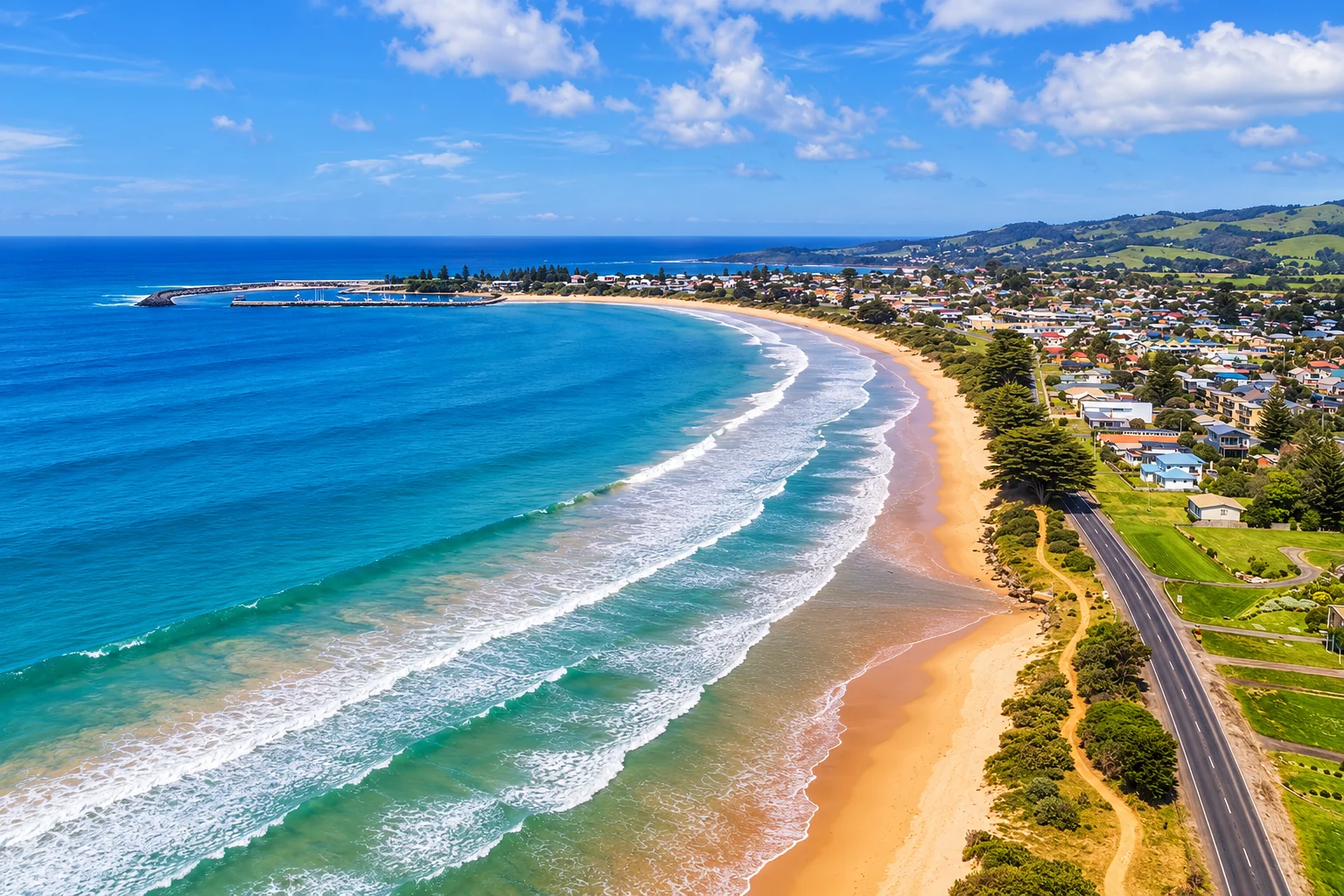
Driving times from Melbourne
Driving without stops, the regional tourism site gives about 4.5 hours from Torquay to Allansford. That figure leaves out every lookout, café and walk, so treat it as the minimum time. Typical leg times from other guides are:
- Torquay to Lorne: 45 km, about 50 minutes (regional tourism site).
- Torquay to Apollo Bay: 95 km, about 1 hour 45 minutes (Anywhere We Roam).
- Apollo Bay to Port Campbell: roughly 95 to 105 km, about 1 hour 30 minutes to 1 hour 45 minutes, depending on the guide.
- Port Campbell to Warrnambool: about 65 km (Roam Dusk).
Parks Victoria puts Port Campbell National Park about 380 km and 4.5 hours from Melbourne via the Great Ocean Road. The inland route is about 230 km and 3 hours.
Day trip or multi-day
The official site suggests self-driving itineraries of one, three or five days.
| Length | Official route | What fits |
|---|---|---|
| 1 day | Torquay to Apollo Bay | Surf coast and Lorne, with time to stop |
| 3 days | Torquay to Port Campbell | Cape Otway, Twelve Apostles and Loch Ard Gorge |
| 5 days | Torquay to Warrnambool | Adds The Grotto, London Bridge and the Bay of Islands |
A one-day trip that reaches the Twelve Apostles is possible. A tour operator says the road can be driven from Melbourne in a day if you return by the faster inland route. Using Parks Victoria’s figures, that is about 7.5 hours behind the wheel and 610 km, leaving little time at each stop. The Offroad and Camping Club of Victoria says most people spend two to three days, and for a first visit that range gives enough time for the Otways and the Shipwreck Coast without rushing between them.
Why the road exists
The road’s pace has a specific origin. It was built as a memorial. Construction started in 1919, and returned soldiers from the First World War did much of the work, cutting the road by hand and with basic machinery along steep coastal cliffs. It opened in 1932 and is dedicated to the soldiers killed in the war. That origin explains the road’s character. It follows the coastline closely instead of taking the shortest line between towns. That is why 243 km of driving takes so long and why the views are so close to the water.
Choosing your length
The memorial road itself is the stretch of the B100 between Torquay and Allansford. Most visitors also want the Otways rainforest above Apollo Bay and the Shipwreck Coast near Port Campbell, so the useful question is how much of that wider region you want to see rather than how many kilometres you want to cover.
- One day: Choose this if you only have a day free. Plan for the Surf Coast and Lorne, accept that you will see little beyond it, and consider a guided tour so you are not driving back in the dark.
- Two days: Overnight in Apollo Bay or Port Campbell. This lets you reach the Twelve Apostles at a reasonable hour and drive back the next day without a rush.
- Three days: This suits a first visit. It adds Cape Otway, a rainforest walk and Loch Ard Gorge without cramming each into a single hour.
- Five days: Choose this if you want the western end, including Warrnambool, and slow mornings.
Accommodation costs depend on the season, so check prices before you commit to a stop. Rooms near the Twelve Apostles fill early during school holidays and long weekends, and Apollo Bay and Lorne book out at the same times. If your dates are fixed, book accommodation first and build the driving around it.
Getting There and Getting Around: Self-Drive, Tours and Public Transport
Most visitors drive themselves, and the first part of the route is easy. Torquay is just over an hour from Melbourne, so a morning departure puts you at the official start of the road with the day still ahead of you. Parks Victoria puts Port Campbell National Park about 380 km and 4.5 hours from Melbourne via the coast road, against roughly 230 km and 3 hours on the inland route.
Driving west to east or east to west
Driving from Torquay towards Warrnambool keeps the ocean on your left. Most lookouts sit on the ocean side, so westbound drivers turn into them without crossing oncoming traffic, and most visitors drive west from Torquay for that reason. Drivers heading east have the ocean on the far side of the road and must cross a lane to reach most pull-offs. Westbound also puts the Twelve Apostles and Loch Ard Gorge at the end of the trip, and the return to Melbourne can then use the faster inland route.
Driving on the left
Visitors from countries that drive on the right need to keep left, sit on the right-hand side of the car and give particular attention at roundabouts and when pulling out of lookout car parks. Rental cars are automatic by default in most cases, which frees attention for the road.
Winding sections, fatigue and wildlife
The Lorne to Apollo Bay stretch is the tightest. The signed limit is 80 km/h, but realistic speeds are 50 to 60 km/h, and rockfall follows heavy rain. Caravans and motorhomes slow traffic further in peak season. Plan on short driving days with regular breaks at designated rest areas to keep fatigue in check.
Dawn and dusk carry the highest wildlife risk, when eastern grey kangaroos are on the move and koalas occasionally cross in the Otway sections. Europcar advises against driving rural roads at night if you are not used to Australian conditions. If you hit an animal, call Wildlife Victoria on 1300 094 535. Slow down for a koala on the road rather than picking it up.
Mobile coverage is patchy in sections, so download offline maps before leaving Torquay and do not rely on live navigation. Fuel needs the same planning: Lavers Hill is the only fuel stop between Apollo Bay and Port Campbell, so fill up in Apollo Bay or Lorne first.
Indicative costs
These are rough ranges only, and prices rise in summer and school holidays.
- Car hire: about A$50 to A$120 a day for a small or mid-size car, with one-way fees extra if you drop off somewhere other than Melbourne.
- Fuel: about A$100 to A$150 for a three-day trip of roughly 600 to 700 km, depending on the car and the pump price. Fuel at Lorne and Port Campbell has been described as 15 to 20% dearer than elsewhere.
- Day tours from Melbourne: about A$100 to A$250 per person, depending on the operator, coach size and whether lunch or entry fees are included.
Get a current quote before booking, because all three figures move with the season.
Without a car
Trains run from Melbourne to Geelong, and coaches connect on to Torquay, Lorne and Apollo Bay, with fewer services further west towards Warrnambool. One guide calls this option slow and infrequent, so it suits travellers with flexible time and a base in one town. A day tour covers the headline stops without the driving. One operator notes that tours can reach the road from Melbourne in a single day by returning on the faster inland route. That makes for a long day with limited time at each stop, but it removes the navigation and fatigue risks.
Mixing trains, hire cars and tours
The options combine well. Geelong, roughly an hour from Southern Cross station by V/Line, has car hire depots. Collecting a car there skips the Melbourne traffic and the drive out through the western suburbs, and you start the coast road already rested. Confirm depot opening hours before you book, because they are shorter than at Melbourne Airport and on weekends some close early.
If you want to drive only part of the route, split it. Hire a car for the winding stretch between Lorne and Port Campbell, where most of the scenery and most of the slow driving sit, and leave the long highway legs on either side to a coach or train. This only works if the pick-up and drop-off towns suit each other, so check one-way fees before committing. Fees for returning a car to a different town can erase the saving from a shorter rental.

Multi-day tours are another choice. Some operators run overnight or two-day trips that stay in towns such as Apollo Bay or Port Campbell and return to Melbourne by a different route. These cost more per person than a day tour, but accommodation and sometimes meals are included, and nobody in the group has to drive after dark. They suit solo travellers and visitors who have never driven on the left.
Whichever option you choose, settle three things before leaving Melbourne:
- Book accommodation in the towns where you stop. Beds fill quickly in summer, at Easter and in school holidays.
- Download offline maps and save your booking confirmations to your phone, since coverage drops out between towns.
- Check VicEmergency for road closures and fire warnings on the morning you leave. Landslips and bushfires can shut sections of the road at short notice.
With transport sorted, the next question is what to prioritise at each stop and how to split the days.
The Surf Coast: Torquay, Bells Beach and Anglesea
The first 45 km or so of the Great Ocean Road follows Victoria’s Surf Coast, which is about 50 minutes of driving from Torquay to Lorne, according to the regional tourism driving guide. Stops are close together here, so a morning of short visits fits easily before the cliff driving starts west of Lorne.
Torquay and its surf heritage
Torquay is where the official route begins, and the Visit Great Ocean Road itineraries start the first day at Surf City Plaza and the National Surfing Museum. The museum (officially the Australian National Surfing Museum) tells the story of Australian board riding and the Torquay surf brands that grew out of it. The plaza’s outlet shops are an easy place to buy sunscreen, a hat or a rash shirt before reaching the open coast. Torquay also has several fuel stations, so fill up here, and the driving guide lists Chargefox electric vehicle chargers at the Surf Coast Plaza.
Bells Beach and Point Addis
Bells Beach is the best-known surf break in Australia and hosts the Rip Curl Pro, usually around Easter. Visitors watch from the clifftop lookouts above the beach, where the long right-hand waves are easy to follow even without a surfboard. Treat it as a spectator stop. It is a powerful surf break, and the surfers in the water are experienced.
Point Addis, a little further west, adds a broader view of the coast. A lookout gives views along the cliffs and down to a beach reached by a track. Allow time for the walk back up the track in summer heat, and keep well back from cliff edges. Parks Victoria warns that cliffs along this coast can collapse without warning.
Anglesea’s kangaroos
Anglesea is known for the eastern grey kangaroos that graze on the golf course. They are most active at dawn and dusk, the same hours that the regional wildlife advice flags as the riskiest for animals on the road, so late afternoon or early morning gives the best chance of seeing a mob. Watch from the edges of the course, stay out of play areas and keep your distance. The town also has fuel and a good range of cafés, which makes it a handy first break after Torquay.
Memorial Arch and Split Point Lighthouse
At Eastern View, the Great Ocean Road Memorial Arch spans the road and recalls the returned soldiers who built it. The Offroad and Camping Club of Victoria lists it with Split Point Lighthouse among the stops between Anglesea and Lorne. The white lighthouse at Aireys Inlet stands on a headland, and the walk around its base gives a wide view of the coast in both directions. Arrive early in the day if you want photographs of the arch without queued traffic.
Swimming, patrols and rips
Swim only at a beach patrolled by lifesavers, and stay between the red and yellow flags. Patrols operate in the warmer months only, so check which beaches are staffed on the day you visit, and note that patrolled beaches near Torquay and Anglesea have no cover in winter. Many surf beaches along the coast have no patrols at all.
Rips are narrow channels of water running out to sea, and they cause most surf rescues. They often look like darker, calmer patches between breaking waves. If a rip pulls you out, stay calm, float, and signal for help by raising an arm. Swim parallel to the shore until you are free of the current, then return in with the waves. Swimming against the rip tires you quickly.
The same caution applies further west. Parks Victoria says beaches in Port Campbell National Park are not patrolled or recommended for swimming, so the Surf Coast’s patrolled beaches are the safest place on the route for a swim.
How long to allow on the Surf Coast
Torquay to Anglesea is roughly 20 km, and Anglesea to Lorne adds about 30 km more. Driving without stops, Torquay to Lorne takes around an hour. Add the stops along the way and the stretch fills a half day: a morning in Torquay, with the surf museum and a Bells Beach lookout, then Point Addis, lunch in Anglesea and a late-afternoon stop at the lighthouse.
Travellers on a two-day trip can compress this into a few hours by choosing two stops. Bells Beach and Split Point Lighthouse give the clearest sense of the coast. Travellers on a three-day itinerary have room to walk the Point Addis cliffs and wait for the kangaroos in Anglesea at the best hour.
Fill the fuel tank and buy snacks and water before you leave Anglesea. The road beyond Aireys Inlet narrows and starts to climb, and the long, slow stretch to Apollo Bay begins at Lorne, with fewer places to stop and less room to pull over. The Surf Coast is the easiest part of the drive, so use it to settle into driving on the left and to practise pulling over safely at lookouts before the winding sections start.
Lorne, Apollo Bay and the Otway Ranges
Past Anglesea, the road squeezes between the sea and the forested Otway Ranges. The bends are tight, so a first trip slows down here, and the best stops sit inland among tree ferns and waterfalls.
Lorne
Lorne is the largest town between Torquay and Apollo Bay, with cafés, a supermarket and plenty of accommodation. Lorne Pier and the foreshore suit a morning coffee and a stroll along the water. For a view over town and the coast, Teddys Lookout sits in the hills above, and the road up is short.
The waterfalls come next. Erskine Falls is about a 15-minute drive inland from the coast, and the Offroad and Camping Club of Victoria also lists Kalimna Falls and Cape Patton Lookout near Lorne. Treat the falls roads as slow driving. Some are narrow, and they can close after fires or storms, so check conditions with Parks Victoria (13 1963) before you leave town.
Kennett River koalas
Kennett River is the easiest place on the route to see wild koalas, usually along the Kennett River Koala Walk, which leads up Grey River Road. Look up into the gum trees; the koalas are often asleep and easy to miss. Slow down if one crosses the road, and do not pick it up. Keep a respectful distance and do not feed koalas, parrots or any other wildlife, since human food harms animals and teaches them to approach cars and people. The stretch between Kennett River and Grey River was also a landslip repair site, and Transport Victoria reported the works were underway in June 2026, after starting in late May and expected to take about four months. Look for current signs and traffic controls when you arrive.
Apollo Bay as a base
Apollo Bay is smaller and quieter than Lorne and the closest town to Cape Otway and the Great Otway National Park. It has fewer places to stay, so book ahead in summer. Lorne to Apollo Bay is about 45 to 50 km and takes roughly 55 to 65 minutes without stops. Fill the tank here, because Lavers Hill is the only fuel between Apollo Bay and Port Campbell.
Great Otway National Park
The park covers the ranges behind the coast, and several of its best walks start within a short drive of Apollo Bay.
Maits Rest is a short rainforest boardwalk west of Apollo Bay, listed on the route between Apollo Bay and Cape Otway. It suits travellers who want ancient forest without a long hike. Hopetoun Falls, reached together with the Californian Redwoods, makes a good half-day loop from Apollo Bay. Check the access road before you go, because it is narrow and shaded.
For something longer, a section of the Great Ocean Walk starts at Apollo Bay. The full walk runs 104 km over seven days to the Twelve Apostles, but a few hours on the first stretch gives a taste. Further west, Melba Gully near Lavers Hill is another rainforest stop.
The Otway Fly Treetop Walk is an optional paid attraction: a walkway raised through the forest canopy. Dunny Dash lists an adult ticket at about $30, but the figure is undated, so confirm the price with the operator. Skip it if you already plan to see forest at Maits Rest or Hopetoun Falls and are short of time.

Conditions in the ranges
Fire and flood have hit this stretch. ABC News reported that Lorne and Apollo Bay were among the worst-affected areas in early 2026, and cars were washed away at Cumberland River on 15 January. On Catastrophic Fire Danger Rating days, Parks Victoria closes the Great Otway National Park and the Great Ocean Walk. Check Parks Victoria, VicTraffic and VicEmergency on the morning you drive, and keep a flexible day in the plan in case a waterfall road is shut.
Driving the waterfall roads
The side roads to Erskine Falls, Hopetoun Falls and the redwood plantings are sealed in places, but they are narrow, shaded and have few passing spots. Slow down on blind bends and pull into a bay or wide verge to let oncoming vehicles pass. Drivers heading uphill usually get priority where two cars cannot fit side by side. Caravans and large campervans are a poor fit for these roads, so leave them at Lorne or Apollo Bay and take the rental car or a day tour instead.
Falls viewing areas often involve stairs. The steps get slick after rain and the forest floor stays damp long after a storm has passed, so wear shoes with grip. Allow extra time for the climb back up, which takes longer than the walk down.
Car parks in the ranges have no mobile coverage in places, so download your maps and note the closure status before you leave town. Keep valuables out of sight, as at any trailhead car park in Victoria. If a road is closed, do not drive around barriers. Closures follow fire damage, fallen trees or washouts, and the surface beyond the gate has not been inspected.
Wildlife rules apply in the forest as they do at Kennett River. Keep to the path, and do not feed birds, koalas or wallabies. Feeding changes their behaviour and diet and draws animals toward car parks and roads, where cars strike them.
The Twelve Apostles and the Shipwreck Coast
The Twelve Apostles are limestone stacks (freestanding rock pillars left when the sea cut away the cliff) in Port Campbell National Park. Parks Victoria says seven stacks make up the formation today. Six are visible from the classic viewing platform, and the seventh stands several metres from its corner. There were never twelve. The name was a later tourism rebrand, the formation is generally reported to have had nine stacks, and erosion has since brought the count down. Another stack is likely to fall eventually, because waves keep undercutting the base of each pillar.
Gibson Steps and the clifftop walk
Park at the Twelve Apostles Visitor Centre, which sits on the inland side of the road, and reach the platforms by the footpath under the road. A 2.2 km return clifftop walk to Gibson Steps takes about an hour. When open, 89 steps descend the cliff to a wild beach, and at low tide you can walk up to the stacks called Gog and Magog. The beach closes at times for high tides and large swell, and kiosk signs show the current status. The same guide recommends against swimming here, because the beaches in these parks are not patrolled.
Loch Ard Gorge and the wreck
Loch Ard Gorge is a small beach enclosed by cliffs. The clipper Loch Ard hit the coast near Mutton Bird Island in 1878. Of the 54 people aboard, only two survived: apprentice Tom Pearce and passenger Eva Carmichael, who sheltered in the gorge. The Shipwreck Walk (1.4 km return, about 50 minutes) tells the story, and the Geology Walk (1 km return, 40 minutes) explains how the cliffs formed. Wrecks and artefacts along this coast are protected by law.
Bay of Islands and Bay of Martyrs
West of Peterborough, the Halladale Walking Track covers 4 km return in about an hour to the Bay of Martyrs. Bay of Islands Coastal Park lies roughly 20 km further west, and on the official five-day itinerary it comes after London Bridge and The Grotto. These stops draw far fewer people than the Twelve Apostles, and they suit the last part of the afternoon.
Timing for light and crowds
Sunrise and sunset give the best colour on the limestone. Little Penguins also come ashore just after sunset, and you can watch from the viewing platforms at the Twelve Apostles and London Bridge. Short-tailed Shearwaters (muttonbirds) return to Muttonbird Island burrows in the evening from September to April, with the best viewing in January and February. Day tours from Melbourne tend to arrive in the middle of the day, so early morning or the last hour of light is quieter. Staying overnight nearby is what makes either option practical.
Port Campbell as a base
Port Campbell is the practical overnight stop, with fuel, a Chargefox AC charger at the visitor centre and caravan parks. The Port Campbell Visitor Information Centre is at 26 Morris Street. There is no camping in Port Campbell National Park or Bay of Islands Coastal Park, and sleeping in the park carparks is not permitted. The 4.4 km Port Campbell Discovery Walk starts at the beach and makes an easy evening stroll. Port Campbell also has the nearest patrolled beach, with patrols in season only.
Paid extras and entry
US News describes the park as free to visit, with charges only for food and drink at the visitor centre. A coffee and snack there plausibly costs $10 to $25. Helicopter flights over the stacks are the main paid extra, and short flights of about 10 to 15 minutes typically start around $150 to $250 per person, with longer flights costing more. Both ranges are indicative estimates, not confirmed prices. Operators set their own fares and change them by season. Entry and booking arrangements for the Twelve Apostles have also been reported as changing, so check with Parks Victoria on 13 1963 before you go.
Cliff safety and roadworks
Cliffs here collapse without warning, so stay behind the barriers and away from cliff edges and cliff bases. Drones are not allowed in national parks. On Catastrophic Fire Danger Rating days the parks close.
Transport Victoria plans barrier installation between Princetown Road and Plantation Road, near the Twelve Apostles and Loch Ard Gorge, from 5 October 2026 for up to three months. Expect one-lane traffic, a 40 km/h limit and temporary lights during work hours. Attractions stay accessible. Check VicTraffic on the day you drive.
Sequencing the stops from Port Campbell
Port Campbell sits between the two clusters of stops, so a base there lets you split the coast into an eastern run and a western run. These distances are approximate road distances from the town, so check drive times before you set out.
The eastern run covers Loch Ard Gorge, Gibson Steps and the Twelve Apostles lookouts. Loch Ard Gorge is the closest, about 5 km east of town. Gibson Steps and the Twelve Apostles are roughly 10 to 12 km away, about 15 minutes’ drive, and the two are only a short distance apart. Allow 30 to 45 minutes at each stop, longer if you walk down the Gibson Steps to the beach or follow the Loch Ard Gorge tracks. On this plan, take the Apostles at sunrise or sunset and fit the other two into the quieter hours either side.
The western run covers the Bay of Islands and Bay of Martyrs, about 15 to 20 minutes from Port Campbell in the opposite direction. Both are short walks from their carparks, and neither draws the crowds of the Apostles. They suit the middle of the day, when the Apostles carparks are busiest.
Fit the stops to the conditions rather than a fixed order. Sea fog, low cloud and strong southerlies change the view at every lookout, and the Apostles can disappear in mist at midday and reappear by late afternoon. If the weather turns, stay flexible about which stops you visit first. A two-night stay in Port Campbell gives you a second chance at the stacks.
Fuel up before you arrive. Port Campbell has services, but the stretch from Apollo Bay is long and Lavers Hill is the only stop in between.
The coast beyond the Bay of Islands continues towards Warrnambool through further lookouts. The stops there lie outside Port Campbell’s reach as a base, so allow extra driving time for them rather than trying to squeeze them in at the end of a sunset visit.
Beyond the Main Stops: Warrnambool, Port Fairy and the Western End
Most itineraries end once the Twelve Apostles and Loch Ard Gorge are done, but the road keeps going for roughly another hour to the west. The route officially finishes at Warrnambool, and some guides mark the end at Allansford, a small town a few kilometres before it. There is no big ceremonial marker, so the last leg is a quiet transition from cliffs to farmland and a larger regional city. The official five-day itinerary uses this stretch for its fourth day, running from Port Campbell to Warrnambool via The Grotto, London Bridge and the Bay of Islands.
Warrnambool and whale season
Warrnambool is the first full-service town after Port Campbell, with several fuel stations and a wider choice of accommodation and restaurants. It also suits travellers who find the road’s eastern towns booked out. ABC News reported that accommodation spending in Warrnambool rose 65% in January 2026, while the Colac Otway and Surf Coast shires fell after the floods and fires.
Southern right whales visit the coast near Warrnambool from roughly June to September, which makes winter a good time to come. Whales arrive to calve and rest in shallow water close to shore, and you can watch from the clifftop viewing platform at Logans Beach. The regional wildlife guide lists whale watching among the road’s wildlife highlights. Sightings are never guaranteed, so treat any whales as a bonus.
Flagstaff Hill Maritime Village is the main indoor-and-outdoor attraction in town. It recreates a 19th-century port, with historic buildings and a shipwreck-themed collection that follows on neatly from the Shipwreck Coast stops. Allow two to three hours, and check opening times and ticket prices on the day, particularly if you want an evening show.
Tower Hill and Port Fairy
Tower Hill Wildlife Reserve sits inland between Warrnambool and Port Fairy, in the crater of an extinct volcano. Short walking tracks lead through the crater, and emus, kangaroos and koalas are regularly seen. It works well as a one- to two-hour stop between the two towns.
Port Fairy is about 1.5 hours from Port Campbell, a 105 km drive. The town is known for its fishing harbour and well-preserved 19th-century cottages and streets, which suit an unhurried walk. Griffiths Island, reached by a causeway from the town, has a lighthouse and a loop track. Short-tailed shearwaters, also called muttonbirds, nest on the island from around September to April, as they do at Port Campbell.
Continuing to Portland or South Australia
Drivers with spare days can carry on west along the Princes Highway to Portland, roughly an hour beyond Port Fairy, a working port with a quieter coastal feel. Beyond that lies South Australia’s Limestone Coast. Mount Gambier, about two hours from Port Fairy, is the main stop, known for its volcanic crater lakes and sinkholes. Check fuel levels and accommodation in advance, because services thin out between towns.
For most first-time visitors, finishing the road at Warrnambool and taking one night in Port Fairy is enough. The return to Melbourne from Warrnambool takes about three hours on the inland route.
Fitting the western end into the trip
The western end suits travellers who have a third or fourth day, or who are heading home through the west rather than returning along the coast. Warrnambool to Port Fairy is roughly 30 minutes by road, so the two towns, Flagstaff Hill and Tower Hill, all fit into one day if you start early. A realistic order is Flagstaff Hill in the morning, Tower Hill at midday, then an afternoon walk around Port Fairy and Griffiths Island before dinner.
Book Port Fairy accommodation ahead for weekends, school holidays and summer, as the town is small and fills quickly. Warrnambool has more rooms and is the easier fallback if Port Fairy is full.
Whale watching suits the June to September window, but the only sound plan treats it as an add-on. If you are in Warrnambool during those months, spend 20 to 30 minutes at the Logans Beach viewing platform at the start or end of the day. Skip it if the weather is poor, since rough seas and low cloud cut visibility. Check the latest sighting reports with the local visitor information centre before you go out of your way.
Finally, remember that the Allansford end point is a signpost rather than an attraction. Visitors who want a photo or a sense of completion can stop there on the way into Warrnambool. The best of the western end lies in the towns and reserves around it.
When to Go: Seasons, Weather and Crowds
The Great Ocean Road can be driven year-round, and the best month depends on whether you want beach weather, quiet lookouts or whales. Victoria is known for "four seasons in one day", and the coast delivers it: a sunny morning in Torquay can turn into wind and drizzle by the time you reach Apollo Bay. Pack layers in every season, including a windproof jacket and something waterproof, because clifftop lookouts are much colder than the beaches below them.
Summer
December to February is the busiest and warmest period. October to April is the beach-weather period, and patrolled beaches operate mainly in the warmer months. School holidays and summer weekends push demand up, and weekends fill months ahead. Accommodation is expensive and hard to find, and Apollo Bay in particular fills fast. Caravans and motorhomes also slow traffic on the winding sections.
Summer also brings bushfire risk. On a total fire ban day, declared when fires would be hard to control, open flames are prohibited. On Catastrophic Fire Danger Rating days, the highest level, Port Campbell National Park and Bay of Islands Coastal Park close, and the Great Otway National Park and Great Ocean Walk have closed on equivalent days. The 2026 summer showed how quickly conditions turn: flood and fire hit Lorne, Apollo Bay and the Twelve Apostles hardest, and cars were washed away at Cumberland River on 15 January.
Autumn
March to May usually suits first-time visitors best. The days are often settled, the crowds thin after the summer holidays and the water is still swimmable early in the season. Accommodation is easier to book than in summer, though Easter weekend remains busy, particularly around Torquay when Bells Beach hosts the Rip Curl Pro.
Winter
June to August is the quiet season. Bigger swells and fewer crowds arrive from May, and the Twelve Apostles are easier to photograph without tour groups. Expect cold, wet weather and storms. Rockfall follows heavy rain on the Lorne to Apollo Bay stretch, which has short winter closures. Southern right whales visit Warrnambool from roughly June to September, though sightings are never guaranteed. The Muttonbird Island viewing near Loch Ard Gorge runs from September to April, so winter visitors miss it.
Spring
September to November brings wildflowers to the coastal heath and Otway forests, and the weather swings between sunny and stormy. Rain jackets and a spare layer matter more here than in any other season. Spring is also when Short-tailed Shearwaters return to their burrows at Muttonbird Island, and Hooded Plovers begin nesting on beaches between August and April, so keep clear of marked nesting sites.
Checking conditions before you drive
Closures on this road usually last hours rather than days, and the inland Princes Highway offers a detour of about 90 minutes. Check VicEmergency for fires, floods and storms, and VicTraffic for road closures and roadworks, on the morning you drive and again before each leg.
Packing for four seasons in one day
Victoria’s "four seasons in one day" reputation applies on this coast. A warm morning in Torquay can turn into a cold, windy afternoon at the Twelve Apostles, because the next landmass to the south is Antarctica and nothing slows the wind off the Southern Ocean. Cloud and rain can arrive within an hour, even in January.
Layers cover every season:
- Base layer: a t-shirt or light long-sleeve top that dries quickly.
- Warm layer: a fleece or light jumper, which you will need at clifftop lookouts even in summer.
- Outer shell: a waterproof, windproof jacket. This replaces an umbrella, which is useless on exposed platforms.
- Sun protection: a hat, sunglasses and sunscreen. UV levels in Australia are high, and sunburn happens under cloud.
- Footwear: shoes with grip. Gibson Steps, forest tracks and wet boardwalks are slippery after rain.
Add swimwear and a towel from December to March, and a beanie and gloves from June to August. Keep the jacket and fleece in the car’s cabin rather than the boot, so you can reach them at each stop.
Choosing your season
First-time visitors who can pick their dates get the most from autumn, when the weather is usually settled and the road is quieter. Summer suits travellers who want beach days. They should book accommodation well ahead, allow extra driving time and accept that a fire may change the plan. Winter rewards flexible travellers who want empty lookouts, storm-lashed coastline and possible whale sightings, and who will cope with wet weather and short closures. Spring suits those who prefer wildflowers and wildlife to guaranteed sunshine.
Whichever season you choose, leave a spare half day in the itinerary. A closure or a storm then costs you a lookout stop rather than a night’s booking.
Sample Itineraries and Where to Stay
One day: a long but possible highlights run
The official one-day itinerary on Visit Great Ocean Road runs from Torquay to Apollo Bay, starting at Surf City Plaza and the National Surfing Museum. That version is easy and relaxed. A day that reaches the Twelve Apostles is far harder. Parks Victoria puts Port Campbell National Park at about 380 km and 4.5 hours from Melbourne via the coast, and the inland route back is about 230 km and 3 hours. That is roughly 7.5 hours behind the wheel before a single photo stop.
If you attempt it, leave Melbourne early. Take the coast road west with short stops at Bells Beach, Lorne and Kennett River, reach the Twelve Apostles and Loch Ard Gorge in the afternoon, then return inland. One tour operator describes this same loop. Driving the winding Lorne to Apollo Bay section in the dark is the main risk, so decide at Apollo Bay whether you are running late and skip Cape Otway. Most first-time visitors will enjoy a day tour or an overnight stay far more.
Two nights: Lorne or Apollo Bay, then Port Campbell
This plan follows the pattern of the official three-day route. On day one, leave Torquay in the morning, visit the Memorial Arch and Split Point Lighthouse, then take in Erskine Falls and Kennett River’s koalas, and sleep in Lorne or Apollo Bay. Choose Lorne for restaurants and a supermarket. Choose Apollo Bay for a quieter base nearer Cape Otway, though it has fewer places to stay.
Day two covers Cape Otway, with its lightstation at the end of the 12 km Lighthouse Road, and then the Twelve Apostles. Aim to be at the lookouts near sunset, then continue to Loch Ard Gorge and Gibson Steps if light and tides allow. Sleep in Port Campbell. Day three can take in London Bridge, The Grotto and the Bay of Islands before you head home. Check VicTraffic first, because road works near Princetown and the Twelve Apostles, and on the Timboon-Port Campbell Road, affect the return leg.
Four or five nights: the relaxed version
The official five-day itinerary adds a fourth day from Port Campbell to Warrnambool, covering The Grotto, London Bridge and the Bay of Islands. A slower version spends one night each in Lorne, Apollo Bay, Port Campbell and Warrnambool or Port Fairy. That leaves time for a waterfall walk, a section of the Great Ocean Walk from Apollo Bay, the Otway Fly Treetop Walk, and dusk Little Penguin viewing at London Bridge.
Accommodation types and indicative prices
Caravan parks are the cheapest option. Dunny Dash lists powered sites from about $35 a night in Torquay, Lorne, Apollo Bay, Port Campbell and Warrnambool. Cabins cost considerably more. Park camping is limited: Parks Victoria says there is no camping in the Port Campbell and Bay of Islands parks, and sleeping in the Twelve Apostles carpark is not permitted.
As a rough guide for a double room outside peak periods, motels start at about $150 to $250 a night, holiday rentals at about $250 to $450, and boutique stays at about $300 to $600 or more. These ranges are broad estimates, so check current rates before you plan a budget. Cape Otway Lightstation also offers cottage and lodge accommodation, according to Beyond Wild Places.

School holidays and long weekends push prices up and leave few rooms. Roaviate says summer weekends fill months ahead, so book accommodation as soon as your dates are fixed, and prefer rooms with free cancellation.
Fuel and food for the quieter stretches
Fill the tank in Apollo Bay or Lorne. Lavers Hill is the only fuel stop between Apollo Bay and Port Campbell, and Dunny Dash reports fuel at Lorne and Port Campbell is 15 to 20 per cent dearer than elsewhere. Lighthouse Road to Cape Otway has no services, so carry water and snacks. Buy lunch supplies in Lorne or Apollo Bay before the Otway and Shipwreck Coast sections, where kiosks have seasonal hours.
Choosing between Lorne and Apollo Bay
On a two-night plan, the first night goes to Lorne or Apollo Bay, and the choice depends on what you want from the evening.
Lorne has the larger selection of cafés, a supermarket and the widest range of rooms. It suits travellers who want to walk to dinner and visit Erskine Falls or Teddys Lookout early the next morning. Because it sits about halfway along the Lorne to Apollo Bay stretch, it also shortens the slow, winding drive the following day.
Apollo Bay is quieter and sits closer to Cape Otway, Maits Rest, Hopetoun Falls and the Great Ocean Walk. It puts you roughly 90 minutes closer to Port Campbell, which helps if you want to reach the Twelve Apostles for sunset on day two. Stay here if the Otways are the priority and you can accept a smaller town.
Either way, the second night belongs in Port Campbell. It is the practical base for the Twelve Apostles, Loch Ard Gorge and Gibson Steps, and with no camping in the national park, it saves you a long drive back to a bed at dusk, when wildlife risk is highest.
Booking in the right order
Lock in the scarce nights first. Port Campbell is a small town with a limited number of rooms, so book it before Lorne or Apollo Bay, which have more choice. If you are extending to Warrnambool or Port Fairy, Port Fairy fills faster, so book it ahead of Warrnambool.
Choose rooms with free cancellation where you can. That lets you secure beds early and still adjust if a bushfire closure, storm or road works change your route. Check VicEmergency and VicTraffic before each leg, as noted earlier, and confirm the check-in time with your host if you plan to arrive late after a sunset stop.
Outside school holidays and long weekends, midweek stays are easier to find and cheaper. Autumn is the most forgiving season for last-minute bookings, though a sunny autumn weekend can still fill the best rooms.
Pace your days around daylight
Whichever itinerary you choose, plan the longest driving in the middle of the day and keep the first and last hours for short stops. Kangaroos and wallabies are most active at dawn and dusk, and the tight coastal bends between Lorne and Apollo Bay reward patience rather than speed. A day with two or three real stops, such as a waterfall, a headland and a lookout, is more satisfying than one that tries to tick off every sign along the road.
Key Takeaways
-
Allow two to three days: The official route runs 243 km from Torquay to Warrnambool. Driving without stops takes about 4.5 hours, so a first visit works best over two or three days, with a night in Lorne or Apollo Bay and one near Port Campbell.
-
Drive west from Torquay: Westbound drivers keep the ocean on the left, so lookouts are easy to reach. Torquay is just over an hour from Melbourne, and visitors from overseas must drive on the left.
-
Fuel up before the Otways: Lavers Hill is the only fuel stop between Apollo Bay and Port Campbell. Fill the tank in Lorne or Apollo Bay, and download offline maps because mobile coverage is patchy.
-
Plan the western end around the Twelve Apostles: Port Campbell National Park holds the Twelve Apostles, Gibson Steps, Loch Ard Gorge, London Bridge and The Grotto. Go at sunrise, sunset or outside tour hours, stay behind barriers because cliffs collapse without warning, and confirm current entry and booking arrangements with Parks Victoria before you go.
-
Check conditions on the day: Look at VicTraffic and VicEmergency each morning and before each leg. Barrier works near the Twelve Apostles are planned from 5 October 2026 and bring one-lane traffic, 40 km/h limits and temporary traffic lights.
-
Avoid dawn and dusk driving: Kangaroos and koalas are most active then, and the Lorne to Apollo Bay stretch often moves at 50 to 60 km/h. Autumn suits first-timers best, while summer brings crowds, high prices and fire closures.