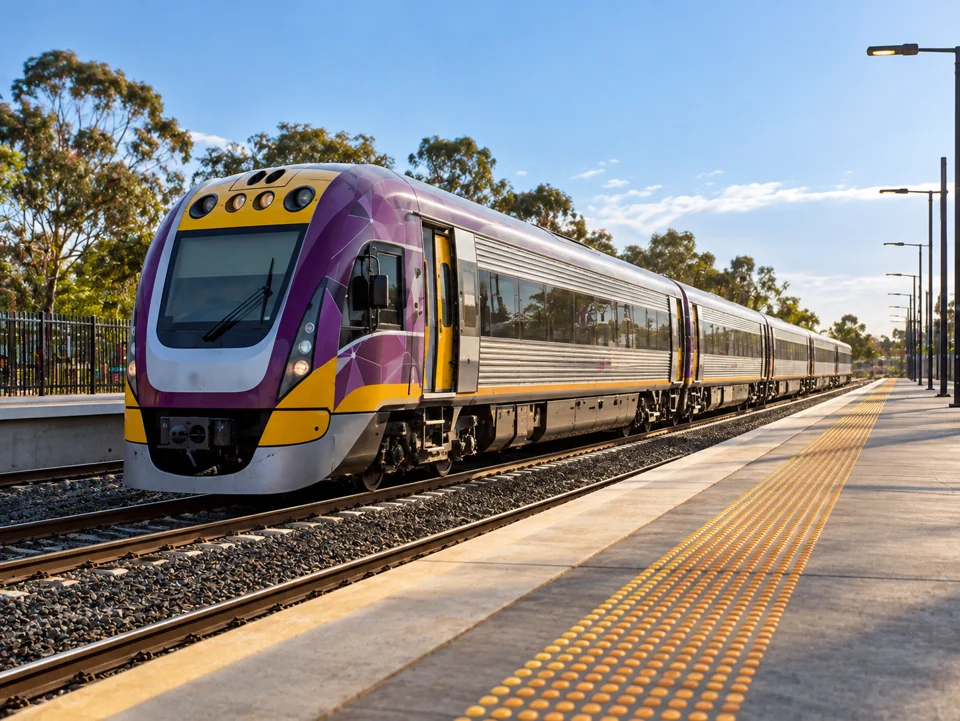
Outside the capital cities, rail lines often stop short of where you want to go. A regional train takes you to a hub such as Dubbo, Albury or Orange. From there, a coach (a long-distance bus) carries you to towns the train does not reach. A first trip that combines the two means dealing with timetables, tickets and luggage rules from different operators.
No national rulebook covers these connections. V/Line runs regional trains and coaches in Victoria, NSW TrainLink does the same in New South Wales, Queensland Rail runs trains and connecting coaches in Queensland, and Transwa covers regional Western Australia. Greyhound Australia operates coaches across the country. Each publishes its own conditions on luggage, ticketing and delays, and none of them guarantees that a connection with another operator will hold.
Four things decide whether a connection works: whether the timetables line up, how much time you leave between services, whether every leg is booked, and whether your luggage is accepted on the second vehicle. A fifth matters when something goes wrong: knowing which operator owes you what.
Who runs the trains and coaches
Each leg has its own operator and rules, so identify the operators before you build an itinerary.
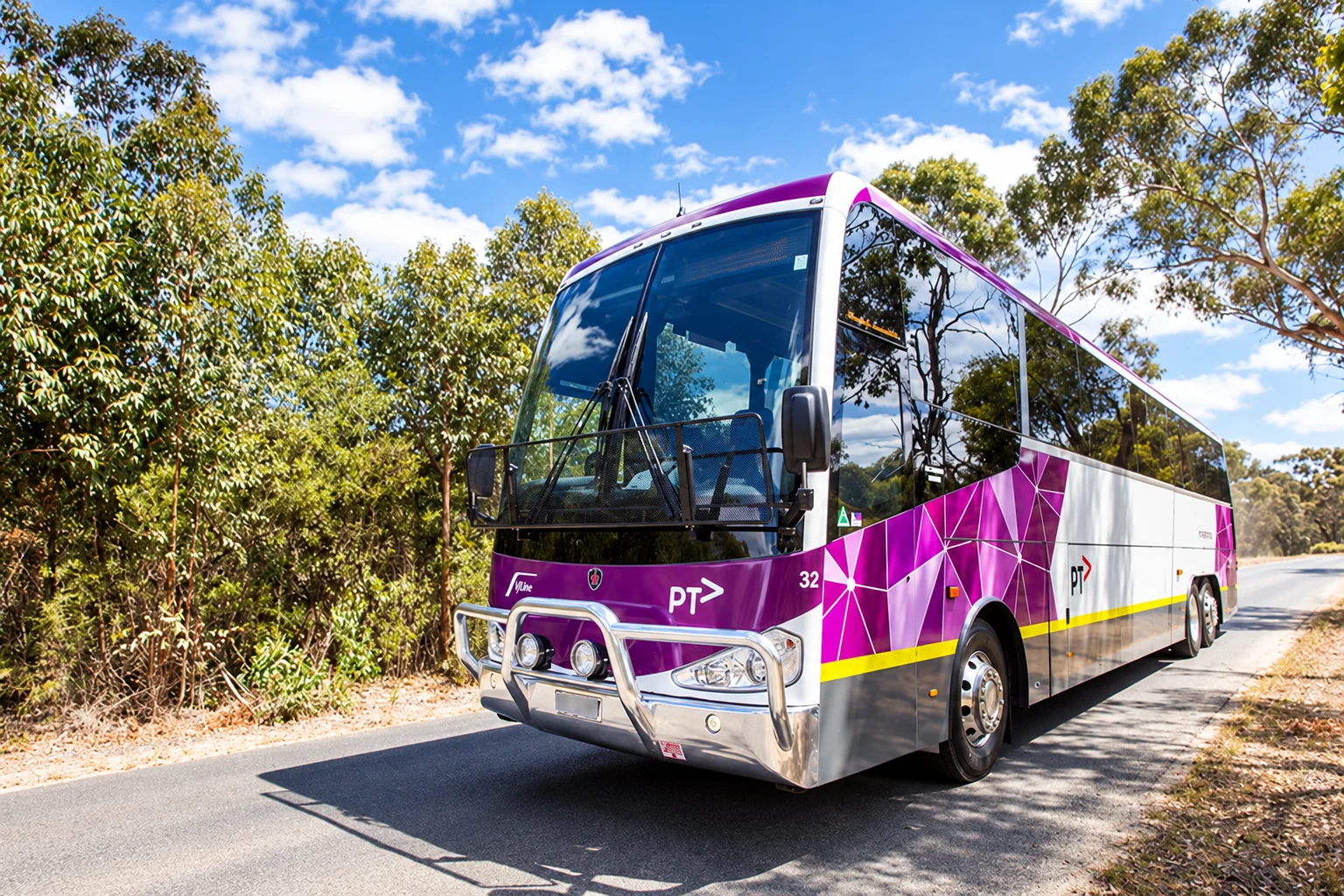
In Victoria, V/Line runs regional trains and coaches. Its master timetable list includes coach routes between Canberra and Melbourne (via Albury), Mildura and Albury, and Batemans Bay and Melbourne, plus a coach route from Adelaide through Ballarat and Geelong. Some coaches serve destinations with no direct passenger train, and others link regional towns to each other.

In NSW, NSW TrainLink runs regional trains and coaches. Its intercity services around Sydney moved to Sydney Trains in July 2024, so the connections you will plan are on the longer regional network. The 2024–25 annual report counts about 1.86 million passenger journeys a year on regional trains and coaches, with roughly 615 timetabled coach services a week and more than 365 coach stops.
In Queensland, Queensland Rail’s regional trains connect with scheduled railbuses that TransLink does not run, because the state has no central coach brand. Queensland Rail’s own policies call the connecting product a RailBus Coach Connection. Check Queensland Rail’s current connections for your route before you rely on a particular coach.
In Western Australia, Transwa runs both rail and road coach services, and its conditions of travel refer to a "connecting Transwa service".
Greyhound Australia is the national coach operator. Where a rail line ends and no state operator runs a coach, Greyhound is often the next option. Greyhound is a separate company, so a Greyhound coach booked after a state train is a connection with another operator. The state operator’s no-guarantee wording applies to that connection.
Matching train and coach timetables
Start by looking for the connection marker. NSW TrainLink timetables show an arrow symbol with the legend "Shows train/coach connection" wherever a coach is timed to meet a train. The Western NSW timetable shows how this works at Dubbo, where several coach departures are marked against the same train arrival.
The Dubbo example in the timetable valid from 26 July 2026 gives you actual numbers. Service 427 from Sydney arrives at Dubbo at 13:46. Coach 361 to Tamworth leaves Dubbo at 14:40 and arrives at Tamworth at 18:55. That coach runs only on Mondays, Wednesdays and Fridays, so a train that arrives on a Tuesday has no matching coach. In the other direction, coach 362 from Tamworth reaches Dubbo at 13:35 and meets service 428 to Sydney, which leaves at 14:17 and arrives at Sydney Central at 20:50.
Some links are much tighter. Service 427 arrives at Orange at 12:06, and connecting departures leave at 12:12, a six-minute window. A timetable shows that a link is possible. It does not mean you should plan around the shortest gap. Several coach departures from Dubbo (14:10, 14:15, 14:20 and 16:45) are marked as connections to the 427 arrival, so check which row in the table belongs to which service before you quote a coach to anyone.
Operators do not guarantee connections, and they say so in writing. Queensland Rail’s Conditions of Carriage state that it "cannot guarantee connections with other transport companies" and that it is not responsible for costs that result from a missed connection. The NSW TrainLink North Coast timetable carries similar wording for connections shorter than a set time. Older NSW timetables list the other operators whose connections are not guaranteed, including V/Line, Queensland Rail, airlines and tour operators. The cost of a missed link falls on you.
NSW TrainLink’s recent performance shows why you need a buffer. Regional train punctuality was 52.5% in 2024–25, against a target of 78%, while regional coach punctuality was 87.5%. About 62.7% of regional train disruptions involved major delays inside the Australian Rail Track Corporation (ARTC) network, where regional passenger trains often give way to freight. The train is usually the less reliable leg, so plan for the coach to leave well after the train is due.
When a connection is the only one of the day, plan to stay overnight. If the coach runs three days a week, as the Dubbo to Tamworth coach does, a late train can cost you a full day, not 20 minutes. For those routes, an overnight stay at the hub town is cheaper than a missed coach and a rebooked itinerary.
Timetables also change. V/Line’s master list gives each coach and train timetable an effective date, and new timetables from 1 February 2026 altered several train lines and some of the coach timetables that connect with them. NSW TrainLink’s annual report says new coach operator contracts were expected from mid-2026, with a coach network review looking at adjusted timetables and new stops to improve links to rail. Check the timetable for your travel date, not one you saved months earlier.
Two small timing details catch first-time visitors. NSW timetable times are 24-hour local NSW time, and during NSW daylight saving, services to Queensland locations run an hour earlier than the printed times because they follow Queensland time. Coach stop addresses printed on a NSW regional ticket can also change, so read the ticket again the day before you travel.
Booking every leg
Book each leg before you travel, and book early. A walk-up coach ticket works on some routes, but it can leave you without a seat on others.
NSW TrainLink requires advance booking for all seats on regional trains and coaches. According to the Western NSW timetable, most services open for booking up to 180 days (about six months) ahead. Exceptions exist. Sydney to Lithgow journeys on service 427 and Lithgow to Sydney journeys on service 428 can be booked only up to seven days ahead, and seats cannot be booked at all for trips between Sydney, Strathfield, Parramatta, Blacktown, Penrith and Katoomba. Some coach services are sold only together with a train service. Booking help is on 13 22 32, and the National Relay Service is on 133 677. NSW TrainLink introduced a central reservations system in February 2025 covering online, call centre and travel centre bookings.
V/Line sells tickets online, at staffed stations, through authorised agents and by phone on 1800 800 007, and a valid eTicket or paper ticket is required on scheduled coaches. Scheduled coaches don’t accept myki (Victoria’s public transport smartcard) or contactless card payments, so tapping a bank card on boarding does not work. V/Line’s ticketing page says reserved coach services are shaded in the timetable, and the Journey Planner marks them "R" for a reserved coach and "RC" for a train with reserved carriages. A reserved ticket guarantees a specific seat, while an unreserved ticket may mean standing for all or part of the trip. Reservations open up to three months ahead.
One V/Line fare rule affects visitors who start or finish in an area where myki doesn’t apply. If a journey starts or ends in the paper-ticket area, the fare guide says you need a paper ticket for the whole journey, so you don’t pay more than the daily fare cap. Paper tickets can be collected at a staffed myki station or posted on request.
Queensland Rail requires a valid ticket for your entire journey under item 3b of its Conditions of Carriage. The same document defines "Carriage" to include transport by any method Queensland Rail substitutes for the train, so its ticket covers a replacement coach. Online bookings offer a "booking special request", which arranges a call from a consultant, and the phone line is 1800 872 467. That call is the practical way to confirm a RailBus connection.
In Western Australia, Transwa tickets are valid only for the people named on them and cannot be transferred. Concession fares need a valid concession card, produced on request. EFTPOS is available on all Transwa Rail services and on Australind road coach services, but other road coach services take cash only, so carry some before boarding a coach in the regions.
Greyhound’s Terms and Conditions say carriage is governed by the Terms and your booking confirmation together. They also define "Add-ons" such as extra baggage, surfboard and bicycle carriage, which you buy at booking. If a Greyhound coach is the second leg after a state train, read its baggage and delay clauses first, because they will not match the train operator’s.
Booking separately with two operators means two sets of conditions and two cancellation rules. Keep each confirmation, and note each operator’s phone number in your phone before you leave a mobile signal.
Luggage limits on each leg
Coach luggage allowances differ from train allowances, and they differ between operators. A bag that is fine on the train can be refused on the coach, so check every leg you booked.
| Operator | Allowance |
|---|---|
| NSW TrainLink coach | 1 hand luggage (max 10 kg), 2 large (max 20 kg each) |
| NSW TrainLink train, economy | 1 hand luggage (max 10 kg), 1 large (max 20 kg) |
| NSW TrainLink train, first class | 1 hand luggage (max 10 kg), 2 large (max 20 kg each) |
| V/Line, all services | 32 kg total: up to two items plus one hand item, no item over 16 kg |
| Queensland Rail | 20 kg per piece, under 180 linear cm; economy seats 1 item, sleepers and business seats 2 items; carry-on 1 bag, max 20 kg |
| Transwa | 1 stowed piece (max 20 kg), 1 carry-on (max 7 kg) |
The NSW figures come from the luggage page, which supersedes older timetables that gave a 5 kg hand luggage limit. The same page adds that prams, mobility aids and medical equipment travel in addition to the allowance, while musical instruments and sporting gear count towards it. It also lists banned items, including compressed gases, flammable liquids, explosives and weapons. Check-in at attended NSW stations closes 30 minutes before departure, and bags must be clearly labelled.
V/Line’s 32 kg total is stated in its coach travel notice. On coaches, all luggage goes into the luggage compartment except one small bag no larger than 40 x 35 x 15 cm. Luggage that could disturb other passengers with odour or noise is not allowed. Keep medication, passports and valuables with you rather than in the compartment.
Queensland Rail’s Luggage Policy lets it accept extra items for $15 each, paid on the day to an onboard staff member, if there is space on the train. Items over 20 kg are refused. Liability for checked luggage is $200 per piece, so keep valuables in your carry-on and consider travel insurance. Ticket offices and luggage check-in at attended stations open one hour before departure and close 30 minutes before. At unattended stations, the onboard crew helps check luggage when the train arrives.
The excess-luggage rule changes on a replacement coach. Queensland Rail’s Luggage page says that because of the limited room on replacement coaches, additional luggage will not be accepted when a service is partially or fully replaced by a coach. The $15 excess fee therefore gives no protection on a coach leg, and a traveller with two large bags and an economy ticket should pack to the base allowance.
Transwa asks for a name, contact phone number and destination on every bag, and a piece over 15 kg needs a heavy luggage label, which Transwa supplies. Its conditions of travel say passengers load and unload their own luggage and collect it promptly. That is easy to forget when you are in a hurry to make a connection with two bags and a small child.
Greyhound defines its baggage allowance through the Standard and Non-Standard Baggage clauses in its Terms, so read those clauses for current figures before you pack. Figures quoted on US or South African sites about Greyhound do not apply to Greyhound Australia.
Bicycles, scooters and mobility aids
Items that are not standard luggage cause the most trouble on a multi-leg trip. Each operator treats them differently, and a coach driver decides what fits on a full vehicle.
V/Line accepts only folding bicycles on scheduled coaches. According to the coach rules, a folding bicycle must be no larger than 82 cm long, 69 cm high and 39 cm wide, have wheel rims up to 20 inches (51 cm), and fold into a bag or cover. It cannot go in an overhead rack. Pedal bicycles may travel on train-replacement coaches where luggage space allows. In NSW, bicycles on trains were carried boxed as checked luggage in 2024–25, and a roll-on bike trial ran on Dubbo XPT services from September 2024. A bike the train accepts may not fit the coach that meets it, so ask before you reach the transfer point.
Transwa restricts bicycles, eRideables and surfboards. One additional item, such as a bicycle, golf clubs, surfboard or bodyboard, may be accepted on some services for a fee if space permits.
Queensland Rail has the most detailed rules, set out in its Luggage Policy. Small kick or push scooters travel if collapsed and in a bag or cover, in the checked area. Non-collapsible kick or push scooters are not accepted. Two-wheeled motorised scooters are accepted only for accessibility use, and they must be battery powered, under 20 kg and within size limits. Charging lithium-ion batteries is prohibited on Queensland Rail services. On a replacement coach, some coach companies refuse e-scooters because of the lithium batteries. Queensland Rail checks with the coach operator and tells you whether the scooter can travel. If it cannot, you arrange other transport, and Queensland Rail is not responsible for the cost.
Wheelchairs and other mobility devices are subject to size and weight limits. For customers on a RailBus Coach Connection, the policy says "special arrangements may be required" so the coach can accept the device, and it advises raising this with a consultant when you book. NSW TrainLink’s booking line (13 22 32) also handles accessible seating requests.
Medical items follow their own rules in Queensland. Medicinal oxygen cylinders are carry-on only, at a maximum of 5 kg when full. Oxygen concentrators go in carry-on, or checked if under 20 kg. Medicines are carry-on only and should be labelled with your name and phone number. Plants and potted plants are not allowed, and firearms and ammunition are banned. NSW also restricts moving fire ant carrier materials from infested Queensland areas, which matters if you are carrying garden items or soil across the border.
If a delay threatens your connection
The first step is to tell the operator of the second leg, as soon as you know. Each operator’s terms put most of the risk on the traveller, so what you do in the first minutes counts for more than any later claim.
Queensland Rail is explicit. Under its Conditions of Carriage, it "may provide alternate transport (such as a bus transfer)" when it substitutes, cancels, delays or changes a service. If you decline that transport and arrange your own, it is not liable for the extra costs. The same document says Queensland Rail is "not obliged to delay" a train for late passengers, so be at the platform before departure.
Transwa’s terms say it is not liable for any consequence of a cancellation, or of a change in arrival or departure time at any station or stop. It may also change a stopping location or the nominated mode of transport, which is how a train becomes a coach without a new booking. Its refund rule requires you to cancel before the service’s scheduled departure from its point of origin, and the ticket must be returned within 12 months of purchase. Read literally, the rule offers no refund path for a leg you miss partway through a journey, so ask Transwa directly if that happens.
V/Line handles delays mainly through compensation rather than rescuing individual passengers. Its scheme is based on monthly performance. The compensation form states targets of 96% of scheduled services operating and 92% punctuality. When V/Line misses them, eligible customers receive compensation equal to a daily fare, loaded onto myki. Eligibility requires a myki pass of 28 days or more and myki use on V/Line on at least 10 days of the month, so most visitors on paper tickets will not qualify. The form says compensation "may also be available" for a delay of 60 minutes or more on a single journey. That wording is discretionary. Long-distance trains count as on time within 10 minutes 59 seconds. For a missed connection, contact V/Line Customer Relations on 1800 800 007 and read the Customer Charter.
V/Line also runs dedicated coach routes and train-replacement coaches when rail maintenance or disruption stops trains. NSW TrainLink sourced more than 1,500 coaches in 2024–25 to replace trains disrupted by major events, and ran replacement coaches to keep towns connected during the May 2025 floods. Replacement coaches can also fail to match your luggage, so a heavy bag that fit the train may be refused.
Greyhound’s terms refer to Australian Consumer Law. Consumer guarantees cannot be excluded, and fare rules, refund terms and liability limits do not apply where they would exclude or modify those guarantees. A consumer may be entitled to a remedy for a breach, including a refund for a major failure. The ACCC publishes guidance on travel delays and cancellations if you need to argue your case. European, German and UK rules, such as 100-minute re-routing rights and 25% or 50% refunds, do not apply to travel in Australia, and Australian operators are not bound by them.
A few habits reduce the damage when a delay hits. Arrive early enough to find the platform, finish ticketing and stow your luggage. Use the V/Line app for service updates and platform information. Carry the phone numbers of both operators, and keep your ticket confirmations accessible offline. If you are on a regional line with a single daily coach, call the coach operator while the train is still running late, because the operator is more likely to hold or reroute a service it has been warned about.
Key Takeaways
- Check each operator’s rules separately: V/Line, NSW TrainLink, Queensland Rail, Transwa and Greyhound each set their own luggage, ticketing and delay terms, and none covers a connection with another operator.
- Leave a buffer after the train: operators do not guarantee connections, and NSW regional trains ran on time only 52.5% of the time in 2024–25. Where a coach runs only three days a week, consider an overnight stay.
- Book every leg early: NSW TrainLink requires advance booking on all regional seats, most open up to 180 days ahead, and V/Line reservations open about three months ahead.
- Pack to the strictest allowance: V/Line allows 32 kg in total, Transwa allows 20 kg stowed and 7 kg carry-on, and Queensland Rail says extra luggage is refused on replacement coaches.
- Phone ahead about bikes, scooters and mobility aids: V/Line coaches take only folding bicycles, and some Queensland coach companies refuse e-scooters because of lithium batteries.
- Contact the second operator as soon as a delay appears: Queensland Rail will not hold a train for late passengers, Transwa limits liability for missed legs, and V/Line’s compensation scheme is built around monthly performance.