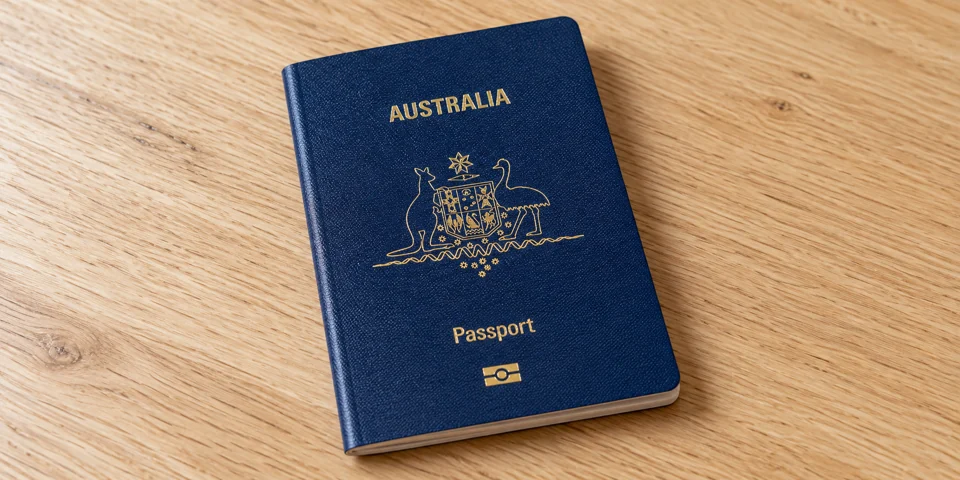
Citizenship by conferral is the route for permanent residents who were not born Australian and have no Australian parent to claim through. To qualify, you must have lived in Australia lawfully for a set period, pass a citizenship test, prove your identity and good character, and, where required, make the Australian Citizenship Pledge at a ceremony. The Department of Home Affairs runs the whole process. In 2024-25, 162,461 people became citizens this way.
The main rule is four years of lawful residence in Australia before you apply, including the last 12 months as a permanent resident. For most adults, the application costs $595 and includes the test. Australian law does not require you to give up your existing citizenship, but your other country’s own rules decide whether you can keep it.
Who Can Apply
The general-eligibility form, Form 1300t, sets out the conditions. You must be aged 18 or over and under 60, be a permanent resident, meet the residence requirement, be of good character, and be likely to live in Australia or keep a close and continuing association with it.
You must also be in Australia when the Department decides your application. The exception is limited: if you are the spouse or de facto partner of an Australian citizen, the decision-maker has discretion to approve you while you are outside the country. Anyone who ceased to be an Australian citizen within the last 12 months cannot be approved.
The Four-Year Residence Rule
The residence requirement counts back from the day you apply. Under Form 1300t you need four years living in Australia on a valid visa, and that period must include the last 12 months holding a permanent visa or a Special Category visa (the visa that New Zealand citizens usually hold on arrival).
Absences are capped at two levels. Across the four years you can spend no more than 12 months outside Australia, and no more than 90 days of that total can fall in the 12 months immediately before you apply. A person who spent a long period overseas in year two but stayed home through the final year can still qualify, while someone who took three months abroad in the last year cannot.
Your permanent residence start date is usually the day your permanent visa was granted while you were in Australia, or the day you first entered Australia on a permanent visa, whichever applies to you.
Time in prison or a psychiatric institution under a court order within the four years does not count towards the requirement.
Checking Dates With the Residence Calculator
Home Affairs publishes a residence calculator that checks whether you meet the residence rule on a planned lodgement date. It is a guide only. It does not pull data from your records. When you lodge, the Department assesses eligibility against its own records.
Before you start, gather four things: your permanent residence date, your lawful residence date, your intended lodgement date, and the dates of every trip in and out of Australia over the past four years. An estimated lawful-residence date is acceptable if you are confident it was more than four years ago. If your own travel records are patchy, you can request your international movement records from the Department, and there is no charge for that.
Discretions and Special Residence Routes
Form 1300t lists six situations where the Minister can treat a shortfall as acceptable. Three cover administrative error or quashed convictions:
- Unlawful status caused by administrative error can be treated as lawful residence.
- Lawful status without permanent residence, also caused by administrative error, can be treated as permanent residence.
- Time in prison or psychiatric detention ordered by a court can count if the conviction was quashed.
A fourth covers hardship: lawful status without permanent residence in the 12 months before you apply can be treated as permanent residence if you would otherwise suffer significant hardship or disadvantage.
The last two help partners of citizens. Periods abroad as a permanent resident can count if you are the spouse or de facto partner (or surviving partner) of an Australian citizen, kept a close and continuing association with Australia, and lived overseas together during those periods. A similar discretion covers periods abroad in the final 12 months as an interdependent visa holder whose partner was an Australian citizen.
Any discretion request needs supporting evidence and a written statement. Without them, processing can be delayed or the application refused.
Two special residence routes suit people whose careers keep them away from Australia. The first, for activities of benefit to Australia, covers athletes in named national teams (the Olympic and Paralympic committees, Commonwealth Games Australia, Tennis Australia and Cricket Australia) and certain Commonwealth employees whose jobs require a Negative Vetting 2 clearance or higher. You must hold permanent residence and have lived in Australia for at least 180 days in the two years before applying, including at least 90 days in the past 12 months.
The second covers particular work that requires regular overseas travel. It applies to ship and aircraft crew and workers on resource or sea installations. It also covers certain senior executives of S&P/ASX All Australian 200 companies, specified scientists and academics, and certain medical specialists. The remaining groups are certain Distinguished Talent or Global Talent visa holders and senior ministers of religion. You must have done that work for at least two years of the past four. The test is then a valid visa for four years including one year as a permanent resident, plus a minimum number of days lived in Australia across the four years, including a minimum in the final year, as set out in Form 1300t. Applicants on this route can be approved while outside Australia, but cannot combine it with the hardship discretion or the two partner discretions.
Defence Service and New Zealand Citizens
Relevant defence service can satisfy the residence requirement. Form 1300t counts at least 90 days in the permanent forces, at least 90 paid service days in a reserve force, or discharge as medically unfit because of service. Family members of defence personnel can also qualify under conditions tied to specified visa types granted on or after 1 July 2007.
New Zealand citizens have their own rules because most arrive on a Special Category visa rather than a permanent visa. Under Form 1300t:
- If your Special Category visa was granted before 1 July 2022, the Department treats you as a permanent resident from 1 July 2022. If it was first granted on or after 1 July 2022, your permanent residence runs from the grant date.
- Holders who are overseas are treated as permanent residents for citizenship purposes if they held the visa immediately before leaving. The same applies to people who were outside Australia on 1 July 2023 and whose last visa was a Special Category visa or a Special Purpose Visa held as airline crew.
- Anyone removed or deported under the Migration Act 1958 is excluded from these provisions, unless the visa cancellation was revoked.
- New Zealand citizens on a subclass 189 visa (the New Zealand stream) do not need 12 months as a permanent visa holder if the visa was granted between 1 January and 31 December 2022 (treated as permanent from 1 January 2022) or on or after 1 January 2023 (eligible from the grant date). The four-year and absence tests still apply.
The Citizenship Test
Most applicants aged 18 to 59 sit the test. It is computer-based, conducted in English only, and has 20 multiple-choice questions to answer in 45 minutes. To pass, you must get all five Australian values questions right and score at least 15 of 20 overall. A single wrong values answer fails you even with 19 of 20 correct. The values questions came in with the updated test that started on 15 November 2020. The application fee covers the test, so there is no separate fee.
The test assesses basic English, understanding of citizenship, adequate knowledge of Australia and its responsibilities and privileges, and commitment to Australian values. Every question is drawn from the resource book Australian Citizenship: Our Common Bond, which Home Affairs offers in 40 community languages. The topics are Australia and its people, democratic beliefs, rights and liberties, government and the law, and Australian values built on freedom, respect and equality.
The official practice test uses the same format and pass rules and lets you answer in any order, skipping and returning to questions. Its questions differ from those on the day, so it tests readiness rather than previewing the exam. Home Affairs expects most applicants to have the literacy to complete the test unaided, and text-to-speech is available so you can hear questions and answers.
Choosing the Right Form
Form 1300t is the general-eligibility form for applicants who must sit the test. Form 1290 covers other situations and generally does not require the test. If you are applying under the standard residence route as an adult, you use 1300t.
Children have separate paths. A child under 16 can be included on a responsible parent’s application, and the parent must consent to and sign it. Children by descent, adopted children and former citizens’ children use different forms, and the pathway for children of former Australian citizens opens conferral to a person whose parent lost Australian citizenship after acquiring another citizenship as an adult. Applicants aged 16 or 17 may be asked to show basic English and an understanding of the responsibilities and privileges of citizenship.
Fees and Concessions
The citizenship fee schedule, Form 1298i, dated July 2026, sets the following amounts:
| Application | Fee |
|---|---|
| Form 1300t, general eligibility (test required) | $595 |
| Form 1290, other situations | $365 |
| Form 118, citizenship by descent | $380 ($160 for second and later siblings applying together) |
| Form 1272, adopted children (Hague Convention or bilateral arrangements) | $380 ($160 for later siblings) |
| Form 128, renunciation | $320 |
| Form 132, resumption | $255 |
| Form 119, evidence of citizenship | $290 |
Children under 16 on the same form as a responsible parent pay nothing. The fees are set in the Australian Citizenship Regulation 2016 and are indexed to the consumer price index every 1 July, so check the live Home Affairs fee page before you lodge.
A concession brings the fee down to $85 on Form 1300t and $40 on Form 1290. You qualify if you hold a valid Pensioner Concession Card issued by Services Australia or the Department of Veterans’ Affairs, either as the primary cardholder or as a dependant aged 17 or younger. Health Care Cards, Student Cards and Senior Health Cards do not qualify, and the card must not be expired. You must supply a copy of both sides, certified if you apply on paper.
Three groups pay no fee on Forms 1300t and 1290:
- British and Maltese former child migrants who arrived in Australia without parents between 22 September 1947 and 31 December 1967 under the Commonwealth Child Migration Scheme. They must provide a letter from the Child Migrants Trust.
- People who served at least 90 days in the permanent forces of the Commonwealth. They must provide a letter or discharge papers from the Australian Defence Force.
- Applicants under the statelessness provision, section 21(8) of the Australian Citizenship Act 2007.
Exemption applicants cannot lodge online and must use a paper form. The Department’s page on fee concessions and exemptions has the current detail.
Lodging the Application
Form 1300t asks you to list travel outside Australia in the last 10 years. If you are a permanent resident whose total time abroad since turning 18 reached 12 months or more, you must also list every country where you spent 90 days or more since your first permanent visa. In that situation the Department can ask for an overseas penal clearance certificate (a police check) for each such country. Start collecting these early, because certificates from some countries take time.
Payment depends on how you lodge. For paper applications you pay through ImmiAccount under My Payments, then Manage Payments, then Pre-Pay Paper Service, then Pre-Pay Citizenship Paper Application. Online lodgement can carry a surcharge, with details on the Home Affairs "how to pay" page. Applicants who do not qualify for a concession pay the full fee before processing begins.
If you rely on a discretion, attach the statement and evidence in the same lodgement. The form’s evidence checklist expects them with the application.
The Identity Interview
The Department interviews applicants to confirm who they are and that they understand Australian citizenship, as set out on the test and interview page. Applicants who do not need to sit the test can still be interviewed. Processing continues once the interview is done.
Bring a photo identity document, such as an Australian driver licence, a passport or an Australian-issued proof of age card. Certified copies and electronic images are not accepted, and if you arrive without photo ID your appointment moves to a later date. Applicants aged 60 or over, or with hearing, speech or sight impairments, may be asked to show they understand the application. A family member or support person can attend with them.
Ceremonies and the Pledge
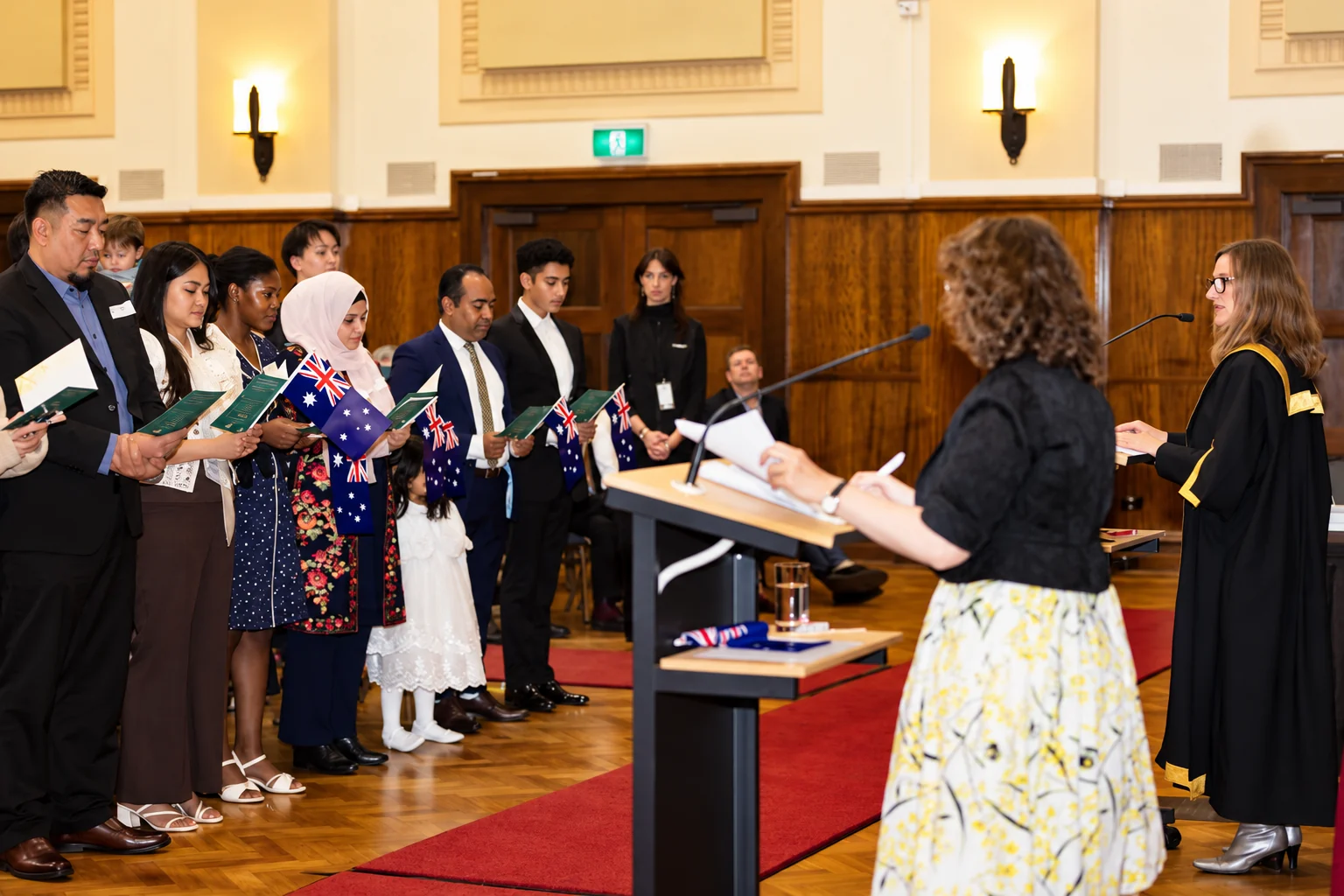
If the Department approves your application and requires a ceremony, you receive an invitation about four weeks before it. Councils host the ceremonies, and your current residential address decides which council runs yours. You cannot choose the date or place, and the invitation states any venue limit on guests.
The wait depends on demand in your local government area, and family members linked to your application can also affect it. Home Affairs publishes ceremony wait times by area, measured from the date of approval. The page was last updated on 16 October 2026, and its figures run to 30 September 2026. The booklet and Form 1290 describe a ceremony as generally held within six months of approval, which is a useful outer expectation, while the wait-times page gives the local picture.
The Australian Citizenship Ceremonies Code sets no minimum or maximum number of conferees for a ceremony to go ahead. It expects most councils to hold ceremonies at least every two to three months, more often if needed. Some are timed with annual festivals or community events. At the ceremony you make the Australian Citizenship Pledge.
Receiving the Certificate
If you do not need to attend a ceremony, the Department sends your citizenship certificate by registered post when it approves your application. The child route under Form 1272 works the same way: no ceremony is required, citizenship starts on the day of approval, and formal evidence of citizenship is issued. Keep the certificate safe, since Form 119 and its $290 fee apply if you later need evidence of citizenship issued again.
Dual Citizenship
Australian law does not make you give up your existing citizenship. A Home Affairs FOI release states that the Australian Citizenship Act 2007 and its predecessor legislation have never required a person acquiring Australian citizenship to give up a previously acquired foreign citizenship. Form 1290 asks whether you hold or have ever held citizenship of any other country, so declare it accurately.
Your other country’s law decides whether you keep your existing citizenship. Some countries remove citizenship when a person naturalises elsewhere, and Australia cannot override that. The same Home Affairs document directs questions about possible loss of British citizenship to British authorities, and the same approach applies to any other country: check with its government before you lodge.
The earlier law matters for older cases. The 1948 Act had an automatic loss provision, section 17, under which an adult who took another country’s citizenship could cease to be Australian. It operated until 4 April 2002 and no longer applies to new conferrals. The 2016 review Australian Citizenship: Your Right, Your Responsibility concluded that, on balance, dual citizenship benefits Australia and should remain an option.
What to Check Before You Lodge
- Count your four years back from the lodgement date: You need four years of lawful residence, including the last 12 months as a permanent resident, with no more than 12 months abroad overall and no more than 90 days in the final year. Run your dates through the residence calculator and your movement records before you apply.
- Prepare for the all-or-nothing values questions: The test has 20 questions in 45 minutes, and you must answer all five values questions correctly and reach 15 of 20 overall. Study Our Common Bond and take the practice test.
- Budget $595 and check the 1 July indexation: Form 1300t costs $595 and covers the test, Form 1290 costs $365, and children under 16 on a parent’s form pay nothing. Pensioner Concession Card holders pay $85 on Form 1300t.
- Bring original photo ID to the interview: Certified copies and electronic images are refused, and missing ID pushes your appointment back.
- Expect no choice over the ceremony: Your council is set by your address, the invitation arrives about four weeks ahead, and the local wait is on the Home Affairs wait-times page.
- Ask your other country before you lodge: Australia does not require you to renounce a prior citizenship, but the other country’s law decides whether you keep it.
