
A first trip to Australia covers long distances, so a two-week itinerary works best with three or four bases and one or two flights between them. The route that suits most first-time visitors runs from Sydney to the Red Centre around Uluṟu-Kata Tjuṯa National Park, then on to Melbourne and the Great Ocean Road. Flights cover the long legs. A hire car is only needed for the coast west of Melbourne. The variations below swap the Red Centre for a coastal drive from Sydney to Melbourne, or give Melbourne and the Great Ocean Road more time.
Check your passport’s entry authorisation before you book, because Australia has no visa on arrival and the permission must be granted before you fly. Prices are in Australian dollars. Fares, fees and timetables change, so confirm each figure with the operator or authority named in the text before you pay.
Entry Authorisation Before You Fly
Short-stay visitors need one of three options: the Electronic Travel Authority (ETA, subclass 601), the eVisitor (subclass 651) or the Visitor visa (subclass 600). US and Canadian passport holders use the ETA. It costs A$20 through the official Australian ETA app, which needs a passport scan and a selfie, and most applications are approved instantly. Some third-party websites charge roughly A$50 to A$100 for the same application, so use the app.
UK British Citizen passport holders use the eVisitor, which is free and applied for through the Department of Home Affairs website. The Home Affairs advice is to book travel only after you have been told in writing that the visa is granted. Each family member needs a separate application. Processing estimates run to 1 to 5 business days, so apply well before booking flights. Passport holders from other countries apply for the Visitor visa (600), which carries a government application charge listed on the Home Affairs website.
The ETA and the eVisitor both allow multiple entries and stays of up to three months per visit, so a two-week trip fits within either.
Choosing a Two-Week Route
Most first-time itineraries follow one of three themes.
- Sydney, Red Centre, Melbourne and the Great Ocean Road. This is the broadest mix of landscapes: a harbour city, the desert interior, a laneway-and-café city and a coastal drive. It needs two internal flights, Sydney to Ayers Rock and Ayers Rock to Melbourne, plus a hire car for the coast.
- East Coast and southern seaboard by road. Drive between Sydney and Melbourne on the coast instead of flying. The coastal road takes three to four days on its own, so it suits travellers who want the drive itself.
- Sydney plus Red Centre. This works with fewer moves and more time at Uluru, with the option of reaching it by road from Alice Springs.
Visitors starting in Queensland can use the same pattern, because direct flights also run between Brisbane and Ayers Rock. The rest of this guide follows the first route day by day, then explains the variations.
Flying or Driving Between Sydney and Melbourne
The direct flight takes about 1 hour 25 minutes gate to gate. Allow four to five hours door to door once airport transfers and check-in are counted. Melbourne Tourism’s 2026 page lists one-way fares of A$80 to A$200 when booked two to four weeks ahead, with last-minute fares above A$300, for the Melbourne to Sydney direction. Jetstar is generally the cheapest carrier and Qantas the most premium, with Virgin in between. The usual advice is to book four to eight weeks out. Fares inside two weeks typically double or triple, and July and December departures may need eight to twelve weeks.
Driving the inland Hume Highway is about 880 km and roughly nine hours. The coastal Princes Highway is about 1,400 km and typically a three to four day trip. For a family of four, the same ShopBack comparison puts a Virgin return flight with bags at A$700 to A$1,200, against about A$260 to A$320 in fuel for driving, so the gap narrows as the group grows. The NSW TrainLink XPT is a third option, suited to solo travellers.
The main itinerary avoids this choice, because the Red Centre sits between the two cities and both legs are flights. In the coastal variation, the drive is the point, and the one-way flight is the way to recover time if you decide to cut it.
Fourteen Days at a Glance
| Days | Base | Main move |
|---|---|---|
| 1 to 4 | Sydney | Arrive, then use Opal public transport |
| 5 | Sydney to Yulara | Direct flight to Ayers Rock |
| 5, 6 and 7 | Yulara (Ayers Rock Resort) | Uluru and Kata Tjuta on a three-day park pass |
| 8 | Yulara to Melbourne | Direct flight |
| 8 to 10 | Melbourne | Myki public transport |
| Next two days | Great Ocean Road | Hire car from Melbourne |
| 13 | Return to Melbourne | Drive of about four hours from the Twelve Apostles |
| 14 | Depart | Airport transfer |
Days 1 to 4: Sydney
Use contactless payment from your first tap after you arrive. Contactless bank cards and Opal cards charge identical adult fares and caps, so visitors can skip buying a card. A physical adult Opal card is free, with a minimum top-up of A$10 at machines. Stations at Sydney Domestic and International airports add an access fee of A$18.61 on Opal or contactless (single trip ticket A$19.00) for adults on top of the fare.
Opal’s adult daily cap is A$19.30 from Monday to Thursday and A$9.65 from Friday to Sunday and on public holidays, as listed from 14 July 2025. The weekly cap is A$50. Confirm current caps with Transport for NSW before you travel. Single adult fares in a June 2026 table start at A$4.33 for trains, A$3.30 for buses and A$7.35 for ferries.
A workable sequence for the four days:
- Day 1: Arrive, travel to your accommodation and take an easy evening walk near the water.
- Day 2: Circular Quay, the Opera House forecourt, the Royal Botanic Garden and The Rocks, all within walking distance of one another.
- Day 3: Take the Manly Ferry from Circular Quay, a 30-minute crossing at the standard Opal fare.
- Day 4: Take a coastal day at Bondi, with the cliff walk toward Coogee, and pack for an early flight the next morning.

If your dates allow, put the farthest-ranging day on a Friday, Saturday or Sunday. The lower weekend cap of A$9.65 makes outer-suburb and beach days cheaper than the same trips midweek.
Days 5, 6 and 7: Uluru and Kata Tjuta
Direct flights run to Ayers Rock (Connellan) Airport from Sydney, Melbourne and Brisbane, operated by Virgin, Jetstar and Qantas, and availability can be seasonal. Compare fares on the airline sites for your dates, and use the airport name the airline shows when booking.
All visitor accommodation is at Ayers Rock Resort in Yulara, about 20 km from Uluru. Yulara has a supermarket and a service station, which helps if you want to self-cater some meals. Book accommodation as soon as flights are fixed, because Yulara is the only place to stay.
Entry to the park needs a three-day pass: A$38 for adults, valid for three consecutive days, with an annual pass at A$50. Those are the listed 2024 prices, so confirm them on the park’s pass page when you buy. You can buy passes online or at the park entrance, and buying online avoids queues. Under-18s enter free, and the pass is per person. The Uluru pass is separate from the Northern Territory parks pass because the park is federally administered.
Plan the three days around the park pass:
- Day 5: Fly in, check in at Yulara and spend the evening watching the rock.
- Day 6: Spend the day at Uluru, with time at the base of the rock.
- Day 7: Visit Kata Tjuta, then head back to the resort.

In the area, optional extras include scenic flights from A$140 for 20 minutes or more and guided tours from about A$95 to A$255.
Fly out on day 8 to Melbourne. The direct flight is one reason this route works in two weeks, because it removes a connection through Sydney.
Reaching Uluru by Road From Alice Springs
Travellers who prefer a road leg can fly to Alice Springs and drive. The distance is 443 km to Yulara and 461 km to Uluru, about five hours of driving. Coach transfers run between Alice Springs and Uluru for those who would rather not drive. The Northern Territory accepts an overseas licence for three months before a local licence is required, which covers a two-week visit. The Northern Territory open-road default speed is 110 km/h.
Days 8 to 10: Melbourne
Arrive from Ayers Rock and base yourself near the CBD. Melbourne’s public transport runs on myki, so visitors need myki or Mobile myki. A myki card costs A$6 for adults. Adult daily caps are A$11.40 on weekdays and A$8.00 on weekends and public holidays, and the two-hour fare across Zones 1 and 2 is A$5.70. A seven-day pass at A$57 is bought in advance. Trams within the free CBD tram zone cost nothing. Myki fares are set by Public Transport Victoria, so check it for changes.
A plain sequence for the three days: arrive and walk the CBD and its laneways; spend the next day at Queen Victoria Market and the Royal Botanic Gardens; leave the last for a beachside suburb such as St Kilda or for time you want to spend elsewhere. Pick up the hire car when you leave Melbourne rather than earlier, because city parking is a daily cost you can avoid.

After Melbourne: Great Ocean Road
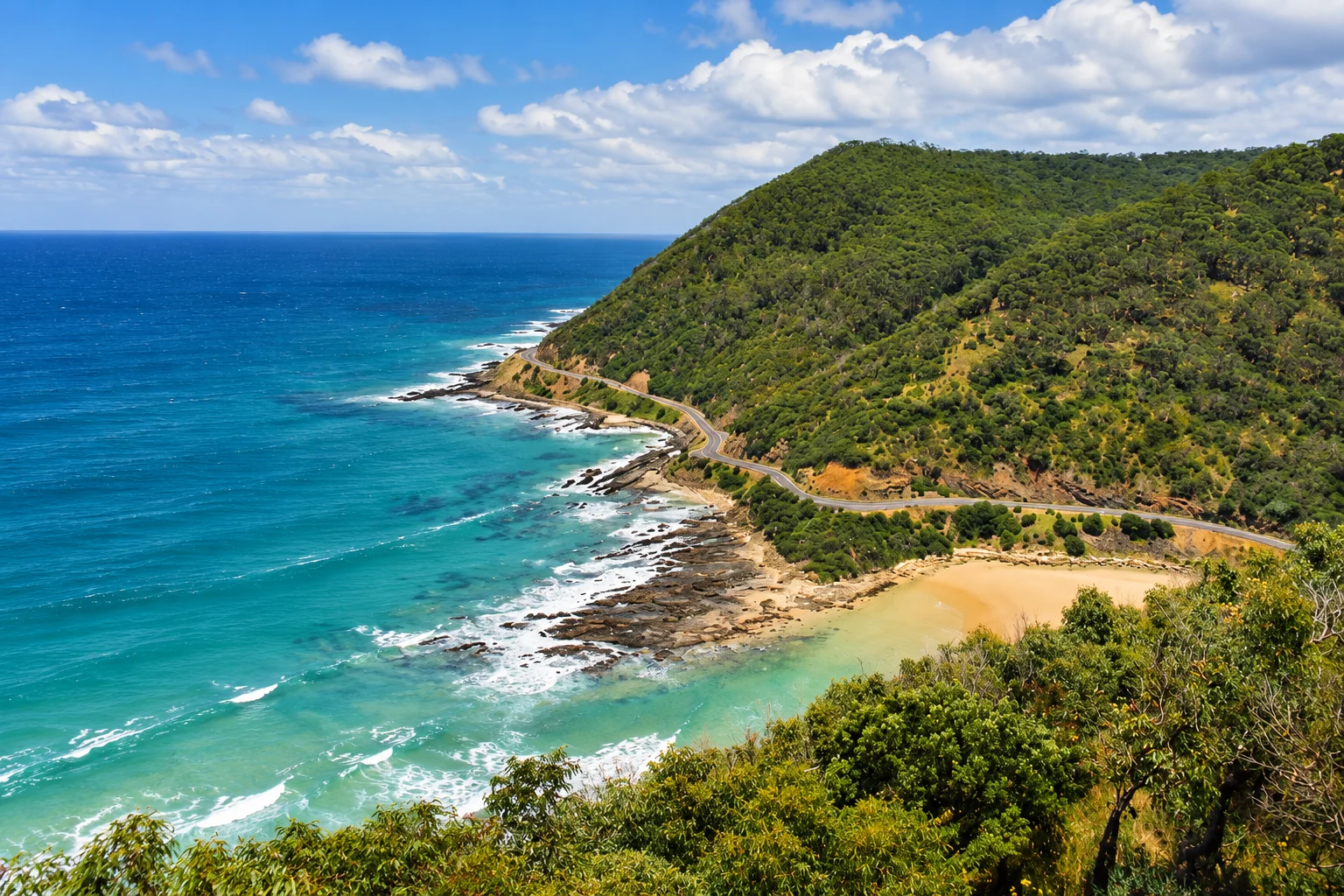
The Great Ocean Road runs about 243 km along Victoria’s south-west coast. The Twelve Apostles viewing area is about 275 km from Melbourne, roughly four hours’ drive on a winding, mostly two-lane road, and the same guide describes two days as the practical minimum. The return to Melbourne on day 13 also takes about four hours, so allow for it.
Torquay, the eastern start of the road, is 103 km from Melbourne, about 75 to 90 minutes’ drive. A sensible sequence:
- First coastal day: Collect the car in Melbourne and drive to Torquay, then follow the coast through Lorne and Apollo Bay, stopping at beaches and lookouts as time allows.
- Second coastal day: Reach the Twelve Apostles area, aiming for early or late light, and stay nearby.
- Day 13: Drive back to Melbourne, about four hours from the Twelve Apostles.
Return the car before the final night if you prefer to avoid city parking, and take public transport on day 14 to the airport.
Car Hire, Licences and Tolls
A visitor driving on an overseas licence written in English needs no International Driving Permit. A licence not in English needs an International Driving Permit or an official English translation, carried with the original licence. In New South Wales, visitors may drive on an overseas licence for up to six months, and Victoria accepts an overseas licence for stays of less than six months.
Rental conditions vary by company. Hertz lists a minimum age of 21 for most vehicle groups and 25 for premium and four-wheel-drive vehicles, and drivers aged 21 to 24 pay a young driver fee. A Sydney driving guide puts that surcharge at about A$30 per day for under-25s, and lists car hire in Sydney at about A$45 to A$100 per day, with CBD parking at about A$60 to A$80 per day. One-way rentals are offered, but fees may apply on some routes, and giving your flight details at booking keeps the car held if the flight is delayed.
Toll roads operate in Sydney, Melbourne and Brisbane, and tolls are electronic with no cash booths. Rental prices exclude tolls. The rental company bills you for the tolls plus an administration fee. Typical Sydney tolls run about A$10 to A$25 per day. Hertz offers a prepaid Toll Day Pass with a flat daily amount for unlimited tolls, or a pay-later option that invoices actual tolls plus a processing fee. Ask at the counter which option applies.
In Australia you drive on the left and everyone in the car wears a seatbelt. Children need approved child seats, which can be hired. The default speed in Sydney’s urban areas is 50 km/h, and motorways run at 100 to 110 km/h.
East Coast by Road
Replace the Red Centre with a drive from Sydney to Melbourne along the coastal Princes Highway, which is about 1,400 km and takes three to four days. A fortnight then looks like this:
- Days 1 to 4: Stay in Sydney and use Opal as above.
- Days 5 to 8: Drive the coast to Melbourne, choosing overnight stops along the Princes Highway.
- Melbourne days: Spend them in Melbourne.
- Final days before departure: Drive the Great Ocean Road as above.
- Day 14: Depart from Melbourne.
This costs more in time and removes the long internal flights. A one-way rental needs checking, because fees may apply on some routes. If the coastal drive runs behind schedule, the Sydney to Melbourne flight is the fallback, about 1 hour 25 minutes.
Sydney Plus Red Centre
With only two destinations, give Sydney the first half and the Red Centre the second. The three-day park pass still covers the Uluru visit, so the extra days go to Sydney or to the Alice Springs road leg described above. Travellers starting in Queensland can use the direct Brisbane to Ayers Rock flights. The Alice Springs road trip adds a full driving day, so it fits a longer stay rather than a tight fortnight.
More Time on the Great Ocean Road
Spend more days on the coast and fewer in cities. Avalon Airport, near Geelong, receives flights from Sydney and is about a half-hour drive from Torquay. That puts the start of the road within reach soon after landing, without a trip through Melbourne. Allow more than the practical two-day minimum if you want unhurried stops, and fit the Melbourne days around the return leg.
Costs at a Glance
| Item | Figure |
|---|---|
| ETA for US and Canadian passports | A$20 |
| eVisitor for UK British Citizen passports | Free |
| Sydney Opal adult daily cap | A$19.30 Monday to Thursday; A$9.65 Friday to Sunday and public holidays |
| Sydney Opal adult weekly cap | A$50 |
| Sydney airport station access fee | A$18.61 on Opal or contactless (single trip ticket A$19.00) |
| Melbourne myki adult daily cap | A$11.40 weekdays; A$8.00 weekends and public holidays |
| Melbourne myki card | A$6 |
| Sydney to Melbourne flight, one way | A$80 to A$200 booked two to four weeks ahead; above A$300 last minute |
| Uluru three-day park pass, adult | A$38 (2024 listed price) |
| Uluru scenic flight, 20 minutes or more | From A$140 |
| Sydney car hire per day | About A$45 to A$100 |
| Sydney tolls per day | About A$10 to A$25 |
Public transport is the cheapest category on this route, and both cities cap daily fares. Flights to and from Ayers Rock are the largest unpriced cost, so check them on airline sites as soon as dates are fixed, and confirm fees and caps with Transport for NSW, Public Transport Victoria, the Department of Home Affairs and the Uluru park pass page before you pay.
Key Takeaways
- Secure entry authorisation first: US and Canadian passport holders use the A$20 ETA app, and UK British Citizen passport holders use the free eVisitor, which needs written confirmation before you book travel.
- Fly the long legs: The Sydney to Melbourne flight takes about 1 hour 25 minutes against roughly nine hours on the Hume Highway, and the Red Centre route uses direct flights to and from Ayers Rock.
- Buy the Uluru pass for three days: The adult pass is A$38 for three consecutive days at the listed 2024 price, bought online, which avoids the queue, and all accommodation is at Yulara.
- Use the daily caps: Sydney’s Opal cap drops to A$9.65 from Friday to Sunday, and Melbourne’s myki cap is A$11.40 on weekdays and A$8.00 on weekends.
- Give the Great Ocean Road two days: The Twelve Apostles are about four hours from Melbourne, so plan the return trip separately and check licence rules, tolls and one-way fees at the hire counter.