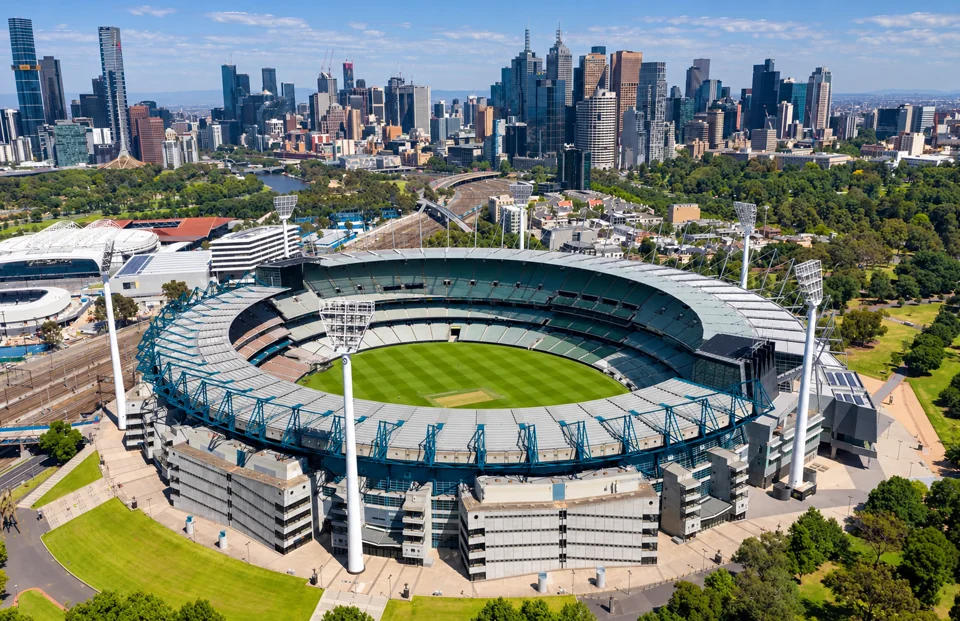
Australian rules football, usually called "Aussie rules" or "footy", is the most popular winter spectator sport in much of Australia. The AFL, short for Australian Football League, is the national professional competition. It has 18 clubs. Games are played on large oval fields by teams of 18 players who kick, punch and run the ball toward goals at each end.
For a first-time visitor, matches are cheap to attend compared with most major sport: in 2026 an adult general admission ticket at the two big Melbourne grounds costs $27. The season runs through the cooler months from March to late September, and the Grand Final on the last Saturday of September is the biggest day. Melbourne has more AFL clubs and games than anywhere else, but every mainland state capital has at least one club.
The rules below come from the AFL’s official Laws of Australian Football, 2022 edition. The AFL may change the Laws at its discretion, so details such as interchange limits or tackling interpretations can shift between seasons. The season dates and prices refer to 2026.
How a Match Is Played and Scored
The field and the players
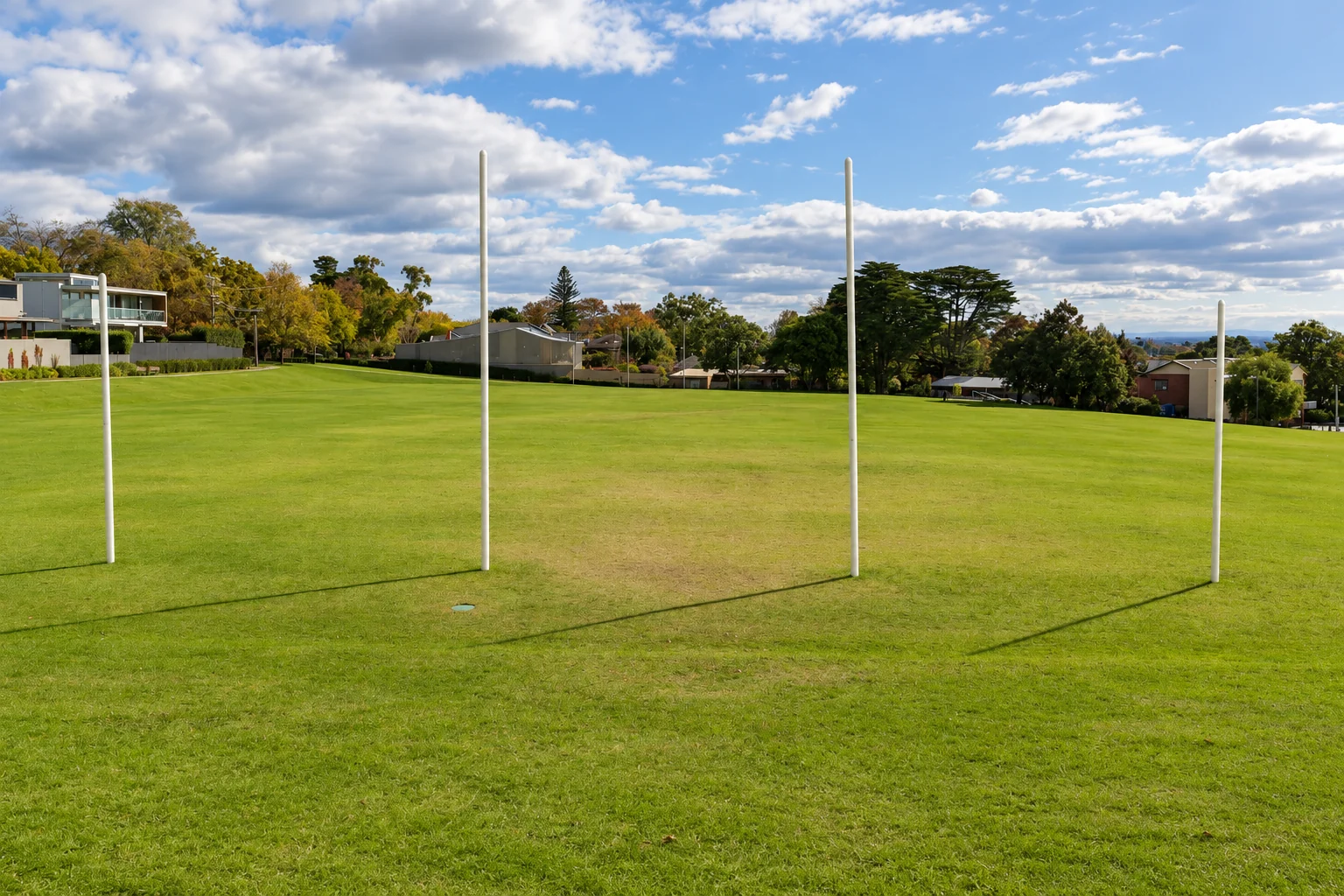
The Laws allow a range of oval sizes, not one fixed size. The playing surface is 135 to 185 metres long and 110 to 155 metres wide. Each end has four posts in a row: two tall goal posts 6.4 metres apart in the middle, flanked by two shorter "behind" posts, each 6.4 metres out from the goal posts. The goal posts stand between 6 and 15 metres tall, and the behind posts between 3 and 10 metres. Because ground sizes vary, a game at the huge Melbourne Cricket Ground can feel different from one at a smaller suburban stadium.
A team has up to 18 players on the field at once. Squads also include interchange players, who sit on the bench and swap on and off, with no more than four interchange players allowed. Because there is no limit on the number of substitutions, you will see players running to and from the interchange area, a 15-metre-wide zone along the boundary. A team that puts more than 18 on the field concedes a free kick, a 50-metre penalty and the points it scored in that quarter up to the moment the extra player is counted.
Scoring: goals and behinds
Scoring in Aussie rules confuses most newcomers at first, but it makes sense after about ten minutes. A goal is worth 6 points. It is scored when a player on the attacking team kicks the ball completely over the goal line between the two tall central posts, and no other player touches it on the way. The ball may bounce before it crosses. A behind is worth 1 point and is scored when the ball passes between a goal post and a behind post, hits a goal post, or otherwise crosses the line outside the central posts.
Goal umpires stand behind each end and signal the result. For a goal, the umpire raises both index fingers and waves two flags. For a behind, the umpire raises one finger and waves one flag. Scoreboards show goals, behinds and total points separately, and total points are the goals multiplied by 6 plus the behinds. The team with more points at the end wins, and equal points make a draw.
Match length
A match is 80 minutes of playing time, divided into four quarters of 20 minutes. The clock stops for stoppages such as the ball going out of bounds or a goal being scored, so a quarter lasts longer than 20 minutes on a wall clock. Breaks run up to 6 minutes after the first quarter, up to 20 minutes at half-time and up to 6 minutes after the third quarter. The half-time break is when many stadiums run entertainment and spectators queue for food.
Moving the Ball, Tackling and Umpires
Kicking, handballing and marking
Players move the ball in two ways. A kick means striking the ball with any part of the leg below the knee. A handball means holding the ball in one hand and hitting it with the clenched fist of the other. Throwing the ball is a free kick offence, and so is handing it directly to a teammate, which is why the handball always looks like a punch.
A player can run with the ball, but must bounce it or touch it on the ground at least once every 15 metres. This produces the sight of a player sprinting, bouncing the oval ball unpredictably, then passing it on.
The mark is the signature move of the sport and the reason crowds roar when a player leaps. A mark is a clean catch of a kick that has travelled at least 15 metres, inside the playing surface, without touching the ground or another player. The player who marks the ball gets a free, unimpeded kick, with opponents standing back. If an opponent touches the ball in flight, the umpire calls "Touched Play On" and no mark is awarded. That is why you will hear the crowd groan when a player drops a catch or when a defender gets a fingertip on the ball.
Tackling
Tackling is permitted, but only on the player holding the ball, and a legal tackle is between the shoulders and the knees. Contact above the shoulders is high contact and brings a free kick to the player who was tackled. Pushing or bumping an opponent in the back and charging are also prohibited. Hip-and-shoulder contact and use of the arms is allowed when the ball is within 5 metres of the player.
A player who has had a "prior opportunity", meaning enough time to dispose of the ball legally, and is then tackled and fails to kick or handball it can concede a free kick for holding the ball. Spectators who hear a crowd chant "ball!" are calling for this. Kicking the ball out of bounds on the full, meaning without it touching the ground or another player first, also results in a free kick.
For serious breaches, such as delaying play or behaving unsportsmanlike, the opposing team gets a free kick plus a fifty metre penalty, which moves the ball 50 metres toward the centre of the goal line. A long-range goal from this advance is common after a penalty.
Who the umpires are
Each match has at least one field umpire, two or more boundary umpires and two goal umpires. The field umpire has "full control" of the match and is the sole judge of free kicks and marks. Field umpires bounce the ball at the centre to start each quarter and after each goal, and stand at the middle of the contest as players jump for the ball. The boundary umpires judge when the ball goes out of bounds and throw it back into play, which they do backwards over their heads. Goal umpires judge goals and behinds, and record the score when the field umpire calls "All Clear".
If lightning is within 500 metres of the arena, the field umpire must suspend play under the AFL Extreme Weather Policy. Summer storms in northern states can cause delays, so allow extra time.
The 18 Clubs and Where They Play
The AFL has 18 clubs, ten based in Victoria and eight in other states. According to the Wikipedia article on Victorian bias in the AFL, a ninth interstate club from Tasmania is scheduled to join in 2028, which would bring the competition to 19 clubs. The competition began as a Victorian league, which explains the concentration of clubs in Melbourne.
Victorian clubs
Of the ten Victorian clubs, nine are in Melbourne and one in Geelong, based on the list of AFL grounds as of the 2025 season. Four play home games at the Melbourne Cricket Ground (the MCG): Collingwood, Hawthorn, Melbourne and Richmond. Five play at Marvel Stadium in the Docklands precinct: Carlton, Essendon, North Melbourne, St Kilda and the Western Bulldogs. Geelong plays at GMHBA Stadium, also known as Kardinia Park, in Geelong.
Some clubs take a few home games elsewhere. Hawthorn plays some at UTAS Stadium in Launceston, and North Melbourne has played some home games at Hands Oval in South Bunbury, Western Australia, since 2025.
Because so many clubs share two stadiums, the AFL says that on any given weekend there could be up to five games in Victoria. For a visitor based in Melbourne, that means a game is almost always an easy trip.
Clubs outside Victoria
The eight interstate clubs are spread across four states:
- South Australia: Adelaide Crows and Port Adelaide both play at Adelaide Oval.
- Western Australia: Fremantle and West Coast Eagles both play at Optus Stadium in Perth.
- Queensland: Brisbane Lions play at The Gabba in Brisbane. Gold Coast Suns play at People First Stadium (formerly Carrara Stadium) on the Gold Coast.
- New South Wales: Sydney Swans play at the Sydney Cricket Ground (SCG). GWS Giants play at ENGIE Stadium (formerly Sydney Showground Stadium) and also host some home games at Manuka Oval in Canberra.

Two pairs of clubs share a stadium and a city: the Adelaide and Perth rivalries are known as the Showdown and the Derby. Both are strong local games if you are in those cities. The AFL’s venues page lists venues by city and state and links to all 18 club sites.
Choosing a club to watch
Most first-timers do not need to pick a team before they arrive. Choosing the home club of the city you are in, and sitting among its supporters, is a common way to enjoy a game. The ground capacities listed on the grounds page give a sense of the atmosphere: the MCG holds 100,024, Optus Stadium 61,266, Marvel Stadium 56,347, Adelaide Oval 53,583, the SCG 48,000, The Gabba 42,000, GMHBA Stadium 40,000, People First Stadium 25,000 and ENGIE Stadium 23,500. A game at the MCG with a big crowd feels very different from a smaller regional ground.
The Season and Finals Series
Home-and-away rounds
The 2026 AFL season runs from 5 March to 26 September. It has 18 clubs, and each plays 23 matches across 25 rounds. This means every club has two rounds off, called byes, which gives spectators on any given weekend a reduced slate of matches. The home-and-away phase sets the ladder, which is the ranking table of clubs by wins. Clubs earn points for wins and draws, and the final ladder determines who plays finals.
A typical round has nine matches spread from Thursday night to Sunday, with games on Friday night and Saturday afternoon and night. This spread gives visitors a good choice of days. A round can contain one, two or three games per day, and fixtures change each year, so check the AFL fixture page for the match times and venues in your travel window.
The 2026 finals system
The finals series is the knockout phase at the end of the season. In 2026 it is five weeks long for the first time, and the top ten clubs qualify, up from eight. The change was announced in October 2025, and it was the first change to the AFL finals system since 2000. In 2025, the finals were four weeks long with the top eight clubs.
The new opening phase is the Wildcard round: the seventh-placed team hosts the tenth-placed team, and the eighth-placed team hosts the ninth. The winners advance into the existing eight-team finals system, which follows the earlier format. Under the AFL’s own announcement, the 2026 Finals open with the Wildcard Finals on Friday 28 August.
The Grand Final
The Grand Final is the last match of the season and decides the premiership, which makes the winner the champion club. The Grand Final is held at the MCG each year, regardless of which clubs play. In 2026 it falls on Saturday 26 September, and the AFL’s official match-day guide gives a start time of 2:30pm AEST, with the 2026 pairing listed as Brisbane against Fremantle. The pre-game entertainment and ceremony schedule begins at 1:39pm.
The Grand Final is a ticketed event that sells out and has its own ticketing rules, covered below. A visitor who cannot get a ticket will find that pubs and clubs across Australia show the game, and the afternoon start makes it a social occasion.
Going to a Game
Choosing a ground
The MCG is the most famous ground and the obvious first choice for a visitor in Melbourne, because it is the oldest AFL ground and hosts the Grand Final. Marvel Stadium is also in Melbourne and has a roof, which is a consideration on a wet or cold evening. The grounds list describes it as the AFL’s roofed venue only indirectly, so check the stadium’s own details on the AFL venues page before you go.
Outside Melbourne, Adelaide Oval is close to the Adelaide city centre, and Optus Stadium, the SCG and The Gabba each serve their city’s clubs. A visitor travelling interstate can build a game into one trip. A Saturday game in Adelaide, Perth or Sydney is a standard way to see the local football culture.
What to expect at the gate
Entry to AFL games is by digital ticket. All 2026 finals tickets are digital and delivered through the Ticketek or Ticketmaster app, which you need to enter the ground. The same ticketing split applies across the season: which company handles a game depends on the venue. Download the right app and load your ticket before you leave your accommodation, because mobile reception inside a crowd of tens of thousands is unreliable.
General admission means you pay for entry but do not have an assigned seat, so arriving earlier gets you a better spot. Reserved seats guarantee a place but cost more. At some venues, the choice is made for you. Sports Australia says Adelaide Oval and Blundstone Arena offer general admission, while Optus Stadium in Perth has no general admission option and requires a reserved seat bought through Ticketmaster.
Watching the game
For the first quarter, follow the ball and the umpire’s signals. When the field umpire throws the ball up or bounces it, big players called rucks jump to hit it to teammates. When someone takes a mark, listen to the crowd’s reaction. Goal umpires’ flag signals tell you whether a score was a goal or a behind, and the scoreboard confirms it within seconds. By half-time you will recognise the free kick calls, and the chant for "holding the ball" will make sense.
Tickets and Prices
Regular-season prices
The AFL froze general admission prices at the MCG and Marvel Stadium for the eighth straight season in 2026. The official price list is:
- Adult: $27
- Concession: $18
- Junior (14 and under): $5
- Children aged four and under: free
- Family ticket (two adults and two children): $54
These apply to all home-and-away games at both venues. For Rounds 10 to 15 only, the AFL reduced general admission prices at the MCG and Marvel Stadium as a cost-of-living measure: adult $20, concession $15, junior $5 and family $40. Reserved seats and other venues have their own pricing, which appears on the ticket page for each match. Some third-party sites give a different junior age range, but the official AFL notice says 14 and under.
Where to buy
Tickets are sold through Ticketek or Ticketmaster, depending on the venue. The simplest route is the AFL fixture page, which has a "Buy Tickets" link on every match and sends you to the correct seller. Buying through the AFL’s links avoids resale sites that charge more than face value.
Finals and Grand Final tickets
Finals are a separate purchase, even for club members, according to the AFL’s finals ticket FAQ. Eligible members get priority access before general sale, and any tickets left after the member periods go on general sale. Entry-level finals tickets were frozen for an 11th straight year. Grand Final prices rose 4 per cent across all categories, and the cheapest Grand Final ticket is $172, compared with $165 in 2025. The AFL directs Grand Final buyers to Ticketek, and premium hospitality is sold through the AFL Event Office at afl.com.au/eventoffice.
Under the 2026 Grand Final Ticketing Scheme, tickets may not be transferred without Ticketek’s prior written consent, resale conditions apply, and the scheme is written to deter scalping, which means reselling tickets at inflated prices. The AFL publishes its authorised outlets and agents on its website. For a visitor, the practical rule is to buy only from those channels. A ticket from an unofficial seller risks refusal at the gate.
Key Takeaways
- Learn the scoring first: A goal is 6 points and a behind is 1, and the scoreboard shows goals, behinds and total points separately.
- Pick a game in the city you are visiting: Ten of the 18 clubs are in Victoria, and the other eight are in South Australia, Western Australia, Queensland and New South Wales, so a home game is available in most mainland capitals.
- Book through the AFL fixture page: Tickets go through Ticketek or Ticketmaster depending on the venue, and every ticket is digital, so install the right app before match day.
- Budget from $27 for an adult at the MCG or Marvel Stadium: 2026 general admission is $27 adult, $18 concession, $5 junior and $54 for a family, with lower prices in Rounds 10 to 15.
- Plan finals and the Grand Final early: The 2026 season runs 5 March to 26 September, with Wildcard finals from 28 August and the Grand Final at the MCG on Saturday 26 September; the cheapest Grand Final ticket is $172.