Finding an accessible walk in an Australian national park means combining three things: the park’s web page, the track grade listed there, and the details behind that grade, such as gradient, surface, width and steps. Many parks use the Australian Walking Track Grading System (AWTGS), a voluntary national standard that rates how hard a walk is. Only Grade 1 tracks are designed for wheelchair users, and only with someone to assist them.
A workable plan also covers the rest of the visit: how you get to the trailhead, whether you need a park pass or shuttle ticket, which concessions or companion benefits apply, and whether the walk is open on your dates. These questions are taken in order below, followed by specific parks in Tasmania, the Northern Territory and Queensland, and fees and concessions in New South Wales and Western Australia.
Check the park page before choosing a walk
The managing authority’s park page is the most reliable place to begin. Tasmania’s Parks and Wildlife Service (PWS) states on its access friendly page that it is committed to providing accessible tracks, facilities and equipment, and that motorised wheelchairs and scooters may be brought into national parks and reserves. Park-specific access information sits on each individual park page, so a state-level statement that parks are accessible for everyone does not replace reading the page for the walk you intend to do.
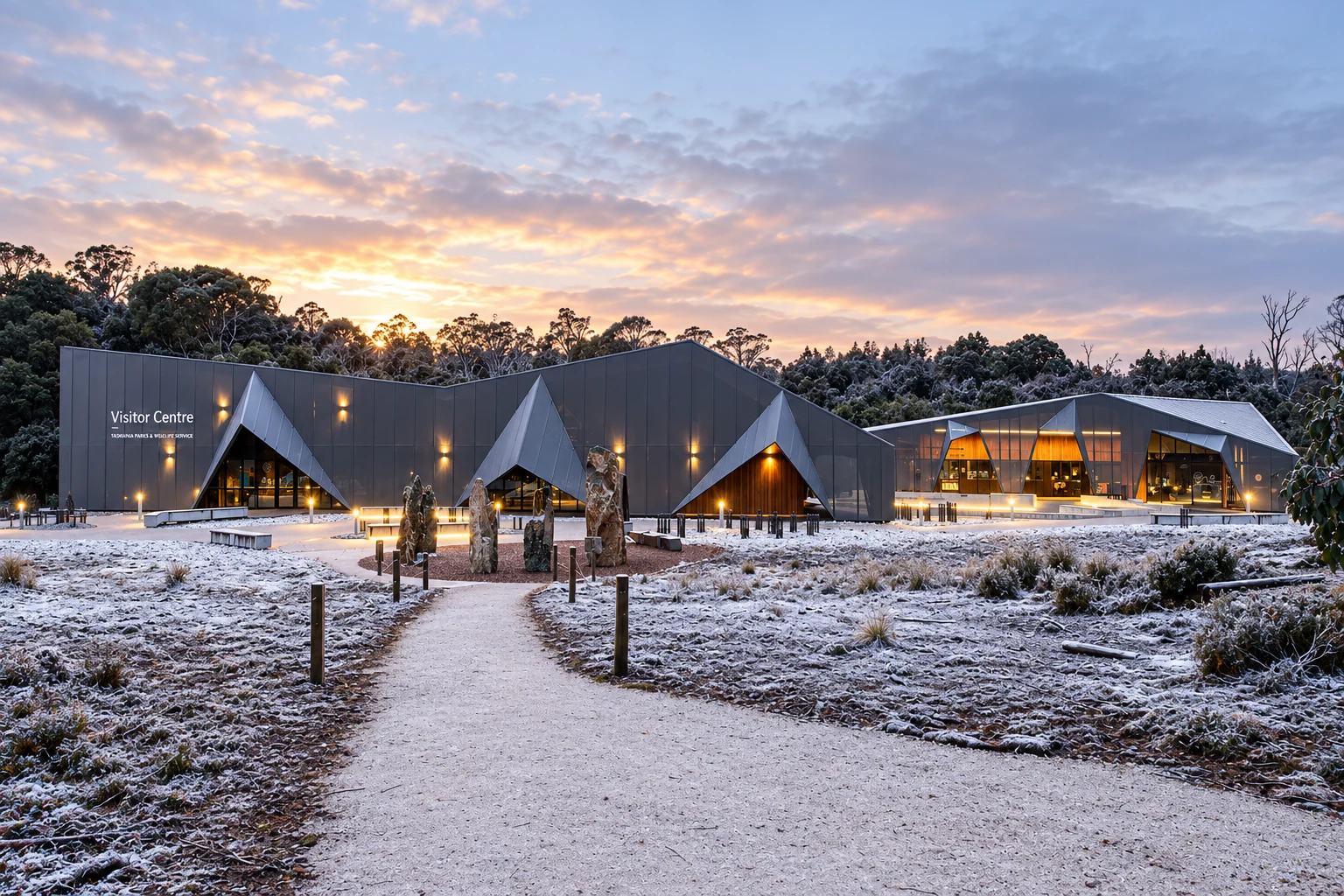
Each track on a park page usually carries a grade, a length and a time estimate. Use those to shortlist, then check the details behind them.
Tourism websites are good for finding ideas. Tourism Australia, for example, says most walking tracks in Uluru-Kata Tjuta National Park are wheelchair accessible, and Queensland’s tourism body publishes a list of wheelchair accessible walks. Such lists often use "accessible" without stating criteria, so confirm each walk on the park’s page before you choose it.
A useful checklist of what to look for comes from the National Parks Association of NSW, whose Naturally Accessible list records toilets, seats, steps, surface, steepness and barriers. Surface, pinch points and steepness matter most to wheelchair users, while steps and seats matter most to people with arthritis or limited stamina. Those headings are worth using as your own questions for any walk.
What AWTGS Grade 1 means
The AWTGS User Guide was developed through the Walking Tracks Grading and Improvement Project with Victorian Government funding and is endorsed by Parks Forum as a voluntary industry standard. It is not a legal requirement, and it exists because Australia had no nationally consistent grading before it. Its stated purpose is to answer the question "is this walk suitable for me?"
A land manager grades the track technically using the AS 2156.1 descriptors, then translates the result into plain English for visitors. The public wording for Grade 1 is "Suitable for wheelchair users who have someone to assist them." For a wheelchair user travelling alone, that wording is the starting point for a conversation with the park. It does not guarantee independent access.
| Component | Grade 1 technical criterion | Public description |
|---|---|---|
| Distance | Total track no more than 5 km | Distance to the nearest 100 m |
| Gradient | Maximum 1:14 (7.14%, 4.1°) for a wheelchair user | "Flat" |
| Surface | Broad, hard-surfaced track suitable for wheelchairs | Well maintained, minimal intrusions |
| Width | 1200 mm or more | |
| Steps | Allowed only with alternate ramp access | "No steps" |
| Markings | Track head signage and route markers at intersections | |
| Experience | No bushwalking experience needed |
The gradient and width figures are the most useful benchmarks for wheelchair users. A gradient of 1:14 means the track rises 1 metre over every 14 metres of length, and a width of 1200 mm or more leaves room for a wheelchair and an assistant to manoeuvre.
Grades 2 to 5 explained
Grade 2 allows walks up to 10 km, gradients generally no steeper than 1:10 (10%, 5.7°), widths of 900 mm or more, and "occasional steps". Its public descriptor is "Gentle hills", and it makes no statement about wheelchair suitability. Some wheelchair users and people with limited mobility will manage parts of a Grade 2 walk, but the grading does not promise it.
Grade 3 covers walks up to 20 km with "many steps", widths below 1200 mm, and gradients that may exceed 1:10 for short sections. Grades 4 and 5 are aimed at experienced and very experienced bushwalkers, and at those levels distance and steps no longer influence the grade.
Why the hardest component sets the grade
The overall grade is set by the hardest single component. The guide says a walk "will often have components that are easier than the walk’s ultimate grade." A short walk can therefore carry a high grade because of one steep pitch or a flight of steps.
The guide’s own worked example is the Wineglass Bay Lookout Walk in Freycinet National Park, Tasmania. It is only 2.4 km, yet it is Grade 3 because its gradient ("Short steep hills") and steps ("Many steps") are Grade 3 components. Its distance, path and markings are easier, and the time estimate is 1.5 hours. Anyone who read only the 2.4 km figure would underestimate it.
Time estimates need the same care. The guide says time does not describe difficulty. It is the land manager’s best estimate for an average-fitness walker in good conditions, so a wheelchair user, a person with a walking aid or someone who rests often should plan on their own pace.
Building standards and bushland tracks
Figures from the AS 1428 series, Australia’s design standards for access in buildings, often appear in accessibility articles. They describe the built environment. The Queensland Government’s universal access guidance, last updated 31 March 2023, says a continuous accessible path of travel in street design should be no steeper than 1 in 20 in the best possible circumstances, with a cross fall no steeper than 1 in 40 and a 1.8 m minimum pedestrian clear width. A ramp guide summarising AS 1428.1:2021 gives a maximum ramp gradient of 1:14 for ramps longer than 1900 mm, a walkway at 1:20 or flatter, and handrails on both sides.
These figures are useful reference points when a park describes a ramp or boardwalk, but they do not tell you about the surface, camber or rest points of a bushland track. For natural tracks, the Grade 1 criteria above are the relevant benchmark.
Cradle Mountain walks and grades
The Cradle Mountain page lists a range of walks that show how grading works in practice.
| Walk | Distance and time | Grade |
|---|---|---|
| Rainforest Walk | 431 m, 10-minute circuit | 1 |
| Enchanted Walk | 1.1 km, 20-minute circuit | 2 |
| Weindorfers Forest Walk | 750 m circuit | 2 |
| Waldheim Chalet | 100 m | 2 |
| Dove Lake Circuit | 6 km, 2 to 3 hours | 3 |
| Crater Lake | 5.7 km circuit | 3 |
| Overland Track | 65 km one way, six days | 4 |
| Cradle Summit | 12.8 km return, large rock crossings | 5 |
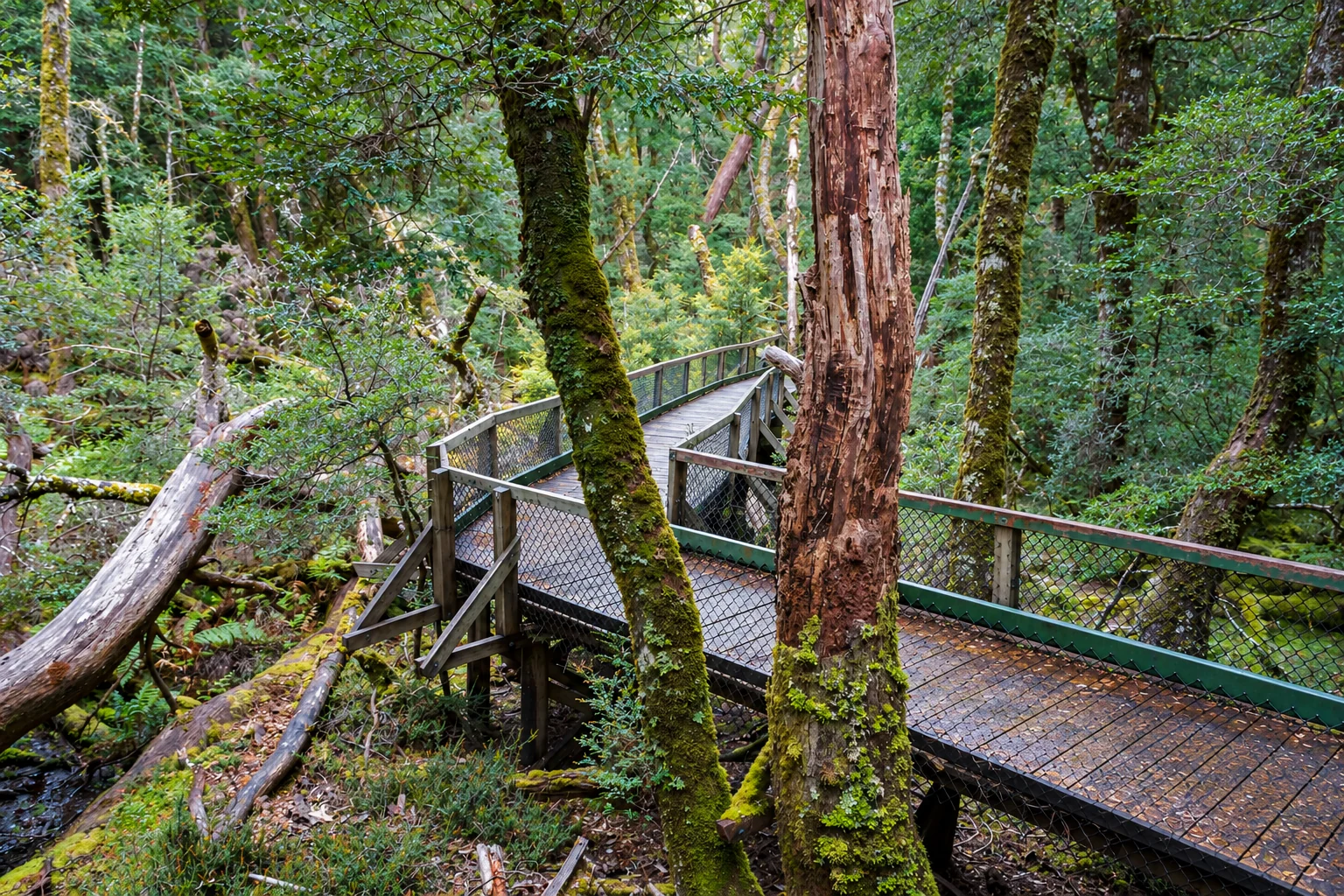
The Rainforest Walk is the Grade 1 option: a short all-weather boardwalk circuit through rainforest. The Enchanted Walk is Grade 2, with a sealed and wheelchair accessible first half and a number of steps after the bridge, so many visitors will do the first half and turn back. The Dove Lake Circuit is described as a good introductory walk but is Grade 3, and the page does not present it as a wheelchair walk.
A valid parks pass is required for entry to Tasmania’s national parks, and visitors are asked to park at the visitor centre, validate the pass and organise a shuttle ticket. Private vehicles may enter the park only outside shuttle operating hours. From 15 November 2023 a $15.50 fee per adult (18+) for a 72-hour ticket applies to ride the Cradle Mountain shuttle bus, so check the park page for the current fee and timetable. Most Cradle Mountain shuttles are wheelchair accessible, and accessible toilets are at the Dove Lake Visitor Shelter.
All-terrain wheelchairs in Tasmania
For visitors with mobility limitations who want to try rougher tracks, Tasmania PWS says TrailRider all-terrain wheelchairs are available at Cradle Mountain, Freycinet and Mount Field. A TrailRider is a single-wheeled, chair-style carrier that a group of people push and steady along a track. Staff can advise which tracks suit it, so contact the park or visitor centre before you arrive.
Uluru-Kata Tjuta, Northern Territory
Uluru-Kata Tjuta National Park has several walks described as wheelchair accessible. Carer Solutions names the Mala Trail (2 km return) and the Kuniya Trail (1 km return) among its wheelchair friendly options. A regional tourism guide says the Uluru Morning Guided Base Walk, 10.6 km on sandy, maintained paths around the base, is accessible by wheelchair, and describes wheelchair access into the Mala and Kuniya walks plus facilities at the Cultural Centre and the Talinguru Nyakunytjaku Viewing Area. A separate accessibility guide describes the Uluru base sections as flat and firm and Kata Tjuta as more challenging terrain.
Treat these as strong leads. Sand, heat and distance affect wheelchair use in ways a grade label does not capture, and a 10.6 km base walk is a long outing for anyone in desert conditions. Confirm the surface and assistance needed with the park before you book a guided walk.

Blind and low-vision travellers have an additional option. The park’s audio guide gives GPS-triggered commentary along all roads in the park, on all walks at Uluru and on the short walk at Kata Tjuta, and Tourism Australia says it has more than 100 stories.
Kakadu National Park, Northern Territory
Kakadu’s distances and seasons shape access more than its grades. A 2016 federal walking strategy recommended building all "easy access" tracks to a Class 1 standard, increasing the number of Class 1 walks, and improving assisted wheelchair (Grade 1) conditions on the first section of the Ubirr track, for example the first gallery. It also describes the Mamukala Bird Hide and viewing platform as suitable for assisted wheelchair access. That report is from 2016, so confirm current track conditions with the park before you rely on it.
The same report notes that walks in the South Alligator District close seasonally when floodplain water rises, because of crocodile safety risks and restricted vehicle access. Plan around the wet season and check closures close to your dates. A tourism guide lists Ubirr boardwalks, sealed paths at Nourlangie and Yellow Water cruises with minimal walking, and warns of long driving distances between sites. Allow generous driving time between stops.
Queensland’s short sealed walks
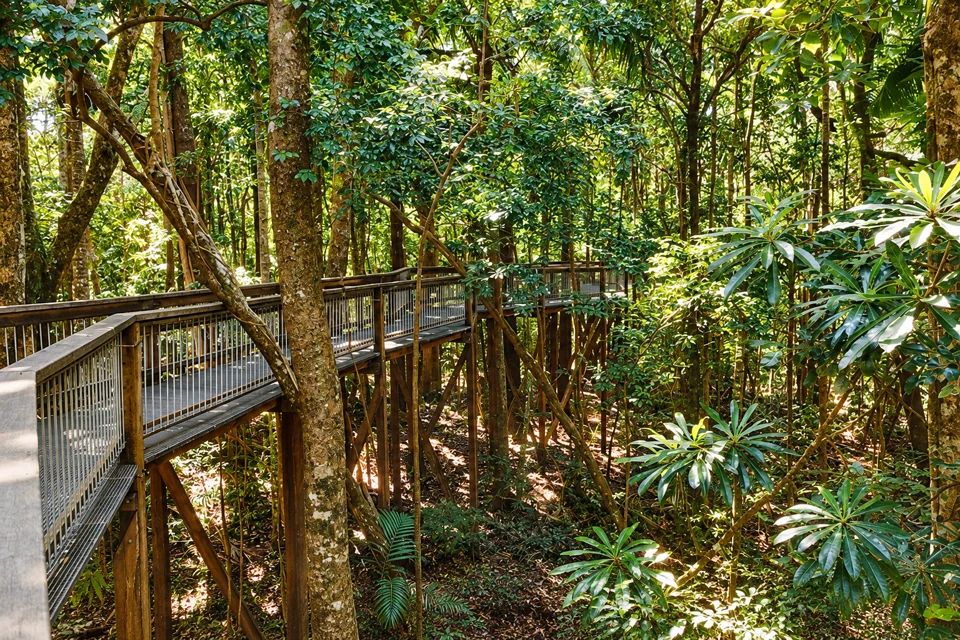
Queensland Tourism lists several short walks suited to wheelchair users. The Daintree aerial walkway is designed to be wheelchair accessible and has slight gradients in some sections. Cedar Creek Falls Lookout in Tamborine National Park is 500 m return on bitumen, and the Lamington Centenary Track is 1.8 km return and sealed. Slight gradients matter if you push a manual chair, so ask the park about the steeper sections of the walkway.
NSW park entry fees and passes
NSW charges motor vehicle entry at 45 of more than 890 national parks and reserves. The fee applies per vehicle and not per person, and walkers and cyclists pay nothing. According to the annual pass FAQs, single-day entry is generally $4, $8 or $12, except in Kosciuszko National Park. A NSW Government media release of 17 June 2025 puts Kosciuszko at up to $29 a day in winter.
Annual passes on the NSW page cost:
- All Parks Pass covers all 45 fee parks, including Kosciuszko, and costs $190 for one year or $335 for two years.
- Multi Parks Pass (all fee parks except Kosciuszko): $65 for one year, $115 for two years.
- Country Parks Pass covers 34 designated Country NSW parks, excluding Sydney-area parks and Kosciuszko, and costs $45 for one year or $75 for two years.
- Single Park Pass covers any one designated Country NSW park, and costs $22 for one year or $40 for two years.
Passes cover private motor vehicles with up to eight seats. They do not cover camping, accommodation, museum or visitor centre entry, tours or activities. Entry stations take Visa and Mastercard with no card surcharge, and do not take cash. Cash works at visitor centres and some car park pay machines, and some parks use self-registration boxes or the Park’nPay app. NSW National Parks urges visitors to check its alerts list for closures before setting out because conditions change quickly.
Companion Card and concessions in NSW
The Companion Card lets people with significant and permanent disability join NSW national park activities without paying extra for their carer. NPWS is an affiliate, and cardholders get concessions on per-person fees such as landing fees, camping and accommodation, tours and events, and museum and attraction fees. The card does not cover a companion’s vehicle entry. Australian Disability Parking Permits and NSW Mobility Parking Scheme permits do not qualify for park entry discounts or exemptions either. Each state or territory program issues its own Companion Cards, and the NSW page links to the national Companion Card page.
Other NSW concessions cut the vehicle fee. The Concession Pass gives Australian pensioner concession card holders and eligible veteran card holders free vehicle entry to the 45 fee parks. Student concession holders, transport concession entitlement holders and international pensioner or seniors card holders are not eligible. The approved applicant must be in the vehicle, and the pass covers private recreational visits in vehicles with up to eight seats. Apply through the online concession application. A current Australian Seniors Card gives about 20% off the full price of all four annual pass types, but not Senior Saver Cards, and not single or multi-day tickets.
Concessions in Western Australia
The Explore Parks WA concessions page was updated on 8 March 2023. Concession rates apply to holders of Australian-issued cards and to recipients of listed payments, including the Companion Card, Seniors Card, Age Pension, Disability Support Pension, Disability Support (Blind) Pension, Carer Payment, Carer Allowance and DVA. The companion or carer of a Companion Card holder may camp or enter free where per-person fees apply. Concessions do not apply to students or health care card holders. Before you travel, check the current rules with the issuer of your card or payment.
Planning the whole visit
An accessible walk can be undone by the parts around it: the road in, the car park, the toilets and the weather. Use this sequence when planning:
- Shortlist walks on the managing authority’s park page, then read the grade and the gradient, surface, width and steps of each walk.
- Confirm whether the walk is Grade 1 and whether you need an assistant, since Grade 1 wheelchair suitability assumes one.
- Check the hardest component on any walk, not just the headline distance.
- Compare the time estimate with your own pace and the conditions.
- Find out whether the park needs a parks pass, day ticket or shuttle booking. Also find out whether vehicle access is restricted.
- Ask the park or visitor centre about accessible toilets, wheelchair access on shuttles and any TrailRider availability.
- Look up closures and alerts close to your travel date, especially in flood-prone areas such as Kakadu’s South Alligator District.
- Confirm pass, concession and companion eligibility with the state or territory issuer at the time of travel.