
Three weeks is enough to see three very different parts of Australia if you fly between them. You will have to skip the rest. The country is roughly the size of the continental United States. A trip that joins the east coast, the Red Centre and either Tasmania or Western Australia works best as a series of bases, with a flight between each. The Red Centre is the desert interior of the Northern Territory, home to Uluru (the sandstone monolith), Kata Tjuta (a cluster of domed rock formations nearby) and the town of Alice Springs.
Route A runs from Sydney up the Queensland coast, then to Uluru, then to Tasmania. Route B follows the same first two stages but finishes in Western Australia around Perth. Domestic flight fares depend on season and booking date, so check airline prices for your own dates.
Sort out your visa and driving licence first
Most visitors from the countries on the eligible list apply for the Electronic Travel Authority (subclass 601), a short-stay visa linked electronically to your passport. The eligible passports include the United Kingdom, the United States, Canada, Ireland, Japan, South Korea, Singapore, Malaysia, Hong Kong, Taiwan and most of western Europe. There is no visa application charge, only a AUD 20 service charge for the app. The ETA lets you stay up to three months per visit and is valid for 12 months with multiple entries, so a three-week trip fits well within the limit.
You apply through the Australian ETA app, and you must be outside Australia when you apply and when the ETA is granted. The Australian High Commission in Kuala Lumpur says the app is the only application channel. A new passport also needs a new ETA. Home Affairs says the result is usually immediate and suggests you hold off booking flights until the ETA is granted. Some websites charge much more than AUD 20 for the same service, so use the official app. If your passport is not on the list, or you have a criminal conviction in any country, you apply for a Visitor visa (subclass 600) instead.
Driving is the next decision, because Tasmania and Western Australia are far easier with a car. Austroads, which represents Australia’s road agencies, says overseas visitors without a permanent visa can drive on a valid overseas licence. You must carry the licence at all times, and if it is not in English you need either an International Driving Permit (IDP, a booklet that translates your licence) or an official English translation. In New South Wales, visitors can drive on an overseas licence for up to six months, as long as it is current and has not been suspended or cancelled. Each state sets its own rules, so check the Tasmanian and Western Australian road agencies for local detail.
Rental companies add their own conditions. VroomVroomVroom reports that most companies want an English-language licence held for 12 months, and Holafly says most require drivers to be 21 or older with at least a year of experience. Drivenow says no supplier accepts learner licences and only Redspot accepts probationary ones. Bring a physical licence, because digital licences are rarely accepted for international visitors, along with your passport and a payment card the rental company accepts.
Tasmania or Western Australia: how to choose
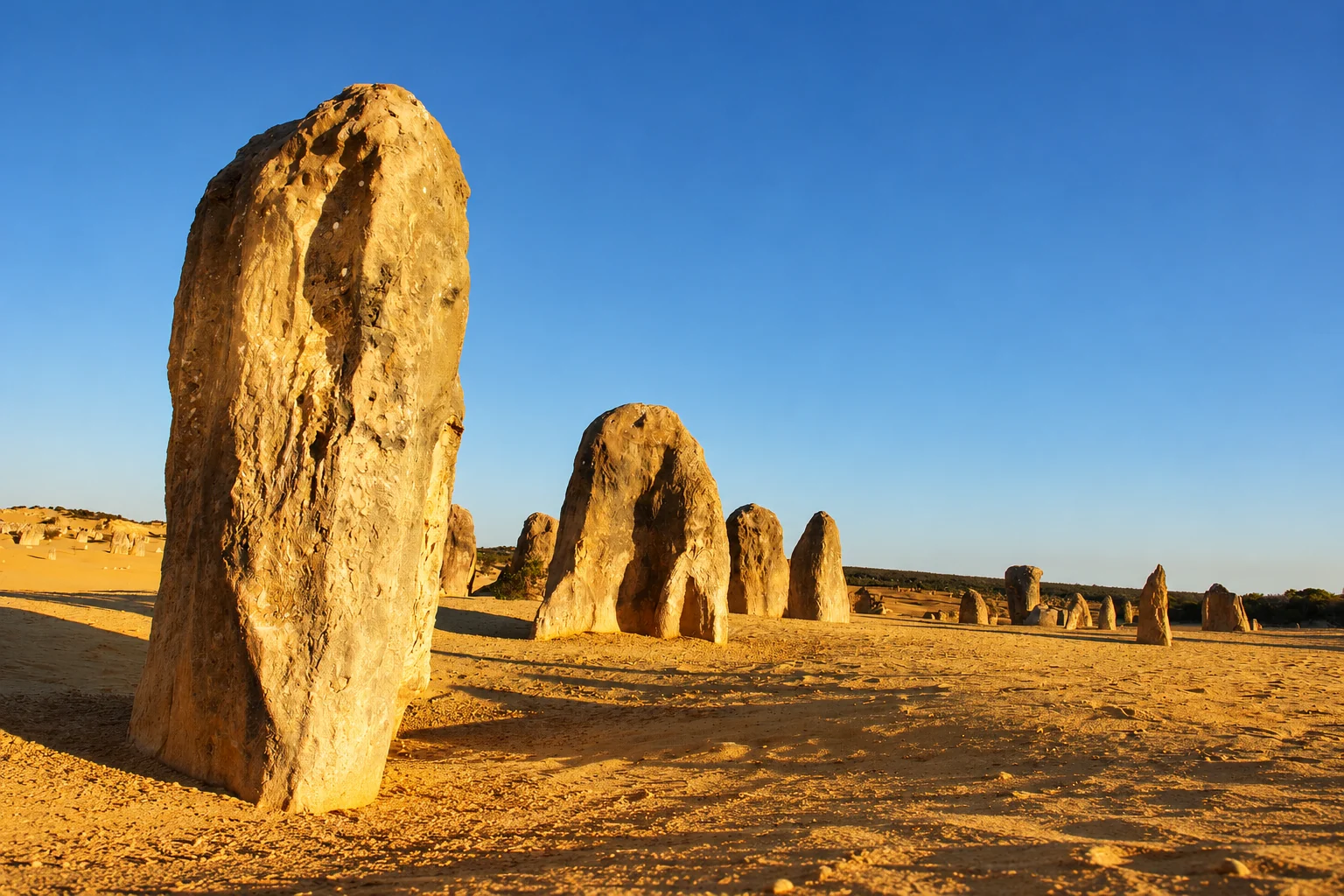
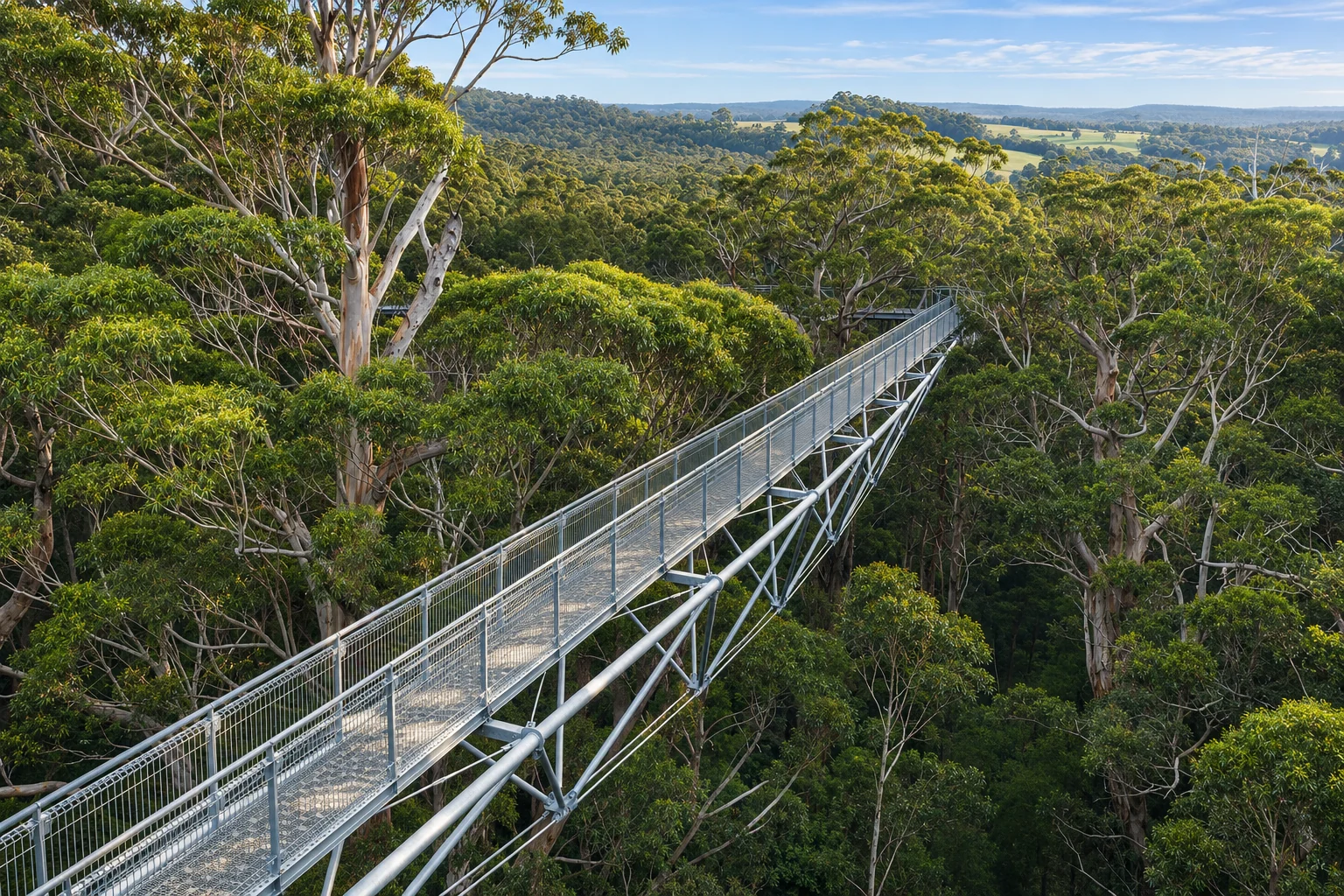
Both finishes need a flight from the Red Centre or a detour through a mainland capital. Choose by the scenery you want. Tasmania packs mountains, coastline and convict-era history into an island you can drive across in a day, which suits a week-long loop with one change of accommodation every two or three nights. Western Australia is spread out. Perth is the main base, and the best-known sights, such as the Pinnacles limestone formations in Nambung National Park or the Valley of the Giants Tree Top Walk in the south-west, are each a long drive from the city and from each other.
If you want hiking and short drives, choose Tasmania. If you want beaches, wineries and wide open roads, choose Western Australia, and plan to cover only one region of it, either the Coral Coast north of Perth or the South West. Seven days is not enough for both. The coast and the south-west lie in opposite directions from Perth.
Tasmania has one transport option the other state lacks. The Spirit of Tasmania sails overnight between Melbourne and Devonport, and Australian Rail Maps describes a Hobart to Melbourne journey that combines an early-afternoon Redline coach from Hobart to East Devonport with the overnight ferry. That route suits a traveller who wants to take a car across, or who prefers to arrive on the water, but it costs a night and a half-day of sightseeing time compared with a flight.
Seasons matter more for the Red Centre and Tasmania than for the east coast. The Ghan’s Expedition service, covered below, runs April to October, which is also the cooler half of the year in the desert. Western Australia’s Danggu Geikie Gorge boat trip runs from the end of April to November. If you travel in summer, plan hiking in Uluru and Kata Tjuta for early morning.
Route A: Sydney, the Queensland coast, Uluru and Tasmania
Sydney. Start with several days in Sydney, which gives you time to recover from jet lag and see the harbour, the Opera House, the Rocks and the beaches. A day trip to the Blue Mountains by train is an easy addition, and you need no car for any of this. Public transport and ferries cover the main sights, and a hire car in central Sydney adds parking cost and stress without saving time.

Cairns and the Great Barrier Reef. Fly north to Cairns for four nights. The day trips from Cairns run by boat to the outer reef for snorkelling or diving, and the Daintree rainforest to the north is a full day by tour or hire car. If you drive, collect the car on the day you leave Cairns for the Daintree instead of keeping it for the full stay, since the city centre is walkable.

Uluru and Kata Tjuta. Fly from Cairns to Ayers Rock Airport, usually via a connection in Sydney, Melbourne or Brisbane, and allow most of the first day for travel. Three nights at the Red Centre resort or in nearby accommodation gives you two full days. The Uluru climb closed permanently on 26 October 2019, the 34th anniversary of the park’s return to its Traditional Owners, the Aṉangu, and Parks Australia says attempting it breaches the Environment Protection and Biodiversity Conservation Act. Spend the days on the base walk around Uluru and on the Valley of the Winds or Walpa Gorge walks at Kata Tjuta. Add sunrise or sunset viewing. Book cultural experiences in advance, since they are led by Aṉangu guides.

Melbourne. Fly to Melbourne for two nights. Melbourne suits a slower pace after the desert, with laneway cafes, galleries and trams. If you prefer the ferry to Tasmania, take the evening sailing from Melbourne on your second night and arrive in Devonport the next morning.
Tasmania. Land in Hobart or arrive at Devonport and drive. A workable loop is two nights at Cradle Mountain, two nights on the east coast near Freycinet, and three nights in Hobart with a day trip to the Tasman Peninsula. The drive from Devonport to Cradle Mountain is a few hours, and the rest of the distances are short by Australian standards. Pick up the hire car on arrival and return it before your departure flight. Leave a spare morning at the end for the airport, because Tasmanian departure flights usually connect through Melbourne or Sydney.
Route B: Sydney, the Queensland coast, Uluru and Western Australia
The first stages are the same as Route A. The change starts after Uluru, when you fly from Uluru to Perth. Check the airline’s routing first, since flights from Ayers Rock to Perth usually connect through a larger east-coast hub, which can use most of a day.
Perth and Fremantle. Give Perth two full days to see Kings Park, Cottesloe Beach and the port city of Fremantle, which has a market and a harbour district within easy reach by train. You do not need a car here, so collect it on the day you leave the city.

One region. For the Coral Coast, drive north from Perth. The first stop is Nambung National Park for the Pinnacles, then Kalbarri National Park for the coastal gorges and river. The two parks are among those where entry fees apply, and a one-day Pinnacles visit fits within a night’s stop. Spend two nights in each of Cervantes, Kalbarri and a coastal town on the way back.
For the South West instead, drive south to Margaret River for the wineries and surf beaches, then on to the tall tingle forests at the Valley of the Giants Tree Top Walk and the coastal granite of the Albany area. A car is required, and the drives between these stops are manageable in a day each. Return to Perth for a flight home at the end of the trip.
Both versions mean a lot of driving for a first visit, so budget a half day at each end of the trip for hire car pick-up, fuel and food stops. Distances in Western Australia run longer than most visitors expect, and phone coverage outside towns is limited.
Park passes and entry fees
Each region charges different park fees, and the three systems do not work together. A Northern Territory parks pass does not cover Uluru-Kata Tjuta because Parks Australia manages that park, not the Territory. Tasmania and Western Australia each run their own pass.
| Region | Pass | Price | Notes |
|---|---|---|---|
| Uluru-Kata Tjuta | 3-day adult pass | Check Parks Australia | Covers both Uluru and Kata Tjuta; under 18s free |
| Tasmania | Daily Pass | $47.70 per vehicle | Excludes Cradle Mountain entry and shuttle |
| Tasmania | Holiday Pass | $95.50 per vehicle | All national parks, up to two months |
| Western Australia | Holiday Pass, mid-length | $50 per vehicle | Unlimited entry to all parks |
The Uluru three-day pass is valid for three consecutive days from first entry. Sources dated 2025 and 2026 give the adult price, and you can buy it from Parks Australia online or at the entry station. Buying ahead gives you a QR code to scan at the gate, and the park’s gate hours change by month, with opening before sunrise and closing after sunset. In summer, Kata Tjuta opens from 8am only when the 5pm forecast the day before is 36°C or higher.
In Tasmania, Parks and Wildlife Service fees cover up to eight people in one vehicle. A Daily Pass is $47.70, and the Holiday Pass at $95.50 covers every national park for up to two months, which makes it cheaper once you visit parks on three separate days. Cradle Mountain has its own arrangement. The Icon Daily Pass costs $29.80 per adult and includes the shuttle bus, while a Holiday Pass holder pays a separate $15 per adult for a 72-hour shuttle ticket.
Western Australia’s park fees guide, current at September 2023, lists a Holiday Pass at $30 for five days, $50 for a mid-length pass and $70 for four weeks, which covers a private vehicle with up to 12 seated occupants. Single-day vehicle entry is $17. The pass excludes camping and several paid attractions: the Tree Top Walk costs $21 for an adult and Monkey Mia Conservation Park charges $15 per day. Because the fee guide is from 2023, check current prices on the DBCA website before you buy.
The Tasmanian and Western Australian passes are priced per vehicle, so a couple sharing one car pays half the pass price each.
Taking the Ghan or the Indian Pacific
Two scheduled sleeper trains cross the continent, and both turn the transport into the main event rather than a way to get between places. They cost far more than flights, and a three-week trip has room for at most one.
The Ghan runs between Adelaide, Alice Springs, Katherine and Darwin, and the Indian Pacific runs between Sydney, Adelaide and Perth. Both are operated by Journey Beyond Rail, and all travel on them is in sleeping berths, with no seated carriages. That affects your budget, because the fare covers a cabin and meals.
The Journey Beyond Rail 2025 fares brochure says the three-day southbound Ghan runs only in March and November, while the four-day Ghan Expedition operates April to October. It also says Advance Purchase fares must be booked at least six months before travel. Confirm current dates with the operator, since fares and timetables can change without notice. Seat61 lists the Indian Pacific as running all year, with westbound departures from Sydney Central at 15:05 on Wednesdays and eastbound departures from Perth at 17:55 on Saturdays.
On cost, the Darwin to Sydney package combines the Ghan Expedition and the Indian Pacific over 8 days and 7 nights, departing Wednesdays from April to October, from $7,535 per person. The page shows Gold Twin Advance Purchase fares between $6,945 and $7,705 depending on month, and much higher Platinum everyday fares. The Darwin to Perth package costs from $8,255 per person for 8 days and 7 nights. Darwin to Perth costs from $7,340 for 8 days and 7 nights. A shorter option is the Ghan Expedition alone, a 4-day, 3-night Darwin to Adelaide trip that a reseller prices from $7,300 per person in Platinum.
For a first trip, the numbers settle the question. Eight days on rail uses a large share of your three weeks and costs thousands per person, which is more than the flights, accommodation and park passes for either route above. Choose the train if the rail journey is the reason you are coming, and in that case build the rest of the trip around its departure date, booked six months out. A traveller who wants Uluru, the reef and a state to explore is better served by the flight-based routes, with the train kept for a second trip.
Key Takeaways
- Apply for the ETA before you book flights: You apply for the AUD 20 Electronic Travel Authority through the official Australian ETA app. It is usually granted immediately and covers stays of up to three months.
- Check your licence before leaving home: A current English-language licence works for driving, a non-English one needs an IDP or official translation, and rental companies add their own age and experience rules.
- Pick Tasmania or Western Australia, not both: Each needs a week and a hire car, and Western Australia’s distances allow only the Coral Coast or the South West in that time.
- Plan Uluru around walks and cultural tours: The climb has been closed since 26 October 2019, and the three-day pass covers both Uluru and Kata Tjuta.
- Treat the Ghan and Indian Pacific as the centrepiece, not an add-on: Packages start in the thousands of dollars per person and should be booked at least six months ahead.