
Adelaide is the capital of South Australia. It is a mid-sized city on the Gulf St Vincent coast with a Mediterranean climate, one public transport network, and a government school system that assigns places by home address. For someone moving from overseas, the choices that matter most are which suburb to rent or buy in, how to get to work or school, which school zone the address falls into, and which government services to register with in the first few weeks.

Housing is the biggest cost, and prices have risen quickly. The metropolitan median house price reached $950,000 in the September 2026 quarter, up from $865,000 in the June 2025 quarter. Buses, trains and trams all use the same fares. Summers are hot and dry, winters are cool and wet. Renting is governed by the Residential Tenancies Act 1995 (SA), which caps bonds and limits rent rises. Overseas driver’s licences are valid for a time, then must be converted.
Choosing where to live
The Office of the Valuer-General (OVG) is the state agency that records every sale, so its figures are the clearest guide to Adelaide’s housing market. Its published data and statistics give the median house sale price across metropolitan Adelaide for each three-month period. The median is the middle price when all sales are ranked from lowest to highest. Half of houses sold for less and half for more.
| Quarter | Metropolitan Adelaide median house price |
|---|---|
| June 2024 | $785,000 |
| December 2024 | $850,000 |
| June 2025 | $865,000 |
| December 2025 | $930,000 |
| March 2026 | $970,000 |
| June 2026 | $975,000 |
| September 2026 | $950,000 |
The median climbed about 24 per cent between June 2024 and June 2026, then dipped in the September 2026 quarter. The OVG warns that small sample sizes and differences between suburbs make short-term movements hard to read. Treat one quarter’s dip as a single data point. For comparison, the OVG’s median for major non-metropolitan towns was $546,000 in September 2026, which matters if your work could be based outside the city.
City-wide medians hide large differences between suburbs. The state government publishes suburb-level median house prices and sale counts on DATA SA, and checking the sale count alongside the median shows whether a suburb’s figure rests on many sales or a handful.
The rental market matters first for most newcomers, since renting is the usual starting point. Domain’s June 2025 house price report found Adelaide’s quarterly house price gains had slowed to just over a two-year low in that quarter. Domain’s June 2025 rental report shows a split between property types: Adelaide house rents had their weakest June quarter since 2020 with the slowest annual growth in five years, while units posted their strongest June quarter since 2005. Domain also describes vacancy rates as "sub-2% everywhere" across Australia. A vacancy rate is the share of rental properties empty at a given time, and a rate that low means many applicants compete for each listing. Start searching before you arrive, prepare documents in advance, and expect to apply for several properties.
Two practical filters narrow the suburb list quickly. The first is school zone, covered below: if you have school-age children, the address decides which government school they attend, so check the zone before signing a lease. The second is how you will travel to work. Adelaide Metro fares are the same on buses, trains and trams, so a suburb near a train line or a frequent bus route keeps commuting costs predictable.
Getting around on Adelaide Metro
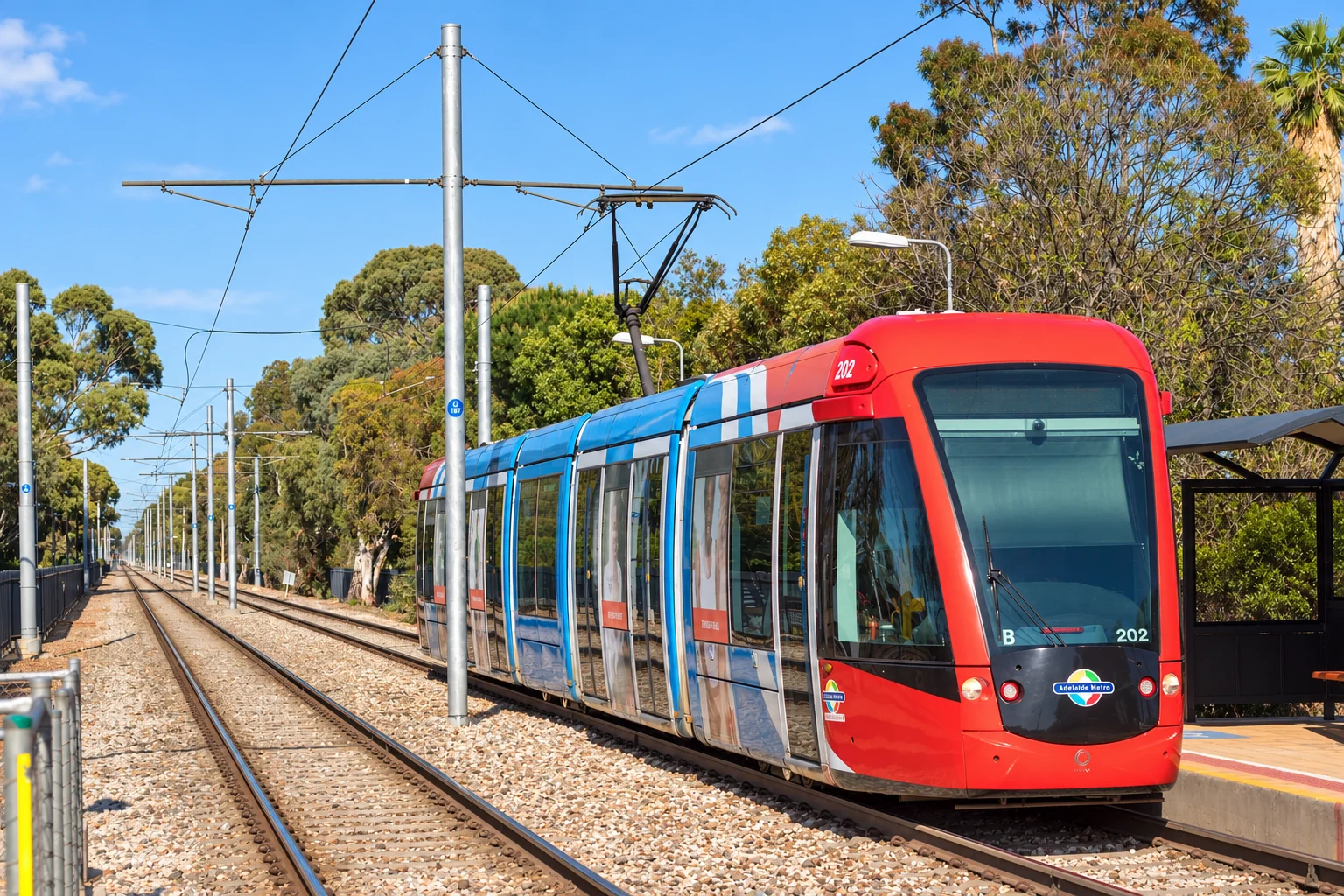
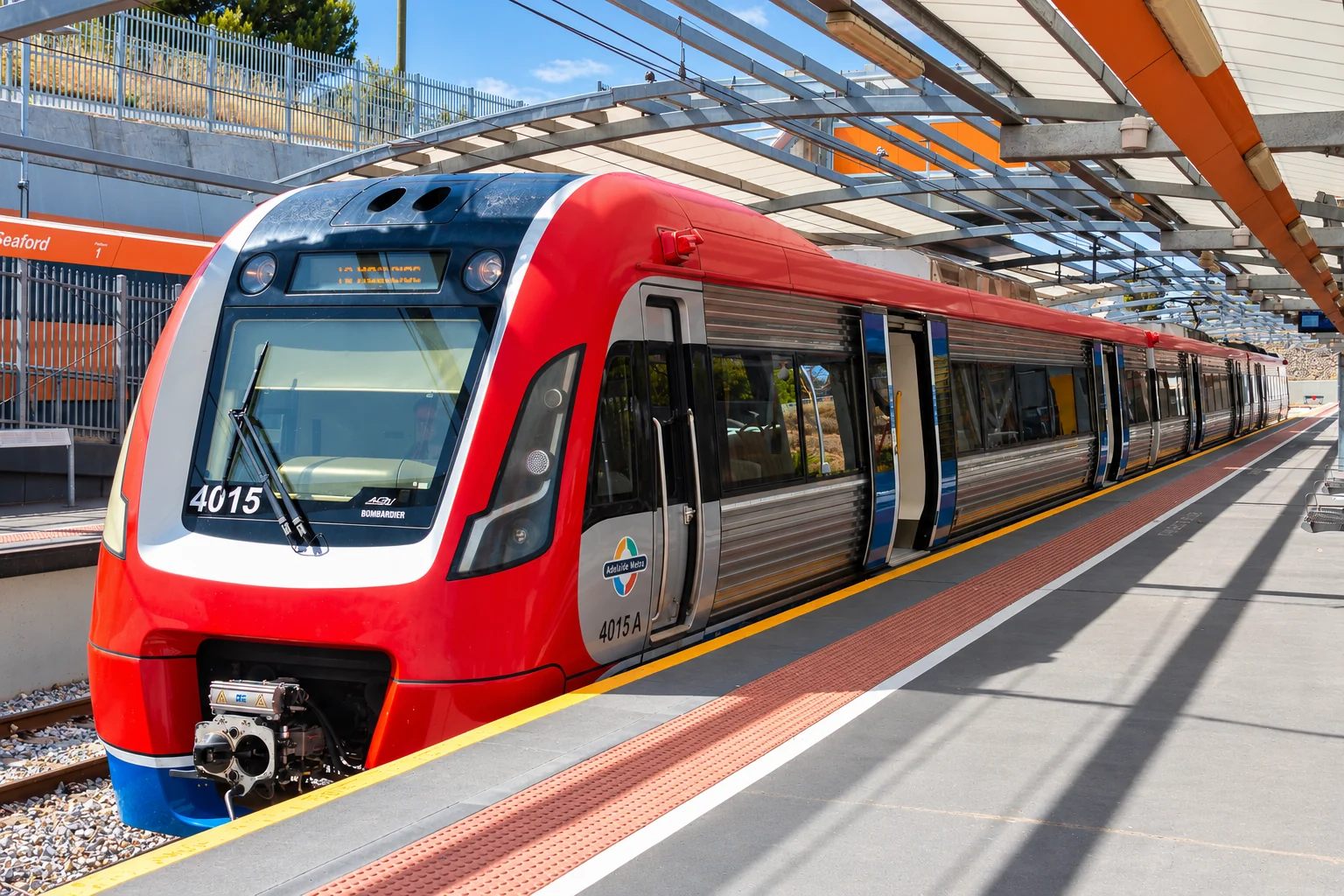
Adelaide Metro is the brand for the public transport network across metropolitan Adelaide, covering buses, trains and trams. It has operated under that name since 23 April 2000, and operations returned to direct state government control with the handover completed on 2 February 2025.
Fares and payment
Fares are the same on buses, trains and trams, so a trip that mixes modes does not cost more than one that stays on a single mode. There are three ways to pay: a rechargeable metroCARD, contactless Tap and Pay using a bank card or phone, or the Buy & Go app. Buses are cashless and tickets cannot be bought on board. If you prefer to pay with cash, buy a metroCARD in person, then top it up or load a Singletrip ticket onto it. Buy & Go fares match metroCARD fares, and tickets can be bought at any time.

Tap and Pay charges regular fares only. The contactless rollout was completed on 20 February 2026, after which paper tickets were no longer accepted on any Adelaide Metro service. Anyone entitled to a concession or student fare needs a metroCARD or the Buy & Go app to get it.
Concessions and students
Anyone aged 15 or over pays full fare unless they carry a current concession card and show it to an authorised person when asked. A new concession metroCARD costs $3.50 for the physical card, and at least $5 must be loaded before first use. Eligible groups include full-time, on-site tertiary students at approved South Australian institutions, and holders of government-issued concession cards such as the Centrelink Pensioner Concession Card, the DVA Gold Card and the South Australian Health Care Card. Companion Card holders pay a concession fare and their carer travels free. An Interstate Seniors Card gives a concession fare in peak times and free travel off-peak.
The listed concession fares are $2.35 at peak and $1.35 off-peak for a concession metroCARD, and $6.50 for a concession day trip. A concession 28-day pass costs $61.60. Fare schedules change, so check the official fares page before budgeting for a commute.
School students received a large reduction in 2025. The Student 28-day pass fell from $28.60 to $10 on 1 July 2025, which the Department for Infrastructure and Transport described as equivalent to 25 cents a trip for students travelling to and from school. Since 10 October 2025, every ticket type, including the Student 28-day pass and the regular and concession 14-day and 28-day passes, is available on the Buy & Go app, and service alerts can be set by route, train or tram.
Public transport works well for commuting into the city, but a car is still useful for trips beyond the rail and tram corridors. If you plan to drive, the licence rules in the setup section below apply from your first day.
Adelaide’s climate
Adelaide has a Mediterranean climate, classified Csa under the Köppen system: wet, cool winters and hot, dry summers. Summer rain is light, infrequent and unreliable, and very little falls until late autumn. Winter wind chill makes the temperature feel colder than the thermometer reading. Temperatures also differ across the metropolitan area. The Kent Town weather site shows an urban heat island effect. Built-up surfaces hold heat, which raises both minimum and maximum temperatures compared with the Airport and West Terrace sites.
The Bureau of Meteorology (BoM) publishes long-term averages for capital cities using the reference period 1981 to 2010:
| Measure | January | February | June | July |
|---|---|---|---|---|
| Mean maximum temperature | 29.2 °C | 29.5 °C | n/a | 15.3 °C |
| Mean minimum temperature | 17.1 °C | n/a | n/a | 7.5 °C |
| Mean rainfall | 20 mm | 13 mm | 80 mm | 76 mm |
Annual mean rainfall in this series is 547 mm. The rainfall row shows this pattern: February is the driest month listed, at 13 mm, while June and July each bring around 80 mm.
Recent years have run warmer than those long-term averages. For summer 2024–25, the mean daily maximum at West Terrace was 30.4 °C, which is 2.4 °C above the long-term average of 28.0 °C, and summer rainfall was below average at all sites across Adelaide and the Hills. For the 2025 calendar year, rainfall totalled 423.8 mm, 80 per cent of the long-term average of 526.5 mm, and the mean daily maximum of 23.2 °C was 1.4 °C above the long-term average of 21.8 °C.
Rainfall also varies a lot from year to year. In November 2025, West Terrace recorded 74.2 mm of rain, 239 per cent of the long-term average of 31.1 mm, and rainfall was well above average at Adelaide and Hills sites. The dry summer and wet spring of 2025 show how much a single season can differ from the average.
For daily life, this means planning for heat from December to February: check whether a rental has air conditioning or a cooling option, and consider how the property is oriented to the afternoon sun. In winter, wind chill and rain suit a proper jacket more than heavy snow gear. The Hills, the higher ground east of the city, are cooler than the plains, and the BoM figures quoted above are for the city sites.
Schools in Adelaide
How zones work
Most government schools in South Australia are zoned. A school zone is the set of suburbs from which the school accepts students as of right, so the school a child attends depends on where the family lives. The Department for Education’s "Find a school zone or preschool catchment area" tool shows the zone for any address, and the enrolment policy governs how the department treats applications.
Some schools accept out-of-zone applications, usually only when extra places are available. A few high-demand schools use a capacity management plan, and those schools may not offer a place even to in-zone families. Check directly with a school before relying on a zone to guarantee a place.
For secondary school, the state-wide transition process lets you nominate up to three non-local secondary schools plus your local zoned school. Offers are made in the order you list them, and if none is offered, your child is allocated to the local zoned school. All students receive secondary offers in term 3. Mid-year transfers are possible at any time, but the child must be eligible for a place at the local school. Late arrivals may find fewer subject choices.
Starting age and timing
Children must be enrolled by age 6, and most start in the year they turn 5. Reception is the first year of primary school, and the start date depends on the birthday: a child who turns 5 before 1 May can start in term 1 of that year, a child who turns 5 between 1 May and 31 October can start in term 3, and a child who turns 5 after 31 October starts the following year. Government primary schools have had two intakes since 2024, one at the start of the year and one in term 3.
Most schools open primary applications before the end of term 2, and applications should be in by the end of that term. Later applications are accepted, but a non-local place is harder to get. Primary offers are usually made about six months before the child starts. Accept by the date the school gives or the offer may lapse, then complete an enrolment form and show documents.
Documents vary by school. Burnside Primary School, for example, asks for proof of residency in the zone, proof of age and a copy of the Letter of Confirmation, and families who have emigrated should provide visa papers and the visa number. Dependants of full-fee-paying international tertiary students follow a separate application that needs a Dependant Notification of School form, proof of a South Australian address, a translated and certified copy of the latest school report, and the Confirmation of Enrolment from the tertiary institution.
Fees for families on a 482 visa
A subclass 482 visa is the temporary skilled work visa. The Department for Education charges a student fee when the family holds one, the child attends a government school in the greater Adelaide region, and total family income is over $75,000 a year before tax. The 2026 maximum is $6,700 for each primary student and $7,900 for each high school student. Reduced fees apply when combined income is below $105,000 (one child), $125,000 (two children) or $145,000 (three or more children). With several children, the eldest pays the full fee and each additional child receives a 10 per cent discount, and for four or more children, fees apply only to the youngest three. Part-year starts are charged pro-rata for the remaining school weeks.
No student fee applies when the school is on the country schools exemption list, the child attends a non-government school, the family holds a subclass 500 visa, the child is in preschool, or family income is $75,000 or less (those families still register). The process runs in four steps: contact the local school to check places and ask about its yearly materials and services fee, which varies by school and is paid directly to it; register online for the year of starting; pay the invoice emailed after registration; and give the school the confirmation of registration letter. Proof of income is the three most recent payslips, a new employment contract showing annual salary, or a visa grant letter showing salary if there is no payslip yet. Registration is renewed every year while on a 482 visa.
Preschool in the year before school
In South Australia, "preschool" and "kindergarten" mean the same thing. Children are entitled to four terms of government preschool in the year before they start school. A child who turns 4 before 1 May can start at the beginning of the year before school, and one who turns 4 between 1 May and 31 October starts in term 3 through the mid-year intake. A child who turns 4 after 31 October starts the following year. Families can also take the funded four-year-old place in a partnered non-government long day care or sessional service.
Aboriginal children and children in care can attend from age 3, with 12 hours a week after turning 3 and 15 hours a week in the year before school. Children with disability or additional needs may start earlier if places are available, though early entry does not guarantee early school entry. Families should contact their local preschool to check eligibility for Statewide Preschool Support.
Funded preschool runs for 15 hours a week, about 40 weeks a year, during school terms. The government pages describe the year-before-school place as government funded and do not list a parent fee, so ask the individual preschool about any charges. The Child Care Subsidy, the federal payment toward child care costs, does not apply to government preschool.
Enrolling
The enrolment process begins with a preschool registration of interest form, which is required to start. Find the preschool for your local catchment area with the department’s search tool, give the completed form to that preschool, and wait for an enrolment offer by email or letter. Children cannot be enrolled or attend unless all immunisation requirements are met under the "No Jab, No Play" rule, so bring a copy of the current immunisation record. The Department for Education answers enquiries on 8226 1000 or free call 1800 088 158. Spaces fill quickly, so register in the year before the child is due to start.
A three-year-old program is also starting. The Flying Start program began rolling out in 2026 across metropolitan, regional and rural South Australia, with universal access planned by 2032. Through the rollout, three-year-old preschool is generally 15 hours a week (600 hours a year), although some services offer 6 to 15 hours depending on capacity. In the first year, access depends on whether a Flying Start partner preschool in your area has a place.
Setting up after you arrive
Renting
The Tenant Information Guide, published by Consumer and Business Services (CBS) in January 2026, summarises the Residential Tenancies Act 1995 (SA). Landlords must give it to you when the agreement is made, and you must acknowledge receipt. Since 1 January 2026, landlords and agents must use the standard rental application form (Form A1).
Bonds. The bond is a deposit held against damage or unpaid rent. It is capped at four weeks’ rent when weekly rent is $800 or less, and six weeks’ rent above $800. The landlord must receipt it within 48 hours, and lodge it with CBS within two weeks (four weeks for registered land agents) through Residential Bonds Online. A landlord cannot ask for more than the bond plus two weeks’ rent in advance at the start of the tenancy. If both parties agree, the refund is claimed online, and disputes go to the South Australian Civil and Administrative Tribunal (SACAT).
Rent increases. A fixed-term agreement cannot raise rent during its term unless the agreement sets out a specific mechanism, such as CPI. Every increase needs at least 60 days’ written notice stating the amount and start date, and must take effect at least 12 months after the tenancy started or the last increase, even if the parties agree otherwise. A tenant who thinks an increase is excessive can apply to SACAT within 90 days of the notice, and SACAT looks at comparable local rents, property value and repair condition.
Landlords must offer at least one electronic rent payment method with no third-party fees, meet minimum housing standards, and carry out repairs, including urgent ones. Inspections are limited to four a year, on 7 to 28 days’ written notice. Repairs need at least 48 hours’ notice. Non-emergency entries are normally between 8am and 8pm, excluding Sundays and public holidays. A landlord cannot refuse pets simply by stating "no pets" or charge a separate pet bond, and must respond in writing within 14 days, after which silence counts as approval. A tenant ends a periodic tenancy with 21 days’ notice; a landlord needs 60 days for owner occupation, demolition, sale or renovations. You need written consent to alter the property, including fitting picture hooks.
For help, CBS is on 131 882, SACAT on free call 1800 723 767, RentRight SA (free advocacy at SACAT) on 1800 060 462, and the Legal Services Commission’s Free Legal Helpline on 1300 366 424.
Medicare and health insurance
Medicare is Australia’s public health insurance scheme. According to the Department of Home Affairs, migrants, refugees and humanitarian entrants generally have immediate access depending on their visa, while other temporary migrants may have to hold private health insurance. Enrol at a Medicare Service Centre seven to 10 days after arrival and bring your passport or travel documents. Find an office through Services Australia or call 132 011. Some people can enrol online through a myGov account using the Medicare enrolment form, which covers first-time enrolment, re-enrolment and newborns born overseas. Visitors from countries with a Reciprocal Health Care Agreement, which includes the UK, may get access to some Medicare benefits.
Medicare covers free public hospital care, part of the cost of out-of-hospital care, and subsidised medicines through the Pharmaceutical Benefits Scheme. Most of a GP fee is refunded after a claim, and some GPs bulk bill, meaning they charge Medicare directly. Dental care, optical care and ambulance transport are not covered. Private hospital fees are not covered either, and Medicare pays only part of the doctor’s fee. Private cover is open to citizens and non-citizens, and the Australian Taxation Office applies a Medicare Levy Surcharge to people aged 31 and over without private cover, depending on income.
Most temporary visa holders have limited access to Centrelink payments, and eligibility depends on visa class. Check with Services Australia before relying on any payment.
Driving licence
Students, visitors and workers on a temporary visa can drive on their overseas licence while it stays current, for the vehicle type it allows. Carry either a current licence in English, a current licence with an English translation, or an international driving permit, and show it to police on request. If the licence expires while you are in South Australia and cannot be renewed, apply to transfer it to an SA licence.
Once you become a permanent resident of South Australia, you must hold an SA licence within 3 months. Only licences from England, Scotland, Wales and Ontario must be surrendered on transfer; other overseas licences can be kept. A licence not in English needs an official translation from a NAATI-approved translator, a consulate in Australia, or the SA Government Interpreting and Translating Centre. Holders of licences from non-recognised countries may be selected for a further driving test. Service SA, on 13 23 24, handles transfers, and an online overseas licence check tool tells you which rules apply.
Key Takeaways
- Check the school zone before signing a lease: Government school places follow the home address, and high-demand schools may not offer places even to in-zone families.
- Budget for the housing market: Metropolitan Adelaide’s median house price was $950,000 in the September 2026 quarter, and vacancy rates are tight, so search early and prepare applications in advance.
- Choose the right ticket: Adelaide Metro fares are the same on all modes, but concession and student fares require a metroCARD or the Buy & Go app, not Tap and Pay.
- Plan for hot, dry summers: Summer 2024–25 averaged 30.4 °C at West Terrace, so cooling in a rental matters.
- Register with Medicare and track licence deadlines: Enrol seven to 10 days after arrival if your visa qualifies, and convert an overseas licence within 3 months of becoming a permanent resident.