
Every year, humpback whales and other large whales travel along the New South Wales (NSW) coast on a long migration between feeding waters near Antarctica and warmer breeding waters to the north. Whales are seen from the coast between May and November, according to NSW National Parks and Wildlife Service (NPWS), the agency that manages the state’s national parks and much of its whale-viewing guidance. Visit NSW puts the number at more than 40,000 whales a year. Humpbacks account for most sightings, and you can watch them for free from headlands between Byron Bay and the Victorian border or book a boat cruise for a closer view.
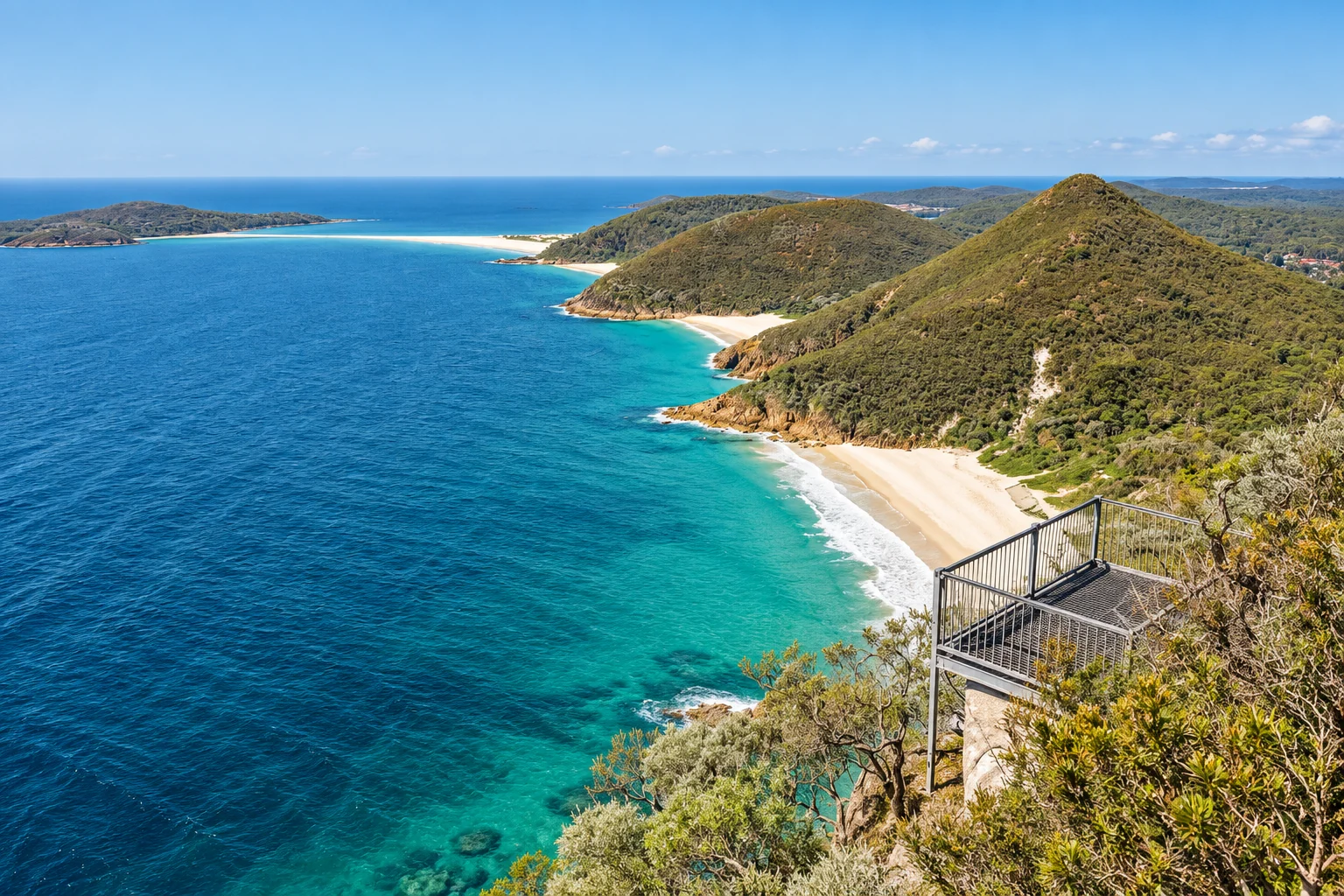

First-time visitors need three decisions: which month to travel, whether to watch from a lookout or a boat, and how to behave around the animals. NSW law sets minimum distances that apply to boats, kayaks, swimmers and drones, and the penalties apply to visitors as well as locals.
When whales pass the NSW coast
The season runs from May to November, and the month you choose decides which whales you see and how close they travel to shore.
Northbound humpbacks, May to July
Humpbacks head north toward their breeding grounds from May. Experience Oz describes May and June as the northbound months at Byron Bay, with July the peak and plenty of breaching (leaping out of the water) and tail slapping. Northbound whales tend to travel further offshore, so lookouts with high, wide views work better than low beaches.
Numbers build through June. An operator in Sydney, Whale Watching Sydney, places the busiest days, with hundreds of whales passing per day, around late June or early July. A first-time visitor who wants the highest number of passing whales should aim for the last week of June or the first half of July.
Southbound humpbacks, August to November
From late August the whales return south, and this is the better phase for families. Mothers travel with newborn calves, and they stay closer to shore than the northbound animals. Whale Watching Sydney reports the first southbound whales appearing in late August. Visit NSW names September as a peak month, and Byron Bay operator Sundive says September and October are the southbound months, with October running at full pace.
The timing shifts a little from north to south. Eden, on the far south coast, sees the whales travel north from May to July and south from August to November, with the most whales passing in September and October. Big4 gives Narooma northbound peaks in June and July and strong southbound viewing from September to November.
Some pages stretch the migration from April to December. Wikipedia’s Sydney entry gives that range, but cruise operators schedule trips from late May or June to the start of November. Plan for May to November. The months at either end of the season have fewer whales and fewer cruises.
Southern right whales
Southern right whales have their own pattern. NPWS says they are increasingly seen on the NSW coast from May to the end of November, with calving from June to August and mating in July and August. They shelter in protected bays and estuaries and sometimes come into the surf zone, so a calm bay can produce a sighting that an exposed headland would not. A Jervis Bay operator, Jervis Bay Wild, gives a shorter window of May to September for its own area, so check locally if southern rights are your priority.
Whales you might see
Plan around humpbacks, because they are the most common sighting from May to November and most tours are built around them. A humpback surfaces to breathe in a series of blows, may lift its long pectoral fins or tail, and sometimes launches its whole body out of the water. In peak weeks, a cruise or lookout visit usually sees several humpbacks.
The other species are possible, but their appearances are harder to predict.
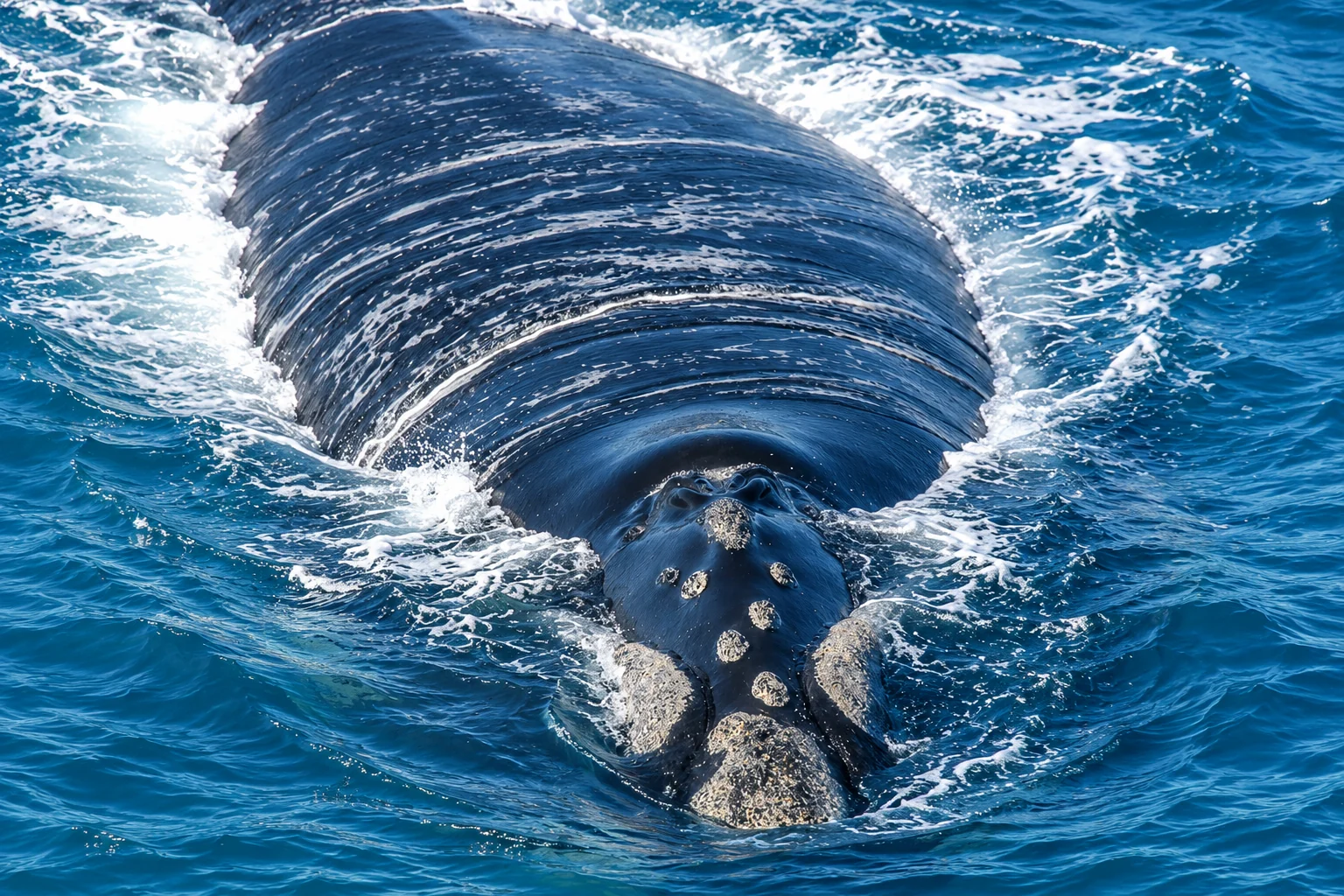
Southern right whales are easy to tell apart from humpbacks. NPWS describes a broad back with no dorsal fin, wide pectoral fins, a long arching mouth and rough patches of skin called callosities on the head. A newborn calf measures 5 to 6 m and weighs 1 to 1.5 tonnes. NPWS names Jervis Bay on the South Coast and Port Stephens on the Mid North Coast as good areas to look. Jervis Bay Wild reports that southern right numbers climbed for decades but that recent surveys suggest recovery has stalled, with calving rates falling. A sighting is a good one, and these animals are protected by the same distance rules as every other whale.
Bryde’s whales (pronounced "BROO-dus") drew a lot of attention on the far south coast in 2022. An ABC News report from August 2022 quoted a Merimbula operator, Sapphire Coastal Adventures, seeing four to five Bryde’s sightings on most trips in the previous month. The same report described a dwarf minke spotted off Eden. Whether Bryde’s whales live in NSW waters year-round is still unsettled, so treat them as a possible bonus on the south coast, particularly off Merimbula and Bermagui.
Minke whales are the smallest of the large baleen whales (the group that filters food through plates in the mouth instead of teeth). NPWS says they are not as plentiful as humpbacks, and they are more elusive.
Orcas (killer whales) are the largest members of the dolphin family. NPWS says you might be lucky to see one from a national park shoreline. Sightings are occasional.
Blue, fin and sei whales also migrate along the coast between May and November, according to NPWS. Wikipedia’s Sydney entry says all three are very rarely seen off Sydney. Visit NSW lists some of these animals as possible, while the Sydney-focused pages call them rare. Treat a blue whale as a lucky extra, not a reason to book a trip.
Sperm whales are present year-round, but the same Wikipedia entry says they usually stay beyond about 20 nautical miles offshore, well out of reach of coastal lookouts and standard cruises.
Free lookouts from Byron Bay to Eden
Shore viewing costs nothing and works well on the coast of NSW because headlands push out toward the migration route. Most of the best lookouts lie inside national parks. Park rules apply there, including the permission requirement for drones covered below.
North coast
NPWS’s list of top whale watching spots is the best starting point for the north. It names the North Head walking track at Brunswick Heads Nature Reserve, Cape Byron Lighthouse, the Walgun Cape Byron Information Centre and Broken Head, which has a picnic area and the Three Sisters walking track. It also includes Tallow Beach in Arakwal National Park, Palm Valley and Bawaii rest area in the Cape Byron State Conservation Area, Iluka Bluff lookout in Bundjalung National Park and the Broadwater Beach picnic area in Broadwater National Park.
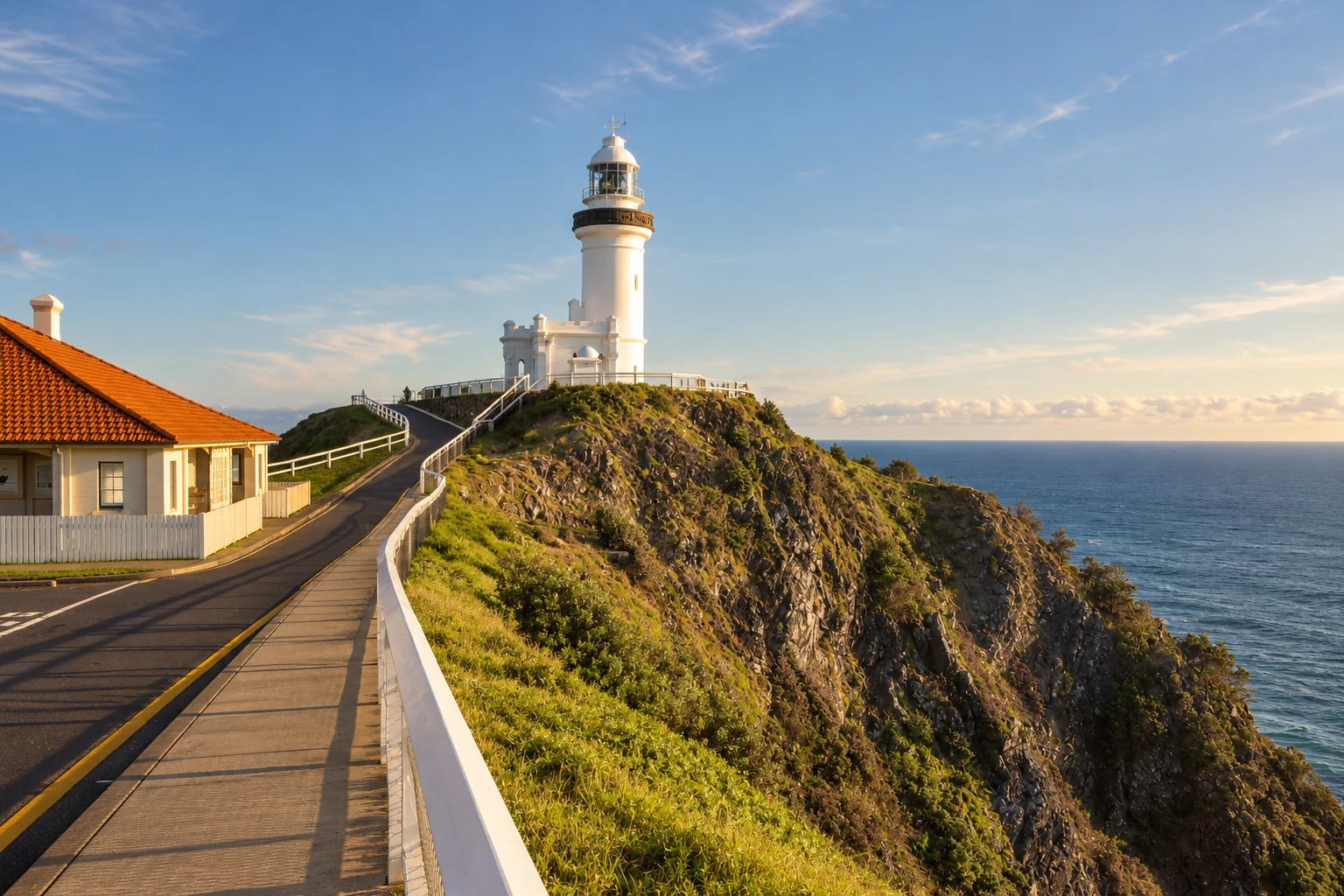
Cape Byron is the easternmost point of the Australian mainland, which puts it close to the migration path. Recorded sightings cited by Time Out Sydney include more than 6,000 at Cape Byron, which is the highest of the locations it compares.
Mid North Coast
In Hat Head National Park, NPWS lists Smoky Cape Lighthouse, the Smoky Cape picnic area, the Little Bay to Smoky Cape walk and the Green Island walking track. Big4 describes the lighthouse as a 360-degree vantage point for humpback, southern right and pilot whales. Further south, NPWS names the Cape Hawke lookout in Booti Booti National Park and, in Tomaree National Park, Point Stephens Lighthouse and Fingal Island. Port Stephens is also one of NPWS’s two named southern right areas.
Sydney
Sydney has easy options for visitors without a car or a long walk. NPWS lists Cape Solander in Kamay Botany Bay National Park, and recorded sightings there number 2,355 according to Time Out. In Sydney Harbour National Park, NPWS lists the Fairfax Walk, North Head, South Head, Hornby Lighthouse and the Arabanoo lookout. Time Out’s figure of 2,203 sightings covers the harbour and surrounding headlands.

Accessibility varies. NPWS says The Gap at South Head offers some of Sydney’s finest views and good opportunities for whale watching, and rates its accessibility as "Hard". For a gentler option, Trailhiking describes the Fairfax Walk at North Head as short, paved and wheelchair accessible, with two lookouts.
South Coast and Eden
Big4 names Murramarang and Meroo national parks near Batemans Bay as leading vantage points, and NPWS lists the Stokes Island picnic area in Meroo. Montague Island Nature Reserve has a walking track and lighthouse, and WWF Australia says visitors can reach the island by boat from Narooma. In Jervis Bay, Cape St George Lighthouse in Booderee National Park is one of the vantage points WWF Australia lists.
Near the Victorian border, NPWS lists the Green Cape lookout, Terrace Beach and the Bittangabee Bay to Green Cape walking track in Ben Boyd National Park. Trailhiking recommends the Light to Light Walk near Eden as a good site for the return migration, which runs from August to November.
Bring binoculars. Look for blows (the misty spout of exhaled air) first, because they show you where to focus. Go early in the day when the sea is flat, since wind chop makes blows harder to spot.
Shore or boat: what each gives you
A lookout is free and lets you stay as long as you like. A boat gives a much better chance of close views of breaching, tail slapping and mothers with calves. Cruises run through the whole season. Many visitors do both, spending one morning on a headland and one booking a cruise.

Boat cruises by region
Fares below are the operators’ own and apply to adults unless noted. Prices change, so check the fare when you book.
Byron Bay. Byron Bay Whale Watching charges A$139 for adults and A$129 for children aged 5 to 17. It runs daily from June to October and departs from The Pass. It takes a maximum of eight guests and lasts three hours in total, with up to two on the water. It carries marine scientist guides and a hydrophone, an underwater microphone for whale song. If the boat does not encounter humpbacks, the operator issues a voucher for another tour within the same year as the booking. Blue Seafaris lists A$125 for adults, A$115 for children under 12 and a family pass from A$345. Its price box on the same page says "from AUD $115", so confirm the current fare before paying. It departs from Brunswick Heads Boat Harbour and carries twelve guests, with a marine biologist on board. Passengers must be at least five years old. It offers a whale guarantee or free return.
Eden. The Eden cruise from Sydney Whale Watching is the cheapest listed: A$85 for adults, A$75 for seniors, A$65 for children, A$30 for infants and A$250 for a family of two adults and two children. The two-hour cruises leave at 9am, 12pm and 3:30pm seven days a week from late May to mid-November, with a whale guarantee and free cancellation.
Sydney and Port Stephens. Sydney Tour Guide lists Sydney cruise tickets at about A$85 per adult for roughly three hours. It also says Port Stephens operators guarantee a sighting between 1 June and 1 November or let you repeat the cruise free. Private day tours to Port Stephens or Jervis Bay start from A$1,350 for two guests, including transfer and a licensed guide. Sydney Spirit lists Circular Quay departures, a Port Stephens cruise to the outer island and a two-hour Jervis Bay whale cruise.
Reading operator claims
Guarantees, qualified guides and sighting rates are promises from the operator. No government accreditation scheme backs them. Sundive says its sighting rate is "well above 95%" on most trips from July to October, and Blue Seafaris cites more than 30,000 humpbacks migrating between May and November. Treat those figures as marketing and pay attention to the practical terms: what happens if no whale appears, whether cancellation is free and how many passengers share the boat. Smaller boats (eight or twelve guests) put you closer to the water, but they move more in swell. If you get seasick, choose a larger vessel or take medication before you go.
Distance rules that apply to you
NSW sets legal minimum distances under the Biodiversity Conservation Regulation 2017, and the NSW Environment and Heritage approach distances page is the governing reference. The distances depend on what you are doing and whether a calf is present.
- Boats, kayaks, surfboards and surf skis: keep at least 100 m from an adult whale and at least 300 m from a mother with a calf. The official page defines a vessel as watercraft that can be used as transport, including motorised or non-motorised boats, surfboards, surf skis and kayaks.
- Jet skis and other personal motorised watercraft: stay at least 300 m away at all times, according to an NPWS media release, whether or not a calf is present.
- Swimmers, snorkellers and divers: enter the water only when at least 100 m from a whale, and once in, stay at least 30 m away, including from a calf. The official page describes 30 m as about the length of a basketball court.
- Drones: keep at least 100 m from a marine mammal.
- Fixed-wing aircraft: 300 m, in a no-fly cylinder that moves with the animal.
- Mostly white animals: the official page says you must always stay at least 500 m from a whale, dolphin or dugong that is mostly white.
Two behaviours are banned regardless of distance. The official page says you cannot approach a marine mammal from behind or wait in front of it. Within 300 m, keep a slow, steady speed and minimal wash, as the NSW Marine Estate 2025 article advises. The government says getting too close can make whales divert or change direction. In July 2025 nearly 40 NPWS staff joined whale-watching cruises as part of Operation Ketos, reported by NewsCop. NPWS officers may ask you to move back beyond the minimum distance if an animal appears distressed, according to Pittwater Online News. Whales also come to you, and a calf may swim up to a stationary kayak. Keep the engine in neutral or paddle away steadily instead of chasing or reversing toward the animal.
Drones
Drone pilots face the most detailed rules. The NSW drone guidance requires permission to launch from or fly over a national park, which covers most headland lookouts. You must launch at least 30 m from people, keep the drone in sight, finish flights in daylight and never approach a marine mammal head-on or hover over it. A companion should watch for birds of prey. If one challenges the drone, return it to base and wait five minutes, then abandon the flight if the bird persists. The guidance warns of stiff penalties for breaking the law. Aviation rules for drones are published by CASA.
Farther offshore and reporting an animal in trouble
State rules cover coastal waters out to 3 nautical miles. Beyond that, the Australian National Guidelines for Whale and Dolphin Watching 2017 apply in Commonwealth waters. The Department of Climate Change, Energy, the Environment and Water summarises them. Vessels must not deliberately approach closer than 100 m, and must use caution and low speed within 300 m. They must also not touch or feed whales and dolphins.
If you see an injured, stranded or entangled animal, keep away from it, because the guidelines warn that disturbed or injured animals behave unpredictably. The guidelines list the ORRCA whale and dolphin rescue 24-hour hotline on (02) 9415 3333 and the NPWS State Duty Officer on (02) 9895 6444. The NSW drone guidance lists environment and national parks enquiries on 1300 361 967.
Key Takeaways
- Book for late June to mid-July or September to October: Northbound humpbacks peak from late June through July, and southbound whales with calves peak in September and October.
- Plan around humpbacks: They are the most common sighting from May to November, while orcas, blue whales, minkes and Bryde’s whales are possible bonuses.
- Try a free lookout first: NPWS lists headlands from Byron Bay to Ben Boyd National Park, and Cape Solander and North Head are easy options in Sydney.
- Budget about A$85 to A$139 for a cruise: Operators quote adult prices of A$85 at Eden, about A$85 in Sydney and A$125 to A$139 at Byron Bay, for cruises of two to three hours.
- Keep 100 m from whales in a boat and 300 m from a mother and calf: Swimmers must enter the water 100 m away and stay 30 m off. Jet skis stay 300 m away, and drones stay 100 m away.