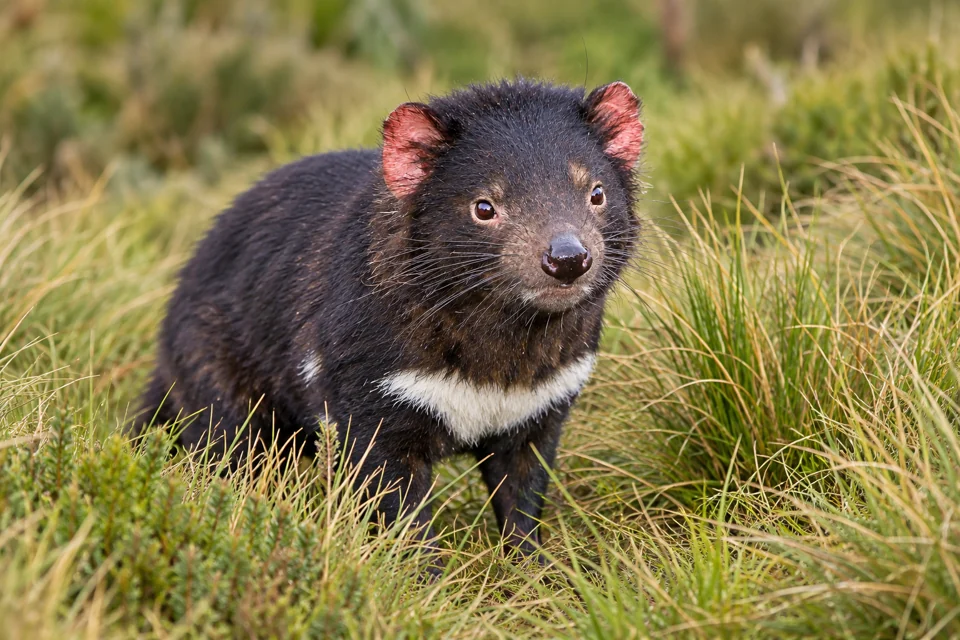
The Tasmanian devil is a stocky, black marsupial carnivore that lives in the wild only on the island state of Tasmania. A sanctuary visit with a keeper is the most reliable way to see one. Wild devils are mostly nocturnal and solitary, so a night drive through national park country offers a chance, but not a sure sighting.
Devils are also the subject of one of Australia’s long-running conservation efforts. Devil facial tumour disease (DFTD), a fatal cancer that spreads between devils through biting, has cut local populations by up to 80%. Several sanctuaries hold devils from the breeding program set up in response, so a sanctuary visit also connects to that conservation work.
Seeing devils in the wild
Devils live in forests and coastal heathlands in the eastern half of Tasmania and along the north-west coast. Cradle Mountain–Lake St Clair National Park is a popular area. The Central Plateau Conservation Area, part of the Tasmanian Wilderness World Heritage Area, is another stronghold, where devils rest in dense scrub during the day.
Early-evening walks through national park corridors give the best odds, along with slow night drives around Cradle Mountain and the north-east, watching for eye-shine just after dark. Tourism Tasmania describes guided night tours as the best way to see devils in the wild. Because the animals are shy and nocturnal, a sighting is not guaranteed, and that is why many tour operators include a sanctuary stop.
Driving slowly after dark is also a conservation measure. Vehicle strikes are, alongside disease, a main threat to the species, and the state’s roadkill project exists because of it (covered below).
Devils@Cradle at Cradle Mountain
Devils@Cradle is a breeding and conservation facility for Tasmanian devils, spotted-tail quolls and eastern quolls. It sits about 500 m before the national park entrance, so it fits easily into a day at Cradle Mountain. Entry does not require a Tasmanian National Park Pass.

The sanctuary is open every day except Christmas Day. The recommended last General Entry admission is 4.30pm. There is onsite parking for cars and campervans, and campervans over 12 m must contact the sanctuary first. No pick-up or drop-off service operates, so visitors need their own transport or a tour that stops there.
The site is outdoors and at altitude. The operator gives average highs of about 18°C in summer and average lows of about 5°C in winter, with frequent rain, snow and wind, so waterproofs and warm layers suit every season. Wheelchair access is available through reception or a side gate, but the grounds include uneven ground, steps, woodchip paths and platforms, so some areas are not accessible. Accessible toilets are provided. Visitors with assistance animals must contact the sanctuary at least 48 hours ahead.
Tours, times and prices
The table shows prices in AUD from the operator’s admission page, last modified 30 April 2026. Check that page before booking, since prices and session times change. Booking is through the link on the same page, and private tours are arranged by email to info@devilsatcradle.com.
| Experience | Times | Adult | Child | Senior/Student | Family |
|---|---|---|---|---|---|
| General Entry and Day Keeper Tour | 9.30am to 5pm daily; Day Keeper tour at 10.30am and 3pm | $27.50 | $15 | $22 | $80 |
| Day Feeding Tour | 1pm daily | $40 | $20 | $32 | $110 |
| Joey Encounter | 12pm (October to April) and 4pm daily | $75 | $50 | not listed | not listed |
| After Dark Feeding Tour | 5.30pm daily; 8.30pm in summer school holidays only | $40 | $20 | $32 | $110 |
| Sunset Experience | 7pm daily (October to April) | $99 | $75 | not listed | not listed |
| Dessert With The Devil | 7pm daily (May to September) | $99 | $75 | not listed | not listed |
The family prices above are for two adults and two children. The operator applies family pricing to other group makeups too, and its page lists the exact figures.
According to the visitor information page, General Entry allows about 45 minutes and the Day Keeper Tour runs 45 minutes. The Day Feeding Tour takes 1 hour and the Joey Encounter 45 minutes. The After Dark Feeding Tour, Sunset Experience and Dessert With The Devil each take 1 hour 15 minutes.
The sunset and dessert experiences cost the most. The Day Keeper Tour comes with General Entry at no extra cost, and is the cheapest way to hear from a keeper. Anyone who wants to watch devils in their most active hours should choose a feeding tour, because devils are nocturnal and the After Dark Feeding Tour runs when they are on the move.
Bonorong Wildlife Sanctuary near Richmond
Bonorong is the southern option. Tourism Tasmania places it near Richmond, about 30 minutes from Hobart, and describes it as open daily with keeper-led sessions that include feeding. The sanctuary offers devil sightings through those sessions, which makes it a practical half-day trip from the capital and a good pairing with the historic village of Richmond.
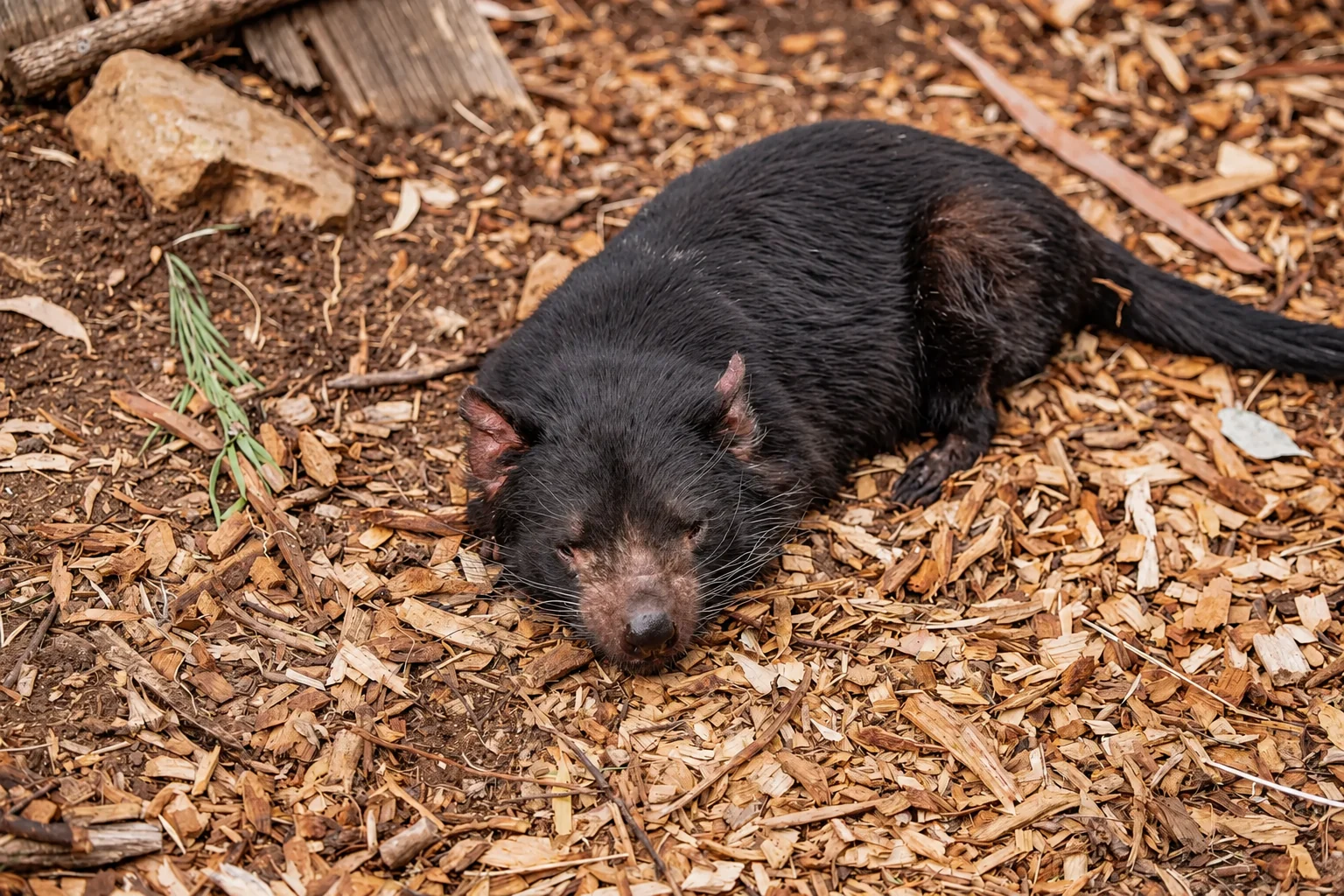
Bonorong runs a devil talk and concentrates on protection, rehabilitation and breeding of endangered devils, eastern quolls, Tasmanian pademelons and Tasmanian bettongs. It also runs guided night-feeding tours and a DFTD-free breeding program. Admission prices and session times change, so confirm them on the sanctuary’s own website before travelling.
Other sanctuaries around Tasmania
Tasmanian Devil Unzoo, Tasman Peninsula
Discover Tasmania describes the Tasman Peninsula property as the world’s first "unzoo", with almost no fencing so animals can come and go. It offers devil feedings by day and a 4WD Devil Tracker Tour by night, which uses infrared night cameras in nearby native forest. This suits visitors already heading to Port Arthur and the peninsula who want an open-range setting.
Trowunna Wildlife Sanctuary, Mole Creek
Trowunna is in northern Tasmania at Mole Creek and has 70 acres of natural habitat. Tours include 45-minute interactions with wombats and devils, a half-day Trowunna Experience that covers conservation efforts, and a junior ranger Joey Club for children. The park has cared for native animals for over 30 years. In 2016 the ABC reported more than 60 devils held at the park as part of the insurance population. It is a convenient stop between Launceston and Cradle Mountain.

East Coast Natureworld, Bicheno
On the east coast, East Coast Natureworld covers 150 acres and includes Devil World, which focuses on the devil breeding program and offers interactive activities. It suits travellers working their way up or down the Freycinet and Bicheno coast.
Tasmania Zoo and Maria Island
Tasmania Zoo is named in travel lists as another place to see devils. Maria Island, off the east coast, carries a free-roaming population of disease-free devils that the Tasmanian Government manages as part of the conservation program, and one travel guide describes them as an insurance population. Maria Island is better known for its other wildlife, so treat any devil sighting there as a bonus.
Choosing where to go
Match the sanctuary to the route. Visitors based in Hobart have Bonorong close by and the Unzoo on the Tasman Peninsula. Those on the north-west circuit can combine Devils@Cradle with the national park walks. Travellers moving through the north have Trowunna at Mole Creek, and those on the east coast have Natureworld at Bicheno.
Daytime visits show devils resting or being fed by keepers, while evening sessions give a better sense of how the animals behave after dark, which is when they hunt and scavenge. If the goal is a wild encounter, plan an evening in national park country and book a sanctuary visit as a fallback. A slow night drive in the north-east or around Cradle Mountain offers the chance, and a sanctuary gives a reliable encounter.
What devil facial tumour disease is
The Tasmanian Government defines DFTD as a fatal condition in Tasmanian devils characterised by obvious facial tumours. The tumours usually develop in the mouth and on the head and neck. Death comes when the cancer spreads through the body, and some devils starve because the tumours limit their ability to eat.
The disease is unusual because it is contagious. An infected devil that bites an uninfected one on the face, which is common during mating and feeding, transfers living cancer cells from its mouth into the wound. It is one of only a handful of known transmissible cancers, and research points to a single originating devil.
The first recorded case was in 1996, in an animal from Mount William National Park in the north-east. A retrospective estimate puts the onset earlier, around 1986. The main strain, DFT1, infects most of the population. A second strain, DFT2, was first detected in 2014 and is limited to southern Tasmania near the D’Entrecasteaux Channel.
How far the decline has gone
The Tasmanian Government reports that where DFTD has been observed for several years, populations have declined by up to 80%. It calls the figure approximate because recent sample sizes are low, and says there is no evidence to date that the decline has stopped or that disease prevalence is falling. The 80% figure refers to local populations. Its annual monitoring project tracks populations as the disease spreads.
Earlier federal conservation advice recorded DFTD at 38 locations across central and eastern Tasmania. The disease has since moved further west. According to Australian Geographic in January 2026, the national population is about 15,000 devils, down slightly from 17,000 in 2021, and the magazine projects the decline to level off around 2030 at about 12,000. It reports that DFTD has caused declines of up to 80% in some areas but has never caused a local extinction. A researcher quoted in the article attributes the continuing decline to the tumour only recently reaching the west coast, where devils have no history with the disease, and expects western populations to recover.
The IUCN Red List lists the Tasmanian devil as Endangered, with disease and vehicle strikes as the main threats.
Resistance, tumour regression and vaccines
Some devils are resisting the disease. Tumour regression was seen in some animals in the early 2000s and is now becoming more common. Some devils, mostly in the north-west, are genetically different enough that their bodies recognise the cancer as foreign, and the ABC reported in 2016 that devils may be developing resistance. The draft recovery plan notes that low diversity in devil MHC genes, which govern immune recognition, may be one major reason the disease has spread so widely. A diagnostic blood test was developed in mid-2009.
Vaccines remain in research and are not in general use. Field immunisation trials took place in 2015 and 2016 as part of the Wild Devil Recovery project. In a 2020 preprint, which has not been peer reviewed, 52 devils were vaccinated with an experimental DFT1 protocol and released at Narawntapu National Park and Stony Head on the north coast. Nearly all produced anti-DFT1 antibodies. A 2022 preprint, also not peer reviewed, reports that the earlier field vaccine trials increased immune recognition of tumours, yet the vaccinated devils still developed them. In captive trials, priming healthy devils with a vaccine and then giving immunotherapy after tumours developed produced complete tumour regressions.
The Save the Tasmanian Devil Program
The Save the Tasmanian Devil Program (STDP) was established in 2003 as an initiative of the Australian and Tasmanian governments, after a national workshop of specialists on the decline of devils. Its vision is an enduring and ecologically functional population of devils in the wild in Tasmania. Its current actions are maintaining a captive insurance population, managing a wild population on Maria Island, and monitoring and managing wild devils and their habitat. The program has moved to a new phase focused on recovery in the wild, and DFTD continues to spread through wild populations.
Federal advice also recommends preparatory work for island introductions and roadkill mitigation in key populations such as those in national parks. It established a Devil Disease Project Team, which brings together veterinary pathologists, wildlife biologists and management specialists. The STDP’s Tasmanian Devil Roadkill Project aims to identify roadkill hotspots, consider mitigation, monitor the spread of DFTD and devil persistence, and reduce roadkill.
The insurance population and Devil Ark
The insurance population is a managed group of healthy devils kept in captive facilities and free-range enclosures. A scientific paper reports that it held over 600 devils across Australia. The aim is to retain genetic diversity until the risk of extinction has passed, to repopulate the wild if local extinctions occur, and to supplement wild populations at risk of inbreeding. Several sanctuaries a visitor can enter, including Trowunna and Devils@Cradle, belong to this network.
The Tasmanian draft recovery plan sets a breeding target of 500 for the insurance population. It records a 2007 calculation that the captive population would need to reach 1,500 if all animals were intensively managed and up to 5,000 if all were free-living, and it notes that existing captive facilities would quickly reach their capacity of about 250. The cost is a drawback. A 2022 preprint says indefinite maintenance of a captive insurance population is costly and that introduced devils can have negative effects on native fauna on islands, so it argues for alternative strategies to recover wild populations.
Part of the insurance population lives on the mainland. Devil Ark, in Barrington Tops, New South Wales, is an initiative of the Australian Reptile Park. It opened in 2011 with 44 founder devils and later bred its 300th joey. The facility now holds around 150 devils, more than half of the mainland’s insurance population, and is described as mainland Australia’s most successful captive breeding facility for devils. In November 2015 Devil Ark began releasing its first batch of 22 devils back to Tasmania.
Summary
- Book a sanctuary for a reliable sighting: Devils@Cradle near Cradle Mountain and Bonorong near Richmond run keeper-led sessions. Devils@Cradle prices were current to its 30 April 2026 update, so check the operator’s page before booking.
- Treat wild sightings as a bonus: Devils are nocturnal and solitary. Slow night drives and early-evening walks around Cradle Mountain, the north-east and the Central Plateau give the best chance of a sighting. Slow driving also protects devils from vehicle strikes.
- Understand what DFTD does: The disease is fatal and spreads when devils bite each other. It has caused local declines of up to 80%, and the Tasmanian Government has no evidence yet that the decline has stopped.
- Read population figures with their source and date: Australian Geographic gave about 15,000 devils in January 2026, down from 17,000 in 2021, with a projected levelling off around 2030. These are magazine figures rather than an official government count.
- Know that the safety net is captive breeding: The insurance population of over 600 devils, including Devil Ark’s mainland group, exists to restock the wild. Vaccines are still in research: field trials have produced antibodies but not protection from tumours.