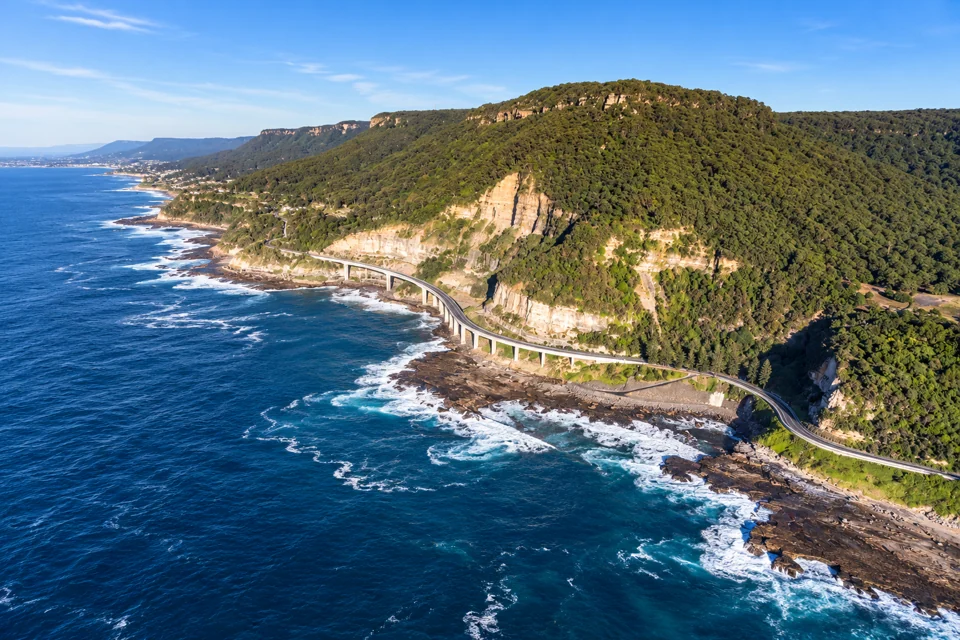
Driving between Sydney and Melbourne, you have two main routes to choose from. The Hume Highway runs inland for about 870 to 875 km and takes at least nine hours. The Princes Highway follows the coast for roughly 1,032 to 1,040 km and takes 12 to 13 hours of driving, so it needs several days. The Hume suits a fast, direct trip. The coast suits drivers who want beaches, forests and small towns along the way.
The two routes are compared on stops, trip length, accommodation, road conditions, seasons, fuel, safety and one-way vehicle hire.
Hume and Princes Highway compared
| Route | Distance | Driving time | Character |
|---|---|---|---|
| Hume Highway (M31) | 870 to 875 km | At least 9 hours | Dual carriageway, most direct |
| Princes Highway (coastal) | 1,032 to 1,040 km | About 12 to 13 hours | Follows the coast, mostly two lanes outside freeway sections |
The Hume Highway is listed at 870 km, and the Sydney to Melbourne driving guide gives 874 km. The distance varies slightly with the start and end points and with the detours included.
Two inland variations exist. One runs via Canberra and the Monaro Highway, which you can reach from the coast by turning off the Princes Highway onto the Kings Highway just before Batemans Bay. The other uses the Olympic Highway between Albury and Sydney via Cowra and Bathurst. A longer inland route through the Snowy Mountains is described as about 1,100 km and about 14 hours. That route is the only one that brings alpine road rules into play, covered under seasons below.
Hume Highway distance and driving time
The RACV says the Hume takes at least nine hours between the two cities (page dated 10 June 2025). At the speed limit, the Wikivoyage guide puts it at at least 10 hours. Once you add fuel, meals and traffic, a realistic day on the road is 10 to 12 hours, against about nine hours non-stop.
That makes Sydney to Melbourne on the Hume a single very long day, and most drivers split it with at least one night on the road. The highway is dual carriageway for its whole length, according to the route guide, with frequent service centres.
Princes Highway driving times
A Sydney to Melbourne drive guide breaks the coast into five legs:
- Sydney to Kiama: 123 km
- Kiama to Ulladulla: 105 km
- Ulladulla to Eden: 251 km
- Eden to Lakes Entrance: 242 km
- Lakes Entrance to Melbourne: 319 km
Together these come to 1,040 km and about 12 to 13 hours without sightseeing. Another guide estimates a straight drive at about 12 hours at the speed limit. Eden sits about 550 km from Sydney, and the Victorian border is about 515 km from Melbourne.
A side trip from Eden to Mallacoota in Victoria adds 85 km each way.
Best stops on the Hume
Driving south from Sydney, the RACV lists these towns in reverse order: Bowral, Goulburn, Gundagai, Tarcutta, Holbrook, Albury-Wodonga, Wangaratta, Glenrowan, Benalla and Seymour.
Gundagai is the natural overnight stop. Wikivoyage calls it a "good halfway point", and it has the Dog on the Tucker Box. Holbrook has a dry-land submarine, and Canberra is a worthwhile detour for a longer break.

On the Victorian side, the first few stops each have a clear reason to pull over:
- Glenrowan is Ned Kelly country, with the Ned Kelly Museum, "The Big Ned Kelly" and the Warby Falls Heritage Trail.
- Benalla has the Benalla Art Gallery overlooking Lake Benalla, the Benalla Aviation Museum, and the nearby Winton Wetlands.
- Seymour has the Goulburn River Trail and the Seymour Railway Heritage Centre, close to the Melbourne end of the drive.
Best stops on the coast
Sydney to the Shoalhaven
The coast starts inside Sydney’s southern edge. Royal National Park has Audley Weir, Wattamolla and Garie Beach, and the guide warns that Audley Weir is sometimes flooded after heavy rain, in which case the Waterfall entrance works instead. The Grand Pacific Drive runs from Stanwell Tops to Austinmer over the Sea Cliff Bridge. At Kiama, the blowhole is the headline attraction, and the Minnamurra Rainforest is nearby.
Further south, Jervis Bay brings Huskisson and Hyams Beach. Ulladulla and Mollymook are surf towns.
Eurobodalla and the Sapphire Coast
Batemans Bay is known for oysters. Just beyond it, Pebbly Beach and South Durras are known for kangaroos, and Mogo Zoo is close by. At Narooma you can see seals and dolphins, and Montague Island offers an overnight stay.
Merimbula and Bega follow, with a cheese factory in Bega. Eden is the best-equipped stop for wildlife and history, with whale watching, the Killer Whale Museum, the Marine Discovery Centre and the Green Cape Lighthouse.

Gippsland and Victoria
After the border, Mallacoota (prawning), Buchan Caves and clifftop camping are the usual detours. The highway then passes Lakes Entrance, Bairnsdale, Sale, Traralgon, Morwell and the Yallourn Power Station before reaching Melbourne. Walhalla, Wilsons Promontory and Phillip Island appear among the headline destinations of longer itineraries.

How many days to allow
The Hume works as one long day. Adding stops for Gundagai, Holbrook and a Victorian town turns it into a full day of driving with breaks, and many drivers prefer to split it over two days with a night in Gundagai.
For the coast, a two-day trip with one overnight is possible, but Wikivoyage recommends at least four days to enjoy the South Coast. A five-day plan with overnights at Kiama, Ulladulla, Eden and Lakes Entrance matches the legs above, keeping each day’s drive manageable.
Slower itineraries spend more time in each area. One suggests one day at Lakes Entrance, one to two days at Eden, and two days each at Batemans Bay and Jervis Bay. Another offers 3-, 5-, 7- and 14-day options. Picking a length comes down to whether you want to see the coast from the car window or stop to swim, walk and tour.
Where to stay
On the Hume, Gundagai is the standard halfway night. On the coast, Eden is roughly halfway and suits an overnight stop. Other natural bases are the five overnight points of the five-day plan: Kiama, Ulladulla, Eden and Lakes Entrance. Narooma is the base for an overnight on Montague Island.
Summer fills the coast. Wikivoyage warns that many accommodations are fully booked then, and the coastal itinerary advises booking ahead for December to February. The same itinerary estimates about $60 to $100 per day for camping and $250 to $500 per day for cabins plus dining, so the style of accommodation sets most of the budget.
Road conditions
The Hume has a simple profile: dual carriageway throughout, with service centres at regular intervals. The coast changes character along the way.
Starting in Sydney, the Princes Highway is six-lane divided through the southern suburbs, then four-lane dual carriageway along the western edge of Royal National Park. The Princes Motorway (M1, 55 km) runs parallel to Bulli Pass and carries most traffic. From Oak Flats it is mostly freeway-standard dual carriageway, except for the Kiama bends at Kiama Heights. The Berry bypass has steeper gradients. Through Bomaderry and Nowra the road is four-lane divided, and a four-lane single carriageway runs for about 4 km from Forest Road to Jervis Bay Road.
South of Jervis Bay Road the highway is mostly a single two-lane road through Ulladulla, Batemans Bay (which has a 1 km dual-carriageway town-centre bypass), Moruya, Narooma, and the Bega and Merimbula bypasses. In practical terms, freeway-grade stretches run from Sydney to Nowra and from Traralgon to Melbourne. The rest has occasional passing lanes, which is slower than the Hume.
The 185 km from Eden to Orbost is the remotest stretch, winding through national and state parks. Between Bairnsdale and the New South Wales border the highway is single-lane in many sections with tight bends through hilly terrain, and Lakes Entrance to Eden takes about three hours without stops, longer behind trucks. The route is sealed and well signed, and a standard 2WD car handles it.
Seasons and snow chain rules
Summer, from December to February, is the busiest period on both routes. Wikivoyage suggests spring or autumn as often the best time for the coast. The coastal itinerary also notes March to May for prawning and fewer crowds, and September to November for whale watching.
Snow only matters if you detour through the Snowy Mountains. In New South Wales, all 2WD vehicles must carry snow chains between the June and October long weekends on three roads in Kosciuszko National Park, as set out in a NSW Government media release:
- Kosciuszko Road, from the park boundary at Thredbo River to Perisher Valley
- Alpine Way, between Thredbo and Tom Groggin
- Island Bend/Guthega Road, within the National Park boundary
Chains are recommended, though not compulsory, on Alpine Way between Jindabyne and Thredbo and on the Snowy Mountains Highway. For 4WD and AWD vehicles, NSW National Parks says the former RMS recommended chains in extreme weather. The same page lists winter closures between the June and October long weekends:
- Swampy Plains Creek Road and Tooma Road (Khancoban to Cabramurra)
- Kings Cross Road and Khancoban to Cabramurra Road
- Long Plain Road and Tantangara Road, beyond the dam wall
National Parks says the closure period may be extended and recommends contacting the Tumut Visitor Centre. These rules apply to the named park roads and do not extend to the Hume Highway corridor. Alpine closures can happen at short notice because of severe weather, snow, ice or rockfalls, and Live Traffic NSW is the place to check current closures, conditions and incidents.
Fuel and rest stops
On the Hume, the first fuel stop out of Sydney is about 50 km along at Pheasants Nest, followed by about 70 km to Sutton Forest and an average of about 100 km between stops after that. The route guide lists frequent fuel and food sites at Pheasants Nest, Marulan, Gundagai, Tarcutta and Barnawartha North.
The coast is less predictable. Services on the Eden to Orbost section are scattered, so fill up in Eden or before leaving a larger town rather than waiting for the needle to drop. In the Snowy area, the nearest fuel and supplies on the Khancoban section are at Khancoban and Tumbarumba.
For breaks, the RACV advises a 15-minute rest stop for every two hours of driving. The NSW Rest Area Map covers rest areas managed by Transport for NSW, councils and the National Parks and Wildlife Service, and can be filtered by facilities such as toilets and BBQ areas. Transport for NSW says 673 highway rest areas sit along NSW road corridors, and rest areas were added to the Live Traffic website and apps in 2024.
Safety on the road
Speed cameras, both mobile and fixed, are common on the route, and highway patrols are frequent. Wildlife is the main hazard after dark, and the Wikivoyage guide considers daytime driving much safer for avoiding kangaroo collisions. Plan to arrive at your overnight stop before dusk, particularly on the coastal two-lane sections.
Fatigue is the other risk on a long day. Transport for NSW reports that in the years to 2024, 42 fatigued heavy-truck drivers were involved in fatal crashes and 207 in serious-injury crashes, and it ranks fatigue among the top three behavioural factors in serious heavy-truck crashes in NSW. The figures cover heavy vehicles, but they support the same approach for any driver on the Hume: regular breaks and a split into two days.
One-way vehicle hire
Driving one way means picking up in Sydney and dropping off in Melbourne, which suits both routes. Operators set a one-way fee that varies by pick-up and drop-off location and vehicle availability, and the fee shows during online booking. A comparison guide says a typical one-way car on major city-to-city routes costs two to three times as much per day as a return hire. An aggregator lists a one-way fee range of $0 to $2,985 for Sydney to Melbourne, which is indicative only. Book in advance, and compare pick-up points in both cities, since the fee changes with the locations.
Operator terms differ:
- Redspot offers one-way hire between NSW and Victoria with drop-off 24/7 unless specified. Sydney branches include Mascot, Sydney Domestic Airport and Sydney International Airport. A small relocation fee may apply. The minimum driver age is 21, drivers under 25 pay a daily surcharge, and you need a valid licence and a credit card.
- Sixt sets a minimum age of 21 with a licence held for at least one year, and a surcharge applies to drivers under 25. Some vehicle types need age 25 or older. One-way rentals between Sixt stations depend on the tariff, and the Melbourne branch page says one-way rental from Melbourne requires prior approval and may carry a fee.
- Budget offers one-way hire at selected times of the year. Its default renter age field is 25 or over, restrictions and fees may apply under 25, and you can phone 1300 362 848. Its Australian terms and conditions are published as a PDF.
Drivers under 25 should add the age surcharge to the one-way fee before comparing quotes.
Key Takeaways
- Choose the Hume for speed: At about 870 to 875 km and at least nine hours of driving, it is a long single day or an easy two days with a night in Gundagai.
- Allow at least four days for the coast: The Princes Highway runs about 1,032 to 1,040 km and 12 to 13 hours of driving, and a five-day plan with overnights at Kiama, Ulladulla, Eden and Lakes Entrance keeps each day manageable.
- Book summer accommodation early: December to February fills the coast, while spring and autumn are quieter, and March to May suits prawning and September to November suits whale watching.
- Refuel before the Eden to Orbost section: The 185 km stretch has scattered services, and the road is winding and remote.
- Check one-way fees and age rules before booking: Fees vary by pick-up and drop-off location, and minimum ages of 21 or 25 and under-25 surcharges apply depending on the operator.