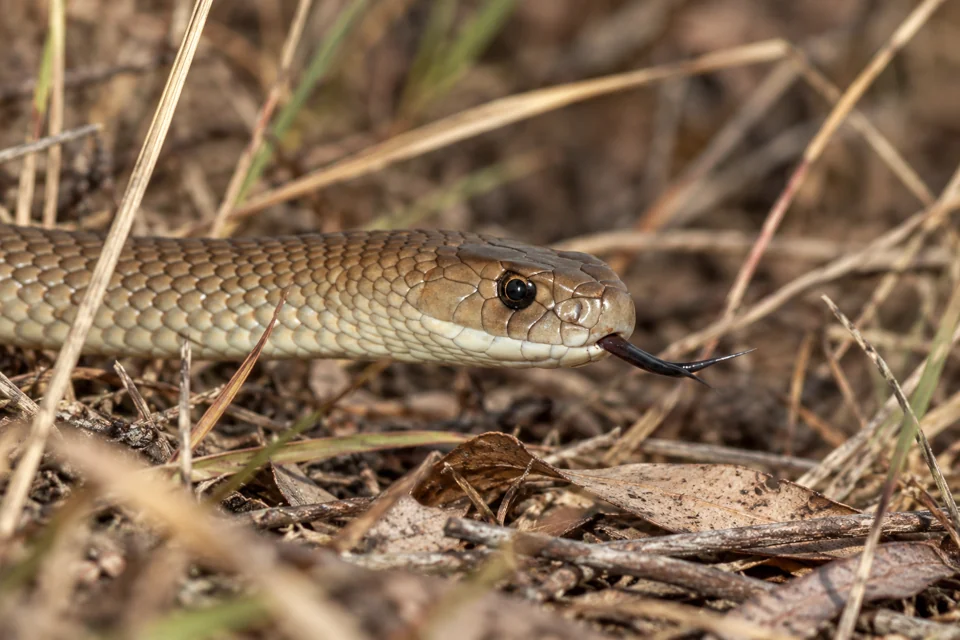
Australia has more than 130 species of elapids, a family of venomous snakes that includes every medically significant land snake in the country and all the sea snakes. Bites are uncommon, and most people never meet a dangerous snake at close range. Snakes do live in suburban backyards, farmland and bushland, though, so residents and visitors should know which snakes carry dangerous venom, where they shelter, and how to behave around them.
Leave any snake alone, and wear closed shoes and long pants in grass or bush. Treat every suspected bite as an emergency: call 000, apply a broad pressure bandage over the bitten limb, and keep the person still. Do not try to catch or kill the snake. Some of the advice differs by state.
Which snakes are venomous
A 2013 review of Australian elapid venoms counts at least 130 elapid species in Australia, sea snakes included. It places 26 genera among the land elapids. Five genera are rated the most medically significant, meaning the danger they pose to a person through a bite:
- death adders (Acanthophis)
- tiger snakes (Notechis)
- black snakes (Pseudechis), which include the king brown (also called the mulga snake)
- brown snakes (Pseudonaja)
- taipans (Oxyuranus)

The same review notes that bites from many small Australian elapids are far from medically significant. That statement applies to the group as a whole and gives no basis for handling an unidentified snake casually.
The national first aid guideline from the Australian and New Zealand Committee on Resuscitation, ANZCOR Guideline 9.4.1, names taipans, brown snakes, tiger snakes, death adders, black snakes, Rough-scaled snakes and many sea snakes as capable of lethal bites. Victoria’s wildlife authority says most Victorian snakes are elapids, that all elapids are venomous, and that even very young, small snakes can deliver a lethal bite.
Australia has harmless snakes as well as venomous ones, and the two are hard to tell apart. The Queensland Department of Education therefore advises that every bite is treated as dangerous. A colour or pattern is an unreliable guide at the moment someone is bitten.
Where snakes live
Snakes live wherever there is cover and food, and that includes suburbs. State agencies describe the same hiding places repeatedly: holes in the ground, rock crevices, fallen logs and long grass. Around houses they use rubbish piles, leaf litter, wood piles, sheets of iron, rock piles, compost bins and sheds. Rats, mice and frogs draw snakes to a property, so a yard that supports rodents is more likely to attract them.
Snakes often pass through backyards on their way to another habitat, so a sighting does not always mean one is living on the property. Many snakes are also active after dark, which matters for night walks and camping.
Snakes in South Australia
Environment SA gives a regional breakdown, updated on 20 September 2024:
- Brown snakes are found across much of the state, and most of them are venomous.
- Red-bellied black snakes turn up around the Adelaide Hills, the Fleurieu Peninsula and the lower River Murray.
- Tiger snakes inhabit Kangaroo Island, coastal areas and the Limestone Coast.
- Mulga snakes range across the Eyre Peninsula, the far west coast and northern South Australia.

Snakes are protected native animals under South Australian law, so killing one is illegal, even in a backyard. Visitors who stay on marked trails in national parks and reserves avoid most snake habitat.
Snakes in Victoria
Victoria’s wildlife authority says snakes turn up in ordinary backyards. Its fact sheet recommends keeping grass short, clearing wood piles, sheets of iron and rock piles, and screening doors and windows to block entry points. The same sheet notes that snakes may hibernate in compost bins or leaf piles over winter.
Snakes are protected under the Wildlife Act 1975, and capturing, harming, disturbing or killing them is illegal. Anyone who needs a snake removed uses a licensed snake controller, covered below.
Snakes in Queensland and the outback
Queensland Health’s advice for householders focuses on keeping yards unattractive to snakes by mowing the lawn and clearing rubbish. It also recommends teaching children never to touch a snake.
The Royal Flying Doctor Service, in its outback survival advice, tells walkers to use a torch at night and to remember that snakes hide in ground holes and rock crevices. Mobile coverage in remote areas is patchy, which is why carrying wide elastic bandages and a charged phone matters on outback trips.
Snakes in Western Australia
Royal Life Saving Society WA says snakes often shelter in rubbish piles or leaf litter in winter and emerge when the weather warms. Injury Matters WA’s KnowInjury snakebite toolkit recommends long pants, sturdy enclosed footwear and watching the ground ahead as you walk.
National data point to the west and south. During the project’s data period, Western Australia and South Australia recorded the most fatal stings and bites from all venomous creatures. Tasmania recorded none.
Which months carry the most risk
Data from the Australian Venomous Injury Project found bites and stings were most likely between April and October. The KnowInjury toolkit still warns that snake bites happen at any time of year. Warm spells in winter bring snakes out of shelter, so a mild day in July calls for the same care as a summer afternoon.
Avoiding bites
Most bites occur when people try to catch, kill, move or touch a snake. Royal Life Saving WA and Environment SA both give this as the main cause, so the main step is to leave the animal alone and keep your distance. Snakes are generally shy and will not attack unless provoked.
Most accidental bites are to the lower limbs, so footwear is the best protection. The ABC’s guidance from a bitten snake professional calls wearing shoes one of the best ways to prevent a bite. South Australian, Victorian and WA advice agrees: wear long pants and sturdy, enclosed footwear in bushland and grassy areas.
On the track, make some noise as you walk so snakes have time to move away. Also look ahead at where you are stepping, and carry a torch after dark. Victoria also recommends carrying wide elastic bandages and a charged mobile phone when walking.
At home, take away the shelter and food that attract snakes. Mow regularly and remove rubbish, wood piles, sheets of iron and rock piles. Control rodents and clean up after poultry. Screen doors and windows, and block gaps that give snakes a way into the house. Children should learn early never to touch a snake.
Recognising a snakebite
A bite can be painless and leave no visible mark. ANZCOR says there is often only a single fang or scratch mark, and localised redness and bruising are uncommon. The warning signs that follow are:
- headache, nausea and vomiting, and abdominal pain
- blurred or double vision, or drooping eyelids
- trouble speaking, swallowing or breathing
- swollen, tender glands in the groin or armpit of the bitten limb
- weakness or paralysis of the limbs, and weakness of the breathing muscles
Brown snake bites sometimes cause an initial collapse or confusion followed by apparent recovery. ANZCOR notes this may be the only sign of envenomation, and it is useful information to pass to the treating clinician. Anyone who thinks they may have been bitten gets first aid even when they feel well.
First aid with a pressure bandage
ANZCOR’s four recommendations apply to adults, children and infants: send for an ambulance, keep the person still, reassured and under constant observation, apply pressure bandaging with immobilisation, and start CPR immediately if sudden collapse with cardiac arrest occurs. The reasoning is that most venom reaches the blood through the lymphatic system, and a pressure bandage with immobilisation slows lymph flow. The guideline acknowledges that the correct pressure is difficult to achieve, but supports the method for snakes encountered in the wild in Australia. Laboratory research it cites shows very little venom reaches the circulation, even after hours, when the bandage goes on immediately and stays on.
In practice the steps run in this order:
- Call 000 for an ambulance. In areas with poor mobile reception, the Flying Doctor says to dial 112. Make the call straight after bandaging and immobilising the limb.
- Keep the person calm, lying down and still. Moving about pushes more venom into the bloodstream, as Queensland Health warns.
- Apply a firm, broad bandage over the bite site as soon as possible. Then wrap the whole limb, starting just above the fingers or toes and moving upward as far as possible. ANZCOR 9.4.8 sets out the technique in full.
- Splint the limb so it cannot move. Any stiff object works, such as a piece of wood, a branch or rolled newspaper. For an arm, add a sling.
- Mark the bite location on the bandage if you can.
The bandage should be as tight as one for a sprained ankle, according to Australian first aid trainers at IRFA. The Queensland Children’s Hospital guideline adds that the bandage should be broad, ideally 15 cm, and preferably elasticated rather than crepe. Its aim is to stop lymphatic spread, not to cut off blood supply. The guideline also says a bandage applied more than four hours after the bite is unlikely to be effective. Victoria’s authority recommends first aid training and keeping several compression bandages in the home kit.
Several actions cause harm or achieve nothing. ANZCOR says not to cut or incise the bite, not to wash or suck it, and not to use an arterial tourniquet. IRFA adds that clothing stays on the limb, and the person should receive no ice, alcohol or medications.
If the person collapses
Early cardiovascular collapse is the greatest threat, and ANZCOR cites it in over half of deaths. Collapse with cardiac arrest can occur within 10 to 60 minutes of envenomation, most often before the person gets to hospital. If the person becomes unresponsive and is not breathing normally, start CPR immediately. ANZCOR states there is no risk of venom transmission to the rescuer from giving CPR.
Identifying the snake and antivenom
Nobody needs to identify the snake for treatment. Queensland Education explains that the type can be determined from residual venom on the skin, and Victoria’s authority says a person does not need to capture the snake or know its species for antivenom to be given. ANZCOR strongly recommends against trying to kill the snake, since that risks further bites or a bite to another person. Many Australian snakes are also protected species. A digital photograph helps identification when it is safe to take one from a distance.
If you meet a snake
Stay calm and move yourself and anyone with you, including children and pets, away from the area. Do not approach, confront or provoke the snake. Give it space and watch where it goes. Environment SA says that if it heads for bush or an open paddock, it is probably gone, and that if it disappears into a shed or under a vehicle you may need a snake catcher.
When you are very close to a snake, especially one agitated and in a defensive striking posture, Victoria’s fact sheet advises you to freeze and stand very still until it stops posturing and moves off. Sudden movement near a posturing snake raises the chance of a strike.
If a snake gets inside
Keep people and pets away. If possible, contain the snake to one room by closing the doors, then call a professional snake catcher, as Environment SA advises. Queensland Education’s workplace guidance says to note the snake’s location and clear everyone from the immediate area until it leaves or a catcher removes it.
In Queensland, a local snake catcher may charge a fee, and Queensland Health says not to attempt to kill or capture the snake yourself. In Victoria, licensed snake controllers are authorised to remove reptiles safely and legally. The service is user-pays, and each company sets its own prices. The state’s Customer Service Centre on 136 186 can supply a list of controllers in your area, though the authority does not endorse them and does not provide a removal service. Removal does not always solve the problem, because another snake may move in if the yard still offers shelter and food.
How common are bites and deaths
Snakebite deaths are rare. A 2025 analysis of hospitalisations covering 2002 to 2020 found snake contact hospitalisation rates stayed relatively low. The most recent published average is 2 to 4 deaths a year. Earlier counts show the same pattern. The Australian Venomous Injury Project recorded 27 snake deaths among 64 venomous deaths, and ANZCOR cites 16 Australian snakebite deaths in the 16 years to 2016.
The project’s data also show where harm happens. Over half of envenoming deaths occurred at home, and about 64% occurred in major cities and inner-regional areas, so the risk also falls in towns and cities. Snakes accounted for more than 15% of venomous admissions, while bees and wasps accounted for about 31%. Per hospital admission, snakebite envenoming caused almost twice as many deaths as any other venomous creature.
Summary
- Call 000 for every suspected bite: Snakes are hard to identify and the first signs of envenomation are subtle, so every bite is treated as dangerous and no identification is needed for antivenom.
- Bandage the whole limb and keep the person still: Use a broad, firm bandage from the fingers or toes upward, splint the limb, and have the person lie down. Do not cut, suck or wash the bite or use a tourniquet.
- Start CPR if breathing stops: Collapse can occur within 10 to 60 minutes, and giving CPR carries no risk of venom transmission to the rescuer.
- Leave the snake alone: Most bites happen when someone tries to catch, kill, move or touch one. Back away, stand still if you are very close, and call a licensed catcher if it enters a building.
- Wear closed shoes and long pants, and clear the yard: Most accidental bites are to the lower limbs. Snakes shelter in leaf litter, wood piles, iron sheets, compost bins and long grass.