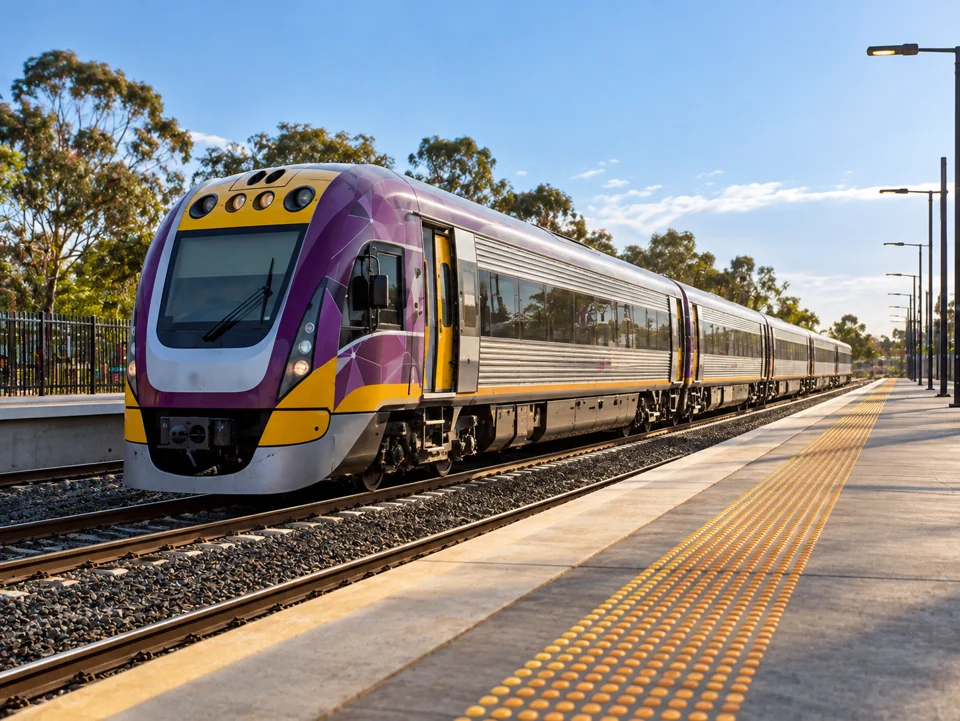
Regional rail in Australia is run by state operators and one long-distance private operator, so there is no single national timetable or booking site. NSW TrainLink runs regional New South Wales, V/Line runs regional Victoria, Queensland Rail (QR) runs Queensland, and Journey Beyond Rail runs The Ghan, Indian Pacific, Great Southern and The Overland. Each of these operators sets its own booking rules and luggage limits, and its own boarding procedures.

Fares, timetables and policies change. The information below is current to late October 2026. Each section links to the operator’s own page for confirmation and covers timetables, booking, luggage and arrival times, assisted boarding, and connections to local buses, trams and suburban trains.
NSW TrainLink timetables
NSW TrainLink’s regional services run across regional New South Wales and into Queensland, South Australia, Victoria and the Australian Capital Territory. The Transport for NSW page sends travellers to transportnsw.info for trip planning, timetables and ticketing, and the timetables themselves sit on four regional pages: Southern, Western, North Coast and North Western. All four pages carry a July 2026 creation date.
Timetable PDFs are for planning only. The North Coast line PDF tells readers to use the Trip Planner or Departures on transportnsw.info/regional for the most up-to-date times, so treat the live planner as the reference. Copies of NSW timetables on unrelated websites are unofficial and go out of date.
Train and coach legs appear together in the same timetable tables, and the Southern and Western pages show them as "Connection" rows. A route that looks like one train journey often includes a coach leg, so enter the whole trip in the planner to see every leg.
NSW TrainLink booking rules
On the Western, North Coast and North Western pages, transportnsw.info states that all seats on NSW TrainLink regional train and coach services must be booked in advance. Seats cannot be bought at the station on the day of travel. Booking early also secures preferred dates, which matters for school holidays and long weekends. Planning and booking both start at transportnsw.info/regional-travel.
V/Line timetables in Victoria
V/Line publishes a master list of train and coach timetables for all current services. Each entry is a PDF with its own effective date. The list is grouped by line:
- Ballarat, Ararat and Maryborough
- Traralgon and Bairnsdale
- Geelong and Warrnambool
- Seymour, Shepparton and Albury
- Coach timetables for the Western, Northern, North Eastern, South Western and Interstate routes
Effective dates vary by route. Several Melbourne-linked train timetables are dated 23 August 2026, while some coach timetables still carry 1 February 2026 dates, so check the date on the PDF for the route you are travelling instead of assuming one date covers the network. Temporary timetables are listed separately for September and October 2026 and include the Ararat Line, the Albury Line and the Bairnsdale and Traralgon lines.
Recent changes affect planning in the east and north. The August 2026 changes replaced coaches between Seymour and Shepparton with trains, added 11 extra weekly coach services for Yarram and Leongatha passengers, extended the weekday Marlo to Bairnsdale coach to Traralgon, and moved some coaches earlier to connect better with trains. Earlier, new train timetables began on Sunday 1 February 2026 on the Geelong, Warrnambool, Ballarat, Ararat, Maryborough, Bendigo, Echuca, Swan Hill, Seymour, Shepparton, Traralgon and Bairnsdale lines, with some connecting coach timetables altered at the same time.
V/Line’s long-distance reserved services (Warrnambool, Swan Hill, Shepparton, Albury and Bairnsdale) let you reserve accessible spaces when booking, according to the V/Line accessibility page. Fare and ticketing details are on V/Line’s "Fares & general info" and "Ticketing & fares" pages.
Queensland Rail tickets and terms
QR timetables and fares are on queenslandrailtravel.com.au. What a ticket allows is set out in the Conditions of Carriage (Version 1.2, effective July 2026). The main points for travellers are:
- A valid ticket must be bought before boarding, or at the first opportunity, and it must cover the whole journey.
- All QR ticket offices, Travel Centres and retail outlets are cashless, so bring a card.
- A ticket entitles the holder to carriage only, unless it says otherwise. Transfers need QR’s agreement.
- QR may ask for proof of identity and concession entitlement.
- Travellers under 16 are covered by QR’s Travelling with Children policy, which applies at the time of booking.
- Assistance animals are covered by a separate Assistance Animals policy.
- Bookings made through QR for other operators’ services follow those operators’ terms.
Booking The Ghan, Indian Pacific and Great Southern
Journey Beyond Rail’s trains are booked as contracts. According to the Great Trains booking conditions, a booking becomes a contract once the traveller has supplied all necessary information, paid the deposit and any other amount due at booking, and received a Booking Confirmation. The operator can decline a booking and must refund any payments if it does. Booking is through bookings.journeybeyondrail.com.au, the manage-booking login is at bookings.journeybeyondrail.com.au/account/login, and the phone numbers are 1800 703 357 for Journey Beyond Rail and 1300 872 465 for Great Trains.
Check these details at booking:
- Names. Names must match exactly as shown on the passport or driver’s licence. If wrong details force airline tickets or documents to be reissued, the traveller pays the supplier fees and the operator’s administration fee.
- Prices. Prices are in AUD and include GST. They can change until you book, and the Booking Confirmation fixes the price.
- Exclusions. Unless stated, the price excludes airfares, airport or hotel transfers, passports, visas, vaccinations, insurance, most meals, gratuities and personal items.
- Add-ons. For add-ons, the operator acts only as booking agent for the separate provider.
Booking steps for any regional trip
The order of steps is the same for every operator:
- Confirm the route and times in the operator’s live planner, and note any coach legs.
- Check the fare type and whether you need to reserve seats or accommodation.
- Book through the operator’s own channel or the booking agent named in its terms.
- Keep the booking reference. If the operator requires ID, check that passenger names match it.
- Before departure, recheck the luggage rules, the boarding time and any accessibility requests.
Trips that cross state borders need one booking per operator unless the operator sells the whole journey. Check each leg’s terms, because a ticket bought for another operator’s service follows that operator’s rules.
Queensland Rail luggage limits
The QR Luggage Policy (Version 1.7, effective May 2026) sets these allowances:
- Checked luggage: One item per customer for Economy Seats, and two items per customer for Single and Twin Sleepers, RailBeds and Business Seats. Each item must weigh no more than 20 kg and measure under 180 linear cm (length plus width plus depth).
- Carry-on: One additional bag of no more than 20 kg and 23 × 34 × 48 cm, small enough to fit under the seat or in the overhead racks. QR suggests checking heavier luggage.
- Excess items: Where space allows, QR may accept extra items for $15 each, paid to onboard staff by cash or card. Items over 20 kg are not considered, and contacting QR in advance for approval is recommended.
Some items are accepted with conditions. Suitcases must be under 180 cm total and in good condition, and backpacks must have nothing tied to the outside. Collapsible prams and strollers go in the checked area, as do child car seats and baby capsules (children cannot travel in them). Collapsible cots are accepted boxed or bagged. Medical oxygen cylinders of up to 5 kg when full travel on board and are restrained. Oxygen concentrators of 20 kg or less go as carry-on or checked luggage. Work toolboxes are also accepted if they are 20 kg or less, lockable and in the checked area. Chef knives are accepted for work use only, in a locked case, in the checked area. Non-standard items need QR’s pre-approval.
Some items must stay with you, starting with medicines, which are carry-on only, labelled, in a sealed container up to 210 × 140 × 75 mm. Small eskies and coolers of up to 10 litres and no more than 38 × 28 × 24 cm are also carry-on only, and so are valuables, laptops, phones, cash, passports, cameras and fragile items.
QR does not accept the following:
- lithium-ion battery charging on its services
- firearms and ammunition
- unaccompanied luggage (QR is not a freight operator)
- golf buggies, even if collapsible
- plants, garbage bags and containers
- frozen seafood and other perishables
- dangerous goods
- animals other than authorised assistance animals
If you are unsure about an item, the policy advises checking before booking or asking a consultant at the time of booking.
Liability for checked luggage is limited to $200 per piece, and QR takes no responsibility for damage to carry-on luggage to the extent the law allows. For lost property, use the QR webform or phone 13 16 17 (7.30am to 5.00pm, Monday to Friday). You can also visit Central Station Brisbane at Plaza Level, Rail Centre 2, 309 Edward Street.
Luggage trolleys and scales at Queensland stations
Luggage trolleys are available at Brisbane Roma Street, Cairns, Rockhampton, Bundaberg and Townsville, and some need coins. QR stations have no luggage lockers, so plan to carry everything from the moment you arrive. A luggage scale is on Platform 10 at Brisbane Roma Street, at the ticket office end, so you can check a bag against the 20 kg limit before it reaches the counter. QR’s Travelling with prams and bags page covers prams and strollers in more detail.
Long-distance luggage and cabin limits
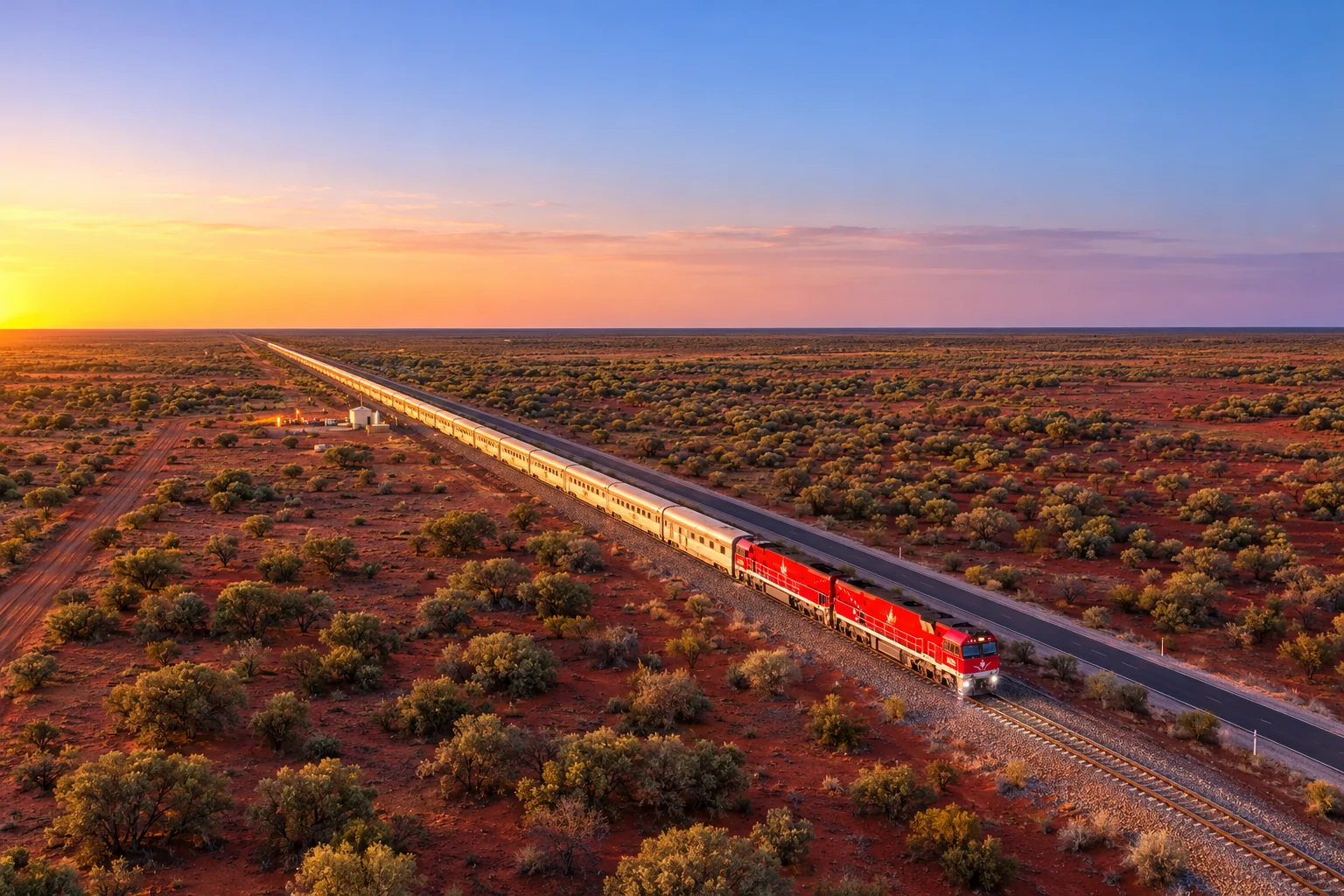
On The Ghan, Indian Pacific and Great Southern, each person carries one piece of hand luggage plus one garment bag, cabin bag or briefcase, stored in the cabin. On The Overland the allowance is one cabin bag per person. Checked baggage depends on service level, as set out in the Journey Beyond Rail FAQ:
| Service level | Checked baggage per person |
|---|---|
| Platinum | 3 × 30 kg (90 kg) |
| Gold Premium | 3 × 25 kg (75 kg) |
| Gold | 2 × 30 kg (60 kg) |
| Red Premium | 2 × 30 kg |
| Red Standard | 2 × 20 kg |
The Platinum service page and the Gold Premium page give the same totals of 90 kg and 75 kg. Outback Spirit holiday packages have their own limits.
Checked luggage travels in a separate part of the train and cannot be reached during the journey, so pack a cabin bag with everything needed between departure and arrival. Passports, medicine, fragile items and perishables must travel as cabin baggage. Each bag must be labelled inside and outside with name, destination address and phone number. The owner must also accompany the bag on the train. The operator can refuse any item, and an excess-luggage fee can apply. Excess luggage must be left at the embarkation point for the whole journey and is stored at the traveller’s risk.
Prams, strollers and booster seats must be checked as stored luggage, as must walking frames, wheelchairs and scooters. If arranged at booking, a specially modified wheelchair can be requested on board for use with a carer. Baby safety capsules and child restraints are carried free.
Arriving and boarding on time
For QR, the Luggage Policy says luggage check-in at attended stations opens one hour before scheduled departure and closes 30 minutes before. Check-in is open only to passengers holding a ticket for that journey. At unattended stations, onboard staff help with luggage when the train arrives. The Conditions of Carriage require passengers to be ready to board before departure, with carry-on loaded and any checked-luggage procedures complete. QR is not obliged to hold a train for late passengers. QR’s Day of Travel Important Information page has arrival guidance for the day of travel.
Long-distance trains use fixed boarding windows. According to the Great Trains terms, boarding for The Ghan, Indian Pacific and Great Southern opens no more than 2.5 hours and no later than 1 hour before scheduled departure. For The Overland it opens no more than 1 hour and no later than 30 minutes before departure.
Several Journey Beyond Rail rules apply on board. Trains stop at various points for Off Train Experiences or operations, but guests cannot leave the train at those stops. A journey can end only at selected major-city departure points on the booked route. Forward-facing cabins can be requested at booking but cannot be guaranteed, since roughly half the cabins face forward.
Assisted boarding on QR and V/Line
Queensland Rail provides assisted boarding on request whenever trains are running. Staff place a ramp between the platform and the train floor to remove the step or gap. On arrival at an attended station, tell station staff what help you need, then wait at the assisted boarding point, which is marked with the international wheelchair access symbol and is usually mid-platform near the help phone. At an unattended station, go to the assisted boarding point and onboard staff will assist.
Calling ahead is optional but suggested so staff can be ready. The QR phone line is 13 16 17, staffed 7:15am to 5pm AEST, Monday to Friday, and the text-only number is 0428 774 636. Give the travel time, start and end stations, and the help needed. The Help with mobility page describes a text service that runs 24/7 and can book assisted boarding, give next-train details and disruption updates, and answer general questions.
The ramp takes mobility devices up to 750 mm wide and 1,300 mm long, with a combined weight of person, device and carried items under 300 kg. Users of motorised devices must use the ramp unaided. Manual wheelchairs need handles so staff can help. Many QR stations have a platform step or gap, which is listed on each station’s "Your station" page. QR’s accessibility pages also link to an Easy English booklet on getting on and off trains.
V/Line states that most of its stations and services can be used by customers with mobility aids. The call centre on 1800 800 007 takes accessibility requirements before travel and can confirm whether a station or service is accessible. If a service is not, V/Line arranges alternative travel provided the mobility aid meets its dimension requirements. Boarding Assistance Zones are at platforms 3A and 15A at Southern Cross Station and on all other V/Line platforms. Staff can assist elsewhere on the platform, but waiting in the zone makes it easier for them to see that you need help. Virtual station tours show station layouts before travel.
Connecting to local transport
The traveller is responsible for every connection. QR cannot guarantee connections with other transport companies and is not responsible for the cost of a missed connection. In New South Wales, the timetable PDFs carry a disclaimer about connections with other operators, including Great Southern Rail, V/Line, Queensland Rail, Sydney Trains and coach, tour, hire car and airline operators. Check the disclaimer in the current PDF before relying on a tight connection.
Victoria’s network is built around Southern Cross Station in Melbourne, where regional departures link with Metro trains, trams and buses. Coaches connect Southern Cross with centres including Warrnambool, Mildura, Bright and Beechworth, and V/Line shows its coach timetables in the same master list as its trains. Coach times are sometimes adjusted to meet trains, as the August 2026 change moving some coaches earlier shows, so the date on a coach PDF matters.
Rules for local services can differ from the regional operator’s. On Metro Trains Melbourne’s Stony Point line, between Frankston and Stony Point, conductors help passengers on and off diesel trains, and at low-platform locations the ramp may be steeper than 1 in 8. In Queensland, Translink follows the same assisted-boarding pattern of waiting at the marked point for staff to deploy a ramp.
A few habits reduce connection risk:
- Leave generous buffer time between a train arrival and a coach or bus departure.
- Confirm whether the coach is a leg of the same booking or a separate ticket.
- Check the live departures board on the day of travel.
When services are disrupted
Under the Conditions of Carriage, QR may substitute, cancel, delay or change services, stations or destinations for good reason, such as safety, track closures, weather or breakdowns, without telling passengers in advance. QR may provide alternative transport such as a bus transfer. If a passenger declines that transport and arranges their own, QR is not liable for the extra cost.
Replacement coaches also change what you can carry. If a QR train is fully or partly replaced by coach, QR checks whether e-scooters can be carried, and if they cannot, the passenger may need other transport at their own cost. A traveller with a bulky item or mobility device should check this before the day.
Conduct on Queensland Rail trains
Alcohol is prohibited on QR property, including trains, unless QR supplies it, it is consumed in a designated place and it is served under QR’s House Policy on the Responsible Service of Alcohol. Smoking and vaping are prohibited on trains, platforms and designated areas. Staff may refuse carriage for safety reasons, and the onboard Passenger Services Supervisor settles disputes during carriage. The Conditions of Carriage are governed by Queensland law and are subject to the Transport Operations (Passenger Transport) Act 1994 and the Transport Infrastructure Act 1994.