Perth to Broome is a one-way drive of about 2,220 to 2,240 km north up Western Australia’s west coast and across the Pilbara, ending in the Indian Ocean town of Broome in the Kimberley. The inland run along the Great Northern Highway is the fastest option, at roughly 22 to 26 hours of driving. Most travellers add stops or take a coastal loop through Kalbarri, Shark Bay, Coral Bay and Karijini, which stretches the trip to about 3,300 km and roughly two weeks.
Four decisions shape the trip: the route, the number of days, the months of travel, and whether to hire a vehicle one way or drive your own. Fuel, bookings and 4WD hire all follow from these choices.
Inland and coastal routes
The direct inland route follows the Great Northern Highway (National Highway 95) and covers about 2,220 km, or about 2,240 km and 24 to 26 hours of driving depending on the calculation. It suits travellers with roughly 7 to 10 days who want Karijini National Park and the Pilbara but have no time for the coast.
The coastal loop adds Kalbarri, Shark Bay, Carnarvon, Coral Bay and Exmouth before cutting inland to Karijini. The loop measures about 3,300 km, and a 14-day version covers about 3,346 km and 42 hours of driving. Both describe a loop that returns down the Great Northern Highway. A shorter variation runs up the coast to Exmouth and then back inland, and The variation measures 2,620 km and about 27 hours of driving. If you plan to drive back to Perth afterwards, RAC describes a return trip of more than 4,000 km.
The coastal loop trades distance for scenery. It adds Ningaloo Reef, Shark Bay’s World Heritage coastline and the Kalbarri gorges, but it consumes days that the direct route would spend in Karijini or in Broome itself. Travellers with a week or less should take the highway and choose one or two inland stops.
Distances and driving times
The segments below show where the hours go on the coastal-and-inland route. Times are driving only and exclude fuel, meals and walks.
| Segment | Distance | Driving time |
|---|---|---|
| Perth to Kalbarri | 570 km | 6 hr 20 min |
| Perth to Geraldton | 415 km | 5 hr |
| Kalbarri to Monkey Mia | 398 km | 4 hr 30 min |
| Monkey Mia to Coral Bay | 581 km | 6 hr 30 min |
| Coral Bay to Exmouth | 155 km | 2 hr |
| Exmouth to Karijini | 658 km | 7 hr 52 min to 8 hr |
| Karijini to Tom Price | 72 km | At least 1 hr |
| Karijini to Port Hedland | 316 to 335 km | At least 4 hr |
| Karijini to Eighty Mile Beach | 563 to 580 km | A long day’s drive |
| Eighty Mile Beach to Broome | 376 to 380 km | About 4 hr |
| Port Hedland to Broome | 613 km | Most of a day |
The long legs are Monkey Mia to Coral Bay, Exmouth to Karijini and Karijini to Eighty Mile Beach. Each is a long day behind the wheel, so plan to leave early and arrive before dark.
How many days to allow
Ten to fourteen days gives a comfortable one-way trip with stops. RAC’s December 2024 coastal itinerary suggests around two weeks for a return trip and advises a 15-minute break every two hours and no more than eight hours of driving a day. Applied to the direct route, that cap means the 22 to 26 hours of driving spreads over at least three days, and a trip that includes Karijini needs more.
A workable split for the full coastal loop is two nights around Kalbarri, one night near Shark Bay, a night in Carnarvon or straight to Coral Bay, two nights around Coral Bay and Exmouth, two nights in Karijini, a night in Port Hedland or at Eighty Mile Beach, and then Broome. Travellers who want Karijini’s gorges and a day at Millstream should add a night to each. Travellers short of time can drop Exmouth and the Shark Bay peninsula and still cover the highlights in about 7 to 10 days.
Kalbarri and Shark Bay
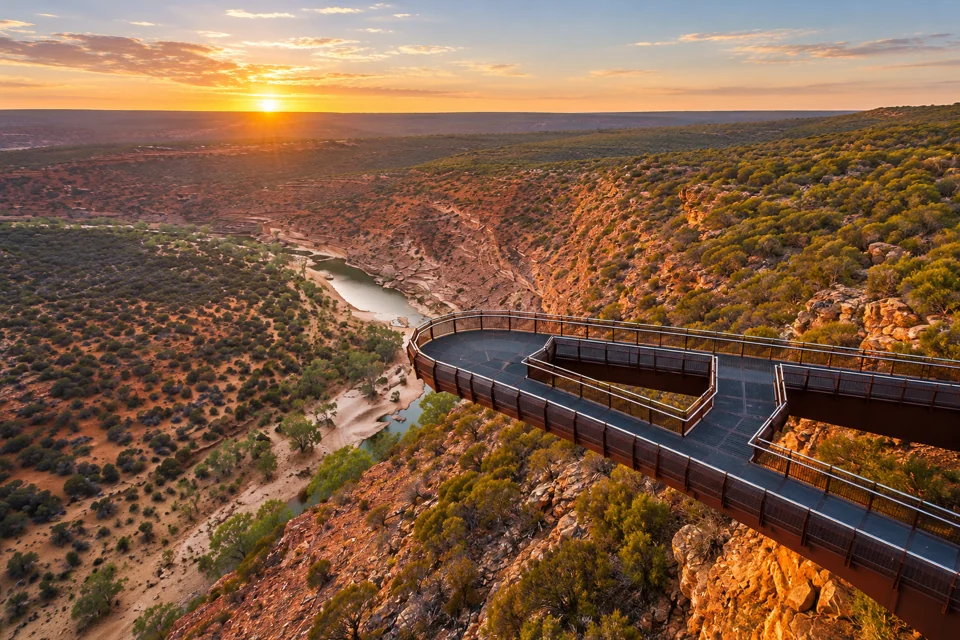
Kalbarri is the first major stop on the coastal route. It is 570 km from Perth, and RAC calls it the perfect first stop on a Broome road trip. Kalbarri National Park has the Skywalk, Blue Holes and The Loop, an 8 km class four hike. Start The Loop early, because it takes most of a morning and exposes you to the sun for much of the route.
From Kalbarri it is 398 km to Monkey Mia in Shark Bay. The turnoff from the North West Coastal Highway at the Overlander roadhouse starts a 150 km section of road that passes Hamelin Pool. RAC advises exploring Francois Peron National Park in a four-wheel-drive vehicle, so travellers in a 2WD should plan on viewing the park from its sealed edges rather than driving the tracks.

Carnarvon, Coral Bay and Exmouth
Carnarvon sits about halfway on the 581 km stretch between Monkey Mia and Coral Bay, and RAC recommends it as a break on the way north. It has the fuel and supplies that Coral Bay lacks at a similar scale.
Coral Bay is the gateway to Ningaloo Reef, which stretches more than 200 km north of Carnarvon. RAC says Coral Bay is where visitors can swim with the "Big 3": manta rays, whale sharks and humpback whales. Exmouth is 155 km and about two hours further north. It is the main base for Cape Range National Park, about 60 km and an hour from Coral Bay, and a night or two there suits travellers who want more reef time. The route then turns inland, and the 658 km run from Exmouth to Karijini is the biggest single day of driving on the loop.

Karijini and the Pilbara
Karijini National Park is the main draw of the inland route and justifies at least two nights. Tom Price is 72 km from the park, and Port Hedland is 316 to 335 km away, so many travellers base themselves inside the park or at Auski, then drive on to the coast.
Caravans heading for the Eco Retreat should use the sealed Karijini Drive and Banjima Drive West, because Banjima Drive North is four-wheel-drive only. Hamersley Gorge is not suitable for towing. Vans can be left at the junction of Nanutarra-Munjina Road and Hamersley Gorge Road, where overnight camping is allowed.
Millstream Chichester National Park is a worthwhile detour for a quieter alternative. Its Miliyanha Campground sits close to the Millstream Homestead Visitor Centre, and campers can use it as a base for a day or two before rejoining the highway.

Port Hedland to Broome
Between the Pilbara and the Kimberley lies one of the emptiest stretches of the trip. RAC advises arriving in Port Hedland by late afternoon so you can leave early for or from Karijini, since the road from Karijini is a long drive. From Port Hedland it is 613 km to Broome, which takes most of a day.
Eighty Mile Beach breaks the journey for travellers who prefer two shorter days. It is 563 to 580 km from Karijini, a long day’s drive, and 376 to 380 km from Broome. Sandfire Roadhouse is the listed fuel stop on the Great Northern Highway between Port Hedland and Broome.
Broome airport is about 5 km (around five minutes’ drive) from the town centre, which makes the end of a one-way trip simple to manage. Some Broome operators offer a pick-up and drop-off at the airport, which suits travellers flying out after returning a hire vehicle.
Where to stay in Karijini
Campgrounds inside Karijini and Millstream book out in the dry season, so reserve early. Karijini has two main options: the state-run Dales Campground and the privately run Eco Retreat.
Dales Campground has 153 compacted gravel, unpowered sites in six named areas, and some areas close during periods of low demand. Bookings are essential and open up to 180 days ahead, for one campsite per booking. Generators are permitted at some sites only, between 8am and 8pm. Facilities consist of no-flush pit toilets and a chemical toilet dump station. Showers are at the Karijini Visitor Centre, 12 km away, open 9am to 4pm daily and closed from December to February. There are no campfires, no dogs and no bins, so carry out all waste. Drinking water is not provided. Dingoes are common around Dales and can be aggressive, so do not feed them.
Camping fees are a per-person charge plus a per-vehicle park entry fee, paid by Mastercard or Visa at booking. Trailers, including camper trailers and caravans, pay no entry fee. A per-vehicle park entry fee of $15 and a five-day Holiday Pass at $25 applied in 2025. Check the Explore Parks WA booking page for the current fee schedule before you travel.
The Karijini Eco Retreat runs 64 unpowered sites, with one vehicle plus a tent, trailer or caravan and up to six people per site. Generators run in the loops from 2pm to 4pm daily. Toilets are shared flushing toilets, and showers are solar hot-water. Reservations are made online, and the operator’s booking page carries current rates. It also offers glamping tents, which makes it the only accommodation inside the park itself.
Outside the park, Auski Tourist Village and Roadhouse offers campsites, motel rooms and cabins at a price range of $30 to $240. It sits at the junction of the Northern Gorge Access Road and the Great Northern Highway between Newman and Port Hedland, and it doubles as a key refuelling stop.
Where to stay at Millstream
Miliyanha Campground has 27 compacted gravel, unpowered sites in six named areas. Bookings are essential and open up to 180 days ahead, for one campsite per booking, on the same fee and cancellation terms as Dales. Generators are permitted at all sites between 8am and 8pm only. Facilities include no-flush pit toilets, a sheltered food-preparation area with a gas barbecue and sink, and sheltered picnic tables. Drinking water is not provided. Untreated water may be available, but supply is not guaranteed and it needs treatment. There are no campfires, no dogs, and all waste must be carried out.
When to go and road conditions
The best months for the drive are May to October. The dry season runs from May to October, which is also the best window to visit Broome, with low humidity. Torrential rain falls in the Kimberley and Pilbara from November to May, and April to October is the best time north of the Tropic of Capricorn.
The Great Northern Highway is sealed for most of the route, but the wet season still shuts it. Heavy rain between November and May can put parts of the road under several metres of water and leave surfaces boggy or washed out. Treat November to April as the wet season for planning. Explore Parks WA lists November to April as the tropical cyclone season, and the Pilbara typically sees 3 to 4 cyclones a season.
A recent closure shows how quickly this happens. On 17 February 2026, floodwater rising at the Blue Bush floodway east of Fitzroy Crossing closed the Great Northern Highway between Fitzroy Crossing and Halls Creek. Main Roads WA said the closure would last at least until the following Wednesday, and floodways across the region, including on the Broome Highway, had water over the road. Check the Main Roads WA travel map for live closures before each day’s drive.
Cape Leveque and gravel roads
Cape Leveque Road is the standard detour from Broome, and it is the point where a 4WD hire becomes useful. The road has three sections: a 13.6 km narrow sealed southern section, a 90 km unsealed middle section, and a 101.4 km sealed northern section from south of Beagle Bay to the terminus. The Shire of Broome maintains it. The unsealed section is often closed in the wet season because flooding makes it impassable.
Gravel roads across the Kimberley follow the same rule. The Shire of Wyndham East Kimberley’s road condition report of 20 May 2024 covers the East Kimberley and Gibb River Road network. It recommends 4WD on all gravel roads and advises against towing trailers or caravans on unsealed roads in the wet season. Main Roads WA’s highway information line is 138 138.
Fuel and services
Unleaded (91) and diesel are widely available in major towns and highway roadhouses. Premium fuels (95 and 98) and LPG are less common and mostly found in towns with several stations. Some stations are self-service and card-only. Australia’s North West notes that the Pilbara Inland Route (Pannawonica, Paraburdoo, Tom Price, Newman, Marble Bar and Nullagine) has longer stretches without services, so refuel before remote sections, and that Auski Tourist Village is the key stop north-east of Karijini. Broome has an additional diesel retailer.
Spacing on the Great Northern Highway through the Pilbara is about 200 to 300 km between service stations, with some gaps longer, and a 20 L jerry can is a sensible reserve. Carry about 10 L of spare fuel, and do not pass a roadhouse with less than half a tank. Compare prices at WA FuelWatch, look up the Broome fuel price list before the last leg, and check the PetrolPulse tracker for shortages.
Safety on the road
Mobile coverage thins out quickly outside populated centres, and metal ore in many Pilbara hills interferes with reception even inside coverage areas. The Pilbara road safety guide recommends telling a responsible person your route and estimated arrival time, and letting them know when you arrive. Satellite phones can be hired through the Royal Flying Doctor Service. Call 000 for police, fire and ambulance. Hand-held phone use while driving is illegal in Western Australia.
If the vehicle breaks down, get off the road if possible, switch on the hazard lights, set out reflective markers and stay with the vehicle until help arrives. Give your location using the map or the white Straight Line Markers on major road verges. At floodways, walk the crossing first. Water should be no higher than the bottom of the door for 2WD vehicles, and no higher than an average adult’s knee for 4WD vehicles. If in doubt, do not cross.
Livestock and wildlife are most active at dusk and dawn, so avoid night driving where possible and keep your speed within headlight range. Road trains can be up to 53.5 m long. Overtake only when the road is clear, which can take up to 2.5 km, and allow for tail swing. Do not overtake road trains while towing. Heavy vehicles may need more than a kilometre to stop, so keep at least a 2-second following distance in dry conditions and 4 seconds in wet conditions. On unsealed roads, carry two spare tyres plus tubes and repair kits, because some surfaces have sharp rocks.
The guide’s road rules include a maximum of 110 km/h outside towns unless posted, headlights on between sunset and sunrise, compulsory seatbelts including on remote tracks, a blood alcohol limit of 0.05% for full licences, and a towing maximum of 100 km/h outside built-up areas. Permits are required to drive on roads over Aboriginal land, and the Pilbara Iron Access Road between Karratha and Tom Price requires one from the Karratha or Tom Price tourist bureau. Do not enter private mining or station roads without permission, and never enter a road with a "No Entry" sign. For restricted Kimberley roads, the Shire’s report says permits must be applied for in writing at least three full business days before travel.
One-way vehicle hire
Most hire companies let you pick up in Perth and drop off in Broome, but the drop-off fee varies widely. Some operators offer one-way hire with pick-up in Broome and drop-off in Perth, and extra fees may apply to drivers under 30 or over 65. One-way fees for small vehicles on a three-day trip run from $854 to $2,985, depending on the company and the distance. Older figures show drop-off fees of $350 from Perth to Broome and $1,050 from Broome to Perth, which points to the northbound direction being the cheaper one. Get a written quote before booking.
Red Dirt 4WD Rentals hires 4WDs from Perth to Broome and further north to Darwin. Its depots are at 6 Aitken Way, Kewdale WA 6105 (Perth) and 33 Clementson St, Broome WA 6725, about 10 minutes from Broome airport, and it runs no airport pick-up or shuttle. A one-way fee applies when you return at a different location, and the fee is waived for rentals longer than 21 days, which makes a slow two-week-plus trip cheaper per day than a rushed one. Vehicles are automatic Toyota LandCruiser 200, Prado and Hilux models with unlimited kilometres, and towing is insured.
The operator’s page says its 4WDs are available to drivers of 25 years and older, and drivers under 21 are not permitted. Its fee list also includes a $30 per day young-driver fee for ages 21 to 24, so confirm your age category with the operator when you book. The driver needs a current, full licence in their own name and a physical credit or debit card. Overseas and interstate licences are accepted, and a non-English licence should be accompanied by an international driving permit. Additional drivers must be present at pick-up with their own licence.
Liability options are $0 per day with an $8,000 bond, $30 per day with $2,500 liability, or $60 per day with $1,000 liability. Bond returns can take up to 21 days after drop-off, and no option covers roof or underbody damage. A full refund, including the deposit, is available with at least 90 days’ notice, less a $110 administration fee. Renters are asked not to drive the Canning Stock Route, Old Gunbarrel Highway, Old Telegraph Road (Cape York), Fraser Island or the Simpson Desert, and not to drive through flooded areas or with warning lights on.
Summary
- Choose the route by days available: the direct inland drive is about 2,220 to 2,240 km and 22 to 26 hours of driving, while a coastal loop through Kalbarri, Shark Bay, Coral Bay and Karijini runs to about 3,300 km and roughly two weeks.
- Travel from May to October: the wet season runs from November to April, brings cyclone risk, and floods the Great Northern Highway, as the closure between Fitzroy Crossing and Halls Creek on 17 February 2026 showed. Check the Main Roads WA travel map each morning.
- Book Karijini and Millstream early: Dales and Miliyanha campgrounds open bookings up to 180 days ahead, one campsite per booking, and neither provides drinking water.
- Refuel at every roadhouse in the Pilbara: service stations are about 200 to 300 km apart, so carry spare fuel and water and do not pass a roadhouse with less than half a tank.
- Price one-way hire in writing: drop-off fees vary widely, Red Dirt 4WD Rentals waives its fee for rentals over 21 days, and a 4WD is needed for Cape Leveque Road and Karijini’s unsealed tracks.