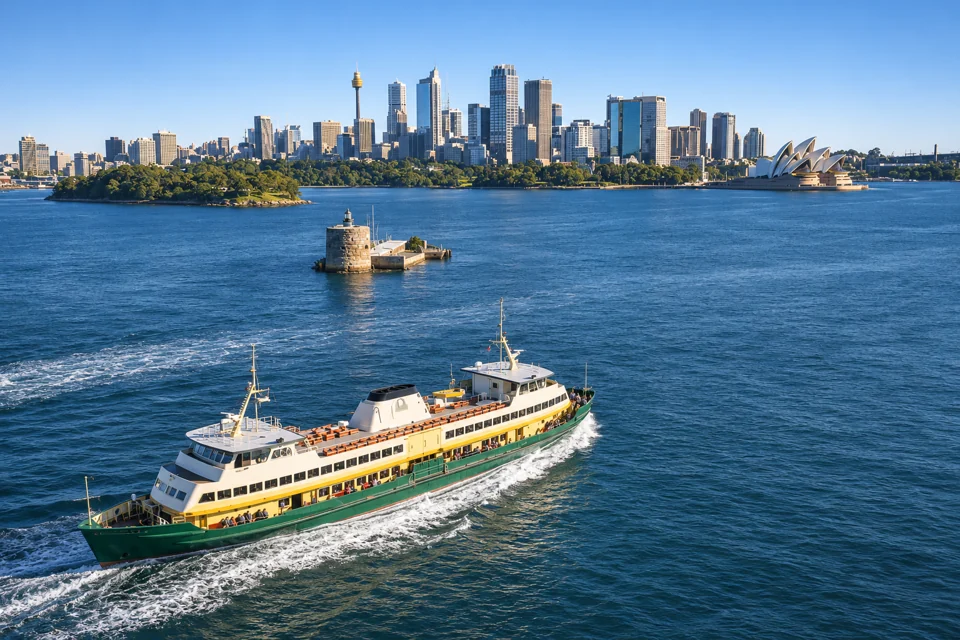
A week is enough to see two parts of Australia properly, but not three. The main highlights are thousands of kilometres apart: Sydney and Melbourne on the south-east coast, the Great Barrier Reef off Queensland in the north-east, and the Red Centre, the desert around Uluru in the middle of the continent. Because of those distances, Tourism Australia recommends at least three days per region, and once flights are added, seven days fills quickly.
A workable first trip pairs one city with a second destination, linked by a single flight. The three realistic pairings are Sydney and Melbourne, Sydney or Melbourne and the Reef, and Sydney or Melbourne and Uluru. To choose between them, check the visa and flight steps, the park and Reef fees, and which regions to save for a later trip.
Why a week covers two places
Tourism Australia’s guidance for city stays is three to four days in a single hub such as Sydney, Melbourne or Adelaide, using public transport or guided day tours for nearby spots. Its regional guidance is a minimum of three days. Add one flight day between two places and the arithmetic leaves room for exactly two stops.
Three stops would require stays of two days or less. A trip covering Sydney, Uluru and the Reef is possible, as Tourism Australia’s Ultimate itinerary shows, but that plan runs for 10 days and covers about 6,500 km by plane, car and boat. Fitting it into seven days means packing and flying almost every day, and spending more time at airports than at the sights.
Many first-time visitors try to fit the Reef and Uluru into the same trip, as Tourism Australia’s sample itineraries often do. Choosing one and doing it well makes a better week.
The table below sets out the three pairings. The day counts are a suggested split built from Tourism Australia’s minimum stays and flight times, not an official itinerary.
| Option | Structure | Flight between |
|---|---|---|
| A: Sydney and Melbourne | Sydney 3 to 4 days, Melbourne 3 days | A short flight |
| B: Sydney and the Reef | Sydney 3 days, Reef region at least 3 days | About 3 hours to Cairns |
| C: Sydney or Melbourne and Uluru | City 3 days, Uluru and Kata Tjuta 3 days | About 3 to 3.5 hours |
Option A suits travellers who want cafes, harbours, galleries and walking. Option B suits those who want to snorkel or dive. Option C suits those who want desert landscapes and Aboriginal cultural sites. The choice comes down to what you most want to see.
Visas and flights
Most visitors need a visa before boarding, and the application is done online. Home Affairs runs a short-stay Visitor visa program with three subclasses: the Electronic Travel Authority (ETA, subclass 601), the eVisitor (subclass 651) and the standard Visitor visa (subclass 600). The ETA is an electronic visa for citizens of countries with ETA-eligible passports, for tourism or business visits. The eVisitor is for eligible European passport holders and must be applied for online. Travellers whose passports fit neither category apply for subclass 600, whose Tourist stream covers holidays.
Both electronic visas allow a stay of up to three months per entry, with unlimited entries within a 12-month validity period. A one-week trip sits well inside that limit. Visitor visa holders cannot work in Australia, so a holiday visa does not cover casual or paid work.
The ETA can be applied for online or through a travel agent, airline or specialist service provider. Home Affairs’ archived eVisitor page says the eVisitor application is free, with no application charge or service fee, but check the live Home Affairs page before you apply. The same page says every family member travelling, children included, must complete an application. eVisitor holders receive no visa label in their passport, so there is nothing to print or stick in.
Two eVisitor limits matter for planning. It does not cover medical treatment or transit travellers. And if you already hold another Australian visa, a granted eVisitor may invalidate it, so check before applying. Sort out the visa before you book non-refundable flights and tours. A check takes minutes for most eligible passport holders, but booking on an assumed eligibility risks losing the fare.
Flying is the standard way to link cities. Tourism Australia says flying is the best way to cover Australia’s large distances in a short time and names four domestic carriers: Qantas, Virgin Australia, Jetstar and Rex.
Sydney to Melbourne is a short hop by air. The coach takes about 12 hours, and the train takes a similar time (the rail timetable lists 12.5 hours in the Melbourne to Sydney direction). The road distance is 879 km, roughly nine hours of driving, according to Tourism Australia’s iconic cities page.
For the Reef, Sydney to Cairns is about 3 hours by air against 2,421 km by road, and Melbourne to Cairns is about 3.5 hours by air against 2,818 km by road. Cairns is the most common gateway, though the same page lists Townsville, Airlie Beach (served by Proserpine airport) and Hamilton Island as other Reef gateways reached by domestic flight.
For the Red Centre, Sydney and Melbourne both have direct flights to Uluru (Ayers Rock Airport, code AYQ) of about 3 to 3.5 hours. The alternative is flying to Alice Springs, the regional gateway, which has flights from all capital cities except Canberra and Hobart. Driving from Alice Springs to Uluru takes about 5 hours (468 km), so the direct flight saves most of a day.
A 3-hour flight plus airport time uses most of a day. Schedule it for the morning of your transfer day, and leave no major sight for that afternoon.
The three pairings
Sydney and Melbourne
This is the lowest-effort week, because the flight is short enough that the transfer costs only half a day. A workable split is three nights in Sydney and four in Melbourne, or the other way round, depending on which city you want more time in.
Tourism Australia’s budget itinerary gives a good template for Sydney’s first day: start at The Rocks, take a ferry of about 30 minutes to Manly, and walk over the Harbour Bridge. That covers the main harbour sights on public transport. A second day can go to the Opera House precinct and inner-city neighbourhoods. A third can be a day trip to the Blue Mountains, which the Ultimate itinerary puts about 90 minutes from Sydney. It is the one nearby excursion worth taking in a short stay, as long as you keep the rest of the day free for the return trip.
Fly to Melbourne on day four, ideally on a morning flight. With three days in Melbourne, the city-hub guidance applies directly: stay in the central area, use public transport, and take a guided day tour if you want to see something outside the city. Melbourne rewards wandering more than ticking off landmarks, so leave unscheduled time for its laneways, markets and cafes.

The classic road trip between the two cities is a different trip entirely. Tourism Australia’s coastal route runs 1,475 km over nine days, with spring and autumn recommended as the best seasons. It does not fit a single week without leaving out most of the coastline it is meant to show.
Sydney and the Reef
The Reef pairing works if snorkelling or diving is a priority. Sydney gets three days, then a flight of about 3 hours to Cairns, which leaves three to four days in tropical Queensland. From Melbourne, the flight is about 3.5 hours.
A sensible Cairns plan puts the Reef cruise in the middle of your stay. The Ultimate itinerary slots a Great Barrier Reef cruise from Cairns into Day 9, with the rest of the time free around it. If the weather turns or seas are rough on one day, a second day gives you a fallback. Build in that buffer instead of booking the Reef on your last day, because a cancelled trip then leaves no fallback.

Daintree Rainforest, about 2.5 hours from Cairns, is the usual add-on. In a week it is optional, because the round trip takes most of a day and leaves less room for the Reef itself.
Sydney or Melbourne and Uluru
Uluru, the sandstone monolith in the desert heart of Australia, sits in Uluṟu-Kata Tjuṯa National Park, which also contains the domed rock formations of Kata Tjuṯa. Tourism Australia’s 3-day Uluru itinerary shows that three days is a sensible stay. With a direct flight of 3 to 3.5 hours from Sydney or Melbourne, the trip fits a week with three or four city days at the other end. Kata Tjuṯa is about 56 km from Uluru by road, so the two sights share one base.

Uluru is the stronger choice for travellers who want desert scenery and cultural sites. Plan the park visit around sunrise or sunset viewing, and leave the middle of the day for shade and the cultural centre.
Park and Reef fees
Both the Uluru and Reef pairings carry fees that are easy to miss when budgeting. They work differently, so check each one.
Entry to Uluṟu-Kata Tjuṯa National Park requires a pass. An adult (18 and over) 3-day pass costs $38 and an annual pass costs $50, both per person. Those fees were set from 1 January 2021 in an announcement dated 10 December 2020, so confirm the current price on the Parks Australia page before you go. Children under 18 enter free, and commercial tour operators and approved sales agents receive a 5% discount on adult park-use fees bought online. A quarter of pass revenue supports Aṉangu homelands and training and business development.
The pass covers only this park, and Kakadu has its own separate pass. The park’s FAQ recommends buying online, printing or saving the pass, and using the pre-paid lane at the entry station. As of 4 September 2025, general visitors taking photos or video for private use do not need a permit.
Reef tours carry the Environmental Management Charge. The Great Barrier Reef Marine Park Authority (GBRMPA) charges an Environmental Management Charge on most commercial activity in the Marine Park. For most tourism operations, visitors pay it to the permit holder, the tour operator, who passes it on to the Reef Authority. All receipts go to Marine Park management. Operators must advertise the total price including the charge, or show the charge amount so you can identify it. Check which version a quoted price includes before comparing operators.
The charge also depends on trip length. GBRMPA defines full-day visits as day trips of three hours or more and part-day visits as those under three hours. A short sunset cruise and a full-day reef trip are therefore charged differently.
What to skip in a week
The common mistake on a first trip is treating Australian distances like European ones. Drives that look short on a map take most of a day, and the flight saving is large enough that nearly every long overland leg should be flown.
Skip the Sydney to Melbourne drive, coach or train. The car trip is about nine hours and the coach about 12, against a much shorter flight. The train and coach make sense only if the journey itself is the point of your trip.
Skip long drives to Uluru. If you are flying to the Red Centre, take the direct flight into Ayers Rock Airport rather than flying to Alice Springs and driving about 5 hours. Also skip the Great Central Road, which crosses Aboriginal land and requires permits from the Central Land Council that you must show at the park entry station.
Skip self-drive itineraries. Tourism Australia’s 7 to 10 day itineraries are built around driving and need more days than a week provides. The 2,600 km budget east-coast trip from Sydney to Cairns, for example, runs for 10 days.
Treat Kings Canyon and Daintree as extras. Kings Canyon is about 3.5 hours from Uluru and Daintree about 2.5 hours from Cairns, so each takes a full day. Include one only if you have a spare day after the main sights are done.
Finally, skip the third destination. Adding Uluru to a Sydney and Reef trip, or the Reef to a Sydney and Melbourne trip, leaves you with two-day stays and three flights. Keep the third place for a second trip.
Key Takeaways
- Choose two places, not three: Tourism Australia recommends at least three days per region and three to four days in a city, so one week covers a city plus one other destination.
- Fly between destinations: Sydney to Melbourne is a short flight against about nine hours by car, and Sydney to Cairns or Uluru is about 3 hours.
- Sort the visa first: Most visitors apply online for an ETA, an eVisitor or a subclass 600 Tourist visa, and the electronic visas allow stays of up to 3 months per entry.
- Budget for park and Reef fees: Uluru adult passes were $38 for 3 days from 1 January 2021 and cover only that park, while Reef tour prices must show the Environmental Management Charge.
- Skip road trips, Kings Canyon and Daintree: These need extra days that a one-week trip does not have.