
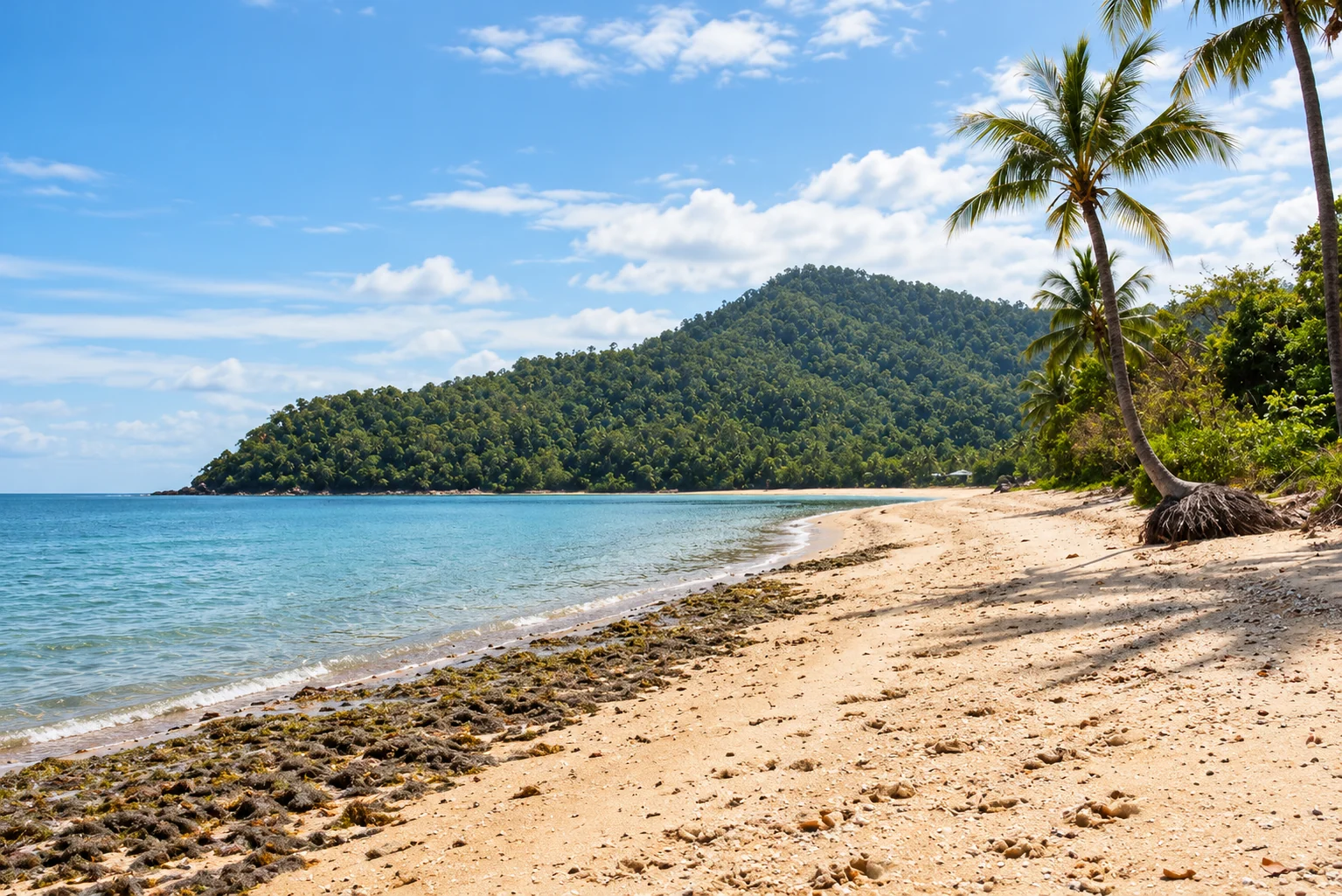
Planning a trip to Mission Beach? It is four small coastal villages on the Cassowary Coast in Tropical North Queensland, about halfway between Cairns and Townsville. Rainforest runs down to long sandy beaches, and the area is less developed than major resorts. Three things shape a trip: stinger season runs from November to May, when box jellyfish are in the water; the endangered southern cassowary, a large flightless bird, lives in the rainforest; and the Dunk Island ferry runs only Wednesday to Sunday.
The dry season, May to October, is the most comfortable time to visit. Wongaling Beach is the most practical base, and a car is useful for anything beyond the village strip.
Where Mission Beach Is
The area is made up of four villages along about 14 km of coastline. From north to south they are Bingil Bay, Mission Beach (the village), Wongaling Beach and South Mission Beach. The Cairns Australia Group describes the region as less developed than major resorts, with island and reef environments within reach.
Walking the full length of the sand between the villages covers about 14 km end to end, and the route is passable only at low tide.
The area takes its name from an Aboriginal mission the Queensland government established at South Mission Beach in 1914. A cyclone destroyed it in 1918.
Mission Beach Visitor Information Centre
The Mission Beach Visitor Information Centre is at 55 Porter Promenade, about 200 m north of the village towards Bingil Bay. It opens Monday to Friday 9am to 4pm and Saturday and Sunday 10am to 2pm. The phone number is (07) 4068 7099 and the website is missionbeachtourism.com.au. These details come from a local tourist information page, so ring ahead if you are timing a visit around the hours.
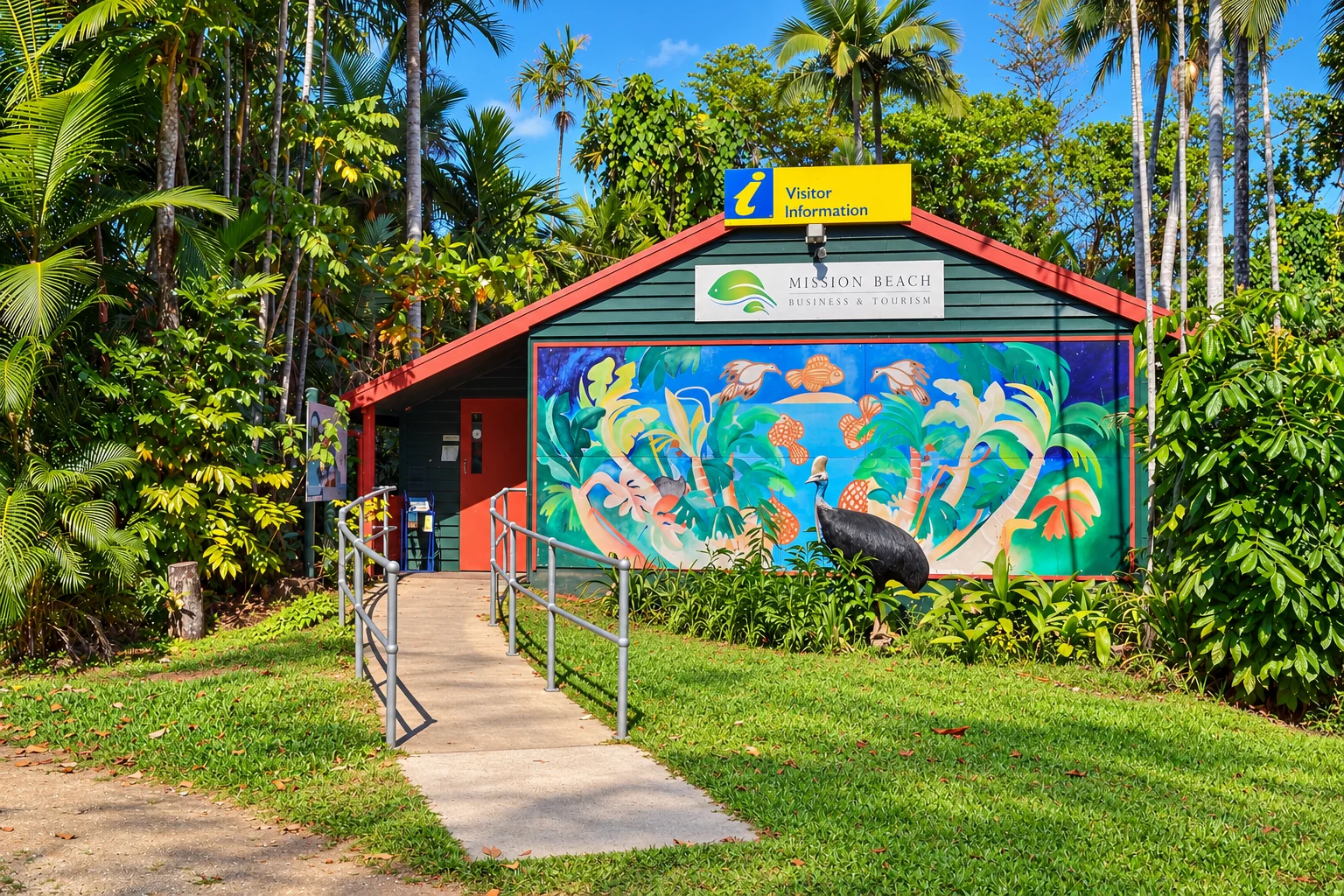
The centre books accommodation and tours for free. It also hands out maps and brochures covering campsites, swimming holes and restaurants, as well as walking tracks, fishing and self-drive routes. Staff also advise on stingers and crocodiles. Volunteers track recent cassowary sightings, and the centre shares them with visitors. The C4 Environment Centre next door has displays on rainforest ecology and cassowary conservation.
Choosing a Village and a Place to Stay
Each village suits a different kind of trip, and the distances between them are short.
Wongaling Beach is the most practical base. Woolworths, a pharmacy, a bottle shop, cafés and the Mission Beach Marketplace are within about a two-minute walk of each other, according to local visitor information. Wongaling is also the base for Dunk Island and skydiving.
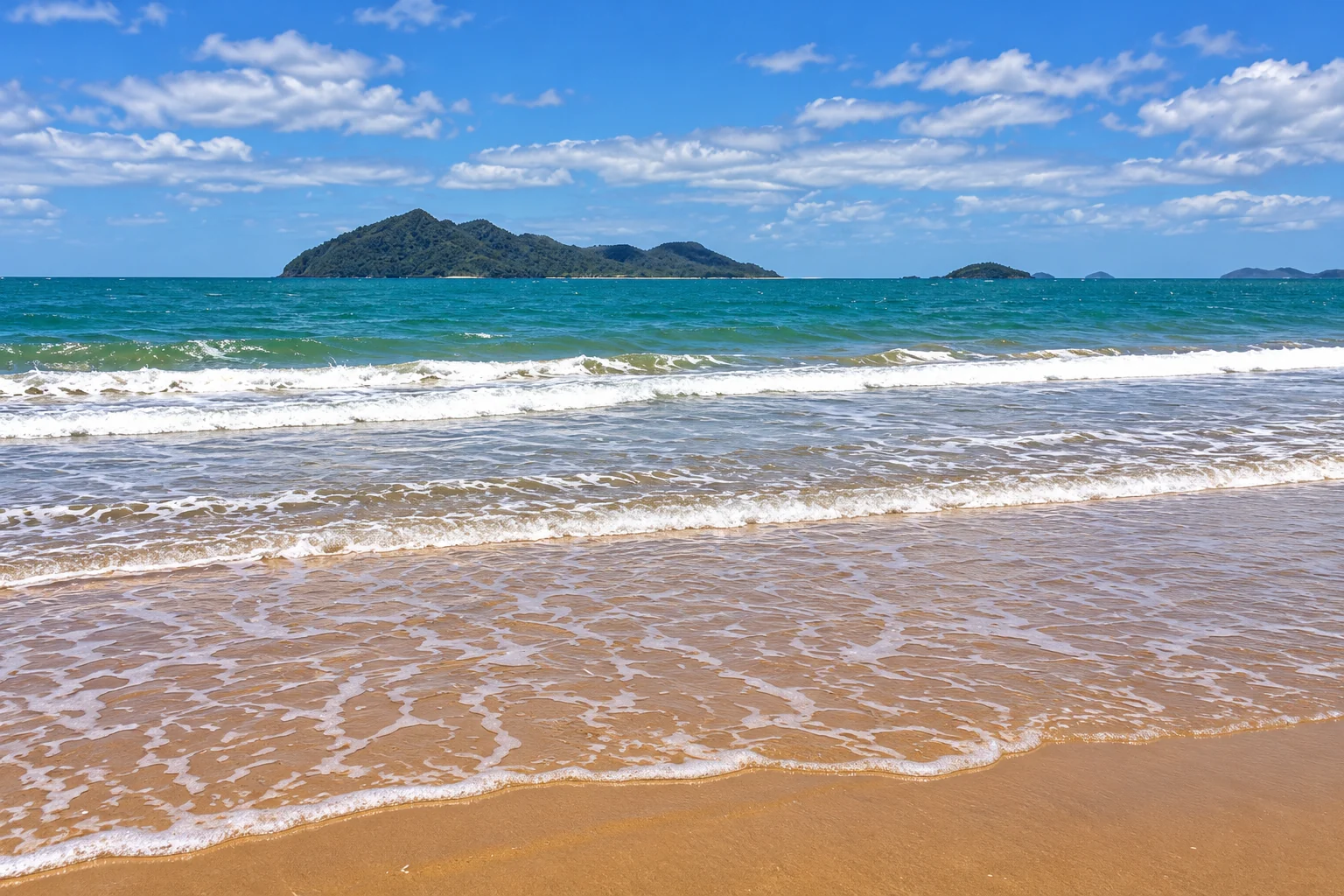
Mission Beach village has the visitor centre, cafés, restaurants and the Ulysses Link Walking Track along the foreshore. Markets run in the village on the 1st and 3rd Sundays of each month.
Bingil Bay is the quietest and most secluded village, with rainforest meeting the beach. Bingil Bay Cafe is a local institution with live music on Friday nights.

South Mission Beach is low-key and popular with long-stay travellers, and the Kennedy Walking Track starts here.
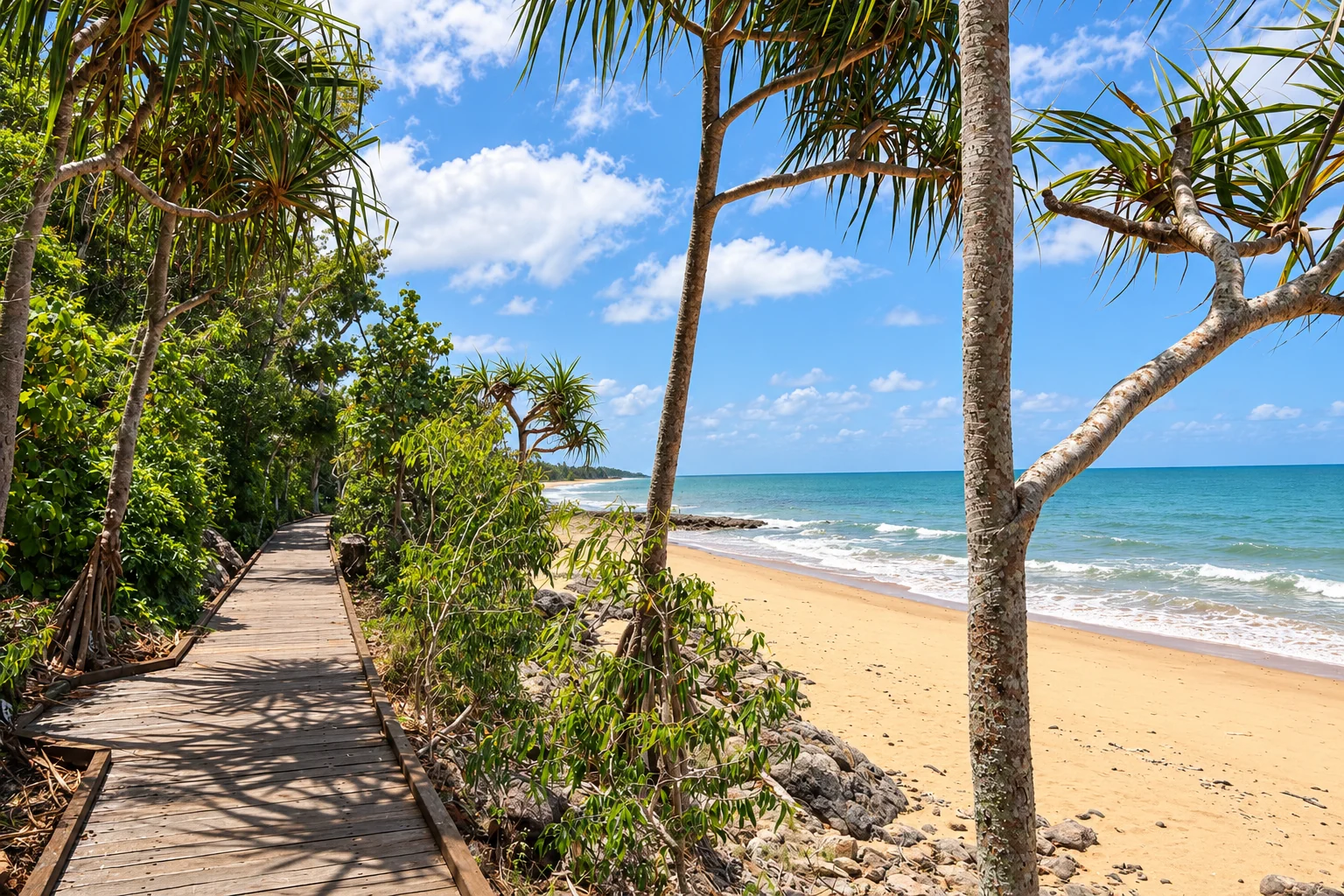
Accommodation includes resorts, beachfront apartments, holiday houses, eco-lodges, motels and budget stays. Most of it is low-rise apartments, beach houses and boutique B&Bs set behind the villages. Named options include the beachfront resorts Castaways and The Horizon, and Mission Beach Retreat, a budget hostel with a pool and laundry. Tropical Hibiscus Caravan Park caters for caravanners and campers. Three holiday parks double as Dunk Island shuttle pickup points: Tasman Holiday Park at South Mission Beach, Bali Hai Holiday Park at Wongaling Beach and Hideaway Holiday Village on Porter Promenade.
If you plan to travel without a car, Wongaling is the sensible choice because shops and the coach stop are close together.
Beaches and Swimming
The beaches are long and sandy, backed by rainforest, and swimming rules depend on the season. The Cassowary Coast Regional Council lists stinger nets at Etty Bay, Mission Beach, South Mission Beach and Kurrimine. Surf Life Saving Queensland patrols Etty Bay, Mission Beach and South Mission Beach during the Christmas and Easter school holidays. Outside those periods the beaches have no lifesavers on duty, so check the council page for current arrangements before you plan a swim.
The Kennedy Walking Track runs from South Mission Beach to Kennedy Bay, where explorer Edmund Kennedy landed in 1848.
Stinger season and first aid
Stinger season runs from November to May, according to the council and Surf Life Saving Queensland. Stingers can be present all year in tropical Queensland, but the risk is higher during these months. The council’s rules for the season are to swim only at patrolled beaches. Swim within the red and yellow flags and inside the stinger nets. Wear protective clothing. Stay out of the water when a beach is closed.
The nets keep out box jellyfish but let smaller jellyfish such as bluebottles and Irukandji through. Irukandji are transparent and usually unseen, about 1 to 2 cm across, though some reach about 10 cm long.
Surf Life Saving Queensland sets out the first aid:
- Box jellyfish: If it is safe, take the person out of the water. Pour vinegar on the stings for at least 30 seconds before picking off tentacles. Call 000 if there is more than one localised sting, or if the person looks or feels unwell.
- Irukandji: Douse with vinegar for at least 30 seconds and keep the person out of the water. Watch them for 45 minutes, since symptoms take time to appear.
Reef tours supply stinger suits, and snorkelling visibility is best in the dry season. The visitor centre also gives crocodile safety information, which is worth collecting before you explore creeks and river mouths.
Cassowaries and Rainforest Wildlife
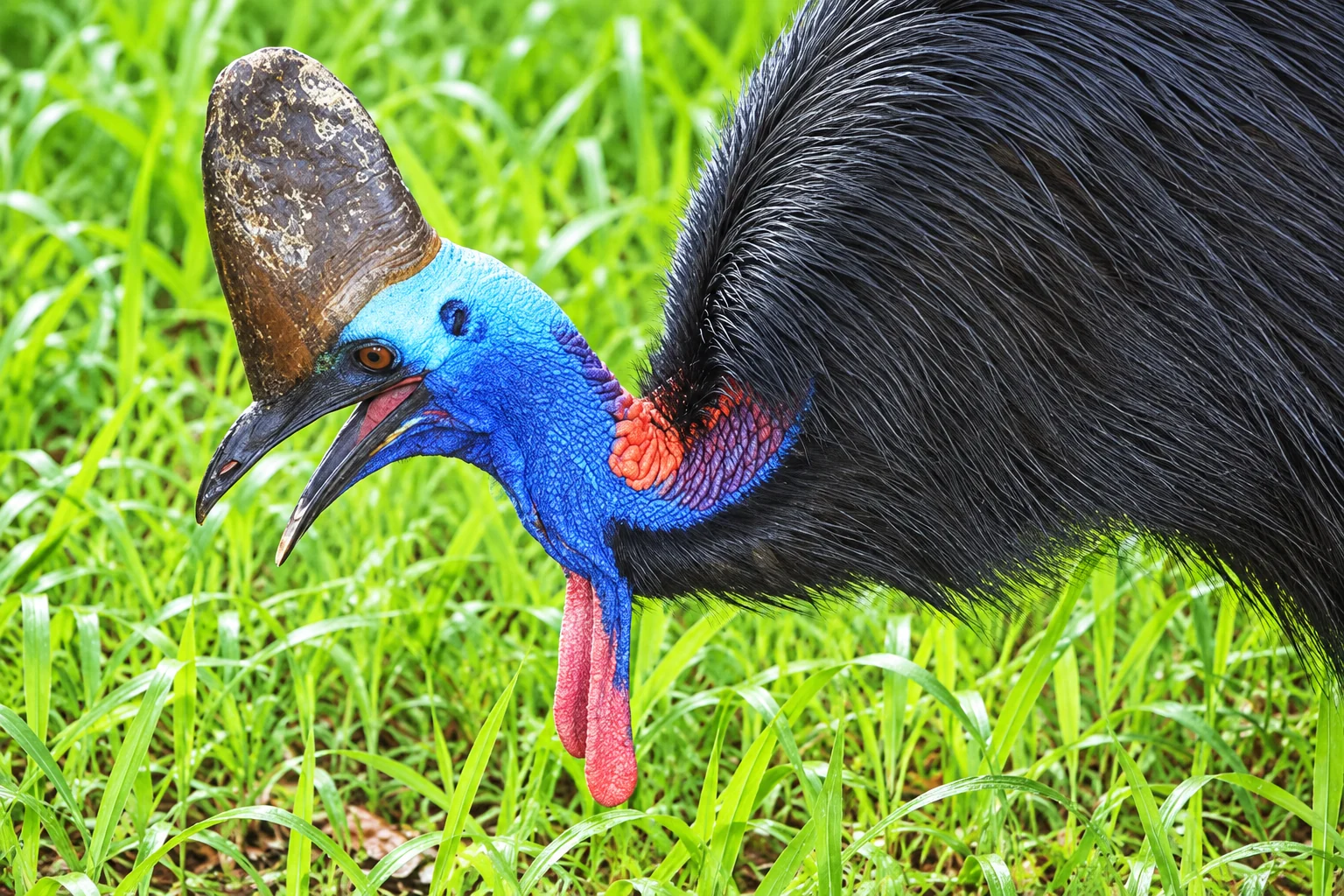
The southern population of the southern cassowary is listed as endangered under Queensland’s Nature Conservation Act 1992, and an estimated 4,000 cassowaries remain in Queensland. Mission Beach is one of the best-known places to see them, and the rules for visitors are specific.
Approaching and feeding cassowaries
Never approach a cassowary, and never approach a chick, because the male defends it. Cassowaries injure people and pets using their large, clawed feet.
Feeding is unlawful. The maximum penalty for deliberately feeding a cassowary is $6,452. Do not feed one from a vehicle or throw rubbish from a car window. The Queensland Government’s 2025 warning says to keep food scraps in closed bins and to use compost bins with secure lids. It also gave the number to report deliberate feeding: 1300 130 372. Injured, sick or orphaned cassowaries go to the Queensland Parks and Wildlife Service.
The warning followed security video from South Mission Beach, recorded on 9 May 2025, of a habituated male cassowary and his chick approaching a home hoping to be fed. Wildlife Ranger Jeff Lewis said feeding changes cassowary behaviour and creates significant risks.

Driving and dogs
Slow down in cassowary habitat and never stop your vehicle on the road to look at one. Vehicle strikes are the leading cause of cassowary deaths around Mission Beach. In a 2021 Queensland Government release, 45 cassowaries, including 24 chicks and juveniles, were reported killed or injured by vehicles near Kuranda and Mission Beach over two years. Rainforest Rescue advises extra care at Mission Beach, Bramston Beach, Coquette Point, Etty Bay, Paluma and Cape Tribulation, and says to watch for cassowary crossing signs. Driving between dusk and dawn needs particular care, when animals are most active.
If you travel with a dog, keep it behind a fence or on a leash, and lock it up at night. Attacks by feral and free-ranging dogs are a major cause of cassowary death and injury, especially around developed areas such as Mission Beach.
Where to see cassowaries
Cassowary sightings are most common around Bingil Bay. Quiet viewing from a distance works best at rainforest fringes, and Licuala State Forest is the classic spot, with a fan-palm boardwalk. Ask the visitor centre for the latest sighting locations, and read the Wet Tropics Management Authority’s guidance on cassowary behaviour and protected habitat.
Rainforest Walks
The walks near Mission Beach range from short boardwalks to a climb with a view:
- Bicton Hill, Clump Mountain National Park: a return climb through rainforest to a coastal view, which takes a bit over an hour.
- Edmund Kennedy walk, Djiru National Park: this flat boardwalk runs through mangrove fringe into rainforest.
- Ulysses Link: short shaded connectors near South Mission Beach, suitable for a couple of hours without a full-day commitment.
- Kennedy Walking Track: starts at South Mission Beach and leads to Kennedy Bay.
Carry repellent and more water than you expect to need. In the wet season, check the Bureau of Meteorology before heading out, because conditions change quickly.
When to Visit
The dry season, May to October, is generally the most comfortable time to visit, with warm days, cooler nights, low humidity and fewer storms. It also brings the best snorkelling visibility.
The wet season, November to April, is hotter and more humid, with afternoon storms. Tropical storms last days at a time, and the Tully River rises. Accommodation is cheaper and crowds are smaller. The country is greener, and coral spawning happens in this period. The wet season overlaps with stinger season (November to May), so most swimming happens inside the nets.
Summer average highs are around 30°C, and January is described as the rainiest period. Winter average lows are around 16°C. Another climate summary puts March as the wettest month, with highs around 28.1°C and lows near 20.3°C, and winter highs near 24.6°C.
For beach swimming with the nets and lifesaver patrols running, aim for the Christmas or Easter school holidays and accept the heat and storm risk. For walking, snorkelling and settled weather, choose the dry months.
How to Get to Mission Beach
By car
Driving gives the most flexibility. From Cairns it is about 139 km south on the Bruce Highway and A1, roughly 1 hour 45 minutes to 2 hours. From Townsville it is about 235 km north on the Bruce Highway, just under 3 hours. From Brisbane the distance is about 1,595 km.
Coming from the north, leave the highway at El Arish. Mission Beach is about 25 km from the turnoff. From the south, turn off just north of Tully, and South Mission Beach is about 18 km along, according to Frommer’s. Behana Gorge, Josephine Falls, Eubenangee Swamp and Bingil Bay are stops along the way. Cairns Airport is the recommended car hire pickup point.
By coach
Greyhound and Premier stop at the bus terminal at the Cassowary Shopping Village in Wongaling Beach, beside the Big Cassowary. Both run daily northbound and southbound services. Greyhound’s Cairns service runs about four times a day, and fares vary by booking. Greyhound’s phone number is 1300 473 946.
By train
There is no direct train. Tully, about 20 km west, is the nearest station on the Spirit of Queensland route, which serves it four days each way (northbound Monday, Wednesday, Friday and Saturday; southbound Monday, Wednesday, Friday and Sunday). The Tilt Train does not stop at Tully. Cairns to Tully on the Tilt Train takes roughly 2 hours 50 minutes. Fares vary by route and seat type, and bookings go through Queensland Rail’s Traveltrain division.
Transfers and flights
Cairns Airport is the nearest commercial airport and there are no direct flights to Mission Beach. Qantas, Jetstar and Virgin Australia fly into Cairns and Townsville. Townsville Airport is smaller and serves domestic destinations including Adelaide, Brisbane, Cairns, Darwin and the Gold Coast.
From the airport and Tully, these ground transfers run:
- Beach Bus runs between Tully and Mission Beach. The operator sets the fares.
- Sun Palm Transport from Cairns and Cairns Airport, twice a day, phone 07 4087 2900.
- Exemplar Coaches and Limousines from Cairns Airport twice a day, with one return a day. Book 48 hours ahead.
- Taxis: 131 008 for the local taxi service. Supreme Taxis also runs Tully to Mission Beach trips, phone 07 4068 1427.
- Mission Link is an on-demand local bus that runs Monday to Friday.
The transfer details are from Frommer’s and Wikitravel. Check current fares with the operators before you book.
Dunk Island Ferry Times and Fares
Dunk Island is the main island day trip. The Dunk Island Ferry runs Wednesday to Sunday with two departures each way, and the crossing from Clump Point Jetty takes about 15 minutes. Its "operating today" and "next departure" displays change daily, so check them on the day of travel.
Other operators have also run island and reef transfers in the past. QuickCoast, which offered ferry services between Mission Beach, Cairns, Dunk Island and the reef, paused its services, so check its current status before relying on it.
Timetable and check-in
- Mission Beach to Dunk Island: 08:45 and 12:30.
- Dunk Island to Mission Beach: 10:30 and 15:30.
Day visitors take the 08:45 out and the 15:30 back. Overnight guests typically take the 12:30 crossing, with check-in from 12:30 pm, and return on the 10:30 am ferry, with check-out by 10:00 am. Check in at Clump Point Jetty by 08:30 for the 08:45 departure, and arrive at least 15 minutes before any departure, because the ferry does not wait.
Fares and booking
Return fares as listed by the Dunk Island Adventures page (AUD, including GST) are:
- Adult (15+): $66.30.
- Child (3 to 15): $41, when travelling with an adult.
- Pensioner: $51, with a valid Pension, DVA or Senior card.
- Family (2 adults, 2 children): $194, saving $20.60 against individual tickets.
- Under 3: free with a paying adult.
All fares include a free shuttle and a safety briefing with a life jacket. Eco Tent or campsite guests who book ferry transfers get 10% off.
Pre-book through the ferry’s online booking system, because walk-ups cannot be accommodated. Each slot has a set number of places, shown as "Seat 1 of 2" or "Seat 2 of 2". Carry the confirmation on your phone or printed.
Shuttle pickups and parking
The free shuttle collects from these points:
| Pickup point | Address | Times |
|---|---|---|
| South Mission Beach | Tasman Holiday Park, 122–132 Kennedy Esplanade | 8:00 am and 11:45 am |
| Wongaling Beach | Bali Hai Holiday Park, 1 Wongaling Beach Road | 8:10 am and 11:55 am |
| Mission Beach CBD | Bus stop opposite Australia Post, 32 Porter Promenade | 8:20 am and 12:05 pm |
| Hideaway Holiday Village | 58–60 Porter Promenade (Eco Tent guests) | 12:10 pm |
If you drive, public parking at Clump Point Jetty is free with no time limit for day trippers. Hideaway Holiday Village offers secure overnight parking for $10 a night, and the Mission Beach CBD Council carpark off Campbell Street is free.
On the island
Dunk Island has walking trails (wear comfortable walking shoes), Mount Kootaloo, snorkelling with the reef close to shore, and camping with a permit. The island restaurant and bar take cash and card. Pack high-SPF reef-safe sunscreen, a hat, swimwear, a towel, snorkel gear and a refillable water bottle.
Day Trips from Mission Beach
Mamu Tropical Skywalk is a canopy walkway 350 m long and 15 m above the ground, in World Heritage-listed Wooroonooran National Park, about an hour from Mission Beach. A combined ticket with Paronella Park is available, and Paronella Park includes a free guided tour.
Josephine Falls in Wooroonooran National Park is a swimming option, and Innisfail is a nearby town to visit. Check conditions after heavy rain, since wet season storms raise water levels.
Atherton Tablelands and Tully River rafting are further options. Tully River flows are higher in the wet season.
Cardwell Spa Pool is about 1 hour south, and the water level reportedly depends on the rainy season, so ask locally before making the drive.
Skydiving departs from Wongaling Beach, and the highlight is the view over rainforest and reef.
Most of these places need a car, which is another reason to hire one at Cairns Airport if you plan more than a couple of excursions.
Money, Getting Around and Safety
Money. A Bendigo Bank branch at Wongaling Beach, next to Woolworths, opens Monday to Friday 10am to 3pm, and ATMs are at Woolworths and a few other points. Many cafés and market stalls, as well as fruit stands, take cash only, so carry some.
Getting around. Most visitors manage without a car within Wongaling Beach. A car is useful for swimming holes, Paronella Park and the Atherton Tablelands. If you stay outside the Dunk Island shuttle route, drive to Clump Point Jetty on ferry days.
Emergencies. Call 000 for emergencies, including a box jellyfish sting with more than one localised sting or a person who looks or feels unwell.
Wildlife. Keep your distance from cassowaries, never feed wildlife, slow down on roads and keep dogs fenced or leashed.