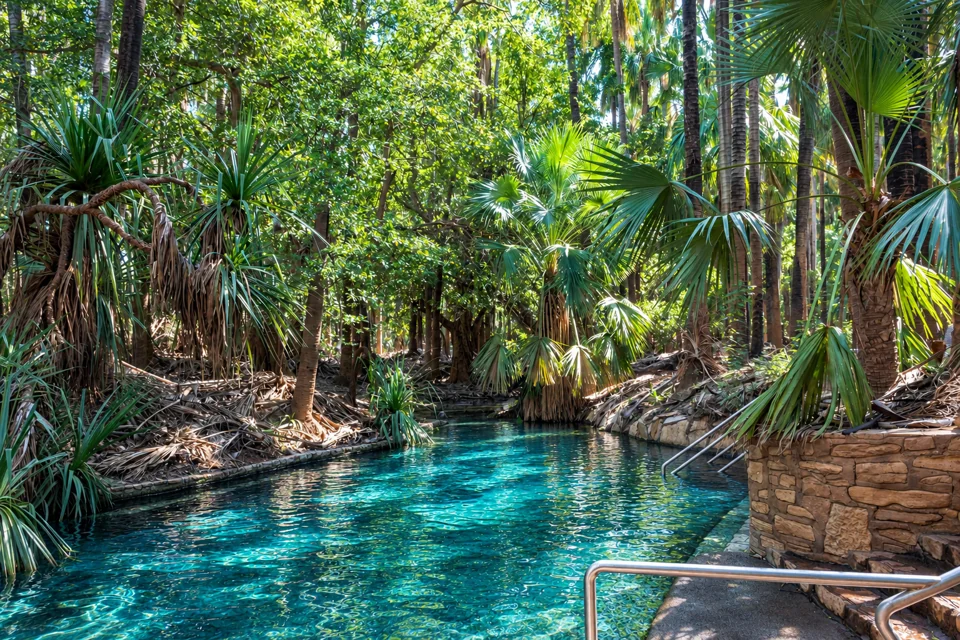
Mataranka is a small town on the Stuart Highway in the Top End of the Northern Territory. It is the base for two natural thermal pools, Mataranka Thermal Pool and Bitter Springs, which sit inside Elsey National Park. Both hold water at about 34°C year-round, making them an easy detour for drivers travelling between Katherine and Darwin.

Visitors need an NT Parks Visitor Pass, but NT residents are exempt. The main timing risk is the wet season, when flooding closes or restricts access to the pools, roughly from November to May.
Getting to Mataranka
The park’s official camping page places Elsey National Park 120 km south of Katherine, near Mataranka. Roper Gulf Regional Council gives 108 km to the town on an all-weather road, which takes about an hour. Allow about an hour to an hour and a quarter from Katherine to the pool itself. The council describes the Stuart Highway here as double-lane and sealed.
For the wider trip, NT Travel gives 314 km and about three hours between Katherine and Darwin, and Norther describes the park as 378 km south-east of Darwin. Mataranka suits a long stop or an overnight, because the pools reward slow soaking.
The NT Government’s Road Report is the live source for highway conditions, and it warns that conditions can change rapidly. Check it on the day you drive.
Best time to visit the pools
The park’s fact sheet names May to September as the most comfortable time to visit Elsey. Crowds peak then too: the pools are busiest during school holidays and from June to August. In those months, early morning or late afternoon visits work best. The 34°C water stays warm even when the air feels cool, so a soak at first light is comfortable in the cooler months.

The wet season brings the closures. The Mataranka Roadhouse listing states that the pool is closed from November to May because of flooding. The exact dates change each year. Check the NT Parks website or phone the park in October or May. Bitter Springs is often closed for part of the wet season because of flood risk and high water levels.
Heat is a second reason to avoid the wet months. Wet-season daytime temperatures are often above 35°C and occasionally around 40°C.
If you travel in the shoulder months, check NT Parks notices and the Road Report before you leave. On the Katherine side, NT Travel warns that Knott’s Crossing on the Nitmiluk Gorge route may be closed during or after the wet season, especially between November and April. That crossing is on the gorge route and does not affect the Stuart Highway south to Mataranka.
Both pools are listed as open 24 hours a day, every day, but seasonal closures apply, so check before you go.
Passes and fees
Entry to Mataranka Thermal Pool and Bitter Springs requires an NT Parks Visitor Pass. NT residents are exempt, and Northern Territory Tourism notes that visitors may be asked for proof such as an NT driver licence. You can buy the pass online through the NT Parks website or at self-registration stations in the park.

Northern Territory Tourism lists these pass prices for Elsey National Park:
| Pass | 1 day | 3 days | 2 weeks | 1 month | Annual |
|---|---|---|---|---|---|
| Adult | $10 | $20 | $30 | $45 | $60 |
| Child (5 to 17) | $5 | $10 | $15 | $22 | $30 |
| Family (2 adults, 4 children) | $25 | $50 | $75 | $110 | $150 |
| Concession (Seniors Card, Pensioner Concession Card, DVA Card) | $8 | $16 | $24 | $36 | $48 |
Prices change, so confirm the current figure on the NT Parks website before you buy. A one-day adult pass covers a morning at one pool and an afternoon at the other. If you plan to stay two or more days and walk to Korowan, the three-day or two-week pass costs little more than buying single days.
Apart from the pass, no separate fee applies to swim at the thermal pool. The pass also reaches beyond Elsey, but Kakadu and Uluru–Kata Tjuta are managed by Parks Australia and fall outside it.
Mataranka Thermal Pool
The pool is at 642 Homestead Rd, Mataranka NT 0852, at the end of Homestead Road, and you reach it by turning east off the Stuart Highway about 1.5 km south of the town. Rainbow Spring feeds the pool and bubbles constantly, and the overflow runs into the Waterhouse River. The water is crystal clear over a natural sandy bottom.
The pool is compact and set in a palm grotto. The pool is better for long floating than for vigorous swimming, and it suits families. Steps with handrails lead into the water, and wheelchair users may need help at the water’s edge. The NT Government walks page lists the 500 m loop from the car park to the pool as pram and wheelchair accessible. Take your shoes off at the water’s edge and bring sun protection for the walk in.
Toilets and picnic facilities are at the Mataranka Homestead car park. The thermal pool site itself has no toilets, Norther notes, so use the facilities before you walk down.
Bitter Springs
Bitter Springs lies off Martin Road, about 2.9 km from the township. The water is also about 34°C and flows at about 30.5 million litres a day. The pool is deeper than the Mataranka pool, and according to Top Hot Springs most visitors cannot stand with their heads above water. Flotation devices are encouraged for children.
Visitors drift a couple of hundred metres down the springs and climb out by a ladder. The drift is unsuited to children under 8. Entry is through a single point with stairs and a ladder, and the shoreline is jagged and edged with pandanus palms. A day-use area has barbecues, tables and eco-friendly toilets.
The official walks page lists Bitter Springs as a 500 m loop of about 20 minutes. It is pram and wheelchair accessible from the car park to the swimming hole, with stairs and handrails into the water. Most visitors choose between the two pools by what they want from a swim. The Mataranka pool suits a short, shallow soak close to the homestead, and Bitter Springs suits a longer, deeper drift with more current.

Swimming safely and crocodiles
Saltwater crocodiles live in the wider Elsey and Roper river system, so swim only in the designated pools. Swimming outside the designated pools is not advised, because estuarine crocodiles enter the Roper system. The same applies to the wetlands and the Waterhouse River beyond the pool area.
Rangers monitor the springs. Crocodile sightings at Bitter Springs are extremely rare, and they close the springs if one is found. Crocodiles are not typically found within the swimming area, and visitors should never enter water where signage advises against it. Obey every warning sign.
A few other rules apply at the pools:
- No lifeguard is on duty, and children must be supervised in and around the water.
- Keep soaps and personal care products out of the pool water, and carry out your litter.
- Flying foxes roost in the surrounding palms and are protected, so keep your distance.
Walks and the hot, exposed riverside tracks bring heat risks. The NT Government’s heat advice covers how to prepare. Carry water, wear sun protection and suitable footwear.
Walks in Elsey National Park
The NT Government walks page (last modified 24 September 2024) lists these walks. It advises choosing one to suit your fitness, telling someone your route and return time, and checking maps and signs. It also warns that the walks are exposed and heat can be extreme.
| Walk | Distance | Time | Notes |
|---|---|---|---|
| Bitter Springs | 500 m loop | 20 min | Accessible to the swimming hole; stairs with handrails into the water |
| Mataranka Thermal Pool | 500 m loop | 20 min | Same access and stair details |
| Sheep Dip | 365 m return | 20 min | Pastoral history; no wheelchair access |
| WWII Aboriginal Army Camp | 650 m return | 30 min | No wheelchair access |
| Stevie’s Hole | 1.2 km return | 45 min | Follows the Waterhouse River from the Homestead to the Riverside Walk |
| Botanic Walk | 1.5 km loop | 45 min | Riverine and rainforest species |
| Korowan (Mataranka Falls) | 8 km return | 4 hours | Tufa dams on the Roper River; suitable for energetic children |
| Riverside Walk | 16 km | 8 hours | River access and picnic spots |
All walks except the two pool loops are graded 2 (easy), and the pool loops are grade 1. The Korowan walk is the pick for a longer outing. Tufa dams form where calcium carbonate deposits build up on rock bars in the Roper River, creating gentle rapids. The Riverside Walk ends at Jalmurark Campground, which makes it a long day or an overnight link rather than a casual stroll. Start long walks early in the dry season, because the tracks have little shade.
Camping and places to stay
Jalmurark Campground is the park’s main campground. It has toilets, showers and barbecues, no powered sites, and 2WD access with room for caravans and trailers. Generators, pets and fireworks are prohibited, according to the official camping page. A campground host is on site during the peak season of May to September.

Bookings for designated sites must be made and paid online before you arrive at parkbookings.nt.gov.au. Payment at the park is not possible. Fees follow the NT camping fee schedule, which lists the current figure for the campground’s category.
On site, boil water before drinking, because the campground does not supply treated water. The same page says to take your rubbish out (no bins are provided), collect firewood from the sides of main roads and keep fires in designated pits. When washing up or bathing with soap or detergent, stay 50 m from waterways. Drones need a permit obtained before arrival.
If you want power or a bed, several commercial options are close to the springs, according to Norther:
- Bitter Springs Cabins and Camping has powered and unpowered sites, plus toilets, showers and picnic areas. Book ahead in peak season.
- Mataranka Homestead is close to the thermal pool. It has powered sites, toilets, showers and a swimming pool.
- Little Roper Stock Camp has basic facilities, unpowered sites, campfires and a communal kitchen.
The Mataranka Roadhouse, near the highway turnoff, has fuel, accommodation and a café.
Fishing and the Roper River
Fishing in the park needs no permit, but traps, nets and spears are prohibited, and fishing is not allowed at Bitter Springs, Mataranka Thermal Pools or Stevie’s Hole. The official list of Roper River fishing locations includes 4 Mile, 11 Mile, 12 Mile Yards (Jalmurark), Korowan (Mataranka Falls), Little Roper, Wabalarr and Mururark, along with the Waterhouse River beside the thermal pools.
Concrete boat ramps are at 4 Mile and 12 Mile Yards (Jalmurark). Most park locations limit outboards to 15 hp, and the ranger station can confirm local limits. Canoeing is also popular on the Roper. Swimming in the river is possible only in selected areas, so stick to the pools unless signage says otherwise.
Scenery and wildlife
The Roper River runs through large waterholes before tumbling over rocks and tufa dams, as the walks page describes. Fan palms (Livistona rigida) line the thermal pools and walking paths, and the official walks page calls Bitter Springs "Livistona-lined." Palms and paperbarks edge the Waterhouse River.
Birdwatchers will see rainbow bee-eaters around the springs, and a flying fox colony roosts in the palms near the pool. Norther describes the park as the setting of Jeannie Gunn’s novel We of the Never Never. The park was established in 1991, covers about 139 km² and is managed by the Parks and Wildlife Commission of the NT. The park recorded 207,700 visitors in 2022.
History around Mataranka
Caravan World names the Mangarrayi and Yangman people as the Traditional Owners of the area. During World War II, more than 100 military units were based at Mataranka, including a hospital, ammunition dumps, workshops and an Aboriginal labour force. The park’s WWII Aboriginal Army Camp walk (650 m return) and the Sheep Dip walk (365 m return, pastoral history) cover parts of this past.
In town, the We of the Never Never Museum covers the North Australian Railway, the Overland Telegraph, WWII and Aboriginal history. Opening hours change, so check current hours before you go. A replica station house built for the film We of the Never Never stands at the Mataranka Homestead Tourist Resort, and guests can stay in it.
Elsey Cemetery is 21 km south of Mataranka, reached by Elsey Cemetery Road off the Stuart Highway. It is a declared heritage place under the NT Heritage Conservation Act.
Side routes and fuel
The Central Arnhem Road branches east from the Stuart Highway 51 km south of Katherine and runs 663 km to Nhulunbuy. Fuel is at Wulugarr (60 km from the junction), Mainoru Store (197 km) and Bulman (256 km), so carry extra fuel. Telstra service is available at Barunga, Beswick, Bulman and at locations marked with blue signposts. The route is a long drive, so plan it as its own trip.
Planning a visit
Most travellers fit Mataranka into a Katherine to Darwin drive as an overnight stop. Arrive in the afternoon, soak at the thermal pool in the late light, camp or stay nearby, then swim at Bitter Springs at the start of the next day before the crowds build. Add a night if you want the Korowan walk or time on the river.
Before you leave, check the Road Report for the Stuart Highway, check NT Parks for closure and flood notices, buy your pass online, and book Jalmurark if you want a campsite. Bring water, sun protection and shoes for the paths.
