
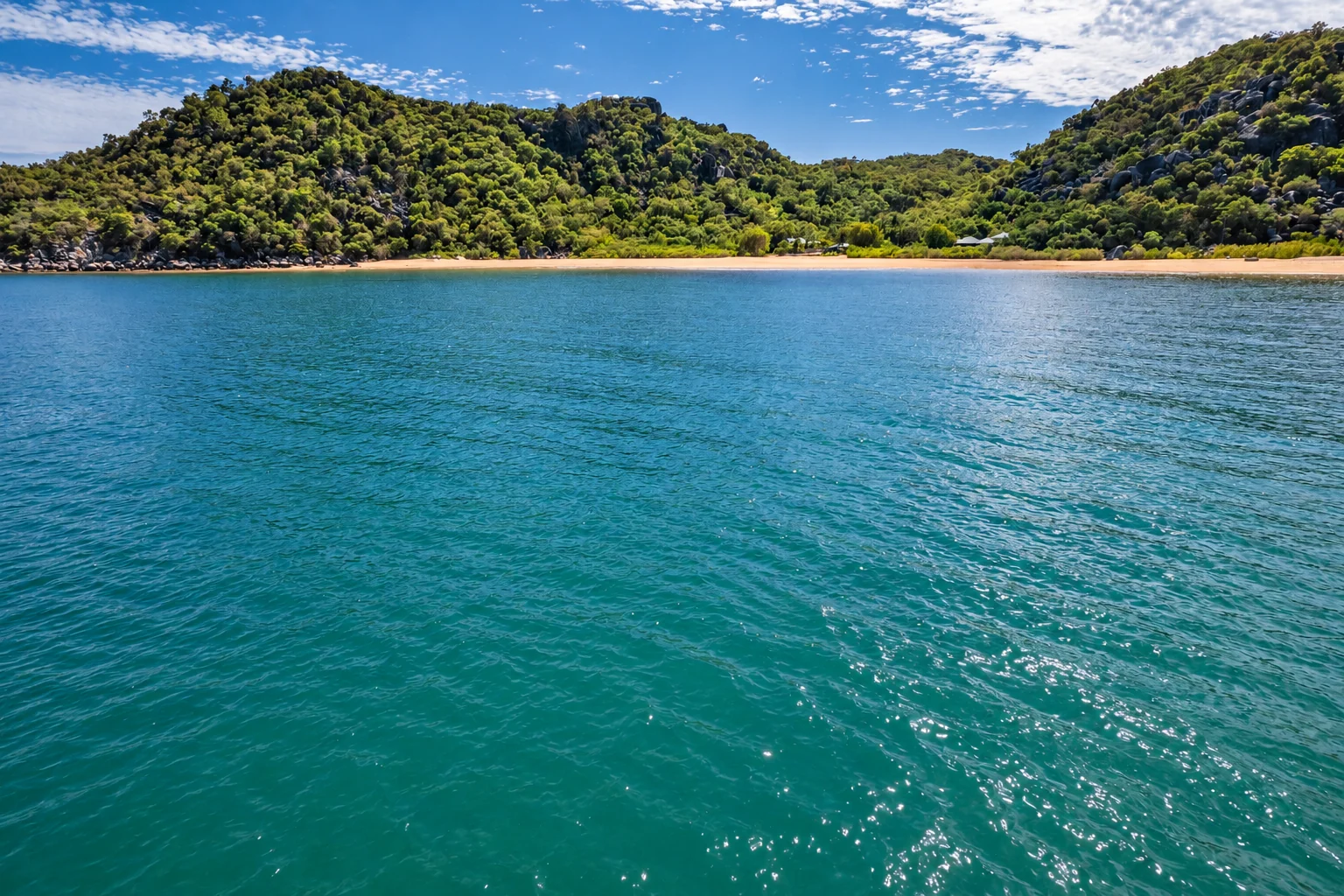
Magnetic Island (Yunbenun to the Wulgurukaba people, its traditional owners) sits off Townsville in North Queensland, and about three-quarters of it is national or conservation park. Visitors can come for a day or stay overnight. The ferry crossing is short, a bus links the main villages, and bays, bush walks and wild koalas are within a few kilometres of the ferry terminal. The guide covers the crossing, beaches, walks, wildlife rules, accommodation, getting around and the best months to visit. Check the official page linked in each section before you travel, as fares, timetables and track notices change.
Getting there by ferry
Two operators run from Townsville to Nelly Bay, the island’s ferry port. SeaLink runs the main passenger timetable from its terminal in the Breakwater area. Magnetic Island Ferries is the only vehicle ferry and departs from 42 Ross Street, South Townsville. Older guides may still refer to Sunferries, the earlier name of the SeaLink service.
The Queensland Parks and Wildlife Service (QPWS) puts the 11.5 km trip to Nelly Bay at about 20 to 40 minutes. Allow about half an hour on the water for the passenger ferry and longer for the car ferry.
SeaLink lists up to 17 return services a day. From Townsville, the first departure is 5:30am (Monday to Saturday, and it may not run on public holidays). Later departures run through the day at 6:30am, 7:00am (Monday to Saturday), 7:45am, 8:45am, 9:30am, 10:30am, 11:40am, 1:00pm, 2:15pm, 3:50pm, 4:30pm, 5:25pm (Monday to Friday), 6:00pm, 7:30pm and 9:20pm. A 10:30pm service runs Wednesday to Saturday. Departures from the island start at 6:00am (Monday to Saturday) and 7:00am (Monday to Sunday), and the last is 11:00pm on Wednesday to Saturday. SeaLink says timetables are subject to change without notice and publishes a ferry status page for live changes.
Public holidays and special events have their own timetables, including the Townsville Show, King’s Birthday, Christmas Day (a reduced schedule), Boxing Day and New Year’s Day. SeaLink is also taking registrations for an extra late ferry after the Foo Fighters concert on Saturday 7 November 2026, which still needs Translink approval. Translink lists Breakwater and Nelly Bay as the ferry stops in its journey planner.
Fares
Magnetic Island Ferries lists a walk-on adult return from $36.00, and its prices page holds the current fares. A 2026 ferry guide lists a walk-on return at $42.00, a standard car up to 5.5 m at $117.65 return and a motorbike with rider and passenger at $52.65 return. Compare these against the operator’s page on the day you book, because the fare depends on operator, ticket type and date.

Parking, luggage and the airport
SeaLink’s Townsville terminal parking starts from $10.00 per day for a standard vehicle, but that car park is not fenced. SeaLink directs travellers wanting secure parking to Metro Quays Car Park, about a 20-minute walk or a public bus ride away. Magnetic Island Ferries lists secure parking from $8.00 per day at Ross Street. Luggage lockers at the SeaLink terminal measure 80 cm × 45 cm × 55 cm and cost from $10 per 24 hours, but they are only accessible during terminal hours.
From Townsville Airport, a taxi to the terminal takes about 10 to 15 minutes. Townsville City Shuttle runs seven days a week and should be booked ahead, according to SeaLink’s FAQ. Arrive 15 to 20 minutes before departure to park and buy a ticket.
Taking a vehicle across
Magnetic Island Ferries calls vehicle bookings essential and carries cars, trailers, campervans and bikes. Its homepage also says it will take snorkelling gear, paddleboards, fishing gear and camping supplies. Book the vehicle ferry directly with that operator, since SeaLink’s timetable page does not set out a vehicle policy. Most visitors skip the vehicle and hire a car, scooter or bike on the island (see the getting-around section below).
Day trip or overnight stay
A day trip works if you plan around the timetable. Take an early ferry, because QPWS advises walking early in the day when it is cooler, parking is easier and wildlife is more active. The late departures give you a long window: the island service runs until 11:00pm Wednesday to Saturday, so check the timetable for your day before you commit to a final return.
In a single day you can fit one main walk, one beach and a bus loop. The Forts Walk is the most popular option. Add a swim at Horseshoe Bay or Picnic Bay (both have stinger nets in season) and a stop for rock-wallabies near the Geoffrey Bay jetty or Nelly Bay harbour in the late afternoon. An overnight stay gives you the early and late hours when animals are most active, plus time for the longer tracks and a sunset at Hawkings Point. Two nights covers the island at an easy pace, including the bay walks that are too long to squeeze in around ferry times.

For either option, pack water, because most walks have none. Bring sun protection and a stinger suit if you plan to swim between November and May.
Beaches on the island
Magnetic Island Ferries describes more than 23 bays and beaches. Official park pages name Horseshoe Bay, Picnic Bay, Nelly Bay, Alma Bay (Arcadia), Geoffrey Bay, Balding Bay, Florence Bay, Rocky Bay, Arthur Bay, White Lady Bay, Lovers Bay and the Five Beach bays.
The villages sit on the island’s more accessible bays. Horseshoe Bay has a beachfront bus stop. Picnic Bay is the southern village, and Nelly Bay is where the ferry arrives. Alma Bay at Arcadia sits between Nelly Bay and Horseshoe Bay along the bus route. These are also the beaches with the most facilities.
The quieter bays take a walk to reach. QPWS describes Balding Bay as a secluded bay with a wide sandy beach, reached by a 1.4 km walk one way of about 40 minutes (Grade 4, no toilets). Florence Bay is reached by the Forts Walk to Florence Bay track. Dogs are not allowed on these bays or on any tidal land in the national park.
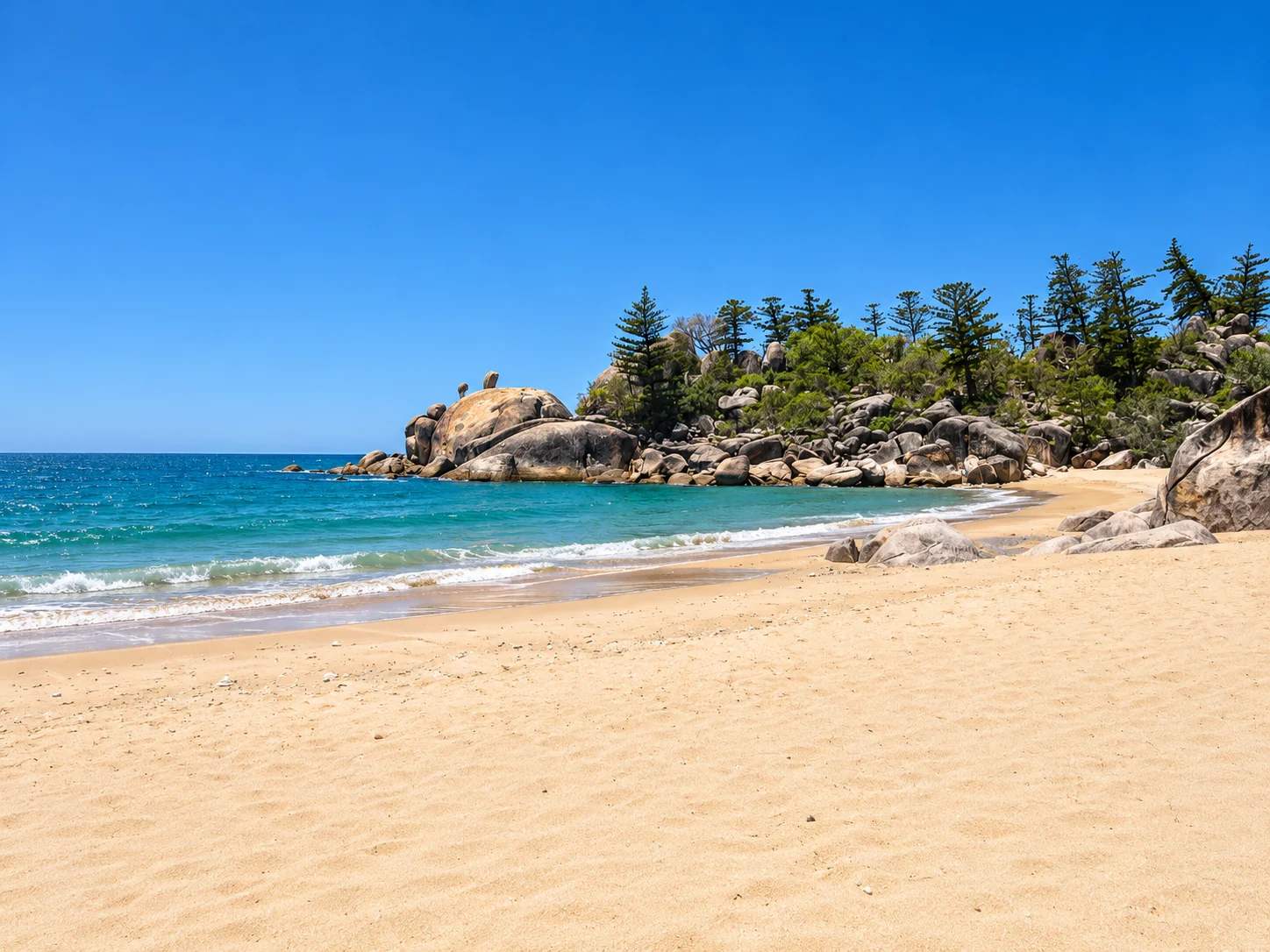
Behind Horseshoe Bay, the Horseshoe Bay Lagoon is the island’s largest seasonal freshwater lagoon and a good spot for birdlife. It is a Grade 2 walk of 560 m one way.
Stinger season and swimming
Townsville’s stinger season, when box jellyfish and Irukandji are in the water, runs from November to May, according to Townsville City Council. Mayor Nick Dametto described the jellyfish as common across the region’s beaches in that period.
Stinger nets (enclosures that fence off a swimming area) protect two Magnetic Island beaches: Picnic Bay and Horseshoe Bay. A local report dated 25 October 2026 said nets were to be installed at six locations that week: Balgal Beach, Horseshoe Bay, Picnic Bay, The Strand North and South, and Pallarenda Beach. The previous season’s nets were removed after the 2025–26 season, so nets are in place only during the season.
The nets do not stop every sting. Council has said jellyfish can still wash over or through the sides in certain conditions, and a 2021 release said the nets can’t stop every sting and recommended carrying vinegar or wearing a stinger suit. Swim inside the enclosure and between the red and yellow flags, wear a stinger suit, and follow lifesaver advice. Do not sit on, play near or interfere with the nets. Surf Life Saving Queensland lifeguards run regular stinger drags and close a beach immediately if one is found. Tell the lifeguard or lifesaver on duty if you are stung.
Outside the netted beaches, treat the water in stinger season as unsafe for swimming. The bays reached by walking tracks have no enclosures.
Walks in the national park
QPWS manages the Magnetic Island National Park walking network, which its 2023 management statement describes as over 20 km of tracks and several lookouts, mostly on the eastern side. All are rated as moderate difficulty because of the hilly terrain. The QPWS Journeys page lists these tracks:
| Track | Length and time | Grade | Notes |
|---|---|---|---|
| Forts Junction (hub) | 400 m return, about 15 minutes | 2 | Toilets; wheelchair access (may need assistance); no lookout |
| Forts Walk | 4 km | 3 | Most popular walk; lookout; no toilets |
| Forts Walk to Florence Bay | 3 km one way | 3 | No toilets; no lookout |
| North-east coastal walk | Circuit | 4 | Only walking tracks to the coastal areas in the park; lookout |
| Balding Bay | 1.4 km one way, about 40 minutes | 4 | Secluded sandy bay; no toilets |
| Horseshoe Bay Lagoon | 560 m one way | 2 | Seasonal freshwater lagoon; birdlife |
| Nelly to Arcadia to Forts Junction | 5 km | 4 | Dry rainforest, grassland and woodland; lookout |
| Hawkings Point lookout | 1.2 km return, about 30 minutes | 4 | Sunset viewpoint; birds of prey |
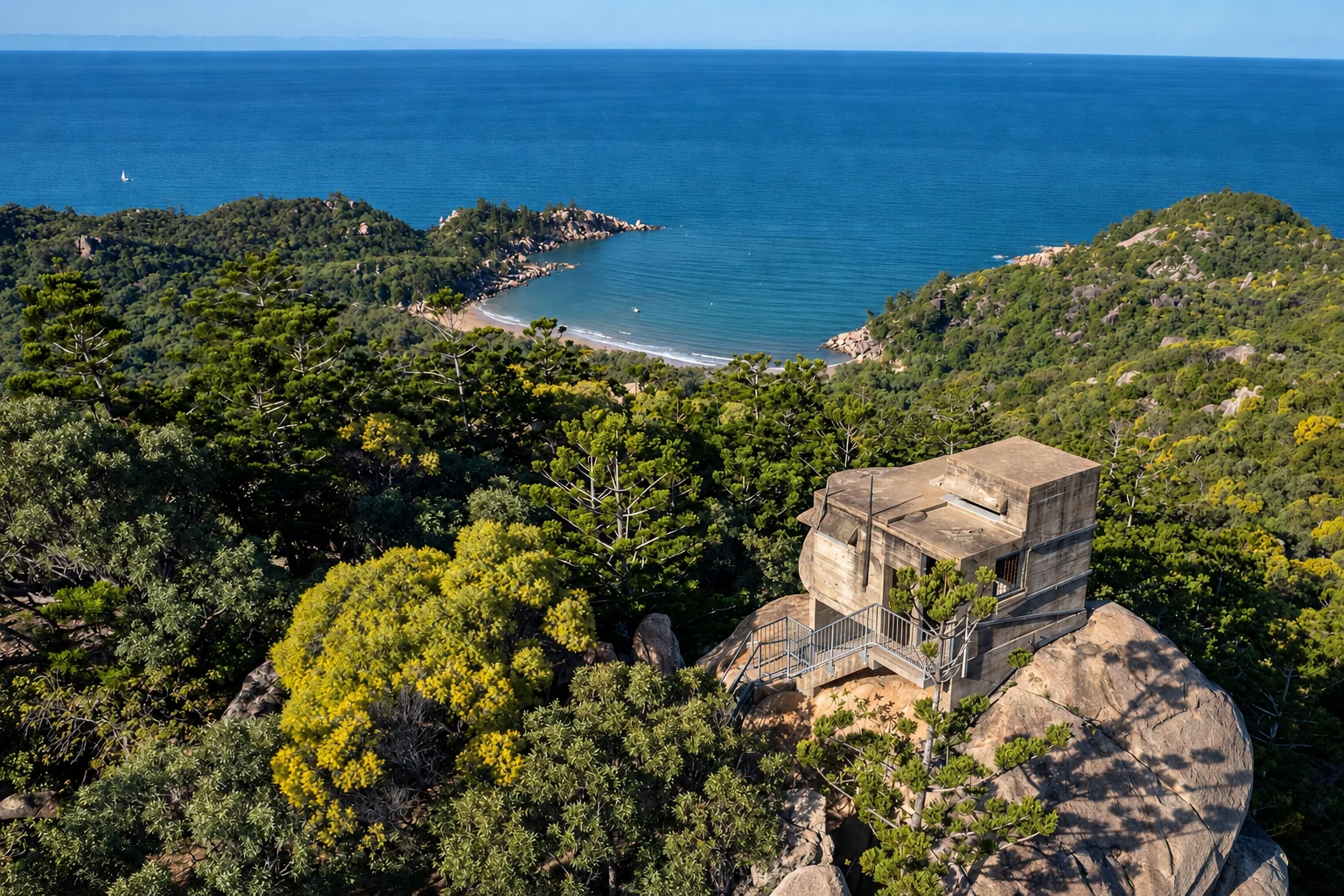
The Forts Walk is the one most visitors do, and QPWS calls it the island’s most popular walking experience. It passes World War II fort ruins, which are on the Queensland Heritage Register, and eucalypt and acacia woodland where wild koalas are regularly spotted. The upper Forts circuit has many steps. If you have time for only one walk, start here and add the Florence Bay extension if you want a beach at the end.
For a sunset, Hawkings Point is a short walk with birds of prey overhead. The Nelly to Arcadia to Forts Junction track suits anyone who wants a longer route through different vegetation.
Track changes before you walk
QPWS lists changes to Route 2 from 14 April 2025 to 8 December 2026. Check the current maps linked from the Visiting Safely page before you walk. A QPWS park map from October 2022 names the older routes (Wumbu, Yida and Gawru, Gubul, Balbamu, Yangugan and Burungar), but it predates the Route 2 changes, so use it for general orientation only.
Most walks have no drinking water, so carry your own. Stay on the tracks and do not damage plants. Dogs are not permitted anywhere in the national park.
Wildlife and park rules
QPWS prohibits feeding wildlife in the national park, because feeding harms animal health and upsets the natural balance of populations. Koalas must not be touched, and QPWS asks visitors not to disturb or give water to them. Keep your distance. QPWS says to give koalas space, and one visitor guide recommends staying at least 10 metres back. Koalas often sit low in trees or on the ground in hot weather to cool down, so look down as well as up.
Camping is not permitted in the national park, and pets must stay at home. Vehicles are prohibited on the tidal land from West Point to Cockle Bay to protect the intertidal environment. Everything in the park, living or dead, is protected and should be left as you found it. Under Queensland’s General Biosecurity Obligation, everyone must reduce biosecurity risk, so check and clean boats, clothing, footwear and gear for soil, seeds and pests before you arrive. Feeding lorikeets or rock-wallabies breaks the park rules.
Where animals turn up
Koalas live in most wooded areas, and the Forts Walk is the best-known place to find them. Allied rock-wallabies live among granite boulders. QPWS suggests looking for them on rocks near the edge of settlements, such as the Geoffrey Bay jetty and Nelly Bay harbour, in the early morning or late afternoon. Short-beaked echidnas are most active in the cooler parts of the day. Bush stone-curlews are still common and conspicuous.
On the walking tracks, green tree snakes are harmless and often seen. Death adders are venomous and common, so stay on the track and watch where you step. Sandy beaches support sea turtle nesting, and the seagrass beds support significant green sea turtle and dugong populations. Crocodiles are possible in the wider region, so follow marine and crocodile advisories.
For a guaranteed animal encounter without rules to worry about, a listing for The Koala Park at 40 Horseshoe Bay Road shows free admission. Confirm opening details with the operator before you go. The QPWS park page has more on the island’s ecology and history.
Where to stay
Camping is not permitted in the national park, so campers need a commercial site. A camping listing shows Bungalow Bay Koala Village at Horseshoe Bay, so check the operator’s current rates. Bungalow Bay YHA at Horseshoe Bay is the hostel option, and Tropical Palms resort at Picnic Bay offers 4WD hire pick-up. QPWS says there is a wide range of holiday accommodation on the island and in Townsville.
Choose a base by the bus stops you will use. Nelly Bay is the ferry arrival and puts you closest to the walk to Arcadia and the e-scooter area. Arcadia (Alma Bay) sits mid-route and is handy for the bus in either direction. Picnic Bay is the quieter southern village. Horseshoe Bay has the beachfront bus stop, the lagoon and the Koala Park, and it is the northern end of the bus route.
Getting around the island
The bus is the simplest option. Sunbus meets each SeaLink service at Nelly Bay with two buses, according to This Is Magnetic Island. One runs to Picnic Bay via the esplanade. The other runs to Horseshoe Bay via Arcadia and The Forts Junction. The service is hop-on, hop-off. QPWS directs visitors to Kinetic for timetables and fares, so check the current timetable with the operator.
A 2026 transport guide lists a $2.80 one-way fare (cash only), a $7.60 unlimited day ticket and an hourly service from 6:00am to 10:00pm. The day pass starts from $8, and frequency varies by time and day, with gaps of 40 minutes or more at some times. Carry cash and check the timetable posted at the ferry terminal stop. A wheelchair-accessible bus is available if booked in advance.
Scooters, bikes and hire cars
ARIO e-scooters operate around Nelly Bay and Arcadia through the ARIO app. Unlocking costs $1 and riding costs $0.45 per minute. For bikes, ride only on pathways and quiet roads. QPWS advises against cycling the road from Alma Bay to Horseshoe Bay.
Hire companies include M.I. Rentals (Jeeps), Isle Hire, Road Runner Scooter Hire, Magnetic Island Roaming, 1st Arcadia Beach Car Hire, Best of Magnetic Car Hire and Tropical Topless Car Rentals. Isle Hire is about a three-minute walk from the Nelly Bay ferry, according to a 2026 hire guide. It offers 24-hour hire with return by 10:00am at no extra cost. Its office is open 8:00am to 5:00pm daily. Vehicles are GPS-tracked, and baby and booster seats cost extra. Hire vehicles are restricted to main roads, with no access to Cockle Bay, West Point or Radical Bay Road and no dirt or gravel roads. Road Runner Scooter Hire offers free ferry pick-up and drop-off.
Driving and taxis
One main road connects the villages, and speed limits are signed. Driving on the beaches is illegal. Parking is free at each main village, and Forts Junction has parking for cars, scooters, bikes and coaches. Some unsealed roads need a four-wheel drive.
For taxis, Magnetic Maxi Service is on 0432 207 186, and This Is Magnetic Island advises booking ahead at busy times because the fleet is small. The Discover Magnetic Island transport page also mentions Uber.
When to visit Magnetic Island
QPWS describes May to November, the dry season, as the best time to visit. The wet season usually runs from December to April. Daytime temperatures sit at 25 to 32°C all year, so the main differences are rain, humidity and stingers. Stinger season (November to May) overlaps the wet months and the second half of the dry season. Swimming at the beaches without a stinger suit means visiting outside that window. Between November and May, swim only inside the nets at Picnic Bay and Horseshoe Bay.
The national park is open all year. Strong wind warnings, gales or cyclonic activity can stop the ferries and cut the island off, so build slack into the end of any trip that depends on a flight home. Public holidays and events change the ferry timetables, so check the special timetables for your dates.
Contacts for planning
The Townsville Bulletin Square Visitor Information Centre is on Flinders Street, Townsville City, Qld 4810, and can be reached on (07) 4721 3660 or 1800 801 902. The island forms part of the Great Barrier Reef World Heritage Area, and the island covers 5,184 ha, of which the national park is a smaller part. Check the QPWS national park page for current track notices and conditions.