
London Arch is a limestone sea arch on the Great Ocean Road in Port Campbell National Park, Victoria, about 7.5 km west of Port Campbell township. Until January 1990 it was a double-span natural bridge that visitors could walk partway out onto. After that, one span fell into the sea, leaving the remaining arch standing apart from the mainland, where it is viewed from clifftop platforms. Allow a short stop for the arch, and combine it with the Twelve Apostles, Gibson Steps, Loch Ard Gorge and Port Campbell for a full day on the Shipwreck Coast.
The same feature has two names. The Department of Climate Change, Energy, the Environment and Water lists it as London Arch, formerly known as the London Bridge, while the managing authority’s page is titled London Bridge, The Grotto and The Arch. Search for both names, as road signs and maps say "London Bridge".
Where it is and what to call it
The arch sits just beyond Port Campbell on the Great Ocean Road. Parks Victoria’s listing describes it as a short drive from the Twelve Apostles, and the official Visit Great Ocean Road itinerary places London Bridge 7 km west, with The Grotto 8 km west.
Parks Victoria also runs a separate day visitor page for The Arch, which describes a rock formation on a rock platform with two viewing platforms that look out towards the Twelve Apostles. The Arch and London Bridge are neighbouring parts of one visitor area, so a single stop covers both.
The original name is attributed to a resemblance to Tower Bridge.
Viewing London Arch
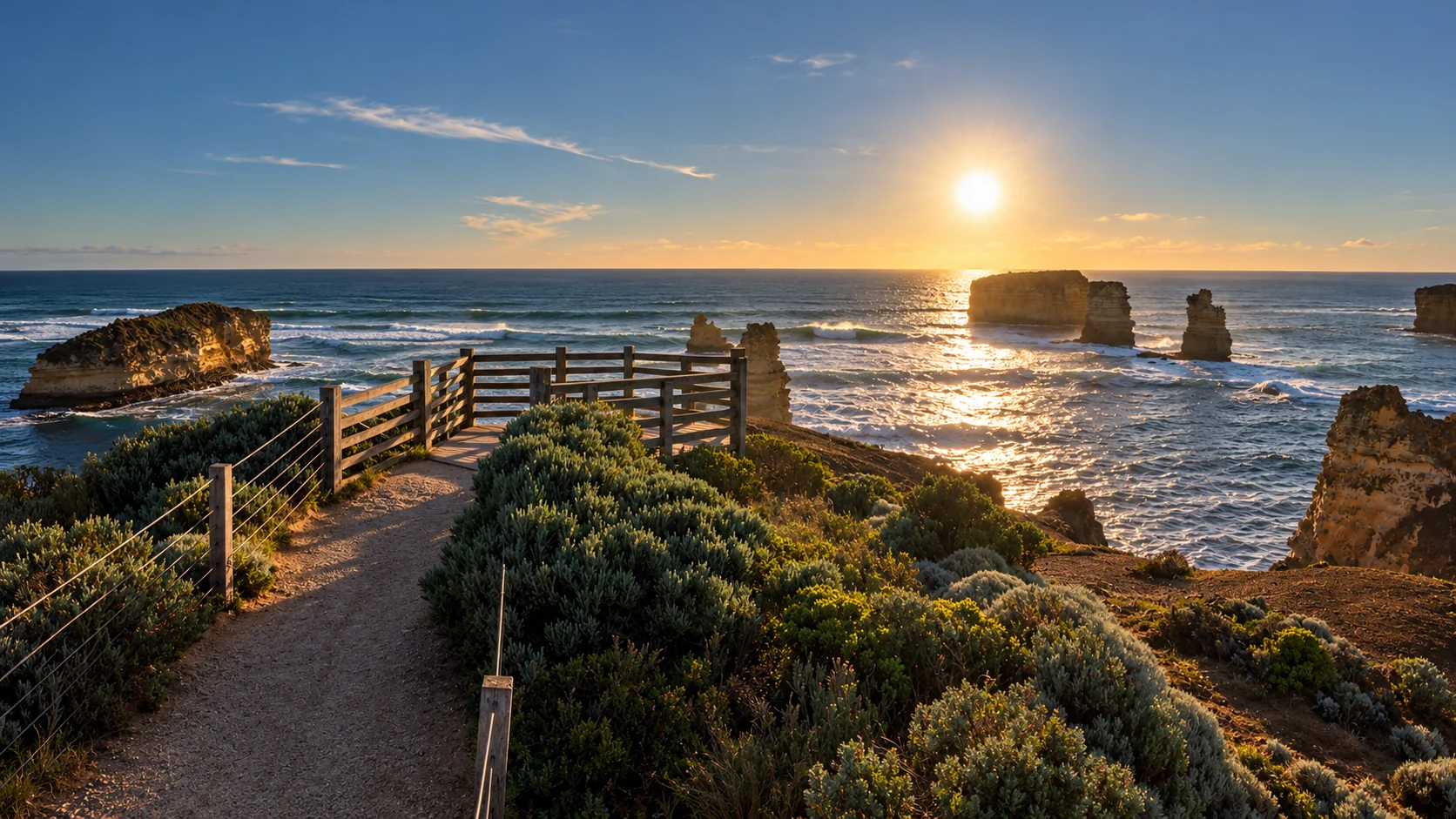
You view the arch from one of two viewing platforms on the clifftop. The remaining structure cannot be walked on and is closed to visitors for safety reasons. The official itinerary describes access as easy from the clifftop car park on the Great Ocean Road, and the Timboon to Port Campbell Trail also reaches the site.
Parks Victoria’s visitor guide (May 2023) shows parking, disabled access, a lookout and a walking track at London Bridge. The Arch has parking, a lookout and a walking track. The guide adds that many viewing platforms, pathways and carparks in the park are accessible to people with limited mobility. Accessible toilets are at the Twelve Apostles and in Princetown, Port Campbell and Peterborough.
The site is open around the clock, and park entry is free. Confirm fees and closures with Parks Victoria before you travel.
Little Penguins at dusk
London Bridge is one of two places in the park where Little Penguins can be watched. Parks Victoria says they come ashore just after sunset and can be seen and heard from the platforms at London Bridge and the Twelve Apostles. Lonely Planet notes the birds are generally about 40 metres away, so binoculars help. The Port Campbell Visitor Information Centre lends binoculars. The same itinerary mentions a winter waterfall at the site, which is worth a look after rain.
Getting there
Port Campbell National Park is about 380 km (4.5 hours) from Melbourne via the Great Ocean Road, or 230 km (3 hours) via the inland route, according to the Parks Victoria visitor guide. From Adelaide the direct route is about 670 km (7.5 hours). The coastal drive is slow and scenic, while the inland route saves time if you plan to stay overnight in Port Campbell and see the coast the next morning.
A V/Line bus stop is on the Great Ocean Road at the Loch Ard car park turn-off, which helps visitors without a car reach the Loch Ard Gorge end of the coast. Before you set out, check VicTraffic for road conditions and VicEmergency for warnings.
What happened to London Bridge
The formation was a complete double-span natural bridge until 1990. The official listing says it collapsed on 15 January 1990 and became an isolated arch no longer connected to the mainland. According to Wikipedia’s account, the collapse came unexpectedly on the evening of Monday 15 January, and it was the span closer to the shore that fell. Tour operators describe it the same way, as the span that linked the bridge to the mainland, and attribute the failure to natural causes.
Two people were on the outer section when the span fell and were stranded. They were cousins Kelli Harrison and David Darrington, and a police helicopter rescued them. Lonely Planet also records that they were rescued by helicopter, and no one was reported injured. The collapse made the news across Australia, with reports in the Canberra Times and the Hobart Mercury on 17 January 1990.
How erosion shaped London Arch
The cliffs belong to the Port Campbell Limestone. A 2026 peer-reviewed study of the Port Campbell Embayment says the cliffs and stacks preserve middle to late Miocene carbonate rocks of the Heytesbury Group. A grey, clay-rich lower unit dates to about 14 to 11.6 million years ago, and a yellow limestone upper unit to about 11.6 to 8.6 million years ago. The upper limestone is brittle and forms most of the cliffs and sea stacks.
The official description explains the sequence. A tunnel forms first, and rain seepage and wave action dissolve and hollow the rock until it stands free as an arch. The page calls the site a good example of the limestone formations in transition along the coast.
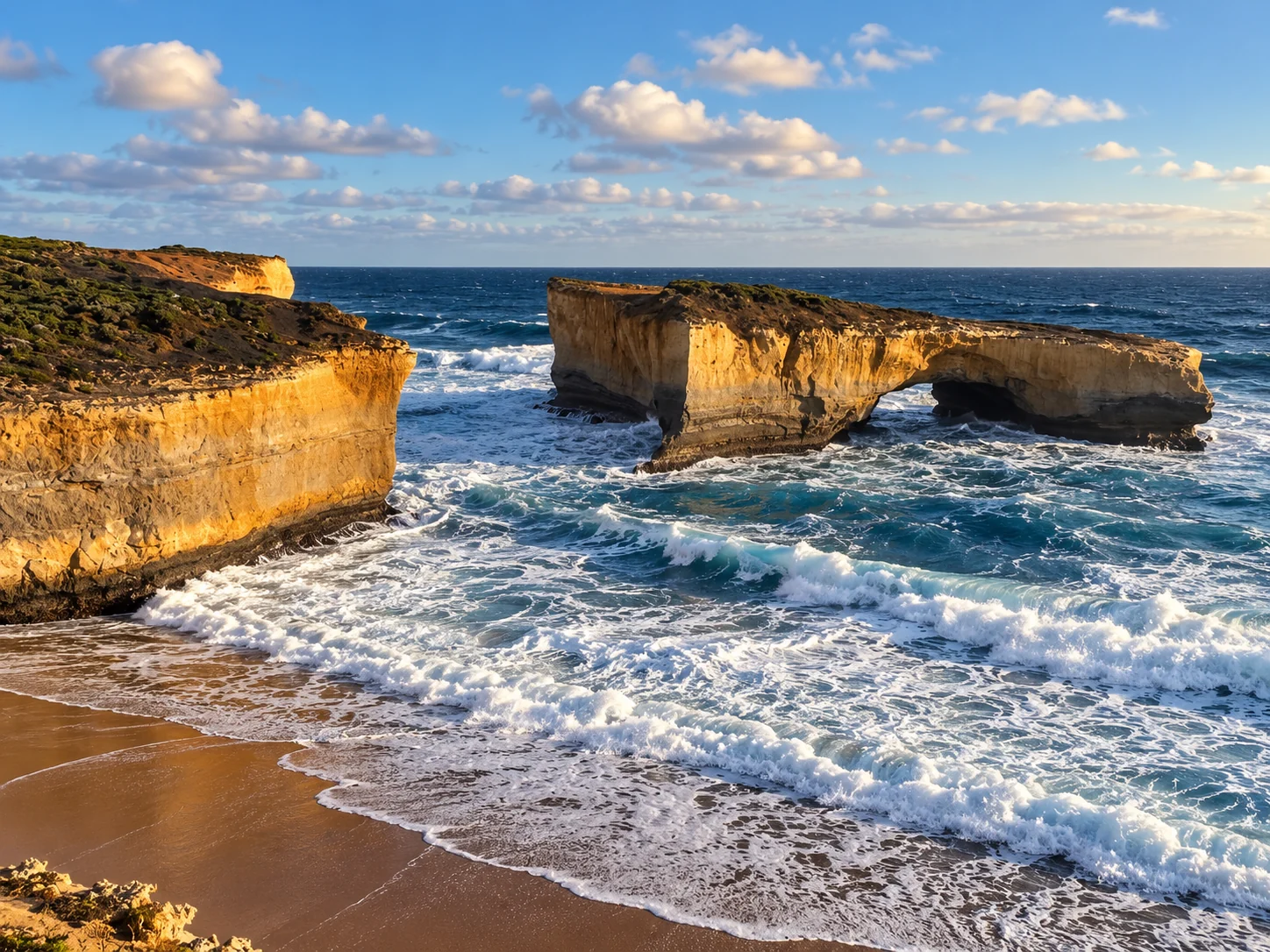
Three processes act together:
- Waves undercut the softer, more slippery base of the cliffs, which creates overhangs, sea caves, arches and a vertical cliff face.
- Groundwater carrying dissolved carbon dioxide dissolves limestone along natural joints, which a local community group describes as occurring about every 100 metres in the Port Campbell Limestone.
- Waves then enlarge those weaknesses. Cliff caves become arches, arches collapse and stacks remain, and the stacks stay exposed to wave erosion.
What happens next
The managing authority states that this arch and other rock stacks will collapse to form rock stacks, and it gives no date. The Commonwealth heritage listing calls the coast a leading place for studying limestone erosion because of its rapid erosion and well-publicised stack collapses. Seeing the arch now means seeing a feature in transition.
Other collapses on this coast show how it behaves. Island Arch, between Loch Ard Gorge and the Razorback, collapsed in June 2009 and is now two stacks, as this local guide describes. The Twelve Apostles stacks are about 45 metres high and have been reduced to eight. One 50-metre stack collapsed in July 2005, with a further collapse in 2009.
Rules and safety on the clifftop
Parks Victoria asks visitors to stay away from cliff edges and the base of cliffs, which can collapse without warning. Stay on designated tracks and lookouts and do not climb over barriers. The Arch page lists unstable cliffs, rough surf and snakes among its warnings.
Restrictions on The Arch page include:
- No dogs, fires, horses, camping, generators or firearms.
- Drones need a permit, so do not fly one without approval.
- Do not touch sick or dead wildlife. The page carries an H5 bird flu alert, and the parks remain open.
The visitor guide adds that camping and sleeping overnight in the park and its carparks are not permitted, so book a bed in a nearby town. Beaches in the park are not patrolled and are not recommended for swimming, and the nearest patrolled beach is at Port Campbell. On Catastrophic Fire Danger Rating days the parks close. Check parks.vic.gov.au or call 13 1963.
Twelve Apostles
The Twelve Apostles are the main sight on the Great Ocean Road. The main boardwalks are sealed or decked, mostly flat and wheelchair accessible, and a loop of the lookouts takes 20 to 30 minutes. The last hour before sunset or sunrise is the best time to visit, and 11:00 to 15:00 is the busiest. A booking system also covers the main viewing area, so check Parks Victoria before you go.
Pairing the Twelve Apostles with London Arch at dusk works well. The penguin viewing on both platforms begins just after sunset.
Gibson Steps
The Gibson Steps are 86 steps down to the beach, on the Great Ocean Road 5 km west of Princetown township. Settler Hugh Gibson carved the steps along a route the Kirrae Whurrong people of the Eastern Maar nation had traditionally used to reach the shore.
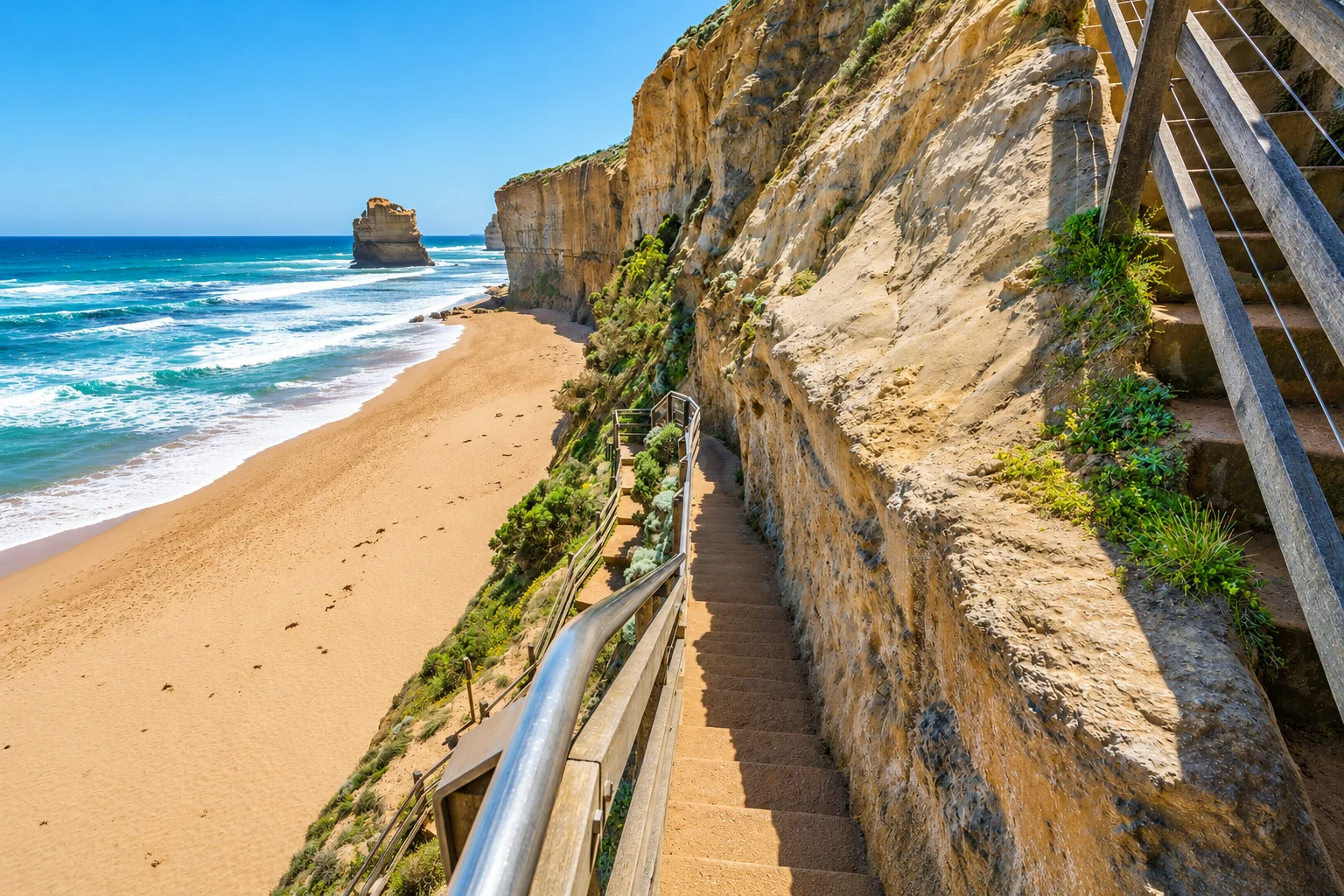
From the Twelve Apostles car park, a gravel clifftop walk to the steps is 2.2 km return and takes 60 to 80 minutes. The car park has an accessible space and the viewing platform is accessible. A gate near the top is locked when conditions are unsuitable.
The steps closed for a long period from August 2025 after ground movement, and they close in heavy seas, so check current status before you travel. At high tide and in big swells the beach can disappear and rogue waves have caught people out. Stay well back from the water, avoid walking around headlands and do not swim. Parking beside a solid yellow line on the Great Ocean Road is illegal.
Loch Ard Gorge
Loch Ard Gorge is named after the 1878 wreck of the clipper Loch Ard. Two walks start here:
- Geology Walk: 1 km return, about 40 minutes.
- Living on the Edge: 3.2 km return, about 1.5 hours.

There are no toilets at the gorge, and the nearest public toilets are at the Twelve Apostles Visitor Centre. Short-tailed Shearwaters (muttonbirds) return to Muttonbird Island from September to April, with peak viewing in January and February.
Port Campbell township
Port Campbell is the base for most visits and the closest town to the arch. The Port Campbell Visitor Information Centre is at 26 Morris Street, phone (03) 5598 2500. The Lonely Planet listing notes a display of items from historic shipwrecks.
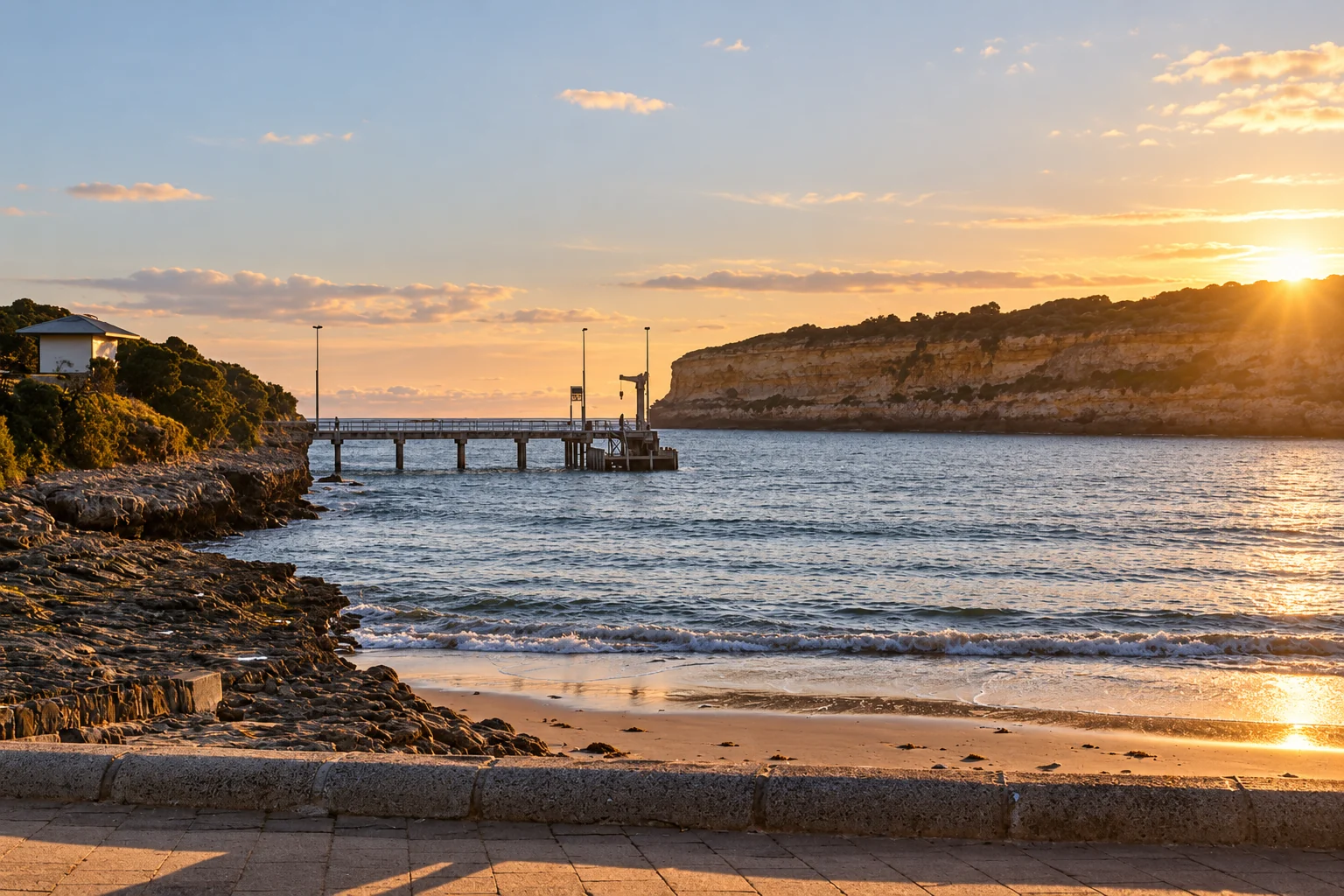
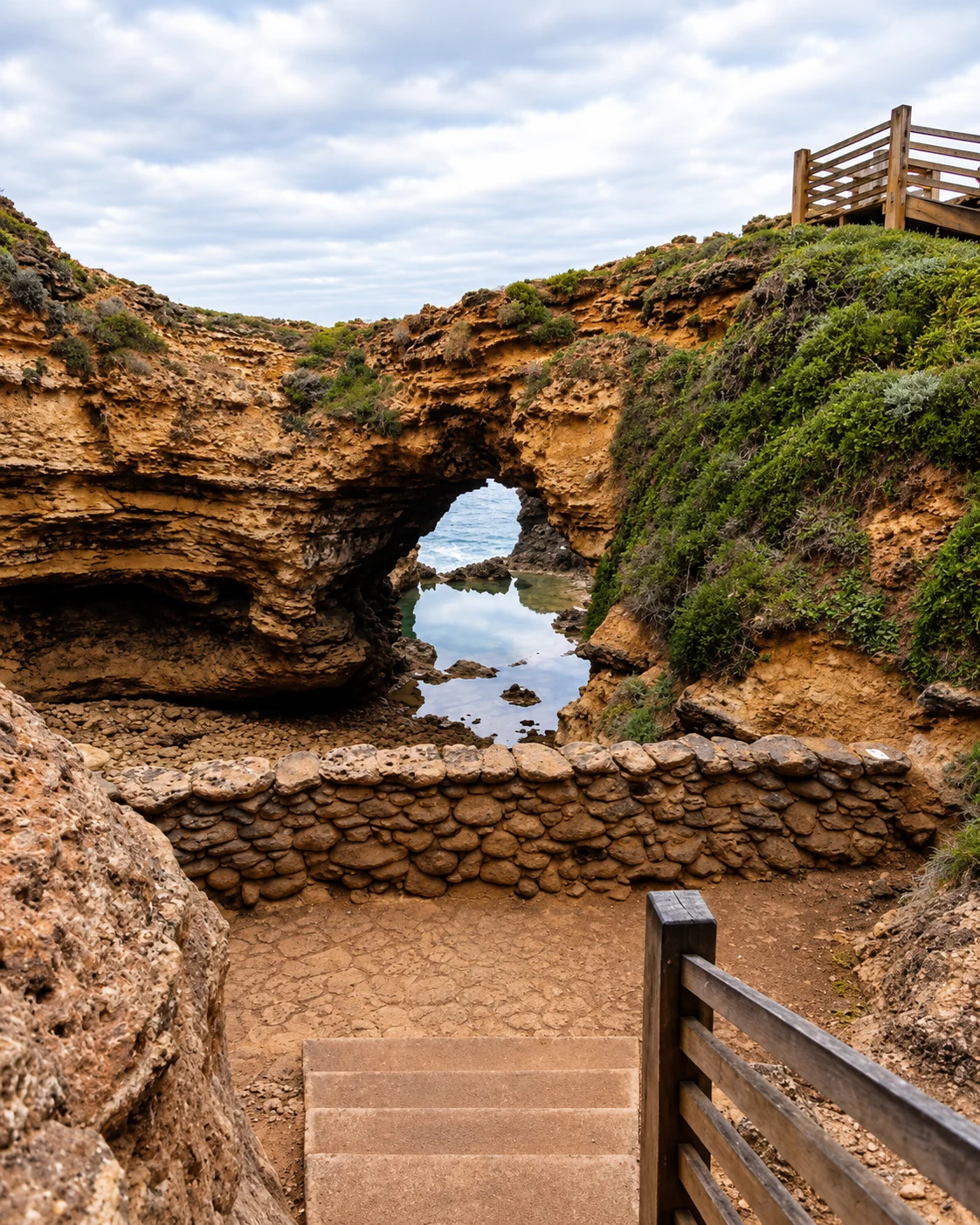
The Port Campbell Discovery Walk is 4.4 km return, about 1.5 hours, starting at Port Campbell Beach. The official itinerary describes a suspension bridge and stairs along the way. The Grotto, a cave and sinkhole about halfway up the cliff, is reached by a paved path and decked stairs. Two Mile Bay appears on the Parks Victoria map beside The Arch, with parking and a walking track.
Bay of Islands and Warrnambool
Bay of Islands Coastal Park lies further west, near Peterborough, which is 12 km west of Port Campbell. For a maritime history stop, Flagstaff Hill Maritime Village in Warrnambool has a visitor centre at 89 Merri Street, Warrnambool, phone (03) 5564 7837. Both suit a second day rather than the same afternoon as the arch.
Eating in Port Campbell
The official township page lists Waves Cafe, Bar and Restaurant, Frying Nemos Fish and Chips and Country Fried Chicken, REAL Pizza Pasta Salads, 12 Rocks Beach Bar Cafe, Port Campbell Hotel, Barrels Bar, Grassroots Deli Cafe, Cafe on Lords, Port Campbell Takeaway, Sow and Piglets Microbrewery, Great Ocean Ducks and Clarke’s Farm Shop, among others. Check opening hours with each venue before you go.
The 48-hour itinerary suggests Grassroots Deli Cafe for breakfast or lunch and REAL Pizza Pasta Salads at 25 Lord Street for dinner. For something quick, Port Campbell Takeaway at 16 Lord Street, phone 03 5598 6237, serves fish and chips, burgers, coffee and ice cream. Its listing notes new management since January 2023.
Staying in Port Campbell
Camping is not permitted in the park, so accommodation is in town. The township page lists Loch Ard Motor Inn, Port Campbell Motor Inn, NRMA Port Campbell Holiday Park, Port Campbell Hotel (rooms), Southern Ocean Motor Inn, Anchors Port Campbell, Southern Ocean Villas, and Waves Luxury Suites and Apartments.
Port Campbell Motor Inn at 12 Great Ocean Road is about five minutes’ walk from the township. Anchors Port Campbell has three villas about 2 km from the town centre and about 10 minutes’ drive from the Twelve Apostles. Southern Ocean Villas, at 2–6 McCue Street, phone 03 5598 4200, is a short drive from the Twelve Apostles, Loch Ard Gorge and the Bay of Islands.
Planning a day on the coast
An efficient order starts at Port Campbell for the visitor centre and breakfast. Then continue to London Arch and The Grotto on the west side. Return through town to Loch Ard Gorge, the Gibson Steps and the Twelve Apostles. The Twelve Apostles reward the last hour before sunset, and the penguins arrive just after, so finish there or at the London Bridge platforms. Phone Parks Victoria on 13 1963 for park conditions, and check the Gibson Steps and Twelve Apostles access details beforehand.