
K’gari, also called Fraser Island, is a sand island off Queensland’s Fraser Coast, within Great Sandy National Park. It has no bridge and no sealed public roads, so a self-drive trip needs a vehicle barge or ferry crossing, a high-clearance 4WD (four-wheel drive) for sand tracks and beaches, and permits bought before you leave the mainland.
A self-drive visit needs a vehicle access permit (VAP) for every vehicle. Every camper also needs a camping permit, unless staying at a privately run campground. Driving has to be planned around the tide. Camping permits can be booked up to 12 months ahead through the Queensland National Parks Booking Service. Dates and fees below are current at 27 October 2026, and several works and closures end between 8 November 2026 and 30 January 2027, as listed under Closures and Dates to Check.
Getting to K’gari
Inskip Point to Hook Point
The shortest crossing is the Mantaray barge from Inskip Point, near Rainbow Beach, to Hook Point at the island’s southern end. Vehicle barges run continuously during daylight hours on this route, and the crossing takes about 10 to 15 minutes. The barge runs from about 6:00am to 5:00pm, roughly every 30 minutes, with extra barges in peak season. Bookings are optional, and walk-on passengers pay the deckhand as they board. Tickets can be bought online, on board, or at the office; pre-purchase is not required.

Erosion has damaged the beach access tracks at the Inskip barge landing, and that is expected to last until 30 January 2027. Allow extra time and watch for signage on arrival. Crossing times also stretch with headwinds and landing point, and loading and unloading add to the total.
River Heads, Hervey Bay
Two services leave from River Heads, south of Hervey Bay. The SeaLink K’gari (Fraser Island) Ferries service, which Island Connections also sells, crosses to Kingfisher Bay in about 50 minutes and to Wanggoolba Creek in about 30 minutes. Fraser Island Barges is the contact for the River Heads to west coast route, where bookings are essential.
Book River Heads crossings ahead because services are limited. The Kingfisher Bay Resort timetable shows departures from River Heads at 7:00am (vehicles only), 9:00am, 1:00pm and 3:45pm. Return sailings leave Kingfisher Bay at 8:00am, 10:15am, 2:30pm and 5:00pm. Island Connections publishes a live ferry status page to check before you leave home.
Choose Inskip Point if you are coming from the south, want the shortest crossing or have no fixed booking. Choose River Heads if you are staying at Kingfisher Bay, or if you want to arrive on the western side. Walkers without a vehicle can also use the River Heads service, and Air Fraser flies to the island from Hervey Bay.
River Heads ferry fares
SeaLink’s published fares for the River Heads service are below. The fares page also lists the full vehicle size categories and 2WD bookings, which go through SeaLink reservations on 1800 227 437.
| Fare | Price |
|---|---|
| Standard 4WD up to and including 6m, one way | from $135.30, plus $5.00 per extra passenger |
| Trailer or caravan up to and including 5m with draw bar | from $89.40 |
| Motorbike including rider, up to 1.5m | from $65.75 |
| Walk-on adult | $50.00 one way, $85.00 return |
| Walk-on child aged 4 to 17 | $30.00 one way, $48.00 return |
| Infant aged 0 to 3 | free |
A 4WD towing a camper trailer is priced higher than a standard 4WD. Camper trailers are listed at $230 return on both the SeaLink ferry and the Mantaray barge, with $200 return for trailers up to 3.4m on the barge. Confirm your own vehicle and trailer length with the operator when you book.
Sealed roads and resorts
The only sealed roads on K’gari are inside the grounds of Kingfisher Bay Resort and the Eurong resort. A standard vehicle can be taken over on the barge for use inside the Kingfisher Bay grounds, and is suitable only within the resort perimeter, which is the only situation where no vehicle access permit applies.
Vehicle Access Permits
Every vehicle entering the Fraser Island Recreation Area needs a valid VAP, except vehicles that stay inside the Kingfisher Bay Resort and Village boundary. That includes day visitors. You must show a digital or printed copy to an authorised officer on request.
Buy the permit online from Queensland Parks and Wildlife Service (QPWS) before you leave the mainland. The QPWS offices at Eurong and Dundubara are generally unattended for enquiries, and they hold self-serve packs with a conditions report and camping tag for people changing or extending a stay. Rangers on the island cannot sell permits, and mobile reception is unreliable. The QPWS vehicle permits page covers all Queensland recreation-area permits.
The 2026 fees are:
- K’gari VAP, one month or less: $61.80.
- K’gari VAP, more than one month up to 12 months: $311.
- Combined K’gari and Cooloola Recreation Area permit: $99.25 for one month or less, or $498.10 for up to 12 months. A 20% discount applies when buying both.
Number-plate surveillance runs 24 hours a day. Plates are recorded on entry and exit and checked against the booking service, and a Penalty Infringement Notice can go to the registered owner of any vehicle without a valid permit. Check that the plate details on your permit are correct before you pay.
Permits are not transferable. For a hire vehicle, the person who hired it for that occasion applies for the VAP, and the same rule covers a newly bought 4WD. Some hire companies sell the permit at pick-up. One operator adds an administration fee of $8.50 per permit.
Choosing and Preparing a Vehicle
Only high-clearance 4WD vehicles, preferably with low-range gearing, suit the sand tracks and beaches. Low-clearance vehicles can find some inland and beach-access tracks impassable. All-wheel drive is not recommended.
The vehicle must be fully road registered. Unregistered vehicles are not permitted. Concessionally registered recreational vehicles, including quad bikes and ATVs, are barred too. Limited exceptions for non-standard, conditionally registered vehicles need written authorisation. Off-road camper trailers need high clearance and must suit the towing vehicle.
Preparation starts before the barge. Check the manufacturer’s tyre-pressure recommendations for sand, since 18 to 20 PSI is a common starting point that you then adjust for vehicle, tyres, load and conditions. Load heavier items inside and low down, spread evenly. Carry a spare tyre, tool kit, tyre pressure gauge, air pump, tow rope, snatch strap, D shackles, traction mats and shovel, because rescues are difficult and mishaps costly. Salt air and spray reach the vehicle, so ask the manufacturer about anti-rust treatment, and carry extra fuel. Engage 4WD and lock the hubs just before you start on sand.
Driving Rules and Speed Limits
All Queensland road rules apply on K’gari, including on the beach, and police patrol at any time. Inland roads, vehicle tracks and beaches are all designated roads, so seatbelts and drink-driving laws apply. When it is safe, give way to buses, trucks and vehicles travelling downhill or towing. Also give way to walkers, cyclists and horse riders. Use the passing bays on inland tracks when you meet oncoming traffic.
The QPWS conditions report sets these speed limits:
- Beach pedestrian areas: 40 km/h.
- The beach: 80 km/h.
- The Hook Point inland road: 50 km/h.
The eastern beach, 75 Mile Beach, is a gazetted highway on the surf side, and more than 1,500 km of sand tracks cross the island. Parts of it are also landing strips for small planes. Give way to aircraft and follow marked zones and ground-crew direction. When a plane is landing, move to the upper beach but stay off vegetation. Walkers cannot always hear vehicles over wind and surf. Slow down near pedestrians and visitor sites such as the Maheno wreck, because passengers in vehicles travelling too fast have suffered serious spinal injuries.
Use only established tracks to reach the beach. Do not drive on dunes, where vegetation is damaged quickly and recovers slowly. When you park on the beach, stay well away from traffic areas and park at an angle to the water so other drivers can see you have stopped. Night driving is restricted.
Tides, Creeks and Weed Banks
Time your beach driving around the tide. QPWS says driving at high tide is dangerous, and the hardest, easiest sand is around low tide. Some beach sections cannot be passed at all at higher tides. SeaLink’s general rule is to avoid the two hours either side of high tide on 75 Mile Beach, and some hire companies set their own terms, so check yours.
Plan to reach camp well before dusk. When you choose a campsite, weigh the tides, the track conditions and the distance. Tides also affect creek crossings, where high water can flood an engine. Check the depth of beach waterholes and creek crossings before you enter, since they can be deeper than expected.
On the western beach, and occasionally the eastern beach, weed banks lie buried under sand and shift constantly. They can deceive experienced drivers, and a vehicle can sink quickly. Tow trucks can take many hours to arrive. In suitable western-beach areas, travel with at least one other 4WD or walk instead, and stay out of any area closed to vehicles. Do not go past signs at sand cliffs, which can collapse without warning. Heavy or prolonged rain also causes washouts and minor flooding on inland roads, so allow extra time.
Choosing a Lake
K’gari’s freshwater lakes sit in sand rather than rock, and they range from clear rainforest pools to tannin-stained brown water. QPWS publishes walking times as estimates only, so build in a buffer on soft sand.
Lake McKenzie (Boorangoora)
Boorangoora is the most visited lake. Short walks lead to the lake from each of three fenced picnic areas, and the busiest period is between 10:30am and 3pm. Arrive early or late to avoid the crowds.
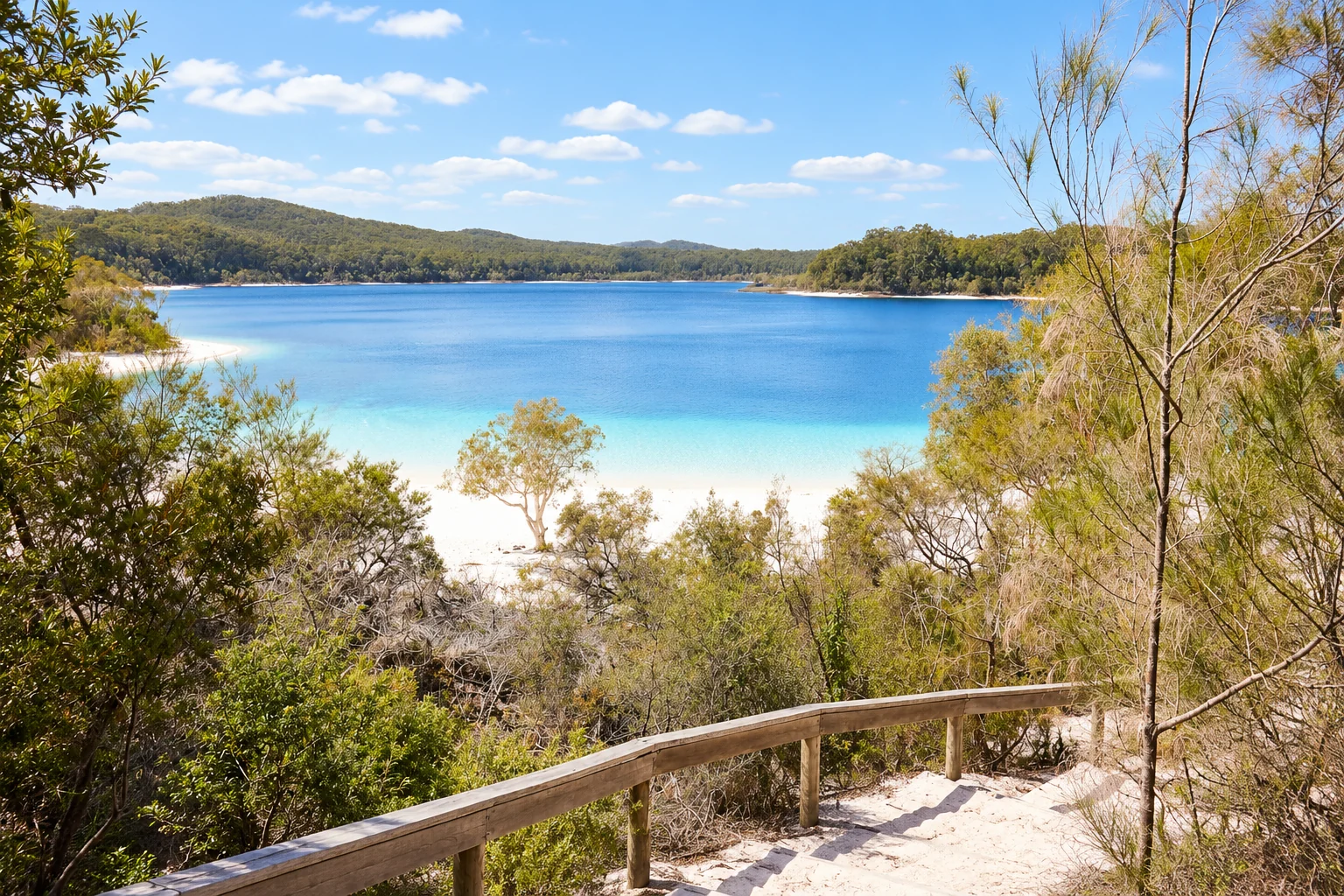
Longer walks reach it from Central Station. The route via Basin Lake is 6.6 km one way and takes 2.5 to 3.5 hours. The route via Pile Valley is 11.3 km one way and takes 3.5 to 4.5 hours, or 17.8 km as a circuit in 6 to 8 hours. From Boorangoora you can continue to Lake Wabby (11.9 km one way, 4 to 5 hours) or to Kingfisher Bay (12.7 km one way, 4 to 6 hours).
Food and drink other than water are prohibited at the lakeshore because of dingoes. Drones are prohibited across the lake, shores, car park and day-use areas until 10 December 2026. The lake floor has deep drop-offs, so supervise children closely. Towing a trailer limits you here. The Central Lakes scenic drive is not suitable for trailers and the Lake McKenzie car park has no room for them. The QPWS visitor guide marks some routes as unsuitable for vehicles towing trailers.
Lake Wabby
Lake Wabby is the deepest lake on K’gari and a significant cultural site for the Butchulla people. It is the one lake where swimming carries a specific warning. QPWS does not recommend swimming, says the water is shallower than it looks, and tells visitors never to dive, jump, run, slide, roll or race down the dune into the lake. Many serious spinal injuries have occurred there.
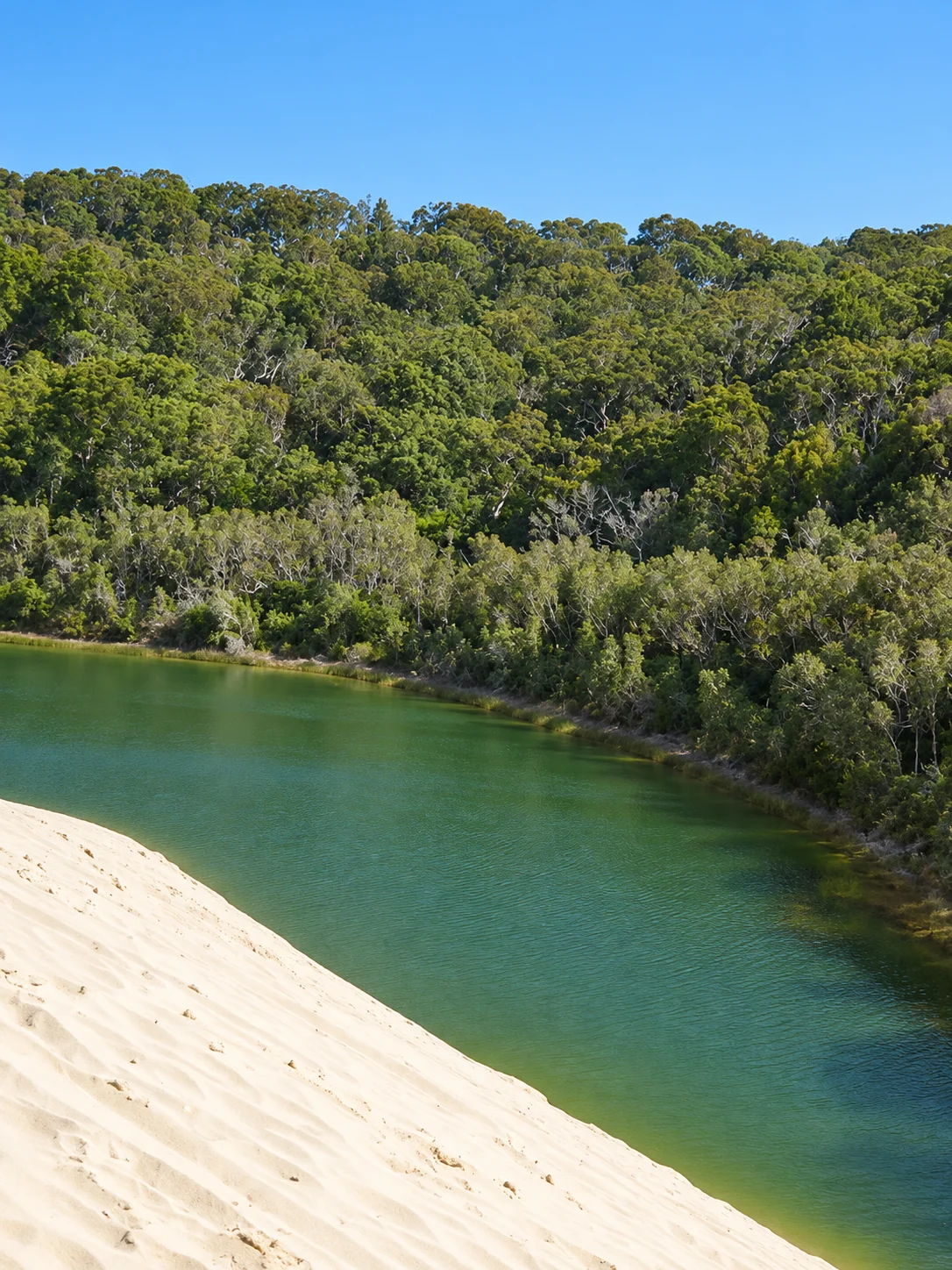
The walks start at the Cornwells Break Road car park. The lookout is 900 m return and takes 30 minutes. The lake itself is 3.1 km return from the lookout (1 to 1.5 hours). A beach-access circuit is 4.8 km return (2 to 3 hours), and a lookout circuit via Hammerstone Sandblow and the lake is 7.2 km return (3 to 4 hours). The Lake Wabby walk is under planned maintenance until 9 November 2026, so check the park alerts before you plan around it.
Lake Birrabeen and Lake Allom
Lake Birrabeen is a 12.8 km return walk from Central Station, taking 4.5 to 6.5 hours. It suits walkers who want a long day and a quieter shore.
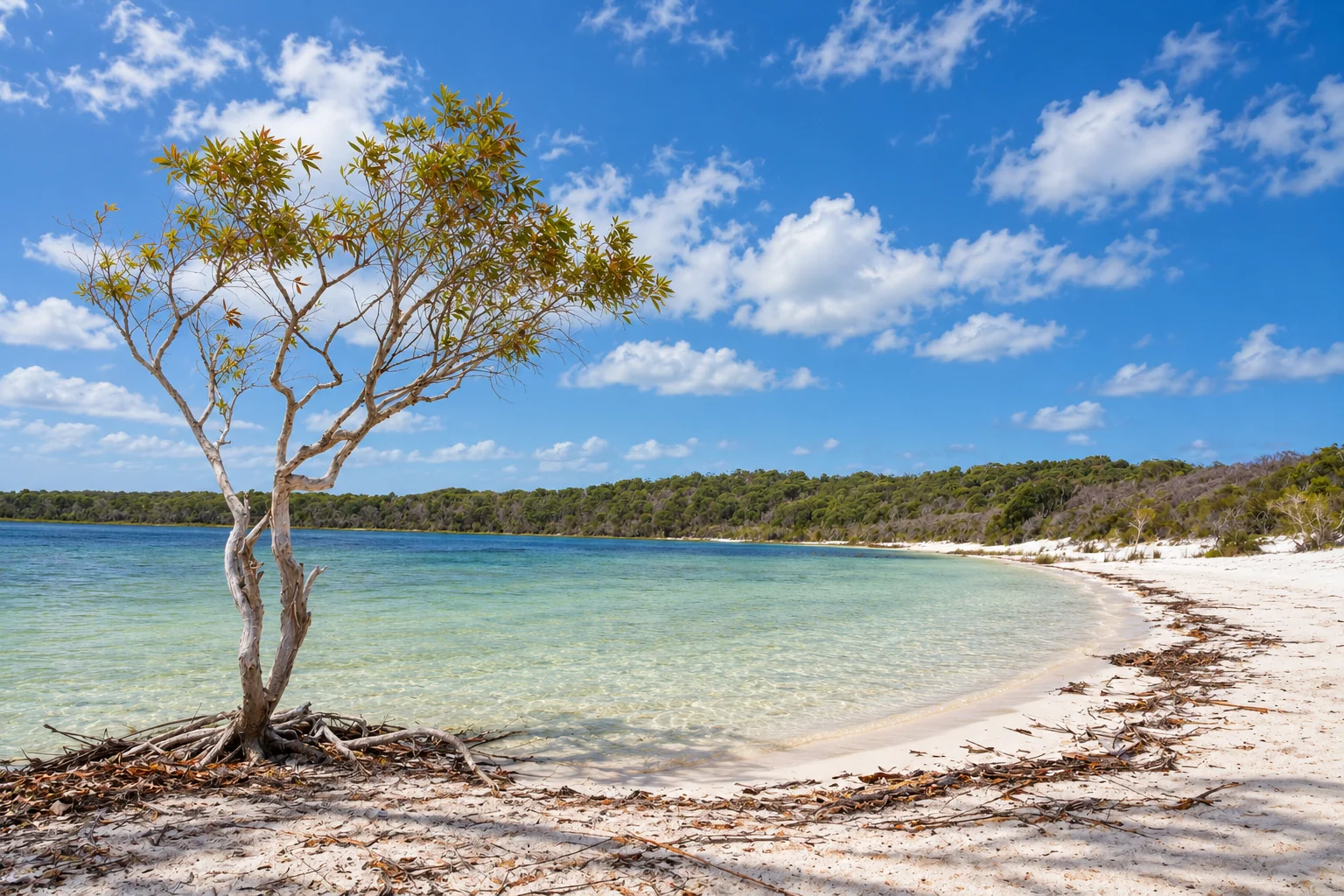
Lake Allom is the easiest option for a short stop. A 1.4 km circuit track from the car park winds through rainforest, and a viewing platform overlooks the lake, where freshwater turtles live. Do not feed them. Read the water-safety information before you swim.
Other lakes
Several other lakes suit particular plans:
- Basin Lake: 5.6 km return in about 3 hours, with an initial steep climb.
- Lake Boomanjin: the largest perched lake in the world, covering almost 200 hectares, with brown tannin-stained water and a fenced campground.
- Lake Bowarrady: 11 km one way from Dundubara in 3 to 4 hours, with no camping at the lake.
- Lake Garawongera: reached by the Bogimbah historical walk, 15.6 km return in 5 to 7 hours.
- Short walks: Boomerang Lakes is 530 m return in 12 minutes, Lake Coomboo is 2.2 km one way in 45 minutes, and Ocean Lake on the Cypress circuit is 900 m in 30 minutes.
Swimming and lake rules
Swimming is not recommended in any waters on or around K’gari, and there are no lifeguards. The ocean has strong currents, and drownings have occurred. Sharks and marine stingers are also present. Soaps, toothpastes, sunscreens, personal insect repellents and detergents are prohibited in lakes and streams. Freshwater fish are protected, and fishing or collecting bait in lakes and streams is not permitted. Use toilets where provided, because human waste promotes unnatural algal growth in the lakes.
Camping Permits and Booking
A camping permit is required for all camping on K’gari except in privately run campgrounds, and it must be displayed at the camp. From 1 July 2026 the fee is $7.75 per person per night, or $31 per family per night. A family is one or two adults plus children under 18, up to 8 people, and children under five camp free.
Book through the Queensland National Parks Booking Service at book.parks.qld.gov.au, where you also buy the vehicle permit. The booking window opens up to 12 months ahead. QPWS strongly recommends booking ahead for school and public holidays, and popular sites in those periods should be booked at least six weeks ahead. When you buy the permit you register which campsites and dates you will use.
You book a specific zone, and you cannot camp in a different zone on those dates unless you change the booking first. The permit arrives by email. Display the tag, or the printed permit details, on your tent or vehicle, and display the booking number at the campsite. Rangers patrol the island to check compliance.
Cancelled bookings made more than two calendar days before the permit start date are refunded automatically. Later refunds are possible for unforeseen circumstances on request, and requests must be made within 28 days of the camping permit end date.
Choosing a Campground
The QPWS visitor guide lists 45 camping areas across the island, so choose by the kind of trip you want and by who is travelling.
Central Station is a fenced inland campground about 8.6 km from Eurong township. It has flushing toilets, treated drinking water taps, picnic tables, washing-up facilities and $2 coin-operated hot showers. It is the best base for Lake McKenzie and Lake Boomanjin. Open fires are prohibited. Its tent and trailer sites are closed for works until 8 November 2026, and infrastructure works there run through 9 November 2026.
Dundubara is fenced and on the northeast coast, 41 km north of Eurong. It has toilets, picnic tables and treated water taps, and it is one of two places with QPWS fire rings. It is also the starting point for the walk to Lake Bowarrady.
Waddy Point sits at the northern end, near Champagne Pools. Waddy Point Top has dingo-deterrent fencing. Infrastructure works there run through 9 November 2026, and booking restrictions apply at Waddy Beach Front through 15 December 2026.
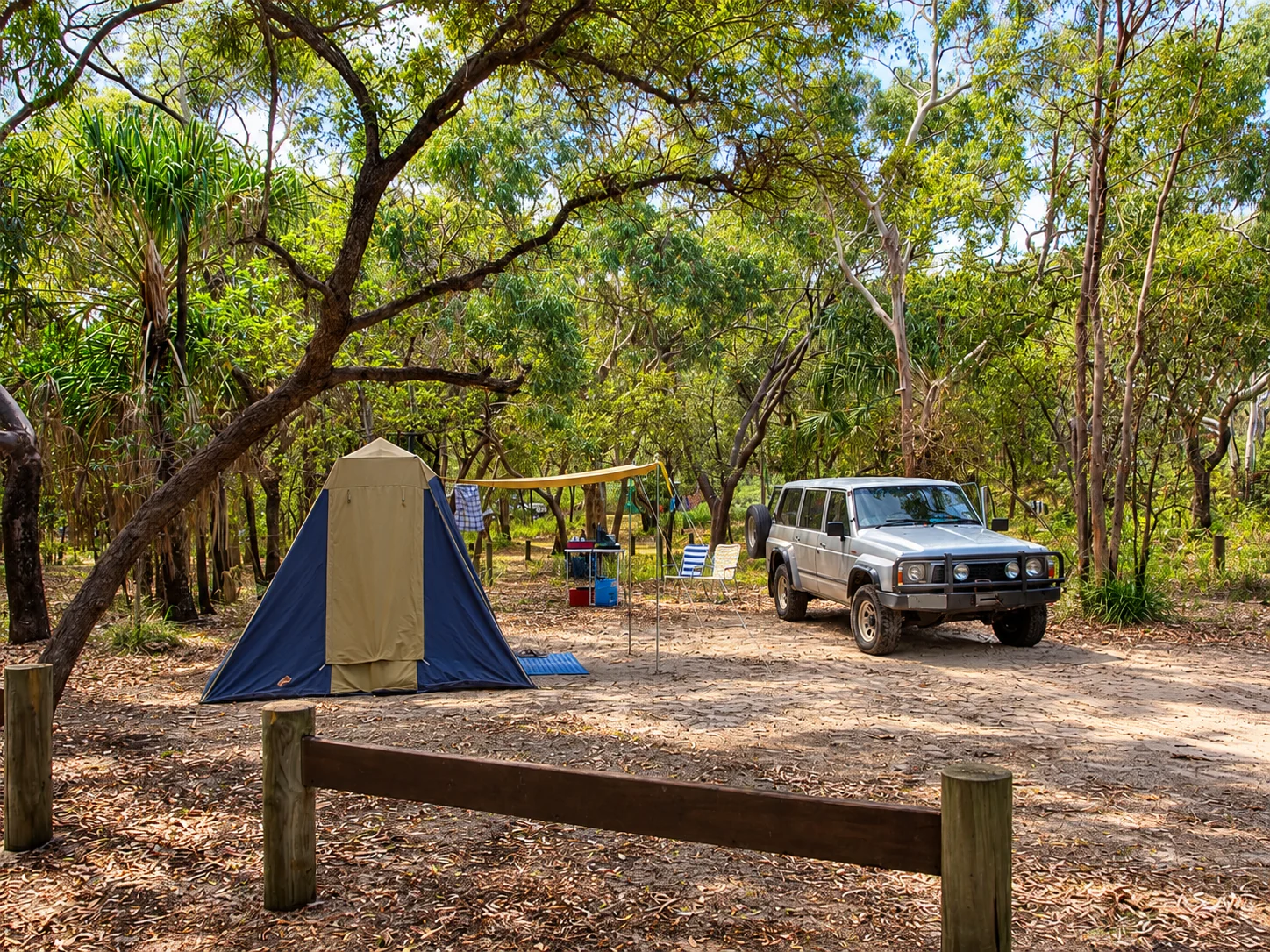
Other fenced options include Wathumba and Lake Boomanjin. Fenced beach areas include Cornwells, Eli Creek, One Tree Rocks and Wongai. At those four beach sites you must bring your own portable toilet.
Beach camping is spread across nine numbered zones along the eastern beach. They are generally informal, facilities vary, and some have no drinking water or toilets. Camp behind the foredunes and use the access tracks. Zone 9 (Diray and Carree) is closed until 29 January 2027, and Happy Valley beach access works run through 14 December 2026.
The western side is quieter, but mosquitoes and midges can be severe, and May to September is best. Sandy Cape Lighthouse is remote with limited sites. Moon Point Road is partly closed until 30 January 2027.
Camp Rules, Fires and Water
Camp at least 50 m from streams and lakes, and behind the foredunes where camping is permitted. Where no toilet is provided, bury bush toilet waste at least 50 cm deep and at least 50 m from creeks and lakes, or as signposted.
Campfires are allowed only in QPWS fire rings at Dundubara and Waddy Point, subject to current fire restrictions. Bring untreated timber mill off-cuts rather than bush wood. Fires are prohibited everywhere else. Generator rules vary: some informal beach areas allow low-decibel generators during specified daytime hours, while many formal campgrounds prohibit them. Drones are prohibited in all camping areas, and dogs and other domestic animals are not permitted anywhere on K’gari.

Bring your own drinking water. Treated taps are at Central Station, Dundubara, Waddy Point and Eurong, and any other water should be treated. Some campgrounds have no supply at all, so carry extra.
Dingoes (Wongari)
Wongari, as dingoes are known on K’gari, are protected by law and significant to the Butchulla people. They can appear at any time of day or night. The QPWS rules are specific:
- Never feed them. Feeding attracts fines.
- Keep children within arm’s reach, "even small teenagers."
- Walk in groups, carry a stick and do not run, because running or jogging can trigger a negative interaction.
- Lock food stores and iceboxes, and secure all rubbish, fish and bait. Never store food or containers in tents.
- Camp in fenced areas where possible.
If a dingo approaches, stand tall, fold your arms and back away calmly. QPWS recommends a dingo-fenced camping area for children aged 14 and under. The fenced options named in the visitor guide are Central Station, Dundubara, Waddy Point (top), Wathumba and Lake Boomanjin. Report encounters to rangers. If you see dingoes inside a fenced area, or damage to a fence or gate, email dingo.ranger@detsi.qld.gov.au and tell a ranger.
The wongari rearing and emergence season runs from 1 September to 30 November 2026, so expect heightened attention to these rules until it ends.
Fuel, Supplies and Walking Safety
Fuel is available at all townships, but not autogas. Shops are generally open 8am to 5pm, and EFTPOS is available only in some places, so carry cash and fill up before the barge where you can. Island fuel is priced higher than on the mainland. Fuel, ice and basic groceries in limited range are sold at Eurong, Kingfisher Bay Resort, Orchid Beach, Happy Valley and Cathedrals.
On foot, never walk alone. Most tracks are sandy with a generally firm surface, but expect soft sections that slow you down, along with fallen trees, uneven ground and long, steep slopes. Dangerous wildlife, including snakes, is present, and crocodiles and marine stingers are a hazard in some waters.
Closures and Dates to Check
The park is open every day, 24 hours a day. These notices are current at 27 October 2026. The QPWS conditions report and the K’gari park page carry the live status.
| Item | Dates |
|---|---|
| Central Station tent and trailer sites closed for works | Until 8 November 2026 |
| Waddy Point and Central Station infrastructure works | Through 9 November 2026 |
| Lake Wabby walk, planned maintenance | 10 August to 9 November 2026 |
| Tukkee Wurroo (Indian Head) walking track, temporary closure | To 18 November 2026 |
| Wongari rearing and emergence season | 1 September to 30 November 2026 |
| Drones prohibited at Lake McKenzie | To 10 December 2026 |
| Happy Valley beach access works | Through 14 December 2026 |
| Waddy Beach Front booking restrictions | Through 15 December 2026 |
| Beach camping zone 9 (Diray and Carree) closed | Until 29 January 2027 |
| Moon Point Road partly closed | Until 30 January 2027 |
| Inskip barge landing beach access tracks, severe erosion | Until 30 January 2027 |