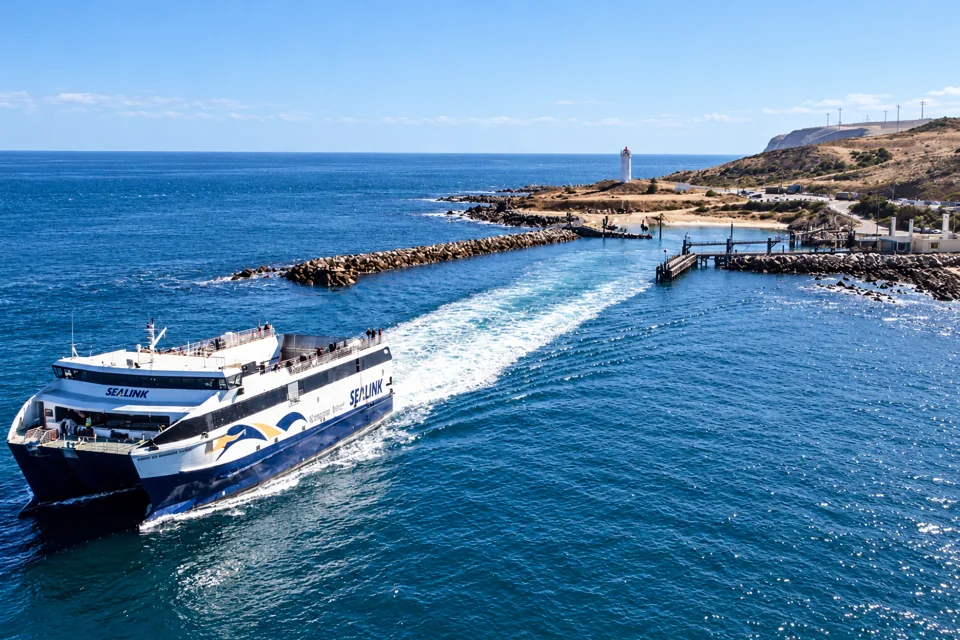
Kangaroo Island sits off the coast of South Australia, and the main way to reach it by road vehicle is the SeaLink ferry. The ferry carries cars, campervans, motorbikes and foot passengers from Cape Jervis, at the tip of the Fleurieu Peninsula about 1.5 to 2 hours’ drive south of Adelaide, to Penneshaw on the island’s north-east coast. SeaLink gives the crossing as about 45 minutes, and the operator is SeaLink SA Ferry Services, part of the Kelsian group.
These facts matter most on a first trip. Every booking needs a vehicle registration number. Check-in closes 30 minutes before departure, and vehicle space runs out at busy times, so the ferry should be booked before accommodation. The island has strict biosecurity rules, which are the laws that protect its pest-free farming and wildlife, and honey is banned outright. The island has no public transport, so you need your own car, a hire car or a booked transfer.
The service is changing now too. SeaLink closed the route for several days in October 2026 to fit new ramps for larger ferries, and the new vessels bring new boarding procedures. Check SeaLink’s live service notices in the days before you travel.
Getting to Cape Jervis and across the strait
The drive from Adelaide
Both SeaLink and Tourism Australia quote about 1.5 hours for the drive from Adelaide to Cape Jervis, and some other guides say closer to two hours. Plan for the longer figure, because the ferry check-in cut-off does not move. SeaLink’s guidance gives about two hours or more from Adelaide to reach the terminal comfortably. The official tourism body also warns of roadworks on Main South Road between Normanville and Cape Jervis, which adds to the case for leaving early.
If you would rather not drive, a public coach runs from Adelaide to Cape Jervis. Coach bookings go through Adelaide Sightseeing on 1300 769 762, and the coach is now operated by Journey Beyond, which acquired Adelaide Sightseeing. Ferry tickets remain a separate booking with SeaLink, so book both and check that the coach arrival leaves enough time before your sailing.
Fuel and parking before you board
Fuel matters on the way home as much as on the way out. SeaLink points out that for late ferries leaving the island, the nearest open petrol station is at Aldinga, 64 km north of Cape Jervis, so fill up on the island before you leave. The island has 24-hour fuel at Penneshaw, Kingscote, Parndana and Vivonne Bay.
If you plan to leave a car at Cape Jervis and walk on, secure day and long-term parking at the terminal costs $21 per day. The car park opens before the first departure and locks after the last arrival from Penneshaw. SeaLink says marine infrastructure works have cut secure capacity and restricted public parking. It strongly recommends booking parking in advance, either when you book the ferry or at check-in. Penneshaw’s parking is ticketed and run by the Kangaroo Island Council, according to SeaLink’s FAQs.
The crossing
The strait crossing takes about 45 minutes, a figure also used by Tourism Kangaroo Island. Allow more time in rough weather. SeaLink’s timetable page lists Cape Jervis departures at 6:00 am*, 7:00 am (Mon-Fri, restricted), 9:00 am (daily), 10:00 am (daily), 12:00 pm (Mon-Sat), 1:00 pm*, 3:00 pm (Sunday), 4:00 pm (daily), 6:00 pm (daily), 7:00 pm (daily), 9:00 pm* and 9:45 pm*, with a larger number of departures from the island, the first at 5:30 am and the last at 10:15 pm. Some sailings are marked with an asterisk because they run only for extra seasonal capacity, and weekday, Sunday and seasonal variations apply. The service runs every day except Christmas Day. During the transition to new ferries SeaLink has been running reduced schedules, so confirm times on the live timetable rather than relying on a printed or remembered one.
Some sailings operate without a staffed terminal, in which case ferry crew handle check-in. Do not assume a ticket office will be open for a late-evening or early-morning departure.
Flying instead
The alternative is a roughly 30-minute flight from Adelaide to Kingscote Airport. Rex and Qantas Link fly the route. Flying suits a short stay when you plan to hire a car on the island, and the ferry suits anyone who wants to bring their own vehicle, camping gear or a pet.
New ferries and the October 2026 shutdown
The Cape Jervis to Penneshaw route is part-way through a change of fleet. SeaLink is introducing two new, larger vessels, and both terminals needed new ramps to suit them. In its 14 October 2026 notice, SeaLink said the ramp installation would take place from 20 to 22 October, weather permitting. The last service before the shutdown left Cape Jervis at 6 pm on Monday 19 October. Services were to resume on Friday 23 October on a limited schedule using SeaLion 2000 only, for an anticipated three to four days.
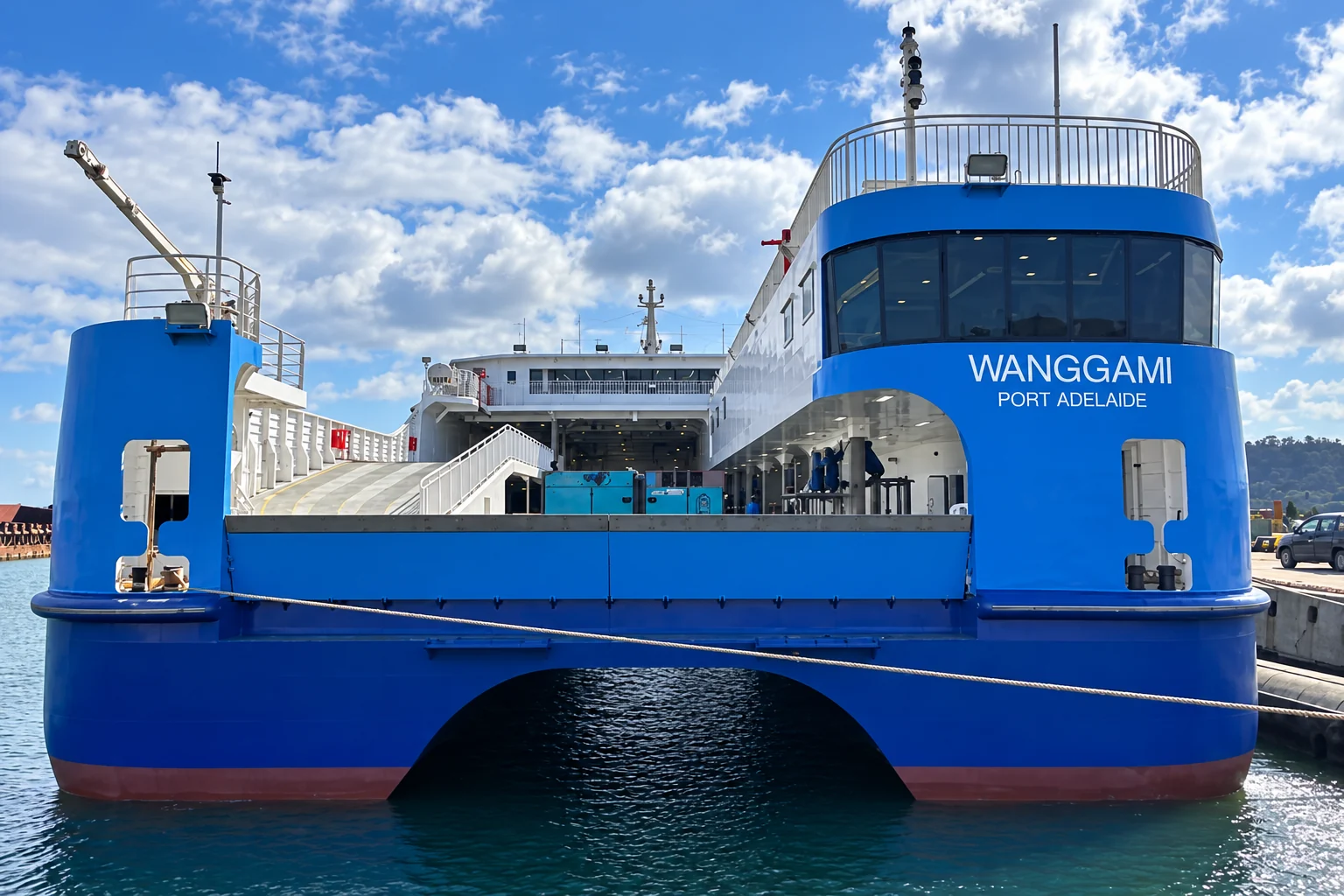
SeaLink’s shutdown information page said the Cape Jervis and Penneshaw terminal precincts would be closed to the public from the evening of 19 October until the morning of 23 October. The ABC reported on 20 October that the first of the two new vessels was being introduced and that the ramp infrastructure at both terminals was built to suit the larger ferries.
A banner on the same SeaLink notice reads "Important Update: Wanggami commences service – 27 October 2026." SeaLink’s notice gives no other detail about the vessel in that banner, so the live notices are the place to see which ferries are running on your travel date and what the schedule looks like.

Delays while procedures settle
SeaLink says delays may occur while new loading and unloading procedures bed in. That is a reason to build slack into your first day on the island, particularly if you have a tour, a wildlife session or a restaurant booking soon after you land. A tight plan, such as a timed tour on the same afternoon, is the one most likely to fall apart if a sailing runs late.
The ferry-builder dispute
The second new ferry has not yet been delivered. InDaily reported on 16 October 2026 that Kelsian has started Federal Court action against the Indonesian builder of that vessel. The same article says the first new ferry, Ruwi, was delayed after an incident during final testing. For travellers, this means the ships in service may change over the coming months, and the published schedule may change with them.
Vehicle passengers on the new ferries
One boarding rule is changing with the new vessels. Older SeaLink terminal material says passengers in vehicles cannot stay in the vehicle during the voyage and cannot access the vehicle deck. The newer notice on SeaLink’s timetable page describes a new process from 27 October 2026 in which vehicle passengers may stay in their vehicles. Follow the instructions on the notice for your sailing and the directions of crew at the terminal, since the rule depends on which ferry is operating.
Booking, fares and changing plans
Book the ferry first
Ferry availability can decide your travel dates, so SeaLink advises booking well ahead and considering off-peak departures. Tourism Kangaroo Island gives the same advice to lock in the ferry before accommodation. Vehicle space is the limit. If your car cannot get a place on your preferred sailing, SeaLink suggests hiring a vehicle on the island at Penneshaw or Kingscote instead.
You can book on SeaLink’s website or by phone on 13 13 01. Klook, AFerry and Bookaway also sell tickets. Klook’s listing says each booking must include at least one car and one adult, so a foot passenger booking through that channel may not work. Booking directly with SeaLink gives you the operator’s own terms and the simplest route to a change or refund.
The vehicle registration requirement
Since 17 February 2025, every booking needs a vehicle registration number. Registrations can be saved to a SeaLink account, and number plate recognition identifies vehicles at the ticket booth, boom gates, check-in and boarding. If you are hiring a car, get the registration from the rental company before you book, and confirm their agreement allows the car on the ferry. Some mainland rental companies do not allow their vehicles on the ferry, and many restrict driving on unsealed roads.
What the ferry costs
SeaLink publishes its fare tables on a page for island residents, and those fares apply to residents only. A visitor should get a quote from the booking screen, which shows the fare for your vehicle length and passenger numbers. The terms set the age bands: child fares apply to ages 3 to 14, and children under 3 travel free if they do not take a seat. Vehicle length affects the price, and the resident tables charge extra for each metre over 5 m, so give accurate dimensions for a caravan or trailer rig.
Changing a booking
Date and time changes can be made online. Other changes need SeaLink’s consent, and each modification may attract a fee, with any fare difference payable on top, per the terms and conditions. SeaLink may also cancel, vary or substitute vessels, and published times can change without notice in circumstances outside its control.
Weather, cancellations and refunds
SeaLink warns that weather can disrupt services and recommends travel insurance. Under Australian Consumer Law, passengers may be entitled to a full or partial refund when the operator cancels, and other refunds are at SeaLink’s discretion. Claims must be made in writing under its refunds and exchanges policy. A booked service you do not use once travel has started is not refunded, and neither is a decision to leave the ferry early.
Individual reviewers on Tripadvisor report that SeaLink has contacted passengers the day before a likely weather cancellation, while others report sailings cancelled without notice. These are individual accounts, so keep your phone number current on your booking and check your email and the SeaLink service notices the day before and the morning of travel. Leave a buffer day before any international flight or fixed commitment on the mainland.
Check-in and boarding
Arrive at least 30 minutes early
SeaLink’s terms require check-in at least 30 minutes before the notified departure time, and boarding can be refused to passengers or vehicles that arrive later. Passengers must also board at the allocated time and date, and SeaLink accepts no liability for loss or damage if they miss it. Arriving early gives you time for the biosecurity check and the walk from the car park.
Check-in with a vehicle
Drivers check in at the terminal, and number plate recognition identifies the vehicle on arrival. Boarding passes can be collected by quoting your booking number. Older SeaLink terminal material also lists the booking reference or surname as an option. Check-in issues a separate boarding pass for the driver and vehicle and for each passenger, according to SeaLink’s FAQs. Only the driver may be in the vehicle during loading and unloading, and drivers park where crew direct them.
Only passengers named on the booking may travel, and tickets cannot be transferred without SeaLink’s knowledge and authority. SeaLink may refuse travel if satisfactory identification is not shown when requested, so carry photo ID for every adult.
Walking on
Foot passengers board by the ramp or airbridge under crew direction and must follow crew instructions. Each passenger may bring one piece of hand luggage, and extra luggage may incur fees. Mark luggage with your full name and address.
Electric and hybrid vehicles
Tell SeaLink when booking if you are bringing an electric or hybrid vehicle, so a space is reserved in a designated position. The terms say the vehicle must be free of open recalls and have enough charge to drive on and off the vessel safely. SeaLink has worked with the Australian Maritime Safety Authority on loading requirements for these vehicles. Charge to a comfortable level before you reach Cape Jervis.
Pets
Tell staff at check-in if you are travelling with a pet. Pets can stay in vehicles during boarding, and some dogs need a muzzle and lead. Pets also face limits on the island itself, covered in the biosecurity section below.
Conduct and prohibited items
Smoking, including e-cigarettes, is banned in terminals and on all areas of the vessel. The terms prohibit firearms, weapons, flammable materials, alcohol and anything illegal to possess, import or export under Australian law, and SeaLink may search luggage and refuse carriage. Assistance animals are permitted, and SeaLink may ask for proof such as an identity card, medical certificate or training certificate.
Passengers must follow the reasonable directions of the Master or crew. Breaches may be an offence under the Marine Safety (Domestic Commercial Vessel) National Law (Application) Act 2013 (SA), with penalties of up to 12 months’ imprisonment or a fine of $62,600, and the Master may refuse boarding or require disembarkation.
Biosecurity rules and what to leave behind
Kangaroo Island keeps strict biosecurity controls. It is free of several mainland pests and diseases, and it supports a significant honey industry. SeaLink’s prohibited items page bans bees, bee-handling equipment and honey products, including jars of honey, because they can spread disease and threaten that industry. Do not pack honey from home, including as a gift.
Restricted items
Several items are restricted rather than banned outright:
- Unwashed or dirty potatoes. Washed or brushed potatoes in new packaging are allowed for eating.
- Declared weeds, including gazania, olive, blackberry and arum lily.
- Interstate vine cuttings, which must be inspected and certified.
- Rabbits and foxes, which are not present on the island and must not be brought in.
Clean your vehicle and gear
Remove soil and plant material from your vehicle, camping gear and hiking boots before arrival. SeaLink asks you to wash the vehicle before boarding, and it notes that car washes are on the route to Cape Jervis, with a wash 15 to 20 km before the terminal described as ideal. Check for bees around door frames, mirrors, roof racks, trays, caravans and trailers, where they shelter during the drive.
Varroa and random checks
Recent detections of varroa mite, a parasite of honey bees, on the South Australian mainland have led to strengthened controls. SeaLink says "enhanced biosecurity measures are now in place for all travel" to the island. The Primary Industries and Regions South Australia department (PIRSA) carries out random checks at the Cape Jervis terminal. Restricted items can be left in the biosecurity bins at the terminal, and SeaLink’s page warns that "severe penalties can apply." To report a pest on the island, call the PIRSA Kangaroo Island office on 08 8553 4949.
Dogs and cats
Owners must notify the Kangaroo Island Council under Council By-Laws 5 (dogs) and 6 (cats), and Customer Services is on 8553 4500. Pets are not allowed at Seal Bay or in any national park on the island, including the car parks. For a trip built around national parks and wildlife viewing, leaving the pet at home is the simpler option.
Getting around once you land
No public transport
The island has no public transport, and SeaLink states that there are no taxis or Uber either. That settles the first big decision of the trip: bring a car on the ferry, hire a car, or book a transfer or tour.
Shuttles and private transfers
A twice-daily shuttle runs between Penneshaw and Kingscote via American River, timed to connect with the morning and evening ferries. Bookings are by phone or email. SeaLink’s timetable page says Peninsula Coaches took over the shuttle on 1 October 2023. Private transfers are available from Kangaroo Island Transfers (0427 887 575) and KI 24/7 Bus Charters (0473 672 139). These suit travellers who are staying in a single town and not driving between the island’s far-apart sights.
Hire cars
SeaLink can arrange a rental from Adelaide, or have a car waiting at the Penneshaw terminal or at Kingscote Airport, and it recommends Budget Kangaroo Island. Hiring on the island avoids a sold-out vehicle deck and any rental agreement that stops mainland cars from taking the ferry. For wheelchair users, Tourism Australia notes that wheelchair-accessible vehicles can be hired from Hertz in Adelaide and that SeaLink’s wheelchair-accessible ferries carry vehicles.
Roads and driving times
A two-wheel-drive car handles the sealed network. SeaLink notes that some visitors prefer all-wheel or four-wheel drive for unsealed roads. The same page advises avoiding driving from dusk to dawn, when wildlife is active, and the biggest risk is kangaroos and wallabies on the road. On a tight schedule, plan your evening drive to your accommodation to finish before dark.
How long to stay
One day gives you a ferry crossing and little else. A travel blog from First Light Travel suggests at least two days, and the distances between Penneshaw, Kingscote, Seal Bay and the western end of the island are long enough that three or more nights lets you see them without rushing the drives. Fit your accommodation dates around your confirmed ferry bookings, not the other way round.
Key Takeaways
- Check SeaLink’s live notices before you leave: the route had a shutdown for new ramps from 20 to 22 October 2026, new ferries are entering service, and delays are possible while new loading procedures settle in.
- Book the ferry first, with a registration number: vehicle space sells out at peak times, every booking needs the vehicle’s registration, and bookings are by SeaLink’s website or on 13 13 01.
- Be at the terminal at least 30 minutes before departure: late check-ins can be refused, and the drive from Adelaide takes 1.5 to 2 hours with roadworks near Normanville.
- Wash your vehicle and leave honey at home: bees, bee equipment and honey are banned, and PIRSA runs random checks at Cape Jervis.
- Arrange transport on the island before you arrive: there are no buses, taxis or Uber, so bring a car, hire one, or book a shuttle or transfer.