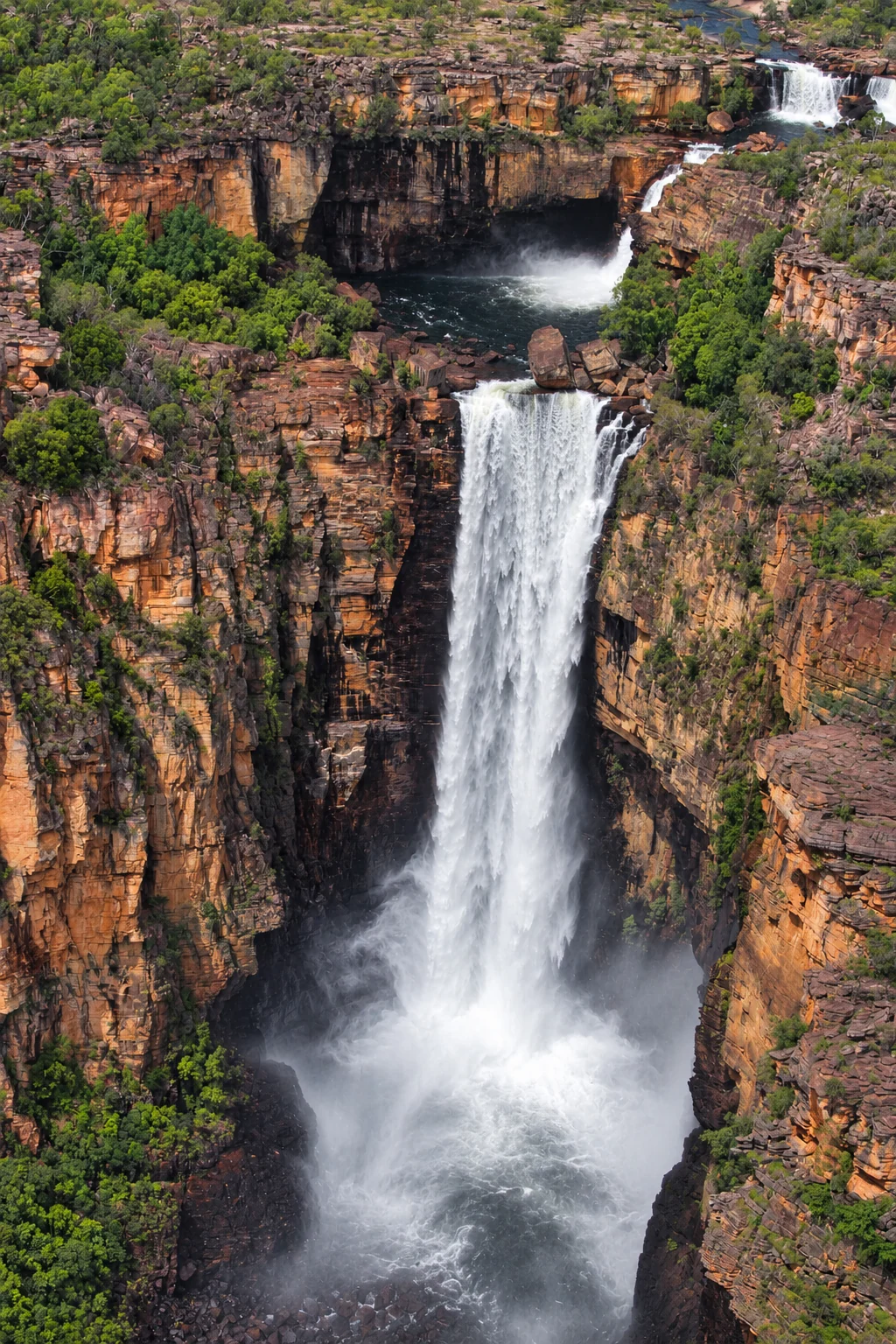
Jim Jim Falls is a waterfall in Kakadu National Park, Northern Territory, that drops about 200 m into a deep plunge pool. Reaching it takes a high-clearance 4WD (four-wheel drive) on an unsealed track, then a short walk over boulders. Kakadu Tourism reports that the falls remain closed for the 2026 dry season due to road and infrastructure upgrades, so visitors travelling in 2026 need to plan for a later season.
A trip depends on three decisions: the vehicle, the time of year, and how much of the walk and swim to do. The falls run strongest in the wet season, when flooding closes the road. The road opens in the dry season, when the falls are thinner.
Is Jim Jim Falls open in 2026?
No. Jim Jim Falls, Twin Falls Gorge, the Twin Falls escarpment walk and Garnamarr campground remain closed for the 2026 season while major road and infrastructure works are completed. Parks Australia updates its online access report daily, and it is the place to confirm the reopening date for any later year.
Other parts of Kakadu remain open for visitors this season. On 18 October 2026, Bilkbilkmi (Graveside Gorge) and Jarrangbarnmi (Koolpin Gorge) closed for the season from 16 October 2026, while Ubirr, Burrungkuy (Nourlangie), Bowali Visitor Centre and the Bowali track are listed as open. Access reports change through the season, so check the live report close to your travel date.
Getting there from Darwin
From Darwin, take Route 36 (the Arnhem Highway) toward Jabiru, then Route 21 (the Kakadu Highway) past Jabiru toward Bowali. The turn-off to Jim Jim is on the east side of the highway, about 45 km south of Jabiru.
Kakadu Tourism gives the distance from Darwin to the falls as about 430 km, or 6 to 7 hours. Jabiru is about 90 km away (roughly 1.5 to 2 hours), and Cooinda Lodge is about 1.5 hours away. Many visitors base themselves at one of these two and drive in for the day.
The road from the highway has two stages:
- Highway to Garnamarr Campground: about 50 km of unsealed, corrugated gravel.
- Garnamarr to the Jim Jim Falls car park: roughly 5 to 10 km of narrow, winding track with soft sand and creek crossings.
Plan for a slow day. Dust from vehicles ahead reduces visibility on the track, so leaving a gap helps. Heavy corrugations make the road hazardous, and tours may be postponed until the road is graded.
4WD rules and the creek crossing
Only high-clearance 4WD vehicles with low range can continue past Garnamarr Campground. Standard hire cars and 2WD vehicles cannot make the drive past the highway section. The stretch from the highway to Garnamarr suits 2WD vehicles, but the final approach to the falls does not. Trailers cannot go beyond Garnamarr because the tracks are narrow and winding, so leave them at the campground, and caravans are not recommended. Visitors without a suitable vehicle can book a guided 4WD tour instead.
The track crosses Jim Jim Creek on a concrete causeway. Parks Australia raised the crossing for safer 4WD access and reopened it on 19 August 2021, when 0.2 m of water covered the causeway. Depth changes with the season and recent rain, and typically the water is 400 to 600 mm over a solid concrete base, reaching about 800 mm at times. Early in the dry season the water can be about 1 m deep, while in September or October it is shallower but can still be half a metre or more.
The crossing requires a high-clearance 4WD with a snorkel (a raised air intake). Engage low range and cross slowly, without making a bow wave. Cross one vehicle at a time. AWD and SUV vehicles are not suitable. Ring Bowali Visitor Information Centre on (08) 8938 1120 before departing to get current depth information. Do not walk in the creek, because saltwater crocodiles live in the area.
The walk to the plunge pool
From the car park, the walk to the plunge pool is about 900 m one way, or about 2 km return, through monsoon forest and over boulders. The track starts sandy, and some sections are sandy and slippery. The final approach needs careful movement over large, uneven rocks.
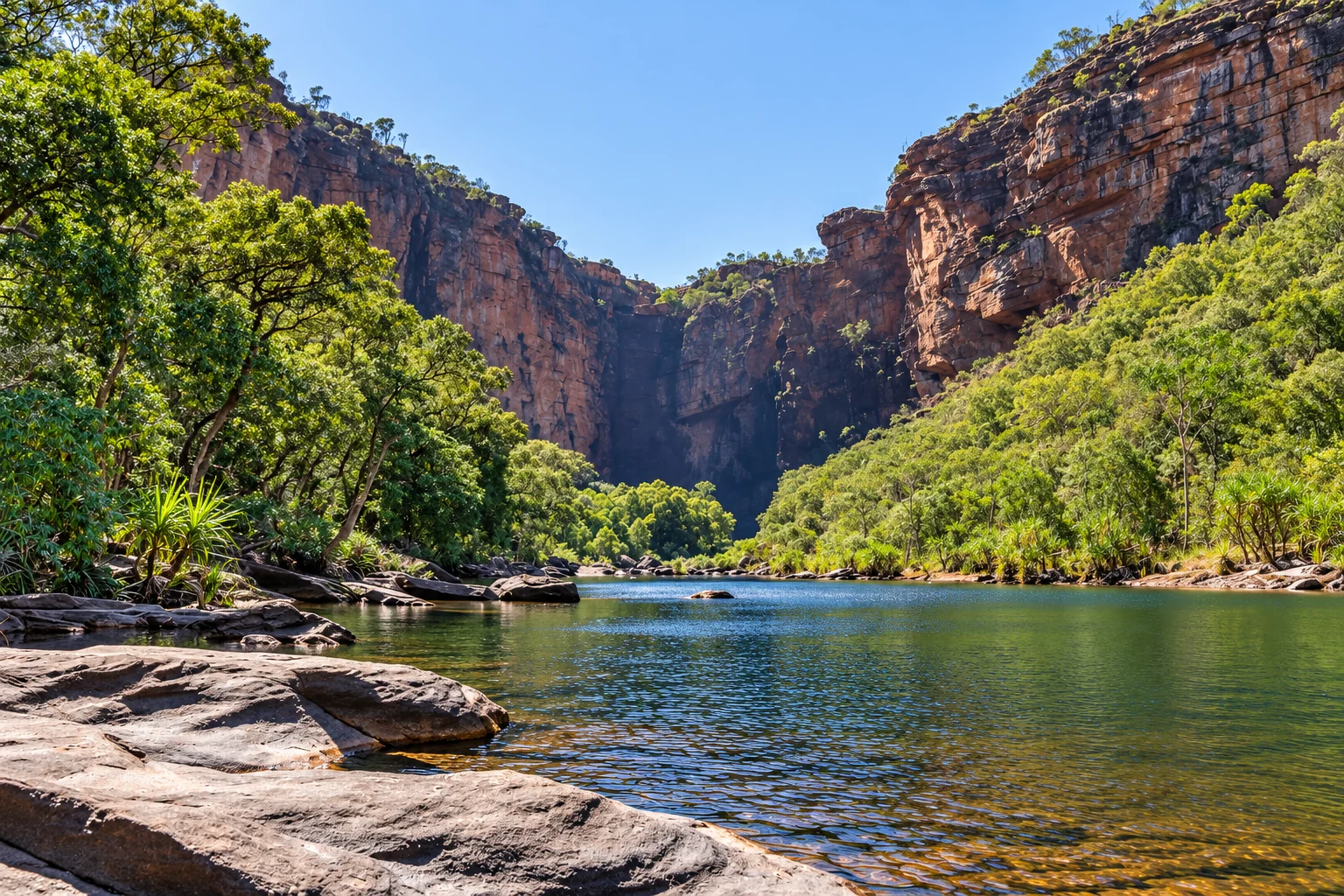
The walk is graded moderate, with an elevation gain of about 91 m, but the boulder scramble makes it harder than the distance suggests. Allow about three hours for the round trip, which leaves time for photographs, rests and the rock sections. Wear sturdy shoes and carry water, sunscreen and insect repellent. There are no services at the falls, so bring all your water, food and a first-aid kit.
Start early. Mornings are cooler, parking is easier and wildlife is more active. Watch animals from a distance and do not feed them.
Other walks near the falls
The Barrk Marlam walk climbs a steep, rugged route to the escarpment above the falls and suits experienced, fit walkers who start early. Kakadu Tourism lists it as 7 km return, and Northern Territory tourism describes it as 6 km taking about 5 hours. Plan for the longer estimate and carry extra water.
Budjmi Lookout is a shorter option of about 1 km, graded moderate, taking about 45 minutes. A rest stop at the Barrk Malam turn-off, the "Gorge Viewing Area", is suggested after the first section of the track.
Twin Falls lies on a separate branch that adds a further 7.5 km, including a permanent creek crossing 600 to 900 mm deep. It is also closed in 2026. Twin Falls is not swimmable.
Best time to see the falls
Jim Jim Falls flows in the wet season, from about the start of the tropical summer (roughly November) into the middle of the year. The falls are at their fullest during these months, but floodwater makes the road impassable from roughly November to April.
The road is generally open from around May or June to October, depending on conditions. Rangers open the falls only once they judge the roads safe and crocodile surveys are complete, so the opening date shifts each year. Late in the dry season the falls shrink to a trickle, but the gorge and its shallow beach remain spectacular. The plunge pool stays accessible after the water stops flowing.

The tradeoff is between flow and crossing depth. Early in the dry season more water comes over the cliff, but the creek crossing is deeper. Later the crossing is shallower and the falls are thinner. Dry-season daily maximums average about 32°C, while the wet brings higher humidity and maximums in the high 30s°C.
Swimming and crocodile safety
Rangers clear crocodiles from the water after the wet season, so swimming is generally allowed only from about June or July, and only when rangers judge it safe. Swimming is at your own risk. Unless signs clearly say swimming is safe, assume crocodiles may be present, and never approach or interfere with one. Treat any crocodile as dangerous and follow ranger guidance.
The water is cold and deep, and the swim to the base can feel long. Shallow water at the edge can drop away quickly. Do not dive or jump from rocks or cliffs, because unseen hazards lie beneath the surface.
Camping at Garnamarr
Garnamarr Campground (also spelled Karnamarr) is the closest managed campground to the falls, about 10 km away and about 50 km from the highway. It has water, toilets, hot showers, wood barbecues and picnic tables but no power, and generators are not allowed. It operates in the dry season only and holds about 200 people.

Dry-season hours are 6:30 am to 8:30 pm, with a fee of $15.00 per night for adults, $7.50 per night for children and $38.00 per night for families. The site suits tents and off-road camper trailers. Camping is permitted only at the designated site at the end of the track, and not at the picnic area before the Jim Jim crossing. Garnamarr is closed for the 2026 season, so check fees and booking arrangements for the year you travel.
Park pass and costs
Entry to Kakadu requires a park pass. The pass is valid for 7 days and can be bought online. It covers Kakadu only, and the Northern Territory Parks Visitor Pass does not cover Kakadu. Northern Territory residents receive free passes. Prices for a 7-day pass are:
| Pass type | Dry season (15 May to 31 Oct) | Tropical summer (1 Nov to 14 May) |
|---|---|---|
| Adult (16+) | $40 | $25 |
| Child (5 to 15) | $20 | $12.50 |
| Family (2 adults + 2 or more children) | $100 | $65 |
| Concession | $30 | $19 |
Parks Australia announced on 25 June 2026 that fees would drop to wet-season rates from 1 July to 31 October 2026, with adults paying $25 and families $65. A separate permit may be needed for drone use, commercial filming, photography or research.
Seeing the falls from the air
When the road is closed, scenic flights are the main way to see the falls at full flow, and the falls are best seen from the air during the wet season. Kakadu Tourism promotes an aerial tour over Jim Jim and Twin Falls, and flights are typically available from November to April. Flights are the only way to see the cliffs carrying a full curtain of water, which the dry-season road trip cannot show.