
The Great Barrier Reef is a chain of thousands of separate coral reefs and islands running along the Queensland coast, rather than a single wall of coral. The World Heritage Area, which UNESCO listed in 1981, covers about 348,000 square kilometres. It stretches from the tip of Cape York down to just north of Bundaberg, a distance usually given as more than 2,300 kilometres. Its inner edge is the low-water mark along the mainland coast, and its outer edge reaches well out past the continental shelf. UNESCO puts that outer limit up to about 250 kilometres offshore.
The count of reefs depends on the method. The official figure has long been more than 3,000 separate reefs, and sonar mapping suggests the true number may be closer to 3,800. The area also holds roughly 1,050 islands, according to GBRMPA (the Great Barrier Reef Marine Park Authority, the federal agency that manages the reef). About 600 are continental islands, which are the tops of drowned mainland hills. About 300 are coral cays, small sandy islands built on reefs, and about 150 are mangrove islands close to shore. Most of the area is protected as the Great Barrier Reef Marine Park, which covers about 99% of the World Heritage Area.
Inner, mid and outer reef
Distance from the coast changes what a visitor sees. Think of the reef in three bands.
Inner reef. Inshore reefs and continental islands sit close to the mainland, often within an hour’s ferry ride. Fitzroy Island is about 45 minutes from Cairns, and Magnetic Island is around 20 minutes from Townsville, according to Coral Reef Science. These waters are shallower and receive more runoff from the land, so visibility is usually lower than offshore. The trade-off is convenience: short transfers, beaches, walking tracks and accommodation. For visitors with limited time, or anyone who dislikes long boat rides, the inner reef is the easiest way in.
Mid reef. The middle of the continental shelf holds scattered reefs and cays between the coast and the outer edge. Many Whitsundays sailing routes and the southern coral cays fall in this band, including Heron Island, which is a catamaran trip of about two hours from Gladstone. Some mid-shelf sites are reached by sailing trip or short flight rather than a day boat, and they tend to suit visitors staying overnight on an island or a live-aboard vessel.
Outer reef. The outer reef lies along the edge of the continental shelf, where the seabed drops away into deeper ocean. Day tours from Cairns generally need about 60 to 90 minutes each way to reach it, and Port Douglas boats head for sites such as Agincourt Reef and the Ribbon Reefs. The longer trip gives clearer water and access to the permanently moored pontoons (floating platforms anchored at the reef) that most first-time visitors use. A full-day tour typically allows three to five hours at the reef.
Why the distinction matters when you plan
The band you choose sets how long you spend travelling, how much seasickness you may face on a rough day, and which kinds of snorkelling or diving you can do. It also affects stinger risk. Visit Cairns describes marine stingers (box jellyfish and Irukandji) as mainly a coastal problem that does not usually affect the reef itself, so inner-reef beaches carry the most risk during the warmer months.
Reef condition also differs by region and by site. The latest AIMS monitoring reports hard coral cover of 35.1% in the northern reef, 31.6% in the central reef and 26.4% in the southern reef. Within each region, individual reefs range from very low cover to more than 50%, so ask your operator which sites they visit on the day.
How the coastline maps onto the reef
The reef runs for roughly 2,300 kilometres along the Queensland coast, from near Bundaberg in the south to the Torres Strait in the north. Only a few towns serve as departure points, and each one puts you in a different part of that length.
Cairns and Port Douglas sit in the central part of the reef by AIMS’s regional split (roughly Cooktown to the Whitsundays). They give the shortest runs to outer-reef pontoons and the widest choice of day tours, which is why most first-time visitors start there. Townsville, further south, reaches Magnetic Island and the inner reef easily. Its best-known dive is the SS Yongala wreck, a site that suits certified divers rather than casual snorkellers.
Airlie Beach and Hamilton Island are the gateways to the Whitsunday Islands. The islands themselves are an inner-reef landscape of beaches and bays, and the outer reef (Hardy Reef is a popular pontoon site) takes a longer boat or helicopter trip. Visitors who want island scenery first and coral second often prefer this base.
The southern cays at the bottom of the reef, including Heron Island and Lady Elliot Island, are reached from Gladstone and Bundaberg. They lie well offshore, so the coral is a short swim from the beach, but you must stay overnight or book a limited number of day-trip spots. They suit travellers who want to see the reef without a daily commute by boat.
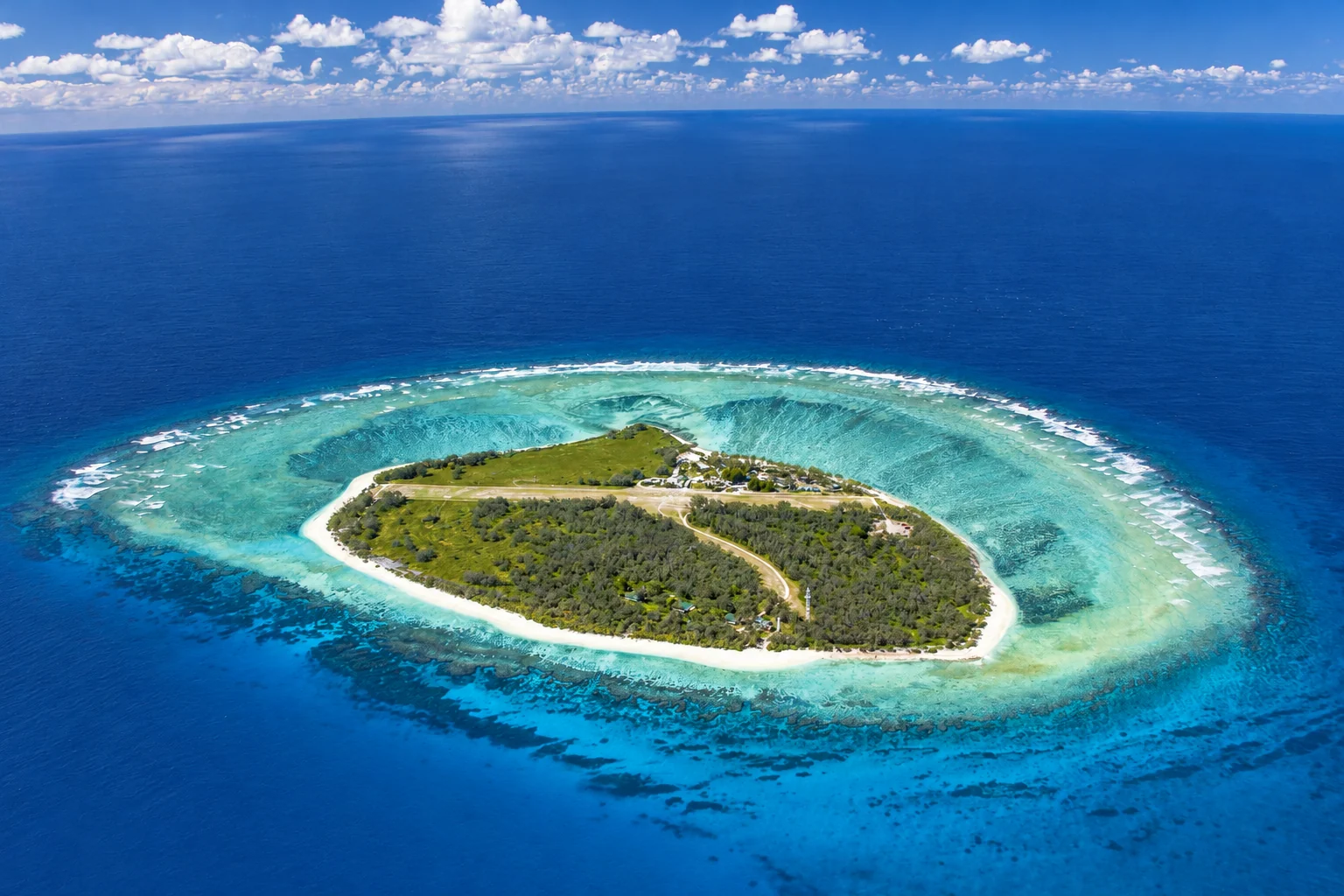
Distance from the coast also affects how far ahead you need to book. Cairns and Port Douglas have dozens of daily departures, while the cays and live-aboard routes have fewer seats and fill earlier. Pick the band of reef you want first, then choose the town that reaches it with the least travel.
Choosing Your Gateway: Cairns, Port Douglas, the Whitsundays and Beyond
Each departure town reaches a different part of the reef. The right base depends on who is travelling and what they want to do in the water.
First-timers are best served by Cairns. It is the largest reef-tour base and the main international gateway, and Cairns Airport sits about 7 km from the city centre and the reef terminal. Direct flights from Sydney, Melbourne and Brisbane make it an easy first stop, so a first-time visitor can land, sleep in town and board a reef boat the next morning. Cairns also has the most operators, so comparing tours is easier. Port Douglas suits travellers who want a quieter base. It is about 90 minutes from Cairns by car along the Captain Cook Highway, a coastal drive that is part of the appeal, and its tours head to the Agincourt and Ribbon Reefs. Port Douglas has no major airport of its own, so most visitors fly into Cairns and drive or take a shuttle.
Families do well with a half-day trip from Cairns, which keeps young children from spending a full day on a boat. One Cairns operator lists a half-day reef tour at AUD 209 for adults and AUD 159 for children aged 6 to 14, with morning and early-afternoon departures. Prices are operator-specific and change, so confirm before booking. Children under four who travel free are also exempt from the Environmental Management Charge, the per-person fee for entering the Marine Park. For a gentler, shorter water crossing, a ferry to an inshore island works well. Magnetic Island is about 20 minutes by ferry from Townsville, and Fitzroy Island is a ferry ride from Cairns.
Divers have more choice than the mainland towns suggest. Tourism Australia says pontoon operators out of Cairns, such as Reef Magic, Quicksilver and Sunlover, suit first-time divers, because the permanently moored pontoons give a fixed, supervised entry point. That page is older, so check current offerings. Experienced divers can look to the outer reef from Port Douglas, or to southern cays such as Heron Island and Lady Elliot Island, reached by catamaran or helicopter. The Heron Island catamaran leaves from Gladstone and takes about two hours, so allow a night in or near Gladstone on either side.
Budget travellers get the best value from Cairns, where competition between operators is strongest. Choose a half-day tour over a full day, and read the booking terms to see whether the Environmental Management Charge is included in the fare or added at the wharf. The full-day charge is AUD 8.50 per person and the part-day charge is AUD 4.25, with the full-day rate set to rise to AUD 9.00 on 1 April 2027. Port Douglas tours cost more: the same Cairns operator lists a Port Douglas pontoon tour at AUD 338 per adult, plus a AUD 10 fuel levy and AUD 45 for return transfers from Cairns. Townsville, with its Breakwater Marina reef departures and cheap ferry to Magnetic Island, suits a lower-cost trip.
The Whitsundays suit travellers who want to sail rather than commute to a pontoon. Airlie Beach is the main base, with day trips to Hardy Reef and scenic flights over Heart Reef. Hamilton Island Airport has direct flights from Sydney, Melbourne and Brisbane, and Whitsunday Coast Airport at Proserpine serves Brisbane and Sydney. The Hamilton Island ferry from Shute Harbour takes about 30 minutes.
Driving between regions takes more planning than it looks. Cairns to Townsville is about 4.5 hours by car, and Brisbane to north Queensland takes more than 20 hours by road, so most visitors fly between regions and hire a car only for the Cairns to Port Douglas stretch.
Beyond the main hubs
Smaller departure points suit travellers who want fewer boats on the water or a stay on the reef itself. Each has a trade-off in cost, travel time or choice of operators.
Fitzroy Island and the Cairns islands sit close to Cairns and take the least planning. A short ferry ride from the city puts you on a continental island with fringing reef, so a night or two there works for visitors who want reef access without a full tour day. Fringing reef grows around the island’s edge and differs from the outer reef, with less variety of fish and coral but easy snorkelling from the beach.

Lizard Island, in the far north, is the remote option. Visitors reach it by small plane from Cairns, and accommodation is limited and expensive. It suits experienced divers and travellers with a large budget who want quiet sites and little crowding. First-timers gain little from the extra cost and logistics.
Southern Great Barrier Reef access starts from Bundaberg, Gladstone and Agnes Water. Lady Elliot Island is reached by light aircraft from the Bundaberg and Hervey Bay area, while Heron Island is reached by catamaran from Gladstone. Lady Musgrave Island is reached by catamaran from the Town of 1770 and Agnes Water. These suit visitors already driving the Queensland coast or based in Brisbane, because they avoid the long flight north. The southern cays are coral islands rather than continental islands, with clear water close to shore. Accommodation is mostly limited to resorts and camping, so book early for school holidays.
Matching the gateway to the traveller
A simple rule narrows the choice. Pick Cairns if you want the widest choice of operators and prices, and Port Douglas if you want the outer reef with a quieter base and can pay more. Pick the Whitsundays if you want to combine sailing, beaches and a reef visit on one trip. Choose Townsville for lower costs and a less crowded base. Choose a southern cay if you want to dive or snorkel straight from the sand.
Distance between regions is large. Treat each gateway as a separate trip unless you have two weeks or more, and book a flight rather than a drive between them. A single region done well, with time for a weather-delayed day, gives a better reef experience than two regions squeezed into a week.
Best Time to Visit: Seasons, Stingers and Visibility
The Great Barrier Reef can be visited in every month of the year. Tour operators run daily departures from Cairns, Port Douglas and Airlie Beach year-round, and no part of the calendar closes the reef. What changes with the seasons is the weather, the risk of marine stingers (jellyfish whose stings can be severe), and which wildlife is in the water. Conditions also vary from year to year and between the northern, central and southern reef. Treat any month-by-month rule as a general pattern, with no guarantee.
Stinger season and what it means for reef trips
Box jellyfish and Irukandji (a tiny jellyfish with a painful, sometimes dangerous sting) live in coastal waters from Gladstone northward. Tropical North Queensland puts the season at roughly October or November to May or June, and most operators cite November to May. Cruise Critic gives October to May for the Whitsundays. The start and end dates shift with the year, so the edges of the season are the least predictable part.
The risk is greatest at mainland beaches. Visit Cairns says stingers are predominantly a coastal problem that does not usually affect the reef itself, although it describes both Irukandji and box jellyfish as potentially lethal. One operator, Cairns Discovery Tours, says Irukandji can be present on the outer reef from November to May. Given that difference, the sensible approach is to expect to wear a stinger suit on any reef trip during the season. Reef tours generally supply a full-body lycra suit, and Visit Cairns says a small fee is very rarely charged for it. The suit also protects against sun.
On the mainland, swim only at patrolled beaches between the red and yellow flags, and inside stinger nets where they are installed. Lifeguards check for jellyfish each day before they raise the flags, and current beach conditions are published by Surf Life Saving North Queensland. Stinger season does not rule out a Cairns or Whitsundays holiday. It means your swimming happens on a reef tour, in a net enclosure or in a pool.
Cyclones, heat and the wet season
The summer months bring the highest chance of storms and marine heat. The 2025–26 summer shows how much a single season can vary. AIMS (the Australian Institute of Marine Science, which monitors reef health) reports that Cyclone Koji, a category 1 system, crossed the central reef in January 2026, and Cyclone Narelle, a category 5, hit the northern reef in March. Heat stress that can bleach coral peaked in February, reaching an alert level in parts of the northern reef. A cyclone or a rough spell can cancel tours or close particular sites, so book flexible dates in summer and leave a spare day in your itinerary.
The cooler months, roughly the Australian winter, avoid most of this risk. The stinger season has ended or is ending, and the sea is calmer on average, which suits first-time snorkellers who may be nervous about swell.
Visibility and wildlife
Underwater visibility depends on wind, swell, tide and rainfall runoff, and it differs between reefs on the same day. Outer-reef sites sit far from coastal runoff and are generally clearer than inshore reefs, which is one reason the longer crossing is worth considering. No calendar guarantees clear water. On the morning of your trip, ask the operator which site they are visiting and how conditions look.
Wildlife follows its own calendar. Humpback whales travel the reef on their winter journey, and GBRMPA lists whale watching and swimming with whales among its permitted tourism activities. Turtles and fish are present all year.
For a first trip, a few days in the cooler months gives the least weather and stinger disruption. A summer visit still works well if you accept the suit, the heat and the chance of a rescheduled tour.
Conditions vary by year and region
The seasonal pattern above is an average, and individual years depart from it. A wet season can arrive early or late, a cyclone can miss the coast entirely, and a mild summer can pass with no bleaching. The 2025–26 summer, with two cyclones in different parts of the reef and heat stress peaking in the north, is one season’s record. It does not tell you what next summer will do.
The reef also spans more than 2,300 kilometres, so one region’s weather does not predict another’s. A cyclone that closes tours out of Cairns may leave the southern cays untouched. The Whitsundays sit further south than Cairns and Port Douglas, so their weather and stinger timing differ from the tropical north. Inshore reefs react to rain and runoff within days, while outer reefs recover clarity sooner. When a news report mentions bleaching or a storm, check which stretch of reef it covers before changing your plans.
Reef condition follows the same rule. Coral health varies between regions and between sites a few kilometres apart, and operators choose sites on the day partly for that reason. A good operator will tell you honestly which sites are in better shape. The GBRMPA website and the AIMS condition summary are the best places to check the current picture before you pay a deposit.
The reef is open all year
No month closes the reef. Tour operators run daily departures through every season, and turtles, reef fish and coral are there whether you visit in January or July. The month you choose changes the trade-offs, and a trip is possible in any of them.
- Winter (roughly June to August): calmer seas on average, no stinger suit needed in most places, and humpback whale season. Expect cooler mornings on the boat, and book early because this is peak tourist season.
- Summer (roughly December to February): warm water, a stinger suit for swimming, and the highest chance of storms and cancellations. Prices and crowds can be lower outside school holidays.
- Shoulder months (spring and autumn): often a workable balance, though stinger rules may still apply at the start or end of the season.
Whatever month you choose, leave room in your plans. Book a refundable or changeable tour where you can, schedule the reef day early in your stay so a cancellation leaves room to reschedule, and confirm the day before with your operator. Weather decides whether a boat sails. A few flexible days at the start of a trip protect the reef day most visitors came for.
Ways to See the Reef: Snorkelling, Diving, Scenic Flights and Glass-Bottom Boats
Snorkelling is the default way to see the reef, and most first-timers start there. Day tours from Cairns and Port Douglas run to outer-reef sites, where you swim at the surface with a mask, snorkel and fins and look down at the coral. Many tours also include a stinger suit, a full-body lycra suit that protects against sun and jellyfish. Visit Cairns says operators very rarely charge a small fee for it. Snorkel guides in the water are worth asking about if you are a nervous swimmer, and the best-run tours say upfront whether guides get in the water or only brief from the deck.
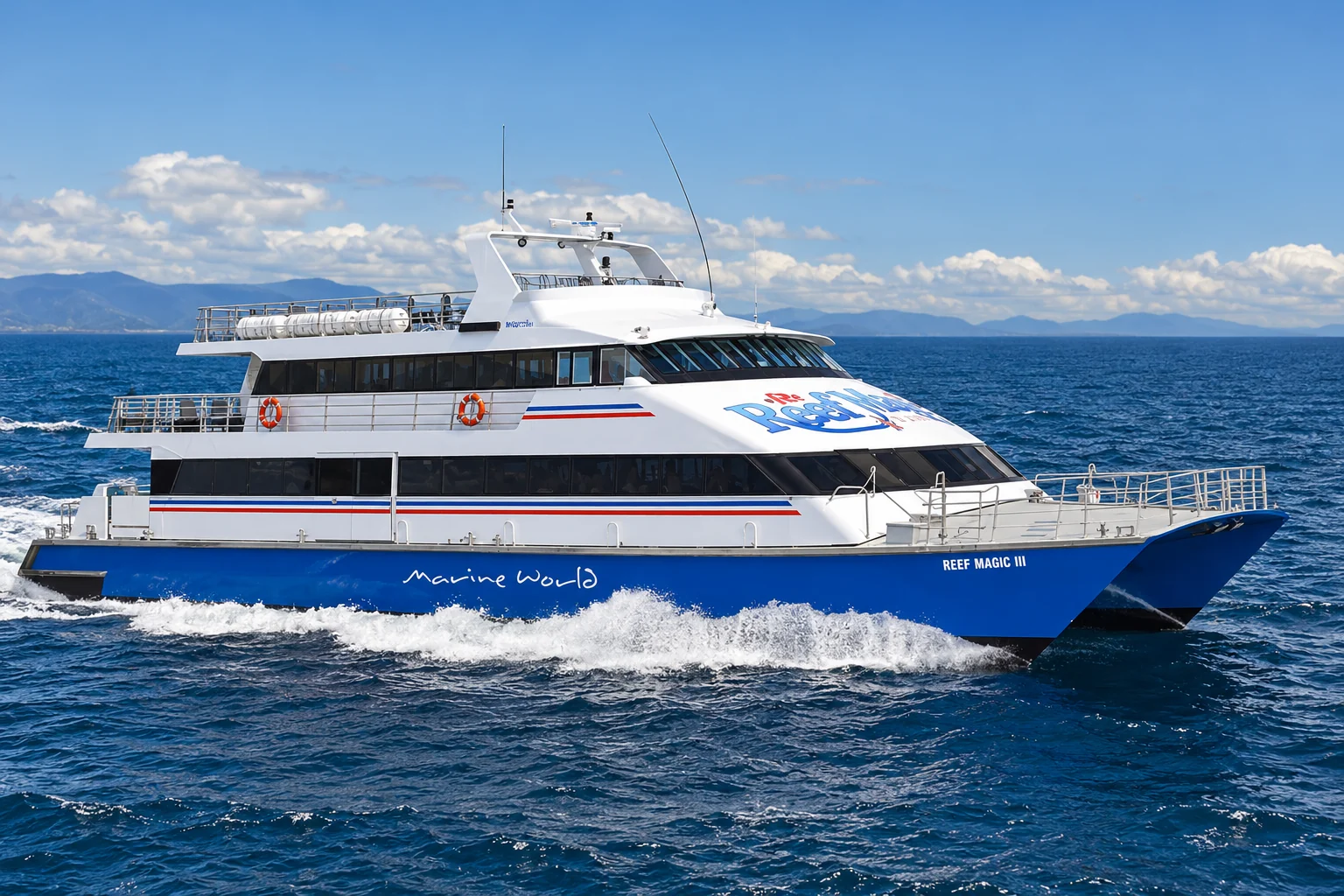
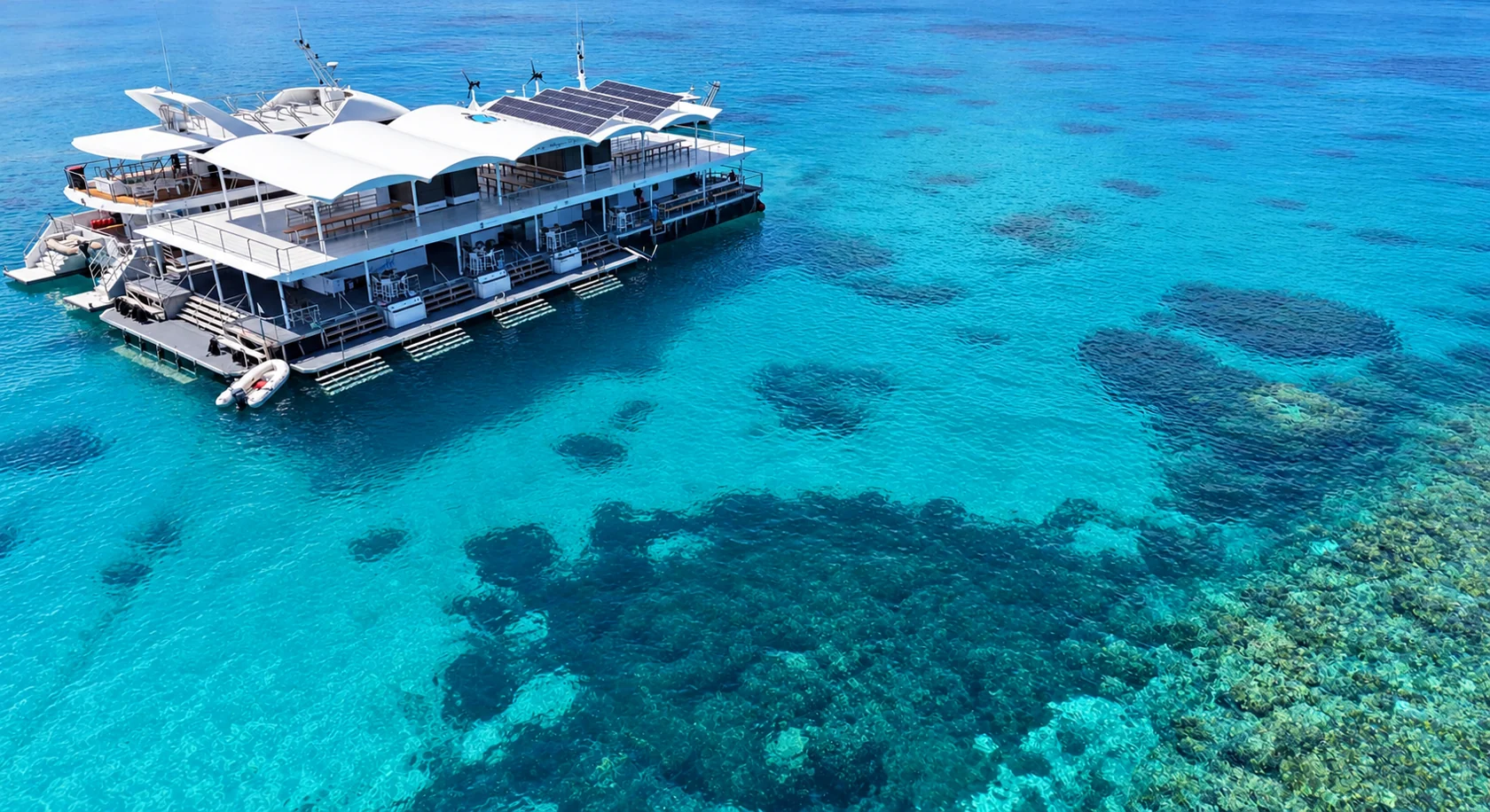
Many outer-reef day trips use a pontoon, a platform moored permanently at the reef. Tourism Australia lists pontoon operators such as Reef Magic, Quicksilver and Sunlover as good choices for first-time divers, because the platform gives you a fixed base, shelter and a place to rest between swims. Full-day tours typically leave 3 to 5 hours at the reef, according to Coral Reef Science.

Diving
Introductory dives let people without a certification dive with an instructor, usually from the same pontoon or boat as the snorkellers. Certified divers can book multi-dive days, or overnight trips and island stays such as Heron Island in the southern reef, which sits about two hours by catamaran from Gladstone.
Every dive operator asks you to complete a medical questionnaire before you go in the water. It asks about conditions such as asthma, heart problems, diabetes, ear and sinus trouble, and recent surgery. Answering yes to certain questions means a doctor must examine you and sign a form before you dive. Complete this before you arrive in Queensland, because a same-week appointment is hard to arrange, and an operator will refuse to take you diving without it. Answer honestly: pressure underwater affects the lungs, ears and heart, and the form exists to catch problems before they happen in the water. If you are unsure, snorkelling is an alternative on the same trip. Check with your operator whether the medical rules also apply to snorkelling.
Seasickness
Outer-reef crossings take about 60 to 90 minutes each way from Cairns, according to Coral Reef Science, and the open water beyond the shelter of the coast can be rough, especially in windy conditions. If you get motion sick, ask a pharmacist about seasickness tablets and take them before the boat leaves, not after you feel unwell. Eat a light breakfast, sit in the middle of the boat on the lower deck where movement is gentlest, and keep your eyes on the horizon. Shorter inshore trips and larger boats are gentler, and some operators run half-day trips for people who prefer a short crossing.
Scenic flights and glass-bottom boats
If you do not want to get wet, scenic flights and glass-bottom boats are the alternatives. GBRMPA lists aircraft and helicopter tours as a standard type of reef tourism. Flights run from Cairns and the Whitsundays, where Heart Reef is the main aerial attraction, and the shape of the reef is much easier to understand from above. Glass-bottom boats and semi-submersibles, which have windows below the waterline, let you see coral and fish while staying dry. Both suit young children, older travellers and anyone with a medical reason to avoid diving.

Prices change, so check before you book
Tour prices vary by operator, season and trip length, and they change without much notice. As one example from an operator’s own listing, Cairns Discovery Tours lists a half-day reef tour at AUD 209 for adults and AUD 159 for children aged 6 to 14, and a Port Douglas pontoon tour at AUD 338 per adult plus a AUD 10 fuel levy. Treat those as a rough guide only.
Also check whether the fare includes the Environmental Management Charge, the government fee for visiting the Marine Park. The official full-day rate is AUD 8.50 per person, and the charge for a glass-bottom boat or sightseeing flight is AUD 0.40 per excursion. Some operators build it into the price and others add it at the wharf.
Medical declarations and the order of your days
Every operator that takes certified or first-time divers asks you to complete a medical questionnaire before you get in the water. Introductory divers, who dive with an instructor and no prior certificate, usually fill it in at the wharf or online before the trip. Answer it honestly. A "yes" to conditions such as asthma, heart or lung problems, epilepsy, diabetes, recent ear or sinus surgery, or pregnancy normally means you need a doctor’s written clearance before you dive. Without it, the operator will not let you take part. Pressure changes underwater affect the lungs, ears and heart, and the questionnaire exists to catch problems before they reach 10 metres of depth. If you are unsure, see a doctor before you travel, because finding a dive-qualified GP in a reef town on the morning of the trip is unreliable. A refused dive still leaves you able to snorkel on most boats, so the day is not lost, but check the operator’s refund policy first.
Diving also affects what else you can book. Flying soon after a dive raises the risk of decompression sickness, because nitrogen absorbed at depth is still leaving your body. The Divers Alert Network recommends a minimum surface interval of 12 hours after a single dive and 18 hours after repeated dives or several days of diving. Many Australian operators advise 24 hours to be safe. The same caution applies to scenic flights and helicopter tours, which you should not schedule for the afternoon after a morning dive. Do your scenic flight first, or put it on a non-diving day. Also leave a full day before your flight home.
Matching the experience to the traveller
Most visitors do better by choosing one main reef experience and one low-effort extra than by trying everything.
Weather decides how all of this plays out. Wind and swell cancel or reroute boat trips, and low cloud or rain grounds scenic flights, which fly on visual conditions. Book the flight or the boat early in your stay and keep a spare day, so a cancellation does not eat your only reef day. When you book, ask each operator about its cancellation and weather policy as well as its price, since refunds and rebooking terms vary.
Choosing a Tour Operator and Booking Well
Every commercial reef tour needs a permit from the Great Barrier Reef Marine Park Authority (GBRMPA), the federal agency that manages the Marine Park, so a permit says little about quality. GBRMPA’s permit rules cover most tourist operations, and its visitor planning page recommends choosing a "high standard" operator. High Standard Tourism is a GBRMPA recognition for operators that show a sustained commitment to reef protection, staff training and visitor education. Wet Tropics Waterways also suggests looking for Ecotourism Australia certification and Master Reef Guides, who are accredited reef interpreters. Check GBRMPA’s current list first, because recognition is awarded to operators and can lapse or change.
Questions that separate one tour from another
Tour descriptions can sound alike, so ask the operator directly. How many guests does each guide look after, and do the guides get in the water or brief from the deck? A comparison of reef tours suggests checking boat capacity, whether a marine biologist or certified reef guide is on board, and whether the snorkel guide is included in the fare or an add-on. First-timers who are nervous in open water benefit most from guides in the water and a low guest ratio.
Ask exactly which reef the boat visits. The reef’s condition varies by region and by site: AIMS’s 2025-26 survey found hard coral cover of 35.1% on the northern reef, 31.6% on the central reef and 26.4% on the southern reef, with large differences between individual reefs. Operators choose sites according to conditions, so an itinerary that names a reef is more useful than one that says "outer reef".
Also ask about stinger suits during stinger season (roughly November to May), the reef-safe sunscreen policy and the cancellation terms. Weather cancels reef trips, so find out whether you get a refund, a rebooking or only a credit.
Reading the price
The headline fare often leaves out charges. The Environmental Management Charge, a per-person levy that funds reef management, is AUD 8.50 for a full-day trip and AUD 4.25 for a part-day trip, rising to AUD 9.00 and AUD 4.50 from 1 April 2027. Children under four who are carried free are exempt. Some operators build the charge into the fare and others add it at the wharf, so check the booking terms. Other extras appear too: Cairns Discovery Tours lists a AUD 10 fuel levy on its Port Douglas pontoon tour and AUD 45 for return transfers from Cairns. Those figures belong to one operator and may have changed, but they show why two tours with similar fares can cost different amounts. Compare the final price with all extras.
Marketing claims to treat with care
Some claims cannot be checked. Operator pages describe their own reefs as having the best coral or visibility, and one commercial site says Port Douglas reaches Ribbon Reef sites with better coral than Cairns. That is the seller’s opinion, and results vary by day. Review volume is sometimes presented as a proxy for safety, but a high review count shows popularity only. A comparison of nine tours found that none publishes a formal safety-incident record.
Credentials from outside GBRMPA, such as Ecotourism Australia or diving agency affiliations, are useful supporting signals but are not the official standard. Words like "eco" or "sustainable" without a named certification tell you little.
Well-known pontoon operators such as Reef Magic, Quicksilver and Sunlover are described by Tourism Australia as suiting first-time divers. That page is older, so check each operator’s current itineraries and inclusions first.
Questions to ask before you pay
Specific answers from an operator tell you more than any claim on its homepage. Before you book, find out:
- Time at the reef. Ask how long the boat stays at the reef and how many sites it visits. A full-day tour can spend half its hours in transit, and the 60 to 90 minute outer-reef crossing is easy to overlook.
- Passenger numbers. Large pontoon vessels carry hundreds of people. Smaller boats carry far fewer and moor at less-visited sites. Neither is better in every case, but the difference shapes how crowded the water feels, so ask for the vessel’s capacity.
- Supervision in the water. Ask whether lifeguards or a snorkel guide watch the water, and whether guided snorkel tours are free or an extra charge. Nervous swimmers should ask about flotation aids and whether a guide can swim with them.
- What the fare covers. Check for masks, fins, stinger suits, lunch, transfers and any fuel levy. Whether the Environmental Management Charge is in the price should be stated clearly.
- Permits and certifications. Operators in the Marine Park need a permit from the Great Barrier Reef Marine Park Authority, and a reputable one will confirm it on request. Treat any additional accreditation as supporting evidence, as covered above.
Cancellation, weather and insurance
Weather decides whether boats run, so read the cancellation terms before you pay. The useful distinction is who cancels. When the operator or skipper calls off a trip for safety, most operators offer a refund or a rebooking. When you cancel, or when you simply feel unwell or the sea looks rough, the terms are usually stricter. Confirm the wording, because policies differ between operators.
Booking through a reseller or booking platform adds a second layer of terms, and refunds may run through the reseller rather than the boat operator. Booking directly keeps the conditions in one place and lets you ask questions by phone or email.
Check your travel insurance for weather and cyclone cover. Many policies exclude events that were already named or forecast when you bought the policy, so buy cover when you book flights rather than the week before departure.
Timing your booking
Book the reef day early in your stay, not on your last day. If wind or swell cancels the trip, you then have spare days to rebook. Divers should also remember the surface interval before flying, so a dive trip on the last day before a flight is a poor choice.
In school holidays and the cooler, drier months, popular departures, introductory dives and small-boat trips sell out, so reserve those several weeks ahead. In quieter periods, last-minute availability is common, and checking the forecast before committing a day works well. Whichever season you travel in, confirm pick-up times and the wharf location the day before, since check-in usually closes well before departure.
Reef Health: Bleaching, Cyclones and What Scientists Are Seeing
The Great Barrier Reef is under pressure from warming seas, cyclones and a coral-eating starfish, and it is still a place where first-time visitors see healthy coral, fish and turtles. The Australian Institute of Marine Science (AIMS), the federal agency that surveys the reef every year, describes a system that has taken heavy losses and keeps recovering.
What bleaching is and how often it has happened
Corals get their colour and much of their food from tiny algae living in their tissue. When the water stays too warm for too long, the coral expels the algae and turns pale, which is called bleaching. Bleached coral can recover if temperatures drop soon enough, but it can also die. AIMS reports that the reef has had six mass bleaching events since 2016. The 2024 event had the largest footprint ever recorded, and AIMS CEO Professor Selina Stead described it as the first time a single bleaching event had affected almost all the coral reefs in Australia. The 2025 event was largely confined to the northern reef.
Recovery since 2024
AIMS’s 2024/25 survey recorded some of the largest annual drops in coral cover since monitoring began, in the northern and southern regions. Its latest annual summary, for 2025/26, reports coral cover rising or holding steady in all three regions, which AIMS calls the start of recovery. The same report says the reef "remains under pressure". Coral cover varies from reef to reef, so recovery is uneven. Some reefs are thriving while others are still rebuilding.
AIMS researcher Dr Mike Emslie has said the reef is in [comparatively better condition than many other coral reefs in the world](https://www.aims.gov.au/sites/default/files/2025-08/Media%20release%20AIMS%20Great%20Barrier%20Reef%20Report%206th%20August%2025.pdf), while also saying the impacts of the 2024 event were serious. He described "increased volatility" in coral cover, meaning cover now rises and falls more sharply from year to year.
Cyclones and crown-of-thorns starfish
Cyclones break and flatten coral, and the wet-season storms that follow can wash fresh water and sediment onto the reef. The 2025/26 summer brought two. Cyclone Koji, a category 1 system, crossed the central reef in January 2026 and caused minor losses on several reefs. Cyclone Narelle, a category 5, hit the northern reef in March 2026. AIMS says a full assessment of its damage must wait for the 2027 surveys, so conditions on some northern reefs are still being measured.
Crown-of-thorns starfish are large starfish that eat coral, and they break out in waves. AIMS recorded them on a number of reefs in 2026 without any severe outbreaks, but it also reports that a fifth wave of outbreaks is emerging in the northern reef. Tour operators work with the Reef Authority on control programs for the starfish.
What this means when you book
Because conditions differ by region and by individual reef, the useful step is to ask your operator which reef they will visit and how it looks now. Operators choose sites partly on current conditions and can move a trip to a healthier one. The Great Barrier Reef Marine Park Authority (GBRMPA) recommends visiting with a permitted operator as a good way to see the reef and follow best practice. Your visit also contributes through the Environmental Management Charge, which funds management of the Marine Park.
The reef is made up of thousands of separate reefs spread over a vast area, so damage in one place does not describe the whole. First-time visitors still find rich coral and abundant marine life, especially on outer-reef sites. Check recent conditions with your operator, expect some variation, and keep the plan flexible.
Visiting Responsibly: Protecting the Reef While You’re There
The Great Barrier Reef is Sea Country for Aboriginal and Torres Strait Islander Traditional Owners. Sea Country means the saltwater environment together with its animals, stories, laws and cultural obligations, and Traditional Owners have maintained a connection to it since long before the reef became a tourist destination. Visitors are guests on that Country. Booking with a permitted operator, following zoning rules and treating the reef’s wildlife with care are practical ways to respect it.
Know your zone before you enter the water
The Marine Park is a multiple-use area governed by the Great Barrier Reef Marine Park Zoning Plan 2003, and each zone sets its own rules on what is allowed, prohibited or requires a permit. GBRMPA’s planning page says some areas are no-take zones where fishing is banned. Anyone heading out in a private boat should carry a zoning map, which local bait and tackle shops stock, or use the Eye on the Reef app. Tour passengers do not need to check zones themselves, because the operator’s permit specifies where the vessel can go.
Private visits and permits
Private recreation, including boating, fishing and swimming, generally needs no permit. Most commercial activity does, including tourism, mooring installation and educational programs. Filming with an unmanned aircraft (a drone) needs no permit only if set conditions are met, so check them before flying one over a reef or island. The maximum penalty for failing to comply with a Marine Parks permit is AUD 22,000 for an individual and AUD 110,000 for a company, and vessels and equipment can be seized with a court order.
Anchoring and mooring
Coral and seagrass beds are easily damaged by anchors. If you take a charter or bareboat (an uncrewed vessel over six metres), use a mooring wherever one is available. GBRMPA’s Responsible Reef Practices set out best practice for anchoring, mooring, diving, snorkelling and motorised water sports.
Whales, dolphins and turtles
Interactions with whales and dolphins require permission, and approach distances are set by GBRMPA. Swimming with whales on their winter migration is offered only by permitted operators, so do not enter the water near whales from a private vessel to try it. Keep the same distance and calm manner around turtles and dugongs.
Sunscreen and stinger suits
Chemical sunscreen washes off into the water at popular snorkel sites. A full-body lycra suit gives sun protection and reduces sting risk, and Tropical North Queensland recommends one for both reasons. During stinger season, reef operators generally supply suits, and most do so at no charge. Ask each operator about its reef-safe sunscreen policy before booking, and cover up rather than relying on lotion.
Pay the charge and choose carefully
Passengers on commercial trips pay the Environmental Management Charge, currently AUD 8.50 for a full day and AUD 4.25 for a part-day. It is either built into the fare or added at the wharf, so check the booking terms. Choosing an operator recognised by GBRMPA as a high standard operator also supports the businesses that invest in staff training and visitor education.
On the water, listen to the briefing, keep your fins and hands clear of coral, and do not take shells, coral or other marine life. If you see an injured animal, a vessel in a no-take zone or other damage, tell your guide or report it through the Eye on the Reef app.
Sea Country and Traditional Owners
The Great Barrier Reef is Sea Country, the saltwater homelands of Aboriginal and Torres Strait Islander peoples. More than 70 Traditional Owner clan groups have connections to the Marine Park, and those connections include law, language, stories and responsibilities for caring for reef and islands that run back tens of thousands of years. Traditional Owners continue to hunt, fish, hold ceremony and manage their sea country today, and GBRMPA works with them through its Traditional Use of Marine Resources Agreements and Reef Joint Field Management Program.
For a visitor, this means two practical things. First, the sea you are snorkelling in has custodians, and many operators now acknowledge them in their safety briefing. Second, you can choose to learn from them directly. Several Indigenous-owned and Indigenous-guided tours operate from Cairns, Port Douglas and Cooktown, including reef trips, cultural walks and island visits. Ask an operator whether it is Indigenous-owned or has a formal agreement with the Traditional Owners of the area where it works.
On islands and headlands, leave cultural sites as you find them. Do not move stones, shells or fish traps, and obey signs that close an area. Some places are restricted for cultural reasons, and rangers and guides can explain which.
Know your zone before you fish or anchor
The Marine Park is divided into zones, and each zone sets what you may do. Green (Marine National Park) zones are no-take: you can snorkel, dive and boat there, but you cannot fish or collect anything. Yellow, blue and other zones allow limited or regulated fishing. Boundaries do not appear on the water, so private boat owners and anyone hiring a boat should check GBRMPA’s zoning maps before leaving the marina. Fishing in the Marine Park is also subject to Queensland size and bag limits.
Commercial operators handle this for you. If you are on your own boat, you carry the responsibility, and penalties for fishing in a green zone are real.
Small habits that add up
- Do not stand on, sit on or touch coral. A single fin kick can break a branch that took years to grow.
- Do not feed fish. It changes their behaviour and draws them to boats.
- Take all rubbish back to the vessel or mainland, including small items such as hair ties and bottle caps.
- Wear a buoyancy aid or rest at the pontoon if you are a weak swimmer, rather than standing on the reef to recover.
- Keep drones away from wildlife and nesting birds. Islands within national parks have their own rules, so check with Queensland Parks and Wildlife Service before flying.
Paying attention to the place and the people who have cared for it the longest is the rest of it.
Key Takeaways
-
Base yourself in one region and book a day tour from there. Cairns suits first-timers best, with direct flights from Sydney, Melbourne and Brisbane and the widest choice of operators. Outer-reef crossings take about 60 to 90 minutes each way, and road distances between regions are long enough that most visitors fly.
-
Visit in any month, but plan around stinger season. From roughly November to May, reef tours generally provide full-body stinger suits, and mainland swimming belongs between the flags or inside nets at patrolled beaches. Visit Cairns describes stingers as mainly a coastal problem. Summer also brings the highest risk of cyclone-related cancellations.
-
Choose a permitted operator and ask which reef it visits. Commercial tours need a GBRMPA permit, and the Reef Authority recommends a "high standard" operator. Ask about guide-to-guest ratios, whether guides enter the water, and the cancellation terms.
-
Add the Environmental Management Charge to your budget. The official full-day rate is AUD 8.50 per person, and the part-day rate is AUD 4.25. Check whether your booking already includes it, because some operators add it at the wharf.
-
Expect a reef in recovery, with uneven results by site. AIMS reports coral cover rising or holding steady in all three regions after the 2024 bleaching, while stating the reef "remains under pressure". Outer-reef sites remain the strongest choice for coral and marine life.
-
Follow the zoning rules and treat the reef as Sea Country. Do not touch coral, feed fish or leave rubbish, and keep to the required distances from whales, dolphins and turtles. The reef is home to Aboriginal and Torres Strait Islander Traditional Owners, and Indigenous-guided tours operate from Cairns, Port Douglas and Cooktown.


