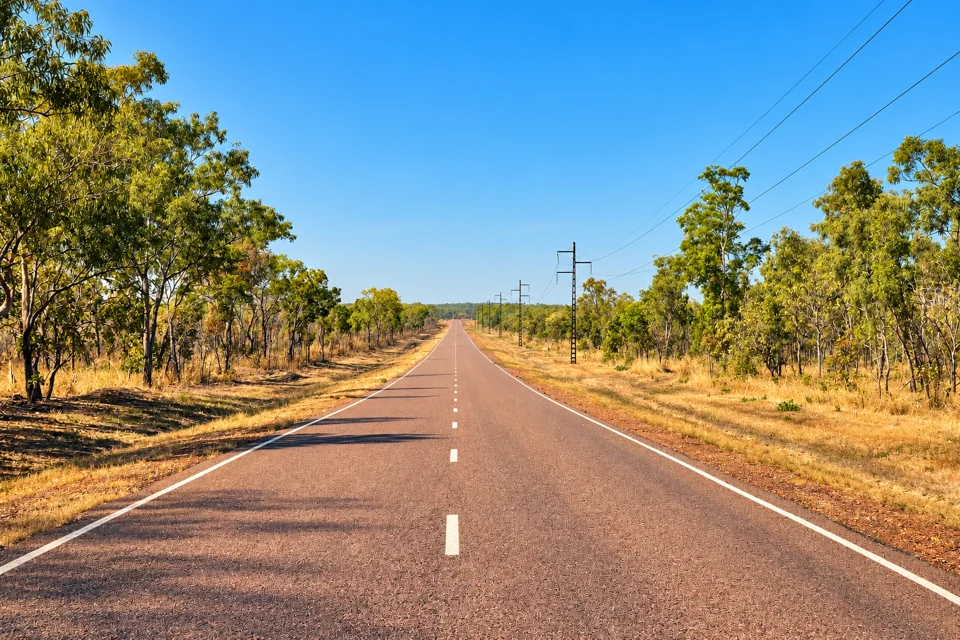
Kakadu National Park lies about three hours’ drive east of Darwin in the Northern Territory (NT). No buses, trains or shuttles run from Darwin to the park, so most visitors drive a hire car or campervan. The standard route follows the sealed Arnhem Highway to Jabiru. A 2WD car reaches Ubirr, Nourlangie, Yellow Water and Cooinda. The waterfall and gorge sites are on gravel roads and need a high-clearance 4WD.
Timing matters more than the route. Floods in early 2026 damaged roads across the NT, Jim Jim Falls and Twin Falls are closed through the 2026 dry season, and park pass prices change on 1 November 2026.
Two Routes to Kakadu
The main route is the Arnhem Highway (NT Route 36), which is 227 km long and runs from the Stuart Highway near Humpty Doo to Jabiru. The junction sits about 35 km south of Darwin. Along the way you cross the Adelaide River bridge at about 32 km, the Mary River bridge at about 78 km and the western boundary of Kakadu at about 117 km. The South Alligator River bridge is at about 180 km, and the Kakadu Highway junction at Jabiru is about 216 km from the Stuart Highway turn-off. The Arnhem Highway then continues to its eastern end at the Oenpelli Road, a no-through road to Gunbalanya.
The alternative is the Kakadu Highway (NT Route 21), which runs 209 km from Pine Creek on the Stuart Highway to Jabiru and enters the park at the Mary River crossing. Pine Creek is 227 km from Darwin according to the NT Explorer fuel tracker, so driving out via Pine Creek totals roughly 436 km, well above the Arnhem Highway route. For that reason most travellers use the Arnhem Highway in one direction at most. A loop that goes out on the Arnhem Highway and returns via the Kakadu Highway and Pine Creek adds distance, but it shows you the southern end of the park (Cooinda and Yellow Water sit on the Kakadu Highway) and avoids doubling back. If you plan to continue to Katherine, the Kakadu Highway and Pine Creek is the natural way out. Jabiru to Katherine is about 320 km, about 3.5 hours.
Distances and Driving Times
Darwin to Jabiru is roughly 253 to 257 km, for example 254 km and 253 km. The fuel tracker lists Jabiru at 257 km. Most operators quote about three hours at normal speeds. On good sealed roads the drive takes 2 hours 45 minutes, or around three hours with a food and fuel stop. Darwin to the park’s northern entrance is about 150 to 152 km, roughly 1 hour 45 minutes, according to Venture North.
Distances inside the park are measured from Jabiru:
| Destination | Distance from Jabiru |
|---|---|
| Jabiru Airport | 11 km |
| Nourlangie | 22 km |
| Aurora South Alligator Resort | 44 km |
| Ubirr and East Alligator River | about 46 km |
| Cooinda | 55 km (about 40 minutes) |
| Bark Hut Inn | 138 km |
| Pine Creek | 214 km (about 2.5 hours) |
| Katherine | 303 km (about 3.5 hours) |
| Litchfield via Arnhem Highway | 302 km |
| Litchfield via Kakadu Highway | 381 km |
These figures come from Kakadu Tours & Travel. Allow a full morning for the drive to Jabiru, because the time you spend at the stops below decides whether you arrive at lunch or late afternoon.
Stops Along the Arnhem Highway
The highway runs through the Adelaide River and Mary River floodplains, and most of the worthwhile stops sit before the park boundary at about 117 km. Fogg Dam Conservation Reserve, Windows on the Wetlands, Adelaide River Jumping Crocodile Cruises and Mary River National Park are the stops listed for the drive. The Adelaide River bridge, at about 32 km, marks where the crocodile cruises operate.
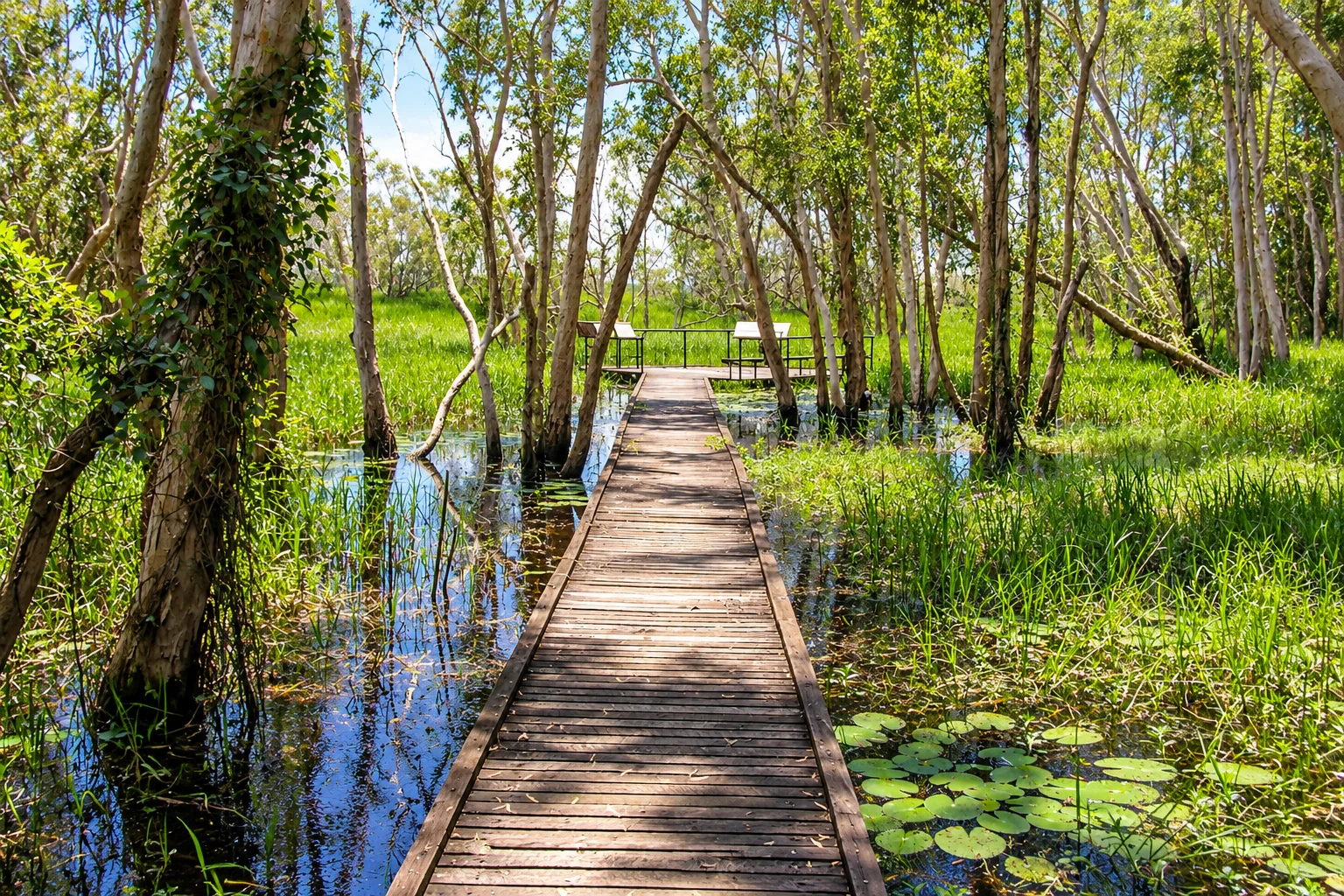
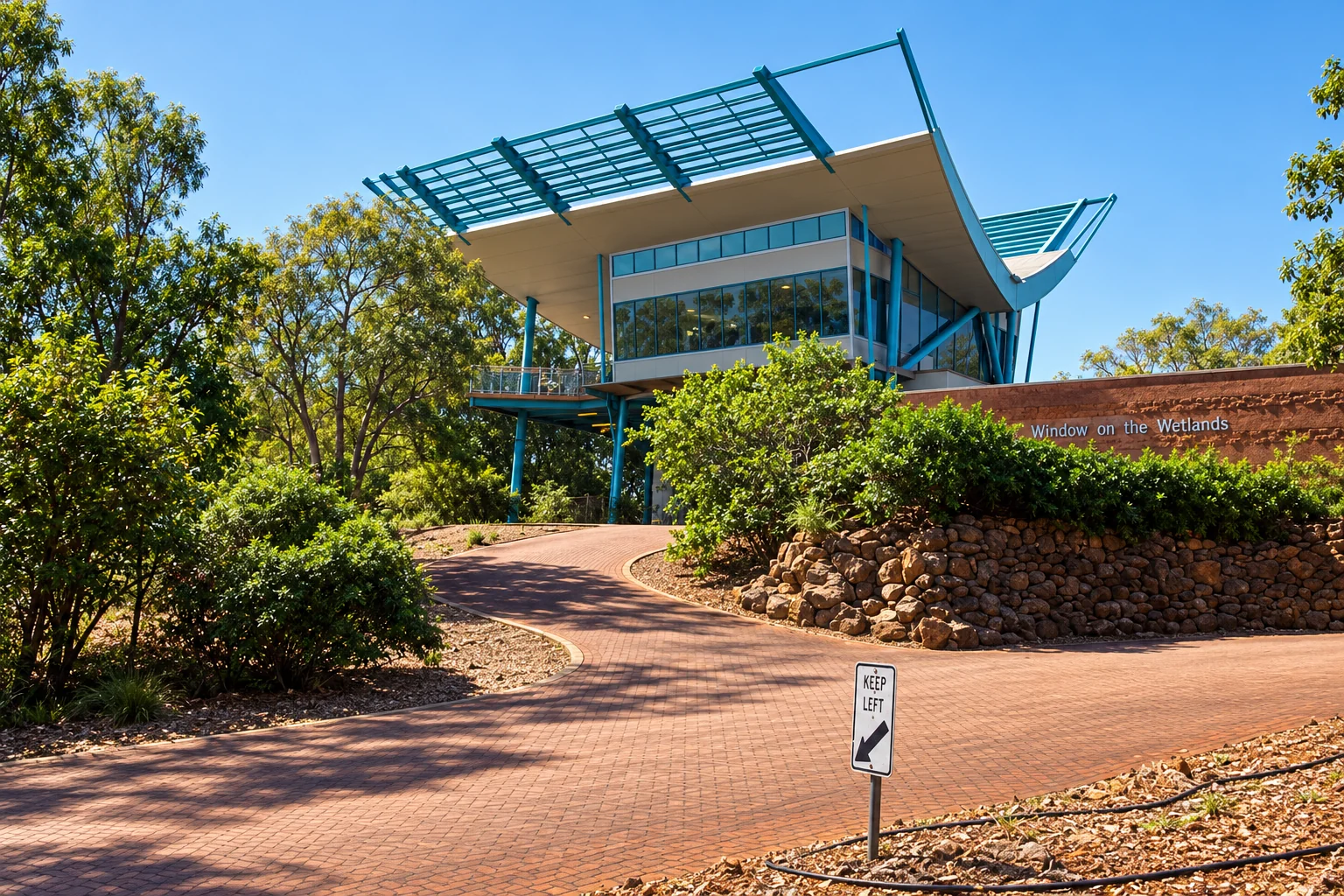
Mamukala Wetlands is the suggested birdwatching stop. The same motorhome guide advises a full day for the drive if you stop along the way. Visiting two or three of these places turns the trip into a day’s outing, so plan your stops with that in mind if you want to reach Jabiru with enough daylight to look around.

Sights Inside the Park
Bowali Visitor Centre, near Jabiru, is the main entry point for most visitors, and it is the place to ask about current track and road conditions before heading out.
Three headline sights are reachable on sealed roads in a 2WD:
- Ubirr is about 46 km from Jabiru, near the East Alligator River at the northern end of the park.
- Burrungkuy (Nourlangie) is 22 km from Jabiru, about 30 minutes south on a sealed road off the Kakadu Highway.
- Yellow Water and Cooinda, 55 km from Jabiru, are also reachable on sealed roads, according to Australian Traveller’s self-drive guide.
Ubirr and Nourlangie suit separate half-days, so base yourself around Jabiru for those two and move south to Cooinda for Yellow Water.
4WD Sites and 2026 Closures
Jim Jim Falls, Twin Falls, Maguk and Gunlom need a high-clearance 4WD. Jim Jim Falls is reached in the dry season via a 60 km gravel road from the Kakadu Highway, and the final 11 km needs 4WD. In the wet season no vehicle can reach the area. Maguk’s 14 km unsealed road also closes in the wet season.
Two of these sites are shut for the 2026 dry season. Parks Australia said Jim Jim Falls and Twin Falls would stay closed because of infrastructure damage, including roads, after a destructive wet season, as ABC News reported on 15 July 2026. Plan the trip around Ubirr, Nourlangie, Yellow Water and the sealed-road sights, and treat the other 4WD sites as optional extras if you have the vehicle and the time. For remote bush camping such as Yurmikmik, Outcamp advises carrying at least 20 litres of spare water.
How Many Days to Allow
A sound base is one day for the drive with stops, plus two to three days inside Kakadu for the main sights. That gives you the Ubirr and Nourlangie rock art sites, a Yellow Water outing from Cooinda, and travel between them. Grantourismo suggests a minimum of three days and nights and five to eight days for a wider trip that also covers Litchfield or Katherine. Distances between sites are long, so cramming everything into a single overnight visit leaves most of the time in the car. Add days if you want to attempt the gravel-road sites, and check each one’s status first.
Where to Stay
Jabiru is the main base for the park, with a supermarket, fuel and a range of accommodation, according to Beyond Wild Places. It is close to Ubirr and Nourlangie and about 40 minutes from Cooinda. At Cooinda, Cooinda Lodge has camping and accommodation but closes in the wet season, so confirm it is open before you book.


Other options sit on the approach roads. Aurora South Alligator Resort is 44 km from Jabiru, and Bark Hut Inn is 138 km from Jabiru. Adelaide River Inn offers accommodation on the Stuart Highway, and Mataranka Roadhouse has camping further south for those continuing towards Katherine.

Kakadu has more than 25 designated campgrounds, from commercial caravan parks to remote bush sites, and some bush sites have toilets and hot showers, according to Australian Traveller. The park pass is separate from camping fees, so budget for both, as Parks Australia guidance (relayed by Campwatch) states. The park’s own pages list current campground fees.
Seasons and Road Conditions
The practical window is the dry season, roughly April to October. Parks Australia’s pass schedule defines the dry season as 15 May to 31 October and the Tropical Summer (wet season) as 1 November to 14 May. Jabiru’s dry season nights from May to August can drop below 10 °C, while the build-up from September to November can exceed 40 °C. Conditions change fastest from January to March, when heavy rain floods the floodplains and closes roads until water levels drop, as Kakadu Tourism explains.
The Arnhem and Kakadu highways are sealed, but they flood. The 2026 season was also severe: ABC News reported on 27 March 2026 that more than 100 NT road sections were closed or impassable after widespread flooding, and the Arnhem Highway was among the roads made impassable. Citing Road Report NT, the ABC counted 76 closed roads, 26 impassable roads and 66 with surface hazards in that late-March snapshot.
Road Report NT lists Arnhem Highway roadworks at the Adelaide River floodplain, with a reduced speed limit and traffic control, so allow some extra time. Check Road Report NT, the NT Government’s road-status service, on the day you travel, and use its live road map before you set out and again at Jabiru. Road closures happen in the dry season too, and Kakadu Tourism recommends checking on the day.
Park Pass Prices
You need a Kakadu park pass, valid for seven days. Parks Australia has reduced prices from 1 July to 31 October 2026, as its announcement of 25 June 2026 explains. The reduced adult pass is $25 instead of $40, a child pass is $12.50 instead of $20, a family pass (two adults and two or more children) is $65 instead of $100, and a concession pass is $19 instead of $30.
From 1 November 2026 the standard Tropical Summer rates on the official passes page apply, and these match the reduced prices: adult $25, child $12.50, family $65 and concession $19. The standard Dry Season rates (15 May to 31 October) are adult $40, child $20, family $100 and concession $30. Park passes are free for Northern Territory residents, and children aged 0 to 4 enter free. Buy through Parks Australia’s pages or at the visitor centre, and check the passes page for the current rate before you travel.
Fuel Along the Route
Fuel is the main logistical constraint. Jabiru Service Station is the last fuel before Cooinda, and Cooinda Lodge closes in the wet season. Australian Traveller advises not passing a fuel stop below half a tank unless you are sure you can reach the next one, and fuel inside the park is expensive, so enter with a full tank. Tourism Australia also advises refuelling as often as possible on the way.
The NT Explorer fuel tracker, last verified on 15 April 2026, lists these stations. Prices change weekly, so use the figures to compare stations rather than as exact prices.
| Location | Distance from Darwin | ULP 91 / diesel | Hours |
|---|---|---|---|
| BP Humpty Doo (Stuart Highway) | 38 km | Not listed | 5am to 10pm |
| Adelaide River Inn (Stuart Highway) | 115 km | $2.30/L / $3.20 | 7am to 6pm |
| Pine Creek Service Station (Stuart Highway) | 227 km | $2.35/L / $3.25 | 7am to 7pm |
| Jabiru Service Station | 257 km | $2.49/L / $3.35 (P95 $2.65) | 7am to 7pm (seasonal) |
| Cooinda Lodge (Kakadu Highway) | 305 km | $2.55/L / $3.42 | Closes in the wet season |
For comparison, Darwin’s average ULP 91 price across the 29 stations the tracker reviewed was $2.11/L. Continuing south, Shell and BP Katherine are open 24 hours at 312 km and 314 km from Darwin, Mataranka Roadhouse is at 421 km and Larrimah Roadhouse at 470 km. Goymarr Roadhouse has no fuel. The Jabiru station’s hours are seasonal, so fill up before late afternoon.
Safety on Top End Roads
Avoid driving at night. Wildlife and livestock use Top End roads after dark, and Kakadu Tours & Travel and Beyond Wild Places both suggest early morning and late afternoon as the better times for wildlife viewing and weather. Mobile reception is limited inside the park. Jabiru has the only stable coverage, with Telstra and Optus, so download maps and note your route before you leave town.
Stay off flooded roads. Australian Traveller warns that floodwater on a closed road can be deep and extensive, whatever your driving experience, and that you should stay clear of the water at Cahill’s Crossing on the East Alligator River near Ubirr. Thunderstorms cause flooding, so check the Kakadu access report in the wet season. For remote bush camping, carry at least 20 litres of spare water. There are no toll roads in the Northern Territory, so road costs are limited to fuel and any hire fees.
One-Way Vehicle Hire
One-way policies differ between Darwin operators, so check the company and vehicle class before you book. Redspot restricts one-way hire to its three Darwin branches (Darwin City, Darwin Airport and Holtze), and cross-border rentals are not allowed from Darwin City, according to its Darwin City page and FAQ. That suits a Darwin-to-Kakadu return trip but not a one-way trip to Katherine.
Thrifty offers one-way rentals between Darwin, Alice Springs, Ayers Rock (Uluru), Broome and Kununurra, with pick-up and drop-off at airport or city locations. Its drop-off fees depend on the number of rental days. For travel between 1 June and 30 September 2026, Thrifty listed $440 for a Darwin to Katherine drop-off on 1 to 3 days and $200 for 4 or more days. It listed $440 to Alice Springs for 1 to 5 days, and $770 to Ayers Rock for 1 to 5 days, falling to $200 for 6 or more days. That window has ended, so confirm the current table with Thrifty before budgeting. Its Kimberley page lists Broome or Kununurra to Darwin at $997.15 for 7 to 13 days and $712.25 for 14 or more days. In general, one-way surcharges run from a few hundred dollars to over $1,000, depending on the vehicle and the season, with campervans and 4WDs costing more, as Defender Adventure reports.
Hire contracts limit where you can drive, and this affects Kakadu directly. Thrifty’s Compact, Full Size and Compact 2WD SUV classes are for sealed roads only, and its Intermediate Wagon is permitted on limited, approved unsealed roads. Thrifty’s deposits were $500 for a 4WD and $200 for a 2WD in the same rate window, payable by Visa or Mastercard. Cars 4 Mates says a 2WD stays on sealed roads, and it advises asking about unsealed Kakadu access if you hire a 4WD. It prohibits off-roading, beach driving, river crossings and unsealed public tracks. Driving south of Katherine or outside the NT needs written approval, and it typically charges $0.27 to $0.37 per km over the distance limit. Road Genius notes that most rental contracts restrict or prohibit unsealed roads, even with AWD or 4WD, so confirm in writing that your vehicle may use the gravel roads to Maguk or Gunlom.
Age and licence rules vary. Cars 4 Mates requires a full licence held for at least two years and renters aged 21 to 75. Redspot’s booking form shows renters aged 25 and over, or 21 to 24, and P-platers over 21 can hire. Redspot’s Darwin City branch at 102 Esplanade is open Monday to Friday, about 8:00am to 3:30pm, and Saturday 8:00am to noon, and it is closed on Sunday. It has no after-hours returns, so return the car the next business day or to Darwin Airport, about 17 minutes’ drive away, which has a 24-hour key drop box in the terminal. Redspot also excludes some Darwin areas from damage liability and 24/7 roadside assistance, and the exclusions are listed in its terms and conditions.
Key Takeaways
- Check roads on the day: Open Road Report NT before leaving Darwin, because 2026 floods made the Arnhem Highway impassable at points and roadworks are listed at the Adelaide River floodplain.
- Take the Arnhem Highway: It runs to Jabiru in roughly three hours, and a 2WD can drive the sealed road to Ubirr, Nourlangie, Yellow Water and Cooinda.
- Allow three to four days: Give one day to the drive and stops and two to three days inside Kakadu. Add more only if you have a high-clearance 4WD that can reach Maguk or Gunlom.
- Fill up at Jabiru: Enter the park with a full tank and refuel at Jabiru. Check that Cooinda is open, because it closes in the wet season.
- Read the hire terms: Redspot limits one-way hire to its Darwin branches, Thrifty offers one-way routes with drop-off fees, and most contracts restrict unsealed roads.
- Budget for the pass: The adult seven-day pass is $25 in the Tropical Summer from 1 November 2026, and $40 in the Dry Season, which runs 15 May to 31 October.