
Brisbane Airport (BNE) has a Domestic and an International terminal, and car hire companies serve them in two ways. Some brands have counters inside the terminals, with cars a short walk away. Others run depots in nearby suburbs and collect you by free shuttle. The pick-up point decides where you queue, how late you can collect or return a car, and what you pay.
Four factors decide most car hire outcomes in Queensland: the driver’s age and licence, the insurance excess (the amount you pay toward damage before cover applies), the rules on unsealed roads, and one-way fees. Operators publish figures for each, as set out below.
Companies at the airport and in town
Off-airport depots reached by shuttle
Four operators run depots away from the terminals with complimentary shuttles.
- Bargain Car Rentals is classed as off-airport. Its depot is at 22 Serpentine Road, Hendra. It opens Monday to Friday from 7:00 AM to 9:00 PM and on Saturday and Sunday from 8:00 AM to 6:00 PM, using normal hours over Easter, Christmas and New Year. The Bargain Brisbane Airport page, last modified 15 October 2026, gives the depot phone as +61 7 3077 6807.
- Ace Rental Cars runs a free shuttle during operating hours, and its branch pick-up information gives the last pick-up as 30 minutes before the branch closes.
- East Coast Car Rentals has an off-site airport branch with a complimentary shuttle that takes a few minutes from the terminal. After-hours returns are available, but there is no after-hours drop box. The shuttle runs via Andrews Airport Parking, and the booking phone is +61 7 5555 8900.
- Evolve Rentals has its office at 490 Nudgee Road, Hendra. You call +61 7 3868 1935 on arrival and the courtesy bus collects you. After hours, the Evolve airport page points to Andrew’s Airport Parking at 539 Nudgee Road, Hendra, which also has a free shuttle to and from the airport.
Brands with terminal counters
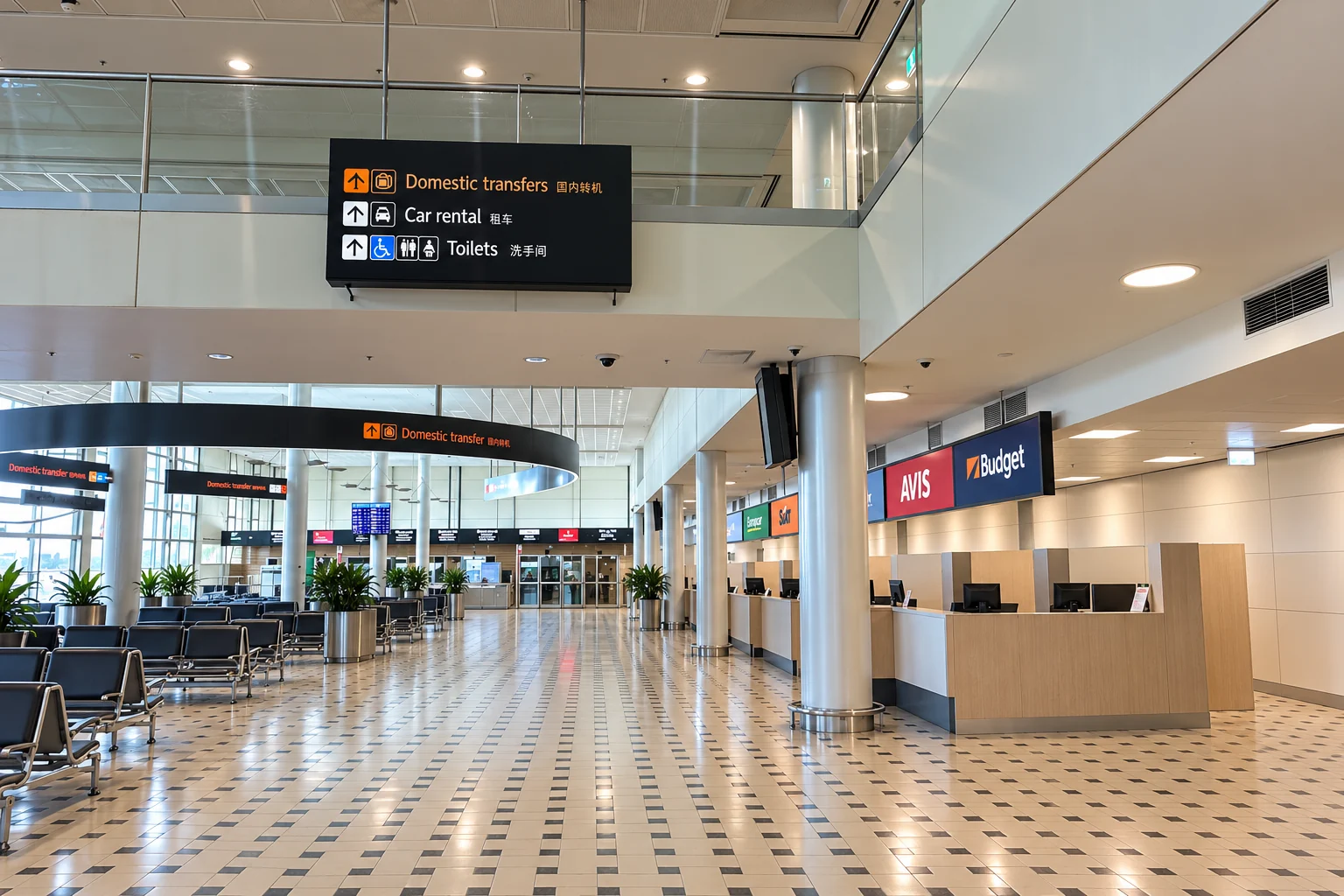
Listings for Road Genius place Avis, Budget, Enterprise/National, Europcar, Hertz and Sixt/Thrifty at terminal counters. A rental listing adds Alamo and Dollar to the list of on-airport brands. KAYAK shows several of the same names, including Thrifty, Europcar, Budget, Dollar, Sixt and Hertz, alongside Bargain, Ace, Alpha and Firefly, as offering shuttle or off-airport pick-up. Because a single brand can appear under both models depending on the rate or booking channel, check the pick-up instructions on your own confirmation, and ask the brand which terminal and which counter or shuttle stop applies.
KAYAK also lists Cheapa Car Rental, Tiger Car Rental and Tripz Car Rentals as single-location Brisbane Airport operators. A separate KAYAK listing places Crazy Clark’s Car Rentals at 1/172 Lavarack Ave, Brisbane, with Redspot servicing it on +61 1300 466 663.
Hire in town
You can collect your car away from the airport. East Coast has a Brisbane City branch in Fortitude Valley, which suits travellers who spend a few days in the CBD first and only need a car for the trip out of town. It also operates CBD locations in Newcastle and Melbourne, which is useful if you plan a one-way trip.
Where to collect your car
Terminal counters. In the International Terminal, the counters are on Level 2 Arrivals, and you collect your vehicle across from the terminal via a pedestrian walkway. In the Domestic Terminal, the counters are on Level 1 near baggage claim, and you collect your vehicle at the P1 parking area via a walkway. Most on-airport companies operate from 5:30 AM to midnight, and major brands generally offer 24/7 returns and key drop facilities, though each brand sets its own after-hours terms.
Shuttle pick-up, Domestic Terminal. Directions vary slightly by operator.
- For Ace, exit via the skywalk following "Bus Zone" signs, go to the ground floor of Bus Zone and wait in areas C1 and C2. Once you have your bags, call 1800 620 408 or book through the Ace Shuttle Collection App.
- For Bargain, take the escalators to the sky bridge, turn right at the Air Train, follow "Buses & Coaches A&B" signs to Bus Zone B1/B2, and call +61 3 6165 0838 (press 1) after collecting luggage. Bargain provides a real-time shuttle tracking link.
Shuttle pick-up, International Terminal:
- For Ace, exit at the Coach Departures door, follow the ramp to the main Coach & Shuttle bus area and meet the shuttle there.
- For Bargain, go to the arrivals hall after customs and turn left, following the Bus/Rideshare/Shuttle signs. Bargain tells passengers not to follow the "Rental Car" signs. Exit, go down the ramp, turn left and walk to the pick-up area.
Shuttle timing. Off-airport providers typically trade from 7 AM to 8 PM and sit 5 to 10 minutes from the terminal. Bargain’s shuttle runs during business hours and up to 20 minutes before closing. For the return trip, Bargain needs no booking for the shuttle back to the terminal, but you should allow about 20 minutes. A late flight that lands near closing time can leave you without a shuttle, so compare your scheduled arrival with the depot’s closing time and with the last pick-up rule (30 minutes before closing for Ace). An after-hours option such as Evolve’s arrangement at Andrew’s Airport Parking helps if your flight is late.
What drives the price
Location model. Off-airport companies generally offer cheaper rentals, with Apex, East Coast and Jucy named as examples. Prices also move with season and availability, so school holidays and peak periods cost more than the same car in a quiet week. The saving buys you a shuttle ride and shorter opening hours.
Driver age. Drivers under 25 face restricted vehicle classes at most operators and a daily young-driver fee at some. The next section sets out the rules.
Insurance. Reducing your excess at the counter adds a daily charge. A standalone policy bought separately typically costs less than half the daily rate of desk waivers according to OCR Australia, and National Cover quotes standalone excess cover at "$5–$12 a day".
Vehicle class. 4WDs, large SUVs and people movers cost more, and some are closed to younger drivers.
Mileage. Capital-city rentals usually have unlimited kilometres, but small-town rentals often include 100 km a day before a surcharge applies. Check the kilometre allowance if you plan to drop the car at a regional depot.
Tolls. Brisbane’s toll roads are billed through the rental company. Most rental cars are enrolled in a toll billing program, and the company adds an administration fee for each day of toll use. A Linkt Visitor’s Pass avoids that fee if the pass captures the toll first.
One-way fees. These depend on the route and brand, and are covered below.
Marketing prices. Bargain’s page advertises "from $35", a free additional driver, no booking fees and free cancellations. The "from" price carries no date or conditions, so compare the quote at checkout, with insurance and age fees included.
Age and licence rules
Most operators set the minimum age at 21 with a full licence held for at least 12 months. Alpha Car Hire applies this to primary and additional drivers, Bargain requires a full, unrestricted licence held for 12 months or more, and VroomVroomVroom cites one year’s licence. East Coast uses the same 21-and-12-months rule for its Brisbane branches.
Redspot calls 21 its minimum age for holders of an Australian provisional or full licence. Under its young driver rules, drivers under 25 must have held their licence for at least one year, and the licence must remain valid for at least 12 months from collection. A daily surcharge applies to all drivers on an Australian provisional licence, and drivers under 25 also pay a separate Young Driver daily fee. Dollar amounts are on Redspot’s standard fees and charges page. Drivers aged 21 to 25 can access small to medium sedans and hatchbacks, while provisional-licence drivers over 25 can access the full fleet.
Alpha charges a daily young-driver surcharge to drivers aged 21 to 24, who cannot hire Family SUVs, Large SUVs, People Movers, Minibuses, moving vans or trucks.
Bargain says it does not charge a Young Driver Surcharge, though drivers aged 21 to 24 may have restricted access to some vehicles, including luxury models.
Peer-to-peer hire. On Turo, drivers under 25 pay an extra $15 a day. The Deluxe class needs a driver aged 25 or over, while Super Deluxe needs one aged 30 or over.
Older drivers and special classes. VroomVroomVroom restricts some vehicle types to drivers aged 29 and over, and it says drivers over 75 may need a medical certificate. Auto Europe notes that many suppliers set a maximum age of 75.
At the counter. Bring a valid driver’s licence and a credit card in the driver’s name. East Coast also asks for any local renter policy documents. Additional drivers must meet the same age and licence rules and be named on the rental agreement. Only named drivers may drive. Alpha accepts Queensland, New South Wales and South Australian digital licences if they can be verified through the official government app on arrival.
Overseas licences in Queensland
Under Queensland Government rules (page last modified 19 February 2024, so check the live page before travelling), visitors can drive with a valid interstate or overseas licence. You must drive only the class of vehicle your licence authorises and follow any licence conditions. You must also show the licence to police when asked. An overseas car licence covers vehicles allowed under a Queensland class C licence: up to 4.5 tonnes gross vehicle mass and carrying up to 12 people, including the driver. Compare your licence class with the vehicle you want before booking a van or minibus.
The page sets no fixed visitor time limit. Driving on an overseas licence stops in defined circumstances, including court disqualification, suspension for unpaid fines or driving more than 40 km/h over the limit, and medical unfitness. It also stops when you become a Queensland resident, which means living in Queensland for three months as an Australian citizen, or for three months as a non-citizen on a pre-move or post-move resident visa. A resident visa means a permanent or special category visa under the Migration Act 1958 (Cth), and temporary, business and guardian visas are excluded. Once a Queensland licence has been issued to you, you cannot drive on your overseas licence. Migration advice updated 25 September 2026 says temporary visa holders can keep using a valid overseas licence for their stay and do not need to switch to a Queensland licence.
Licences not in English. Carry a recognised English translation and show it with the licence if police stop you. The state page points to NAATI for approved translators. The state page does not mention an International Driving Permit, but rental brands set their own document rules: East Coast requires an IDP with a non-English licence, and Turo accepts an IDP or an official English translation. Ask your brand before you fly.
Insurance, excess and damage
Two different figures circulate, and they measure different things. Consumer Affairs Victoria says that paying an insurance or excess fee limits your liability to a particular amount, "usually between $3000 and $5000", with higher limits for prestige cars. This is Victorian guidance, last modified 27 June 2025, and gives a benchmark for the capped amount rather than a Brisbane price list. The excess itself, before any reduction product, is higher. The NRMA says it typically ranges from $4000 to $8000 depending on the vehicle and provider. A car hire insurance guide cites $3,000 to $8,250 for standard vehicles, with higher amounts for prestige and 4WD models. The rental agreement states the amount that applies to your booking.
What waivers leave out. According to CAV, excess reduction options will not fully cover you for damage. They reduce only what you pay for damage to the car while it is in your possession. CAV says they often exclude roof and underbody damage, single-vehicle accidents, careless driving, vandalism and hailstorms. Other commercial guides add windscreens and tyres. Redspot says damage from unsealed roads, such as chipped windscreens, suspension damage and tyre blowouts, is usually not covered by standard protection unless stated.
Charges beyond the excess. The NRMA says a company may charge the excess to your card straight after an incident, and any refund of a lower repair cost depends on the company. Administrative and processing fees, towing and loss-of-use charges can also apply. A waiver covers some of them but not all. Third-party or credit-card cover is another route, and ACCC guidance (page modified 13 July 2026) notes that some travel insurance and credit cards include hire-car excess cover. Even so, a car hire insurance guide says that this cover does not usually stop the rental company from charging your card first, so you claim the money back afterwards.
Third-party cover. Compulsory third-party (CTP) cover is a legal requirement for rental cars in Australia. It covers injury to others and damage to their property, and it does not cover the hire car.
Your rights. CAV says card deductions for damage should follow an itemised bill and a reasonable chance to dispute the charge. It also says an acknowledgement that the car was undamaged is unfair unless the company gave you a condition report to sign. Consumer guarantees also apply, so the car must be of acceptable quality, fit for purpose and consistent with promises made before the contract. If the booking screen shows only a summary, ask for the full terms before you arrive.
At pick-up. Walk around the car and look underneath and inside with a company representative, insist on a condition report and record all existing damage in the contract. Photograph the car before you return it, and keep the contract and photos until the deposit is released and any road charges have posted.
One-way hire
A one-way hire is a pick-up in Brisbane with a drop-off in another city, such as Cairns, Sydney or Melbourne. Fees and availability depend on the brand and route, so ask for the one-way fee in the quote for your exact drop-off location before booking. Red Spot says one-way rentals may be unavailable in remote Northern Territory and Western Australia locations because cars are harder to restock there, and it advises against driving after dark in those regions. Drop-offs at big-city depots are the easiest to arrange. East Coast’s CBD branches in Brisbane, Newcastle and Melbourne give that operator several city options.
Unsealed roads and remote Queensland
Whether you can leave the bitumen depends on the brand, and the rental agreement governs. An unsealed road your contract forbids can void your insurance even if no damage occurs.
Operator rules. The supplier terms as reproduced by DriveNow show the following Read the contract in your booking, because operators update these terms.
- Europcar bars unsealed roads unless the road is properly formed, graded and well maintained, the distance is less than 500 metres, the speed is no more than 40 km/h unless a lower limit applies, and the sole purpose is accessing accommodation, official camping areas or recognised tourist attractions or destinations. The other exception is buying "Unsealed Road Cover". It also bars river, stream, creek and tidal crossings, as well as roads that are closed or under official warning. Stradbroke, Magnetic and Bribie Islands are among its island exceptions.
- Hertz bars unsealed roads except access roads to recognised camping or accommodation grounds, sealed roads under repair, or roads Hertz permits in writing. It also bars "airport service roads and associated areas".
- Thrifty allows unsealed roads only in a 4WD with a transfer case that has independent low- and high-range gearing. It bars off-road driving, beaches and water crossings. Thrifty’s safe driving page says only 4WD vehicles may use unsealed roads, except that a 2WD may go on them to reach National Parks, State Parks or holiday accommodation. No vehicle may drive on beaches or in salt water. Your rental agreement sets the final terms.
- Avis and Budget allow roads that are "sealed, metalled or gravel", and the 4WD-only restriction applies in Western Australia. They also restrict driving outside town or city limits between dusk and dawn.
- Redspot allows unsealed roads only where they are the most direct access to recognised accommodation, a service station or a tourist attraction, and lists Cape Tribulation as sometimes requiring unsealed driving.
Queensland no-go lists. The restricted areas differ by operator.
- Europcar bars travel north of Chillagoe, west of Georgetown, north of Cooktown or Laura, and north of Maggieville. It also bars the Burke Development Road, the Bloomfield Track, the Savannah Way, and unsealed roads north and west of Mt Isa.
- Hertz bars non-4WD vehicles from the Bourke Development Road between Chillagoe and Normanton, and from the Savannah Way between Normanton and Borroloola. It also bars them from the Bloomfield Track, and from Cape York from December to May inclusive. At any time, it bars the Old Telegraph Track section to Cape York and Fraser Island.
- Avis and Budget restrict Highway 27 beyond Chillagoe going west, and Highway 1 beyond Normanton going south, with no travel north of Karumba. For passenger vehicles and trucks, they bar travel beyond Cooktown to the north or Lakeland to the west, and north of Cape Tribulation. The Coast Road from Helenvale to Cape Tribulation, or from Laura to Lakeland, requires a 4WD.
- VroomVroomVroom lists K’gari and Magnetic Island, the Cape Tribulation Coast Road, and Highway 27 west of Chillagoe. It also lists anywhere north of Karumba and anywhere beyond Lakeland in Cape York. It also bars unsealed sections of the Savannah Way and the Burke Developmental Road.
Gazetted roads. VroomVroomVroom explains that gazetted roads are government-kept roads shown on a map, whether bitumen or dirt. Rental companies often bar unsealed roads even where they are gazetted, so a gazetted road can still be off limits under your contract.
Road conditions. Outback Queensland’s tourism body says most main-route roads are sealed and in good condition and regular vehicles can generally use unsealed roads, though a 4WD may be needed for off-track routes, national parks and the Simpson Desert. Large towns generally have hire-car options, and Qantas and Rex fly into the Outback from Brisbane, which gives you an alternative to a long drive and lets you hire locally. The Cairns to Cooktown route via Mareeba is fully sealed.
Driving practicalities. Thrifty notes that most major roads are now sealed but can become impassable through flooding in the wet season. It advises planning fuel stops, since prices are higher in remote areas and stations can be several hundred kilometres apart, and allowing an average of 80 km/h on bitumen when estimating distances.
Booking tips
Start with the pick-up model: ask whether your brand uses a terminal counter or a shuttle, and in which terminal. Then compare your landing time with the shuttle cut-offs, such as Bargain’s 20 minutes before closing or Ace’s last pick-up 30 minutes before closing. Call or use the app as soon as you have your bags, because the shuttle is dispatched on request.
Check age and licence rules before comparing prices. A driver aged 21 to 24 should look at both the surcharge and which vehicle classes remain open, since a cheap headline rate can exclude the family SUV you need. Overseas drivers should confirm the licence class against the vehicle and ask whether the brand wants an IDP. If the licence is not in English, bring a recognised English translation.
On insurance, compare the capped liability with the full excess, and ask whether your travel insurance or credit card covers it and whether the company charges your card first. A separate excess policy usually costs less than the desk waiver but requires you to pay the company first and claim back.
If your route leaves the bitumen, read the unsealed-road and restricted-area terms in your own agreement and ask whether a 4WD is required, because the operators’ lists differ. Finally, check the live quote at booking, because advertised prices change.
Main rules to check
- Confirm the pick-up model first. Terminal counters and shuttle depots such as Bargain in Hendra have different hours and walking routes, and a late flight can miss the last shuttle (20 minutes before closing for Bargain, 30 minutes for Ace).
- Check age and licence before price. Most operators require 21 with a full licence held for 12 months, and drivers under 25 face fees or vehicle limits that differ by brand.
- Compare the excess, not just the daily rate. Commercial figures put the excess at $3,000 to $8,250, and a waiver does not cover roof, underbody, tyre or unsealed-road damage.
- Read the unsealed-road clause before leaving the bitumen. Europcar, Hertz, Thrifty, Avis and Budget each list different Queensland restrictions, and breaching them can void your insurance.
- Ask for one-way fees by route. Drop-offs in remote Northern Territory and Western Australia may be unavailable, so get the fee and the drop-off options in writing.