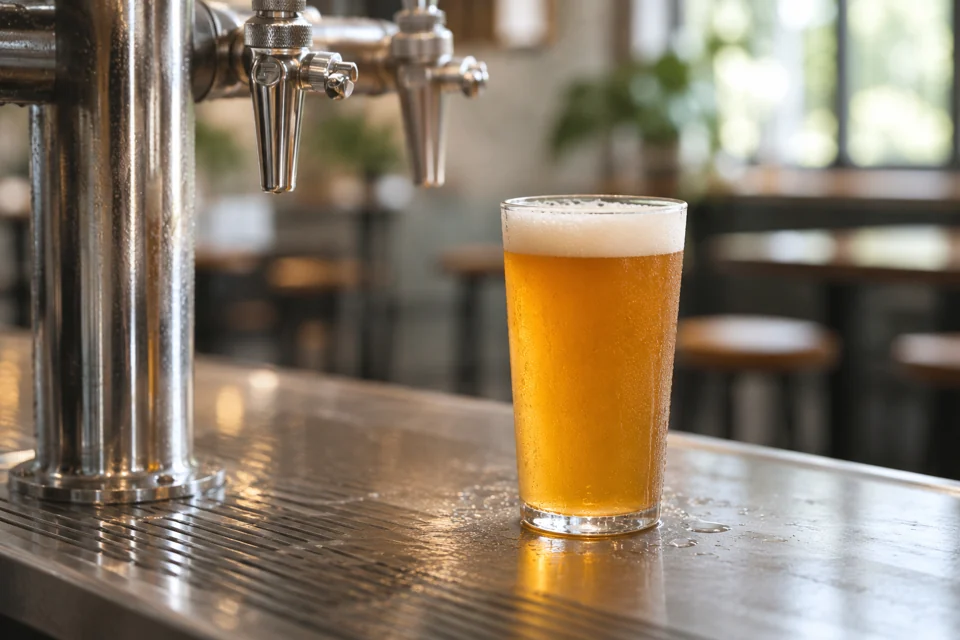
Australian pubs serve draught beer (beer poured from a tap) in glasses whose names change from state to state. A 285 ml glass is a middy in New South Wales (NSW) and Western Australia and a pot in Victoria and Tasmania. In the Northern Territory it is a handle, and in South Australia it is a schooner. A 425 ml glass is a schooner nearly everywhere else, and in South Australia it is called a pint. A 570 ml glass is the pint most visitors from the UK or Ireland already know.
The easy rule for a first trip: outside South Australia, ask for a schooner (425 ml) or a pint (570 ml) and you will be understood in every state. In South Australia, "schooner" gets you the smaller glass, so say "pint" if you want the larger one.
Glass size also decides how many standard drinks you have, which matters for Australia’s health guidelines and drink-driving limits.
The Glass Sizes and What They Hold
Australian draught beer comes in a handful of standard volumes. The names attached to them are the confusing part, so it helps to learn the volumes first.
| Name | Volume | Notes |
|---|---|---|
| Pony | 140 ml | Limited use; varies by venue |
| Seven / glass | 200 ml | Traditional Victorian pubs; Tasmania ("seven"); Melbourne ("glass") |
| Schmiddy | 350 ml | NSW only; introduced in the late 1990s |
| Middy / pot / handle / half-pint | 285 ml | Name depends on state |
| Schooner | 425 ml | Most states; 285 ml in South Australia |
| Pint | 570 ml | South Australia uses a 568 ml Imperial pint |
| Taster / flight | 90 to 120 ml | Craft breweries |
The 285 ml glass is the mainstay. The federal Department of Health’s Standard Drinks Guide calls it a "small glass" and calls the 425 ml glass a "large glass". Most beer poured in a pub is one of these two sizes. The Pot glass entry covers the history of the 285 ml measure, which is a half-pint in older imperial terms (an imperial pint is about 570 ml, so half of it is about 285 ml).
At the small end, the pony (140 ml) is a tiny pour that some venues stock. The 200 ml "seven" or "glass" appears in Victoria and Tasmania, and it suits a drinker who wants one quick, cold beer on a hot afternoon without ordering a full glass. The Melbourne "glass" is the same size under a different name, so do not assume it means a full-sized serve when you order it in a traditional Victorian pub.
The 350 ml schmiddy sits between a middy and a schooner. According to Stone and Wood’s guide to Australian beer sizes, it is found only in NSW. It arrived in the late 1990s and has not caught on widely, so a bartender in Sydney will understand it but most locals will order a middy or a schooner instead.
Craft breweries add another category. A taster is a small pour of 90 to 120 ml, and a flight is a row of several tasters on a paddle or tray. A flight lets you try a brewery’s range without buying a full glass of each beer. Flights are common in taprooms in every capital city and many regional towns.

A standard pint in most of the country is 570 ml, which matches the imperial pint used in the UK. Pints are less common than schooners in everyday drinking, and many pubs pour them mainly for tourists and for beer styles that suit a bigger glass. If a pub lists beers by size on a board, you will often see the middy and schooner prices side by side, and the pint appears only at venues with an Irish or British leaning.
What to Order in Each State and Territory
The volumes above hold steady across the country. The names are what shift. The table below lists what to say in each jurisdiction for the two most common glasses.
| State / Territory | 285 ml glass | 425 ml glass | Other notes |
|---|---|---|---|
| NSW | Middy | Schooner | Pint (570 ml); schmiddy (350 ml) |
| Victoria | Pot | Schooner | Pint; seven or glass (200 ml) in traditional pubs |
| Queensland | Middy or pot | Schooner | Pint |
| Western Australia | Middy | Schooner | Pint |
| South Australia | Schooner | Pint | Imperial pint (568 ml) |
| Tasmania | Pot | Schooner | Seven (200 ml) |
| Northern Territory | Handle | Schooner | Pint |
| ACT | Middy or half-pint | Schooner | Half-pint is more common in UK-influenced venues |
Brews News’s guide to ordering a beer in Australia gives the same broad picture, and Stone and Wood describes Queensland’s names as largely the same as NSW. In practice, Queensland pubs use both "middy" and "pot" for the 285 ml glass, and either one gets you the right serve.
The South Australia exception
South Australia is the one place where the usual word for a glass changes size. A schooner there is the 285 ml glass that the rest of the country calls a middy, pot or handle. The 425 ml glass that interstate visitors call a schooner is a pint in Adelaide. A traveller who arrives from Melbourne and asks for "a schooner" will get a smaller beer than expected, and one who asks for "a pint" in Sydney will get a bigger one.
South Australia also has the 568 ml "Imperial pint", which is the full-size pint found in other states. If you want that bigger pour in Adelaide, ask for an Imperial pint by name, because a plain "pint" gets you the 425 ml serve. A bartender will usually clarify, but you save a round of questions by being specific.
Practical ordering rules
Outside South Australia, "schooner" is the safest word. It works in NSW, Victoria, Queensland, Western Australia, Tasmania, the Northern Territory and the ACT. It gives you 425 ml, a size that suits most drinkers on a first visit. If you prefer a smaller glass so your beer stays cold, use the local word for the 285 ml serve. That is "middy" in Sydney, Perth and Brisbane, and "pot" in Melbourne and Hobart. In Darwin it is "handle".
Say the beer name along with the size. Most pubs have a row of taps, and "a schooner of Victoria Bitter" or "a middy of the pale ale" leaves no room for confusion. If a bartender asks "schooner or pot?" they are offering two sizes, and either answer works.
Bottles and cans sidestep the whole system. A bottle or can is typically 375 ml, which the Department of Health lists at 1.4 standard drinks for a 4.8% beer, so it sits between a middy and a schooner in alcohol terms.
Standard Drinks: What a Glass Contains
Australian health guidance counts alcohol in standard drinks. A standard drink holds 10 grams of pure alcohol, and the Department of Health’s Standard Drinks Guide lists the figures for common pub serves. At 4.8% alcohol by volume, which is a typical full-strength lager:
- A 285 ml glass holds 1.1 standard drinks.
- A 425 ml glass holds 1.6 standard drinks.
- A 375 ml bottle or can holds 1.4 standard drinks.
These numbers matter because many people assume one glass equals one drink. A schooner of full-strength beer is already more than one and a half, so three schooners in an evening come to nearly five standard drinks. The Flinders University knowledgebase covers the same definition in more detail.
The guideline limits
Healthdirect, citing the Australian Guidelines, says healthy adults should have no more than 10 standard drinks a week and no more than 4 on any one day. A visitor who has three schooners of full-strength beer on a single night has already gone past the daily figure of 4. The guidelines come from the National Health and Medical Research Council.
Strength changes the count
The figures above assume 4.8%. Craft beers often run higher, and the standard-drink count rises with the strength. A 425 ml schooner of a strong India pale ale or a stout holds noticeably more alcohol than a lager of the same volume. The percentage is printed on the tap handle, the menu board or the can, so check it before you choose a size. When you cannot find it, ask the bar staff what they are serving.
For a first-time visitor, this is the practical reason the small glasses are useful. Hot weather, long afternoons at the pub and the custom of buying rounds all push drinking up. A middy or pot helps you keep the beer cold and the count down. Tasters and flights at a brewery give you variety in volumes of 90 to 120 ml, so a flight of four beers is well under two standard drinks at typical strengths.
Australian venues also sell a fair amount of low-alcohol and zero-alcohol beer. If you are driving or pacing yourself, ordering one of those in a schooner keeps you in the round without adding to your count. The shouting custom, covered below, does not require everyone to drink the same thing.
Drink-Driving Limits for Visitors
Pubs in most Australian towns are not on a train line, and a rental car makes it easy to forget that the legal blood alcohol limit is low. Blood alcohol concentration (BAC) is the concentration of alcohol in a person’s blood. For a full licence holder, the limit is 0.05 in every state and territory, according to CarExpert’s explainer on the legal limit for drink driving.
Two or three schooners in an hour can put a person over 0.05, and the exact figure depends on body weight, food and timing. A 425 ml full-strength schooner is already 1.6 standard drinks. The safe plan is to leave the car at the accommodation and use a taxi, a rideshare or public transport on any night you intend to drink.
Zero-alcohol groups
Learner drivers and provisional drivers (P1 and P2) must have a BAC of zero in every state and territory, as Australian Breathalyser’s legal-limits page sets out. That includes drivers with an alcohol interlock condition on their licence, a device that stops the car starting if the driver has been drinking. In Queensland, a supervisor sitting beside a learner driver is also held to zero.
Professional drivers face stricter limits than the general 0.05, and the details differ by state:
- NSW: under 0.02 for buses, coaches, taxis, rideshare, vehicles over 13.9 tonnes and dangerous-goods vehicles. The NSW Government page covers the rules, and NSW is the only jurisdiction with an under-0.02 tier for professionals.
- Victoria: zero for trucks over 4.5 tonnes, buses, commercial passenger vehicles including taxis, and driving instructors, according to Transport for Victoria.
- Queensland: zero for heavy trucks, large buses, taxis and rideshare on duty, and driver trainers, per the Queensland Government.
- Other jurisdictions: Western Australia, South Australia, Tasmania, the ACT and the Northern Territory also apply zero to commercial and heavy-vehicle drivers, with different weight thresholds. The WA Road Safety Commission, Tasmania’s Road Safety Advisory Council, ACT City Services and the Northern Territory Government each publish their own lists.
A visitor who drives a taxi or a tour bus is unlikely, but anyone who joins a work trip or a volunteer driving job should check the state page first. Penalties for exceeding the limit change often and differ by state, so confirm current amounts with the state road authority before you rely on any figure.
Age, ID and the Rules Inside the Pub
The legal age to buy or drink alcohol in a licensed venue is 18 across Australia. Bar staff must check ID or evidence of age, and, as SBS reports, responsible-service policies require venues to ask for ID from anyone who looks under 25. A visitor in their late twenties may still be asked. Carry your passport or a photo licence, and hand it over without fuss.
Under-18s cannot be sold alcohol at licensed venues. They may drink at private premises under the supervision of a parent or guardian. In NSW, a person under 18 caught with liquor in a public place without a responsible adult or a reasonable excuse can have it seized, with a maximum fine of $20, according to the Alcohol laws of Australia entry.
Responsible service and refusals
Every person who serves alcohol in Australia works under responsible service of alcohol (RSA) rules, a licensing requirement that teaches staff to refuse service to intoxicated people and minors. The Northern Territory Government’s RSA page shows how this works in one jurisdiction: anyone serving alcohol in an NT venue must hold a valid RSA certificate and must complete the course within 7 days of starting work. Other states run their own versions.
If a bartender thinks you are drunk, they will refuse the next drink. Arguing will not change that. Venues must refuse service to anyone under 18 or intoxicated, and a licensee who breaks the rules risks the licence. Accept the refusal, ask for water and move on.
Public drinking and councils
Rules about drinking in public vary by state, territory and local council. Many councils, including many Sydney suburbs, declare alcohol-free zones, and those zones are often set for four years and renewed each September. A bottle of wine on a park bench is fine in one suburb and banned in the next. Look for signs at the edge of parks, beaches and shopping strips, and expect police or rangers to confiscate open bottles where a ban applies.
Closing times and last drinks
Trading hours differ by state and venue licence, and they have changed several times in recent years. Wikipedia’s Alcohol laws of Australia entry reports that NSW removed its remaining lockout conditions, including a 3:30 am last-drinks rule, in January 2026 after a review by Liquor & Gaming NSW. A venue’s own licence still sets its closing time, so check with the pub or the state regulator for the night you plan to go.
In Victoria, a 2024 hospitality training workbook says customers get 30 minutes after closing to finish drinks they have already bought. Bottle shops keep different hours from pubs. The Western Australian liquor licensing page lists liquor store hours as 8:00 am to 10:00 pm Monday to Saturday and 10:00 am to 10:00 pm on Sunday, which means you buy takeaway cans and bottles earlier in the evening than you can drink at the bar.
Pub Etiquette: Shouting, Ordering and Tipping
Australian pubs run on a few unwritten customs, and the most important one is the round. Buying a round is called "shouting", and it works like this: one person in the group buys drinks for everyone, and the others take their turn afterwards. The Round of drinks entry describes the custom across English-speaking countries. A guide to the unwritten rules of an Aussie pub warns against accepting drinks with no intention of buying a round in return, and that matches the general expectation that everyone contributes.
If you join a group of locals, expect someone to ask what you are having. Say yes, then shout your own round when the glasses run low. If the group is large and you only plan to stay for one drink, say so early and buy yours separately. Otherwise, you are expected to stay until your turn comes round.
Ordering at the bar
Order drinks and food at the bar rather than waiting at a table. Most pubs have no waiter service for drinks. When a server brings food to your table, the order was usually placed at the bar or through a table number system. Stand at the bar, make eye contact, and wait your turn. Bar staff serve in the order people arrived, and waving money or shouting looks rude. When the bartender gets to you, name the beer and the size, and pay on the spot or open a tab if the venue allows it.
Saying no
Declining a drink is normal in Australian social life. According to NewLife in Australia’s party and nightlife etiquette, nobody is expected to justify it. You can take a lemon, lime and bitters or a zero-alcohol beer and still take part in the round. If you are the driver for the night, say so once and people will move on.
Tipping
Tipping is not expected in Australian pubs. Staff are paid a wage, and a tip jar at the bar, if there is one, is optional. At restaurants, a tip of 5 to 10% for good service is appreciated but not required, and cafés and takeaway counters do not usually expect anything. Mike Gravel’s do’s and don’ts for Australia makes the same point for visitors used to the American tipping system. If a bartender has been especially helpful, buying them a drink or leaving a few coins is a friendly gesture, but nobody will chase you for it.
Behaviour at the venue
Treat the bar staff’s decisions as final. If a bartender refuses service, tells you to leave or asks you to move a group on, comply quietly. Pubs in Australia are social spaces for all ages during the day, and many serve families at lunch and early dinner, so loud or aggressive behaviour gets noticed quickly. Dress codes are casual in most pubs, though some venues ask for closed footwear after dark.
Key Takeaways
- Order a schooner or a pint outside South Australia. A schooner (425 ml) is understood in every other state and territory, and a pint (570 ml) gets you a larger glass.
- Check the name in South Australia. A schooner there is the 285 ml glass and a pint is 425 ml, so ask for an Imperial pint if you want the full 568 ml.
- Count standard drinks by glass size. A 425 ml schooner of 4.8% beer is 1.6 standard drinks, and the guideline for healthy adults is no more than 4 in a day.
- Skip driving after drinking. The limit is 0.05 BAC for full licences. Learner and provisional drivers must be at zero, and many professional drivers must be at zero or near it.
- Carry photo ID and take your turn at shouting. The drinking age is 18, venues check anyone who looks under 25, and you buy a round when it is your turn. Tipping is not expected.