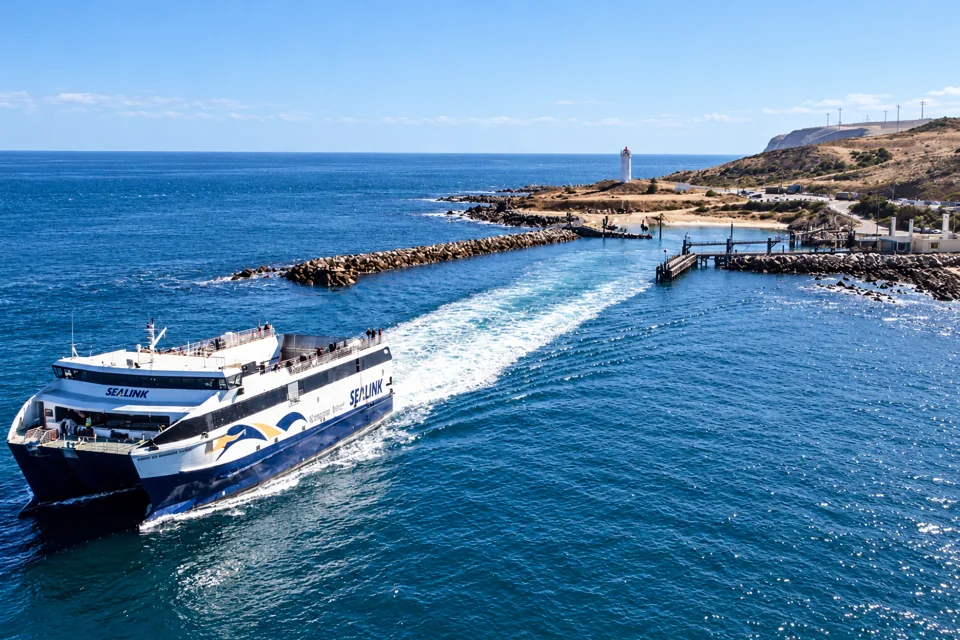
Australia has no national ferry booking system. Each service sets its own tickets and check-in deadlines. It also sets its own luggage rules and weather policies, and fares come from a state government or a private operator. A Sydney Harbour commuter ferry paid for with a bank card has almost nothing in common with the overnight Spirit of Tasmania crossing of Bass Strait, which you book months ahead with a car. A rule that matters on one route does not apply on the next.
First-time visitors most often meet six services: the Spirit of Tasmania between Melbourne and Devonport, Sydney Ferries on the harbour, Brisbane’s CityCats on the river, the SeaLink ferry from Cape Jervis to Kangaroo Island in South Australia, the Rottnest Island ferries from Perth and Fremantle in Western Australia, and the Bruny Island ferry south of Hobart in Tasmania. For each one, the same six questions apply. Which ticket do you need, and when must you check in? How much luggage can you take, and when does the boat leave? What happens in bad weather, and how do you reach the terminal?
Two terms come up repeatedly. "Check-in" is the stage where the operator confirms your booking and issues a boarding pass, and most long-distance services close it well before the boat leaves. A "walk-on" passenger travels without a vehicle, while a "vehicle passenger" brings a car, campervan or motorbike aboard. Fares and timetables change often, so treat every dollar figure below as a guide and confirm it on the operator’s own page before you book.
Choose the right ferry ticket
The right ticket depends on the route, because each operator sells a different product. Long-distance and island services sell fixed tickets for a passenger, a vehicle or both. City services charge by distance and let you tap on and off with a card.
Spirit of Tasmania
The Spirit of Tasmania sells fares in tiers, including Flexi, Spirit and Red Hot. The fare conditions page sets out how each tier handles cancellations and online amendments, and what changes cost. Cheaper tiers carry stricter conditions, so decide how likely your plans are to shift before picking the lowest price. Prices change with season and demand, so check the live fare page instead of relying on memory or another website.
Sydney Ferries
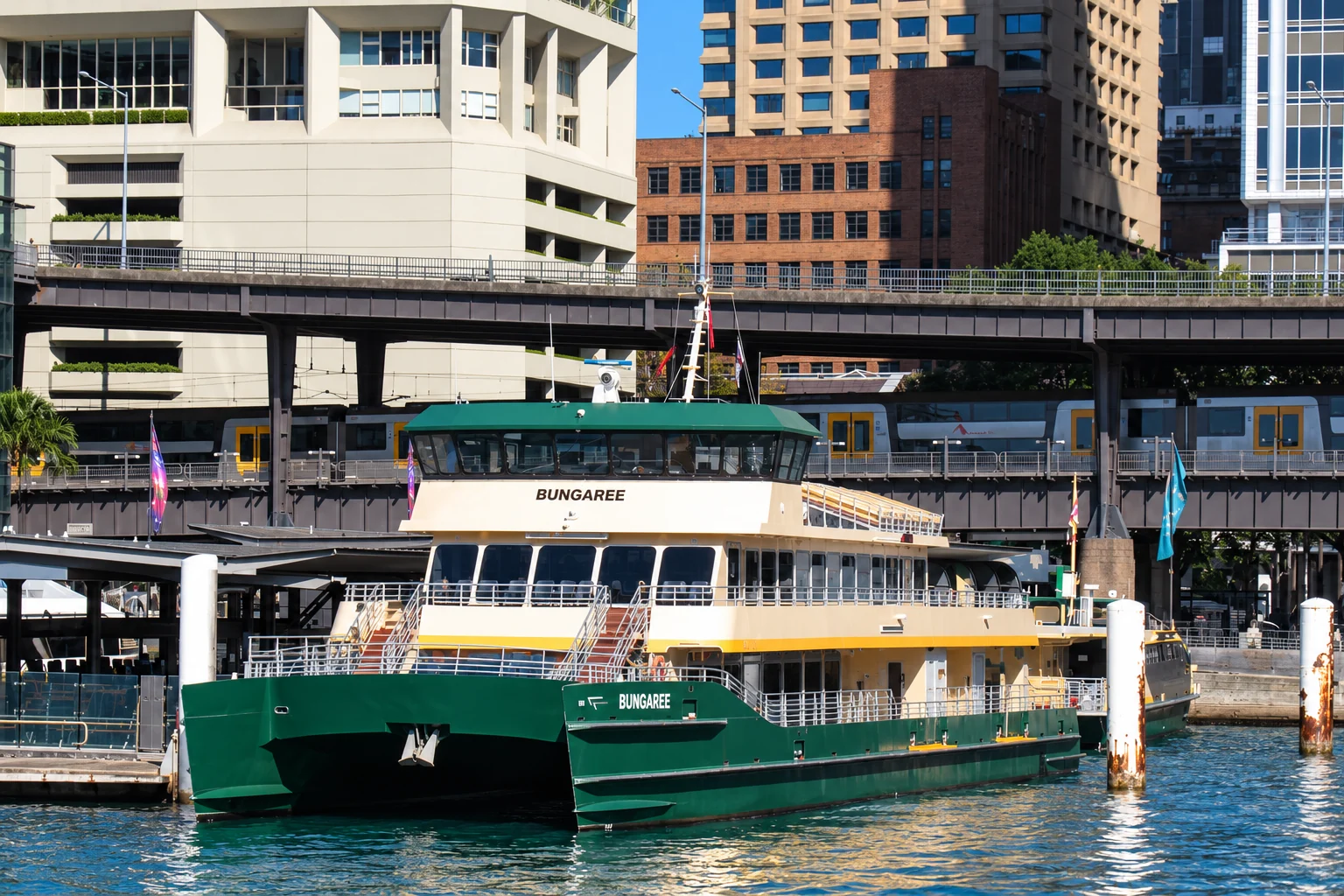
Sydney Ferries accept Opal (the NSW public transport card) and contactless bank cards, so a visitor can tap on with a credit or debit card and skip buying a separate card. The figures below come from the IPART fact sheet on Opal fares from 14 July 2025, which reproduces the Transport for NSW tables. Confirm them on the Transport for NSW fares page, since adult fares are reviewed each year.
| Adult fare | With Opal or contactless | Single-trip ticket |
|---|---|---|
| Ferry, up to 9 km | $7.35 | $8.80 |
| Ferry, over 9 km | $9.20 | $11.00 |
| Stockton ferry (Newcastle), peak | $3.30 | $4.00 |
Daily caps limit what you spend. An adult pays no more than $19.30 from Monday to Thursday, and $9.65 on Fridays, Saturdays, Sundays and public holidays. The weekly cap is $50.00, and an adult transfer discount of $2 applies when you change between services. The cheap weekend cap makes a Saturday or Sunday the best day for a few harbour trips. Private harbour cruise operators sit outside this system and sell their own tickets.
Brisbane CityCat
Brisbane’s river ferries run on TransLink, South East Queensland’s public transport network, and use the go card. Virgin Australia’s Brisbane guide lists a refundable deposit of $10 for an adult card and $5 for a child, concession or senior card, and says paper tickets cannot be bought on board a bus, train or ferry. The same guide describes a flat 50 cent fare across TransLink zones, and Orbit Remit’s public transport guide dates that flat fare to early 2026. Check the current fare and the card name on the TransLink website, because the go card is due to be replaced by a new Translink card.
Kangaroo Island
SeaLink’s Kangaroo Island fares page listed prices valid to 31 March 2026, so those figures are out of date and serve only as a rough scale. They put an adult one-way ticket at $49, a concession or student ticket at $39, a child aged 3 to 14 at $25.50, and infants aged 0 to 2 free. A car, campervan or motorhome up to 5 m cost $99 one way, rising to $112 for 5.1 to 5.9 m and $144 above 6 m. A motorbike cost $38, a bicycle or surfboard $13, and a single kayak $17.50. The driver pays a passenger fare in addition to the vehicle fare, and prices vary with demand and travel time. Online booking covers vehicles up to 5.9 m within the stated limits. Larger vehicles need a call to 13 13 01 or an email, and measurements must include bike racks and bull-bars.
Rottnest Island and Bruny Island
Three operators run Rottnest Island ferries: Rottnest Express, SeaLink and Rottnest Fast Ferries. The Rottnest Island Authority says the island admission fee is built into the ferry fare at booking, and the operator collects it on the Authority’s behalf, so there is no separate payment on arrival.
Island Connections runs the Bruny Island ferry, formerly operated by SeaLink. All tickets are return fares, and the homepage quotes them from $58.60 per vehicle. A pre-purchased ticket is valid for the next available ferry rather than a set departure, and you can also buy at the Kettering terminal when you arrive.
Check in by the operator’s deadline
Check-in deadlines are strictest on the Spirit of Tasmania, where a missed cut-off means you do not sail. They are much looser on the short island crossings, where operators recommend arriving about 30 minutes ahead.

Spirit of Tasmania
The operator’s two published statements disagree. The FAQ page says check-in opens well before the scheduled departure on all sailings and closes strictly 45 minutes before. The sailing schedule says check-in opens in a different window before departure, and asks passengers with special needs to arrive at least 2 hours before. Arrive early. Your booking confirmation gives the times that apply to your sailing. A passenger who arrives after check-in closes is not allowed to board.
Bring your e-ticket (the electronic ticket you receive by email) and photo ID. The FAQ names a driver’s licence as an accepted form of photo ID. If you need a Medical Alert Form, submit it at least 48 hours before departure.
Sailing day information on the operator’s site gives more detail on what happens at the terminal. With a car, allow extra time for the line of vehicles, because everyone arrives within the same check-in window.
Kangaroo Island
SeaLink strongly recommends pre-booking. At the Cape Jervis terminal, you give a booking reference or surname and receive a boarding pass for each passenger, plus one for the vehicle and driver. Plan Kangaroo Island advises checking in at least 30 minutes before departure. Summer and school holidays fill vehicle spaces first, so book a car space well before you leave home.
Rottnest Island
The Rottnest Island Authority recommends reaching the terminal at least 30 minutes before departure. That time covers parking, labelling and loading luggage and equipment, and collecting tickets. If you carry no luggage or freight and hold an e-ticket or QR code, you can go straight to the boarding gate. Overnight guests and anyone who has hired equipment check in at the ticket office, and luggage labels can be arranged in advance or on the day.
Bruny Island
Bruny Island has no check-in step in the same sense. Because pre-purchased tickets are valid for the next available ferry, you drive to Kettering, join the queue and board when your turn comes. In peak periods the queue, not a booking cut-off, decides when you cross.
Check ferry luggage limits
Luggage limits depend on whether you bring a vehicle, and the Spirit of Tasmania has the most detailed rules. Every operator restricts dangerous goods, and operators set their own rules for bikes and sports equipment.
Spirit of Tasmania
The preparing for sailing page sets different rules for vehicle and walk-on passengers. A vehicle passenger may take one carry-on bag or suitcase to the cabin or passenger decks, and it should hold personal toiletries, medication and clothing. All other luggage stays in the vehicle for the crossing, and the vehicle decks are closed during the voyage. Pack the night bag before you reach the terminal, because you cannot return to the car once you have boarded.
A walk-on passenger can check in two bags or suitcases and also carry one on board. The carry-on is one medium bag or suitcase up to 66 cm x 46.5 cm x 27.5 cm, with no weight restriction. The Spirit of Tasmania also publishes no weight limits for carry-on bags.
Alcohol cannot go onto passenger decks. Keep it in the vehicle or check it with your luggage. Dangerous goods are restricted, and the operator links its policy from the same page.
Tasmanian biosecurity rules sit outside the operator’s luggage policy but affect what you pack. Tasmania restricts bringing plants (including fruit and vegetables), honey and fish products into the state, so finish your fresh produce in Victoria or check the Tasmanian rules before you pack the esky.
Kangaroo Island
SeaLink asks you to lock luggage in the vehicle and take only essentials to the passenger deck. Travellers with no vehicle can leave bags in the SeaLink luggage van beside the terminal and collect them on arrival. The van excludes dangerous goods and freight. Lock the vehicle, because the traveller is responsible for any bag left loose on the car deck.
Rottnest Island
Rules depend on which of the three operators you book. The Authority says bikes, SCUBA gear, surfboards, kayaks and stand-up paddleboards are generally welcome, subject to each provider’s rules. Size and weight limits apply to delivery of luggage between the ferry and island accommodation, and overweight items may attract charges. Rottnest Fast Ferries includes standard luggage in the fare and charges a small extra fee to carry bicycles. Bike space is limited, so book early if you plan to bring your own instead of hiring one on the island.
Check the sailing timetable
Timetables differ by route in how often boats run and how often the schedule changes. Bruny Island runs a frequent shuttle, the Spirit of Tasmania runs on fixed sailing times, and the Rottnest services vary by season.
Spirit of Tasmania
The sailing schedule lists departure and arrival times along with check-in requirements. It is the page to check when you plan the days either side of the crossing, such as hotel nights or a hire car pick-up. Because the vessels sail overnight on many services, confirm whether you arrive in the morning, and allow time to clear the terminal and the biosecurity checks.
Bruny Island
Island Connections runs ferries from Kettering every 20 minutes between 6.10 am and 7.00 pm, and the crossing takes 20 minutes. From Monday 28 September 2026, the ferry runs its summer timetable, which applies through the warmer months. The service has a live ferry status page, worth opening on the morning you travel. Kettering is about 40 minutes’ drive south of Hobart, so factor that into your departure time. Plan your day around the final sailing from the island, since the last departure is your way back to the mainland.
Rottnest Island
The Authority sends visitors to the operators for times. SeaLink’s Rottnest timetable carries tables for 2026 and 2027 and states that timetables are subject to change without notice. Rottnest Fast Ferries runs daily from Hillarys Boat Harbour, with two to three or more departures and returns a day depending on season and day of the week. A day trip needs a return sailing that leaves enough island time, so look at the last departure from Thomson Bay before you choose your outbound boat.
Kangaroo Island
SeaLink runs the ferry daily except Christmas Day, and the crossing takes about 45 minutes according to Plan Kangaroo Island. The terminal opens from 8.00 am to 7.00 pm at Cape Jervis, subject to seasonal departures, and from 7.30 am to 7.30 pm daily at Penneshaw. The company publishes a ferry status page for the day of travel.
Allow for weather and disruption
Ferries cross open water, and operators cancel or delay sailings in poor conditions. Bass Strait and other open-sea routes carry the most risk. Sheltered river and harbour services carry the least.
What the Spirit of Tasmania says
The conditions of carriage state that severe weather or sea conditions can cause a service to be cancelled or delayed. If a sailing is delayed, the operator sends updates to your mobile phone, so keep your phone charged and check your messages before you leave for the terminal. Give your correct mobile number when you book. Flexible fares matter most in this situation, because they set how easily you can move your booking to another sailing. Leave a buffer in your itinerary, such as not booking a non-refundable tour or flight for the morning you arrive.
Consumer guarantees
The ACCC (Australian Competition and Consumer Commission), the national consumer regulator, says travel services within Australia carry consumer guarantees. Those guarantees include a requirement that services be provided within a reasonable time after a delay or cancellation. The ACCC’s examples are flights and tours. It also says a consumer may be entitled to a replacement travel service or a refund if a travel service is delayed or cancelled, depending on the circumstances. The ACCC does not resolve individual complaints about delayed or cancelled travel, but it accepts reports. Because its guidance covers travel services in general, read the operator’s own terms for ferry-specific remedies, and keep your booking confirmation and any delay messages as records.
Island services
On Rottnest Island, if all ferries are cancelled on the departure day, accommodation reservations staff contact guests and offer an alternative, according to the Authority. Booking conditions vary by operator, so a day-trip passenger should read the terms of the company they booked with.
Tours that depend on the ferry have their own cancellation rules. Pennicott’s Bruny Island Cruises, a tour operator and separate from the ferry, charges a 100% fee for cancellations within 24 hours of departure and 50% within 48 hours. Guests can switch to another day if the weather is unsuitable. If a ferry cancellation affects a tour booked separately, contact both companies early.
Plan transport to and from the ferry
Getting to the terminal is a separate task on every route. On some islands, the transport at the far end matters as much as the crossing.
Rottnest Island
Ferries leave from four mainland points, according to the Authority: Northport at Rous Head in North Fremantle, B Shed at Victoria Quay in Fremantle, Barrack Street Jetty in Perth city, and Hillarys Boat Harbour in the northern suburbs. Crossings take about 25 minutes from Fremantle, 45 minutes from Hillarys and 90 minutes from Barrack Street Jetty. SeaLink gives about 30 minutes from its Fremantle departure at O’Connor Landing, so confirm the terminal with your operator. Return ferries leave from the Main Jetty in Thomson Bay.
Parking is paid at Victoria Quay, with secure undercover parking on Henderson Street, and secure parking is available at Rous Head. Hillarys Boat Harbour offers free short-stay and overnight parking. Buses and trains stop near B Shed and Barrack Street Jetty, and buses on West Coast Drive serve Hillarys. At the time of writing, the Authority noted that ticket booths at Victoria Quay were temporarily on the east side of E Shed because of works at the B Shed terminal, so check the notice before you leave.
Kangaroo Island
Cape Jervis has secure car parking that opens before the first departure and closes after the last arrival from Penneshaw. Penneshaw has ticketed parking run by the Kangaroo Island Council. From Adelaide, the Link SA Route 1259 bus runs to Cape Jervis. On the island, Peninsula Coaches has run a shuttle between Penneshaw and Kingscote since 1 October 2023 (phone 08 8821 2755).
The island has no public transport, and ShopBack’s ferry guide, citing SeaLink, says taxis and Uber are also unavailable. Walk-on passengers need a hire car, a transfer or a tour arranged before they arrive. If vehicle space on the ferry is full, SeaLink suggests hiring a car at Penneshaw or Kingscote instead. For a late departure from the mainland, fill the tank first, because the nearest open petrol station to Cape Jervis is at Aldinga, 64 km north.
Bruny Island and Sydney
Kettering, the Bruny Island departure point, is about 40 minutes’ drive south of Hobart. Australian Traveller reports a local bus to Kettering for passengers without a car, though the ferry crossing then leaves you on the island with no car, so check how you will get around before you commit.
In Sydney, the ferry is part of the public transport network. Tap on at the wharf with Opal or a contactless bank card, and your connecting bus, train or light rail trip counts toward the same daily cap, so a ferry leg costs little extra when you are already travelling around the city.
Key Takeaways
- Check each operator’s live page before booking: Australia has no national ferry system, and fares, timetables and rules differ by route and change often. Kangaroo Island’s published fares were valid only to 31 March 2026, and Sydney’s latest fare schedule is dated 14 July 2025.
- Arrive at the Spirit of Tasmania terminal early: The operator’s FAQ and timetable page give different check-in windows, and check-in closes 45 minutes before departure. Read your own booking confirmation and carry photo ID.
- Pack a separate overnight bag for Bass Strait: Vehicle passengers may take one carry-on of up to 66 cm x 46.5 cm x 27.5 cm on board, and everything else stays locked in the vehicle. Alcohol must stay out of passenger decks.
- Tap on with a bank card in Sydney and use the weekend cap: Adult ferry travel is capped at $9.65 a day on Fridays, Saturdays, Sundays and public holidays, and $19.30 from Monday to Thursday.
- Arrange transport on the island before you cross: Kangaroo Island has no public transport, taxis or Uber, so walk-on passengers need a hire car, transfer or tour booked in advance.
- Keep records for weather disruption: Operators can cancel or delay for severe weather, and the ACCC says consumers may be entitled to a replacement service or refund depending on the circumstances.